Sunday, October 10, 2010

La Maison d'Eglantine, Séguret

If you are a regular reader of Our House in Provence blog, you probably know that Séguret is a very pretty village located about two km northeast of Sablet.

As you can see in the picture, Séguret is elevated above the vineyards that separate the two villages and stretches in a narrow band across the hill.

Wife Shirley's favorite morning walk is to head out on the path through the vineyards up to Séguret and then walk through the village before heading back to Sablet on the connecting road.


We have been to Séguret many times, starting with our first visit to Sablet as that is where the immobilier (realtor) who introduced us to our home in Sablet has his office.

We have eaten in several restaurants including Le Mesclun, checked out the art gallery, and visited the santon maker but somehow we had missed La Maison d'Eglantine.

That is we missed it until my friend Cherry and her daughter Kirsten spent two weeks in Sablet and posted pictures on Facebook and talked about the charming café where they ate in Séguret.


Cherry said the café serves déjeuner - lunch so Shirley and I decided to try it out. We found La Maison d'Eglantine on a narrow cobblestone street in the center of Séguret.

The café entrance has Salon de Thé (tea room) inscribed on a sign above the door.


We stepped down into La Maison d'Eglantine and were greeted by monsieur and shown to a small dining room with wood beams on the ceiling and rough stone walls at the back of the cafe.


The dining room was empty so we chose a table in front of a narrow window with a gorgeous view across the vineyards to Sablet.


Lunch options besides the various baked goods the café sells are limited. On this day, the options were a cheese tart and pissaladière, a pizza-like dish with caramelized onions, anchovies and olives, served with a vegetarian salad.

We decided to try one of each and a glass of chilled rosé from the region. While monsieur tends to the front of the café and takes your order, madame cooks upstairs and then brings the food downstairs to your table.

Generous portions of the simply prepared tart and pissaladière were brought out along with a bowl of the salad for us to share. It was a perfect lunch for a hot day.


The café also sells glaces - ice cream, and we both chose a trio of different flavors to try; my trio included dark chocolate, coffee and hazelnut.


Shirley chose chocolate, coffee and orange ice creams.


Before long, we were joined by other diners including this couple with their dog.


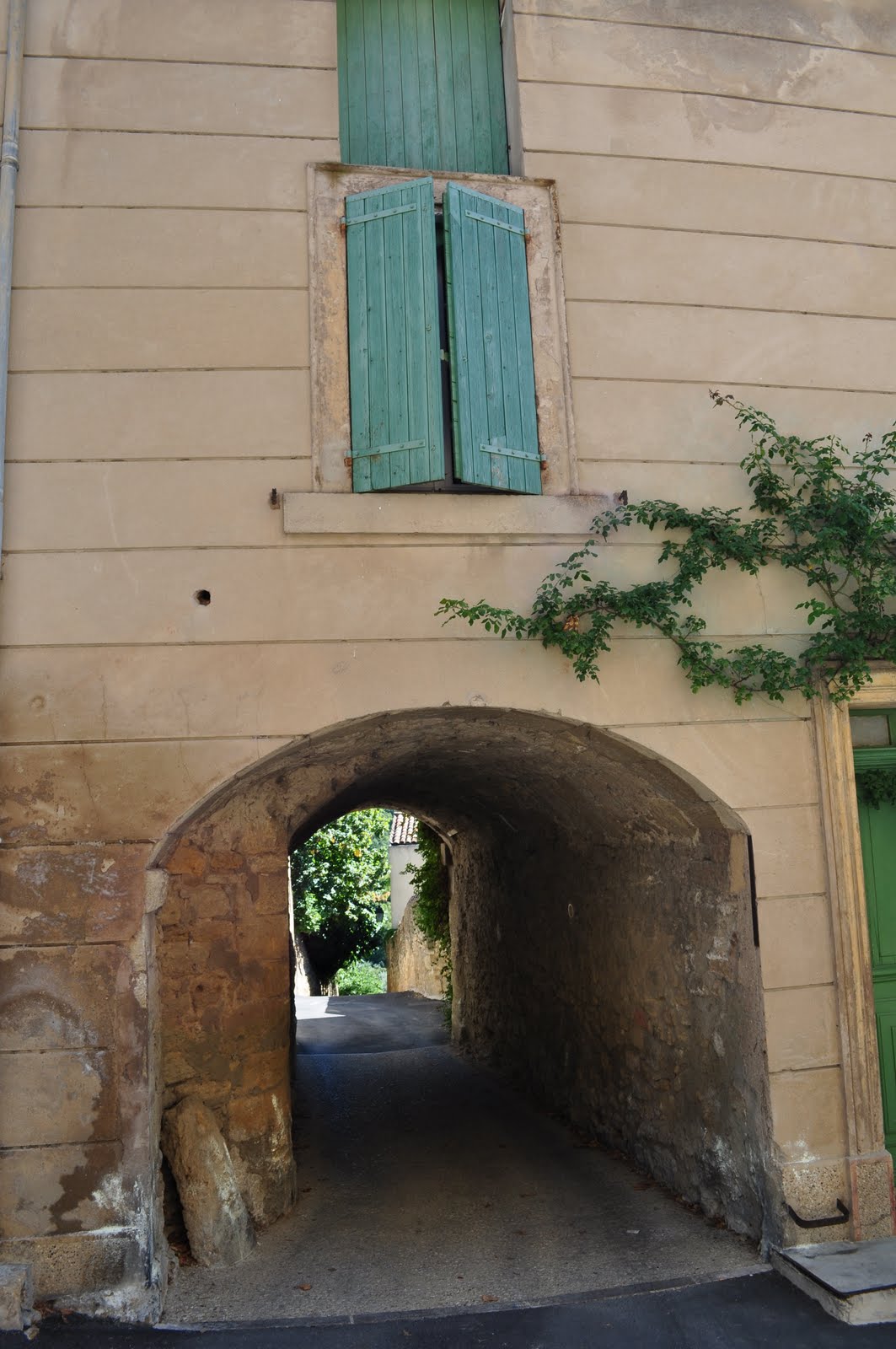
If you drive to Séguret, you have to park your car in the parking lot located at the entrance to the village as Séguret is restricted to pedestrians-only. It is a short walk up the hill through the arched portail into Séguret.

Wednesday, October 6, 2010

Mont Ventoux, Giant of Provence

There is so much beauty, history, good food and wine within 90 minutes of Sablet that we have not yet seen or tasted. We are hardly in a rut but we return frequently to the same places because we usually have visitors and we take them to our favorite and the most renowned spots in Provence.

This fall we didn't have visitors and wife Shirley and I agreed that we would go to some different villages, eat in different restaurants and see new sights. When we have visitors, we don't go to places where we have not been because we want our friends to see the best of Provence.

One of the most prominent sights in the Vaucluse, that's our part of Provence, is the 6,266 foot high white-capped peak of Mont Ventoux visible from miles away across the countryside. Since we had never been to the top of Mont Ventoux we decided to drive up one day after lunch.


We had been to the base of Mont Ventoux at Bédoin to watch the peloton arrive from the start in Montélimar and begin the climb up to the summit during the 20th stage of the 2009 Tour de France.

We have had several guests ride bikes to the summit but we were definitely not in shape to attempt this feat so we headed to the top in our car.

There are three ways to get to the top of Mont Ventoux:

* East from Sault up 3,970 feet over 16.1 miles. This is the easiest route for road racing enthusiasts;

* North-west from Malaucène up 5,151 feet over 13.3 miles;

* South from Bédoin up 5,305 feet over 13.5 miles. This is the most famous and difficult ascent. The road to the summit has an average gradient of 7.43%.

Since we had eaten lunch in the village of Puyméras northwest of Mont Ventoux, we decided to drive up Mont Ventoux by way of Malaucène and come down by way of Bédoin.


The first few miles of our ascent was past fields of lavender but unfortunately, the lavender had already been cut. After the lavender fields, the road wound its way through forests of pines and other trees, with picnic tables sitting amongst the trees here and there off the road.

On the north-side, Mont Ventoux borders the Drôme Department and you can see the Alps on a clear day. Mont Ventoux is the largest mountain in the region and is nicknamed the "Giant of Provence".


As the name suggests (venteux means windy in French), it can be very windy at the summit especially if the Mistral is blowing. Wind speeds as high as 300 km (200 mph) have been recorded and the wind blows at 90+ km (56+ mph) 240 days a year.


The top of Mont Ventoux is bare limestone without vegetation or trees which makes the mountain's peak appear from a distance to be snow-capped all year long.


Mont Ventoux stands alone to the north of the Luberon range and just 16 km to the east of the Dentelles de Montmirail, its foothills, which stand over Sablet (the village where we have our home).


The view from the top is superb.


Mont Ventoux is well known as one of the most gruelling climbs on the Tour de France. A climb up Mont Ventoux has been a stage on the Tour fourteen times since 1951; the peloton has raced to finish at the summit eight times and crossed over the summit to a finish in a town below six times.

Except for the first ascent in 1951 when the approach to the summit was from Malaucène, in all other years the approach to the summit has been from Bédoin.


There is small ski area called Chalet Reynard part way up Mont Ventoux. High winds and low elevation limit the number of days the ski area is open to the public.


Twice a year in Provence, sheep are transferred between low-land pastures and mountain meadows. In the summer, the movement towards the mountain destinations begins in June. When the first snows begin in October, the flocks begin their descent back to the winter pastures in the low-lands.

One of the mountains that sheep are brought to is Mont Ventoux. I am sure there was a shepherd or two with sheep dogs in the distance tending this flock of sheep we encountered on our descent.


Each sheep was marked with a different color or symbol so the shepards know who own the sheep.


We encountered a large number of bikers of all ages dressed in colorful spandex outfits pedaling their way up and down from the top of Mont Ventoux. After driving up to the summit, we have renewed appreciation for the amateurs and professional riders who zip up and down.

Monday, October 4, 2010

Geneva, Switzerland

We travel to Provence from California either by plane to Paris then take the TGV (Train à Grande Vitesse - high-speed train) to Avignon's TGV station or fly to Marseille. Usually, the latter is the least expensive and fastest way to get there.

I always check to see what it would cost to fly to other cities within a reasonable drive of our home in Sablet including Nice, Lyon and Geneva Switzerland in case there might be a less expensive way.

Up to now, flying to Marseille has been the best way to go. That is until last month when we discovered that we could save more than $300 each for Shirley and me if we flew to Geneva then drove three and one-half hours to Sablet. So that's what we decided to do.

We arrived early in the morning at the Geneva airport after an overnight flight. After waiting what seemed like an eternity to get through the line for customs, we took a short ride on the shuttle bus to the rental car lot, then drove away from the airport towards Lake Geneva.

It was a sunny day and we thought it would be fun to take a short stroll around downtown Geneva before we set off for our drive to Sablet. Geneva is the second most populated city of Switzerland (after Zurich), a financial center, and home to numerous international organizations including the Red Cross and World Health Organization.

As I said, it was early in the morning and the weekend, so we were able to easily find parking near Lake Geneva and this memorial recognizing the reunification of the Canton of Geneva with the Swiss Federation.


A symbol of the Geneva watch industry, this flower clock is located at the edge of the Jardin Anglais (English Garden) near Lake Geneva. It is a beautiful combination of technology and floral art. The seconds hand of the clock is the largest in the world (it is more than 8 feet long).


My father Daniel wrote his doctoral dissertation about John Calvin, a protestant reformer who was based in Geneva during the 16th century. So its no big surprised to know that I wanted to see the Reformation Wall which is a monument to the reformation movement.

I have included a few pictures of our walk around Geneva.


We came upon a sunny square lined with cafes, several with outdoor seating around a pretty fountain where the servers were already busy on this beautiful morning.


Given that it had been several hours since we got off the plane and the light breakfast served before landing, we decided it was a good time for cappuccinos and croissants.

I have such good memories of eating little Japonais cakes, made of hazelnut meringue and chocolate butter cream in Switzerland many years ago, I couldn't resist buying one to have with my cappuccino. I swear one of the croissants was for Shirley.


The construction of the Reformation Wall began in 1909, the 400th anniversary of the birth of John Calvin and the 350th of the founding of the University of Geneva. The monument is backed against part of the ancient defensive walls that surrounded Geneva until the middle of the 19th century.

At the center of the wall, more than 16 feet high, are the four great figures of the movement: Guillaume Farel, one of the first to preach the Reformation in Geneva, Jean Calvin the "pope" of the reformers, Théodore de Bèze, first rector of the University and John Knox, founder of Presbyterianism in Scotland.


The administration building for the Canton of Geneva.


Part of St. Peter's Cathedral.


Cathédrale St-Pierre - St. Peter's Cathedral originally a Catholic cathedral became a protestant church in 1536.


The interior of St. Peter's Cathedral where John Calvin preached in the 16th century.


A narrow passageway we came upon as we were walking around Geneva.


Hotel Longemalle, one of many hotels located near Lake Geneva.


The Jet d'Eau has become the symbol of Geneva. Formerly a simple security valve at the Coulouvrenière hydraulic factory, in 1951, the Jet d'Eau was provided with an autonomous pumping station that propels 132 gallons of water per second to a height of 460 feet at a speed of 200 km per hour.


Geneva is situated in a very pretty place under the towering Salève Mountain which rises almost 4,600 feet over the City and at the place where the Rhone River leaves Lake Geneva for its almost 500 mile journey to the Mediterranean Sea.

The drive from Geneva to Sablet was easy and we would fly into Geneva again if the price was right.

Saturday, September 25, 2010

Cassis

I think you know Cassis is one of our favorite towns in Provence. With its narrow streets, pastel colored houses and Provençal street names, Cassis is a charming blend of the Mediterranean Sea and Provence.

Thankfully, it's an easy drive of about 1 hour and 4o minutes from Sablet to Cassis. The picture perfect town is tucked into a curve of the coast along the Mediterranean Sea amidst the calanques - little coastal fjords, 20 kms east of Marseille.

Cassis is a small fishing port with 8,000 inhabitants. The port is filled with little fishing boats, yachts and a collection of tourist boats for visiting the calanques, something we still have yet to do.


Cape Canaille which stands over Cassis, is one of the highest cliffs of Europe at 399 meters (1,309 feet) above sea level and the highest cliff in France.


Frederick Mistral famously wrote in his poem Calendal “Qu'a vist Paris, se noun a vist Cassis, a ren vist”? (Those who have seen Paris but not Cassis, have seen nothing).


The port is lined with tourist shops, terrace cafés and restaurants, offering a variety of food and prices.


There are even more shops and restaurants on the little streets of the village away from the port.


We have tried a number of the restaurants along the port but except for being great for people-watching, we have yet to find one that has really good food.

If anyone has a restaurant(s) in Cassis to recommend, please share so we can try it out on our next visit which I am sure will be in the not too distant future.


At the outter most tip of the port stands the statue of Calendal. Calendal was a humble anchovy fisherman and hero of a work by poet Frédéric Mistral that recounts Calendal's exploits to win the heart of his true love. His memory is now honored by this statue made of Cassis stone.


Besides not having discovered any good restaurants yet in Cassis, the one bad thing is trying to find parking close to the port. Invariably, we've had to park quite a ways away and walk to the port.

The last time we were there, this plant was in full bloom around the parking lot where I (I drop off wife Shirley as close as I can to the port and then I go park) found an empty space.

A beautiful plant but don't know what it is despite my efforts to identify it. Anyone know?


We will return again and again to enjoy the beauty of Cassis and the surrounding area along with the wonderful white and rosé wines that are produced in the Cassis AOC.

Sunday, September 12, 2010

Ansouis, Luberon

We have been trying to visit all of the villages in the Vaucluse that are officially classified as a Plus Beaux Villages de France. The only village we have not visited is Ansouis which is in the southern part of the Vaucluse in the Luberon.

So each time before we leave for Provence, I dutifully print out directions from the Michelin web site for the shortest way to get to Ansouis from our home in Sablet thinking that this time we will finally make it there.

We think all of the Plus Beaux Villages de France in the Vaucluse are pretty but we wouldn't consider all of them to be the prettiest villages in the Vaucluse. There is a an extensive evaluation process to become a Plus Beaux Villages de France with two general criteria:

1. the village has to be small and the population can not exceed 2,000 inhabitants;

2. the village has to have at least 2 protected sites or monuments (either listed or registered on the list of historical monuments).

A few days ago, we decided to go explore Ansouis. Ansouis is located a little more than 100 km southeast of our home in Sablet between the Durance River and the foothills of the Luberon Mountains on a rocky slope crowned with a castle.


The sign as you enter Ansouis showing that the village is classified as a Plus Beaux Villages de France.


You enter into Ansouis through this pretty archway.


The Mairie - town hall is located right on the plane tree shaded village square.


Ansouis is well restored and has a number of little streets that are perfect for wandering during a visit.


The medieval chateau dating from the 12th century is located on the site of an old fortress. It has been privately owned for centuries. It is fairly stark from the outside.


One of several narrow passageways we discovered as we wandered around the village.


There is a beautiful clock tower dating from the 16th century topped with a campanile or bell tower built among the houses.


Wife Shirley enjoying one of the many beautiful views out in every direction from the village.


There are not many shops, always a disappointment to Shirley but there is a nice restaurant (which we will return to try on a future visit) and a terrace café


The beautiful interior of the 12th century Saint Martin's Church.


More beautiful views from the village.


Shirley taking a rest on one of the many walls that wander through the village.


Another passageway.


The monument to the children of Ansouis who died for France in WWI and WWII. Note the huge diference in numbers between the two wars: 32 dead in WWI and 2 in WWII.


The pretty gardens, terraces and views from the village make Ansouis a village worth visiting.