Showing posts with label Paris. Show all posts

Sunday, March 15, 2015

A visit to the spectacular gardens of the Palace of Versailles.

If you are regular readers of "Our House in Provence," you know we love Bruno Bordeaux, the charming proprietor of Café des Sports in Sablet. One day last spring, shortly before we were leaving for a sojourn in Sablet, we got an email from Sylvie, Bruno's sweet wife, saying they had something important to discuss with us.

A few days later we were sitting outside Café des Sports with Bruno and Sylvie and they told us their niece Mathilde, who was an engineering student, needed to spend 30 days doing volunteer work in an English speaking country. They wondered if we might be able to help her find a position and host her at our home.

Flash forward to October and we were back in Sablet. Mathilde spent the month of July with us doing volunteer work in the activities department including teaching a French class to the residents of Chancellor Place of Windsor, an assisted living community located a short distance from our home.

Since we were planning to return to California by way of Paris. Mathilde's parents graciously invited us to visit them at their home just outside of Paris in Versailles. As we were planning our rendezvous, they asked if we had any interest in visiting the Palace of Versailles. So as agreed, they picked us up at our hotel and headed out to their home and to the Palace of Versailles and gardens.

The Palace of Versailles is a royal château in Versailles in the Île-de-France region of France. When the palace was built, Versailles was a country village; today, however, it is a wealthy suburb of Paris, some 20 kilometers southwest of the French capital.

The court of Versailles was the center of political power in France from 1682, when Louis XIV moved from Paris, until the royal family was forced to return to the capital in October 1789 after the beginning of the French Revolution.

View of the Palace of Versailles from the City of Versailles

The Royal Stables were reopened as the Academy of Equestrian Arts in 2003. The huge stables were once home to 600 of the king’s horses. This equestrian school combines instruction of equestrian knowledge and practice of other disciplines such as fencing, dance, singing and Kyudo (traditional Japanese archery).

Academy of Equestrian Arts

In 1816 Louis XVIII commissioned an equestrian statue of Louis XV for Place de la Concord in Paris. The horse was sculpted by Pierre Cartellier. In the end Louis XIV was seated on the horse, sculpted by Louis Petitot, Cartellier’s son-in-law, and set in front of the Palace of Versailles. The proportions of the statues of horse and the king are slightly different.

Equestrian statue of Louis XIV in front of the Palace of Versailles

The Versailles palace and surrounding gardens were commissioned by King Louis XIV and took almost 50 years to construct. At one time, almost 2200 men were employed on the project. By 1682, construction was finished and Louis XIV moved the royal court to Versailles, where all French monarchs lived until the revolution, and the city of Versailles became the unofficial capital of the Kingdom of France.

Visitor entrance to Palace of Versailles

The Grand Canal is the most original creation of André Le Nôtre who transformed the east-west perspective into a long light-filled sheet of water. The work took eleven years, from 1668 to 1679. The Grand Canal which is 5479 feet long, was the setting for numerous nautical spectacles and many types of craft were sailed on it.

In 1669, Louis XIV ordered rowing boats and reduced models of ships. In 1674, the Republic of Venice sent the King two gondolas and four gondoliers who lodged in a suite of buildings at the head of the Canal, since then known as Little Venice. In the summer the King’s fleet sailed along it, while skates and sleighs whizzed over the frozen water of the Grand Canal in winter.

The Grand Canal

The Pièce d’Eau des Suisses is named for the Swiss Guard who excavated the lake in 1678 in an area filled with marshes and ponds, some of which had been used to supply water for the fountains in the garden. This water feature, with a surface area of more than 37 acres, is the second largest, after the Grand Canal, at Versailles.

The Orangerie in the gardens of the Palace of Versailles with the Pièce d’Eau des Suisses in the background

The Orangerie was built by Jules Hardouin-Mansart between 1684 and 1686 to replace the small orangerie built by Le Vau in 1663, it consists of a central vaulted gallery 150 meters long, prolonged by two side galleries located under the stairways of the Cent-Marches. The building is lit by large windows.

The Orangerie and Parterre

The Orangerie Parterre covers more than 7 acres. In the reign of Louis XIV it was decorated with sculptures now housed in the Louvre Museum. Consisting of six sections of lawn and a circular pool, in the summer it features 1,055 trees in boxes, including palm trees, oleanders, pomegranate trees, eugenias and orange trees that spend the winter inside the building.

The Orangerie and Parterre

The arch and the Palace of Versailles

As you can see below, you can rent golf carts to visit the gardens if you don't wish to walk. We didn't think we needed the carts but as you will see later, we changed our minds.

Palace of Versailles

The Queen's Grove replaced the Labyrinth with illustrations of thirty-nine Aesop fables with lead animals in fountains painted in natural colors. Built in 1669 after an idea of the tale-teller Charles Perrault, it was destroyed during the replanting of the gardens in 1775-1776, and replaced by the Queen’s Grove. The present sculpted plantings was installed in the late 19th century.

The Queen's Grove

The Temple of Love, which the queen could see from her room in Petit Trianon, was erected by Richard Mique in 1778 in neo-classical style. Built entirely out of marble, this building is especially notable for the quality of the sculptures by Deschamps which adorn its Corinthian capitals, its friezes and the inside of its dome.

"Temple of Love" in the garden of the Petit Trianon

This exceptional quality is due to the fact that it was supposed to house a recognized masterpiece of French sculpture, Cupid cutting his bow from the Club of Hercules by Bouchardon whose original, now on display at the Louvre, was replaced by a replica by Mouchy, another 18th century sculptor.

Shirley and I at the Temple of Love

Although Madame de Pompadour, who wished to “relieve the king’s boredom”, was the instigator of this small palace that Gabriel built in the 1760s, it is the memory of Marie-Antoinette that hangs over Petit Trianon. In 1774, Louis XVI offered the Trianon estate to the Queen who was able to live away – too far away for some – from the Court.

Petit Trianon

Marie-Antoinette, seeking to flee the Court of Versailles, ordered the construction of her hamlet in 1783. There, she regularly found the charms of country life, surrounded by her lady's companions. It became a veritable farm, directed by a farmer, whose products supplied the kitchens of the Palace.

No sooner had the garden around Petit Trianon been finished than Marie-Antoinette began thinking about creating another, as an extension towards Saint-Anthony’s gate. Between 1783 and 1787, the Hamlet was created in the spirit of a true Norman village, with eleven houses spread out around the Big lake. Five of them were reserved for the use of the Queen and her guests: the Queen’s House, Billiard Room, Boudoir, Mill and Refreshments Dairy.

Hamlet of Marie-Antoinette

The Queen's House is the most important building of the Hamlet. In fact, it is composed of two separate buildings joined by a wooden gallery, decorated with white and blue earthenware flowerpots with Marie-Antoinette’s monogram. On the right, the Queen’s House itself, the ground floor comprised of a dining room and a games room, while the first floor was made up of a large living room, a small living room and a Chinese room.

On the left, the Billiard Room, the ground floor comprised of a billiard room, and a private apartment on the first floor. From the top of the gallery, the lady of Trianon, wearing a simple white muslin dress and a straw hat, could oversee the work being done in the fields.

The Queen's House

Built at the edge of the lake and on a forebay, the Mill and its wheel were used to grind the grain, and also had a washing-place. It was intended for the use of the village.

The Mill

With its roof of reeds, dormer window, its lean-to and old stone staircase, the Queen’s Small House, known as the boudoir, is made up of a living room and a wardrobe and is surrounded by a closed garden.

The Boudoir

The Grand Canal

A fountain was built here in 1636, under the reign of Louis XIII, which Louis XIV decorated with an impressive and celebrated group in gilded lead representing Apollo on his chariot. The work of Tuby, after a drawing by Le Brun, it is inspired by the legend of Apollo, the Sun God and emblem of the king. Tuby produced this monumental group between 1668 and 1670 at tapestry factory in Paris, and it was then transported to Versailles and installed and gilded the following year.

The Apollo Fountain with the Palace of Versailles in the background

King Louis XIV of France used fountains in the Gardens of Versailles to illustrate his power over nature. There were so many fountains at Versailles that it was impossible to have them all running at once; when Louis XIV made his promenades, his fountain-tenders turned on the fountains ahead of him and turned off those behind him.

Louis built an enormous pumping station, the Machine de Marly, with fourteen water wheels and 253 pumps to raise the water three hundred feet from the River Seine, and even attempted to divert the River Eure to provide water for his fountains, but the water supply was never enough.


The royal golden gate of the Palace of Versailles was finally restored in 2008, after being demolished during the French Revolution in 1789. It took over two years to replicate the original 260-ft. long gilded wrought iron fence and gate. 100,000 sheets of gold leaf were crafted onto fleur-de-lys designs, crowns, masks of Apollo, cornucopias and the crossed capital Ls representing the Sun King, Louis XIV.

The Royal Fence in front of the Palace of Versailles

We will have to return to Versailles some day to visit the interior of the palace. We spent the entire afternoon walking around the gardens. By the end of the day, we were exhausted from walking and Mathilde's father spotted a golf cart sitting unattended so we hijacked it and rode back to the palace and returned it to keepers of the golf carts.

Have a great week. Chat soon.

Thursday, December 9, 2010

My self-indulgent trip to Paris - Part 4

A week ago,I took a self-indulgent trip to Paris. After learning that I was short a few thousand miles to maintain my status as a 1K flyer with United Airlines, I packed my bags for a quick trip before the end of the year. I didn't have enough time to go to Sablet so I went to Paris; I flew on Thursday, arriving early Friday morning. My flight home was on Sunday afternoon.
After lunch at La Fontaine de Mars on Saturday, cousin Matthias and I walked to the Metro station and squeezed ourselves onto the crowded train and headed toward Place de la Bastille near where his apartment is located.

If you don't know, Place de la Bastille is a large square, where the Bastille prison stood until the 'Storming of the Bastille' and was later destroyed between July 14, 1789 and July 14, 1790 during the French Revolution. The square straddles 3 arrondissements of Paris, namely the 4th, 11th and 12th.

In the center of Place de la Bastille stands the July Column (Colonne de Juillet), which to my surprise doesn't commemorate the storming of the Bastille but rather the Trois Glorieuses, the "three glorious" days in July 1830 that saw the fall of Charles X of France and the start of the "July Monarchy" of Louis-Philippe.


I don't usually spend a lot of time visiting museums or art galleries as they typically bore me, but I accepted Matthias' invite to accompany him to meet his Sorbonne classmate Astrid at the Centre Pompidou and see the Arman exhibition.

As I found out, Arman was a leading figure of post-war art. A founding member of New Realism, a movement promoting new "ways of approaching the real", Arman made art from manufactured objects produced by the consumer society. In my opinion, it looked like art made from junk collected from garbage.

The view from Centre Pompidou's upper level down to the square below looked quite mystical in the waning light of the day.


We invited Astrid to eat dinner with us at Le Cochon à l'Oreille, another bistro included on Alexander Lobrano's list of 23 best Paris bistros. Being a typical girl, Astrid wouldn't go to dinner until she changed clothes (I thought she looked cute the way she was, but what do I know).

We met up, Astrid in her newly changed outfit, in front of Le Cochon à l'Oreille (the pig has the ear) on Rue Montmartre in the 1st arrondissement near Les Halles.


We walked into the tiny belle epoque dining room with its old zinc counter, antique pay telephone and wooden booths, all charming reminders of Les Halles' heyday as the City's celebrated food market.


One wall of the Bistro is covered with ceramic tiles that depict scenes of Les Halles' market in all its chaotic splendor.


Madame, we later found out she was the wife of the patron - owner, came over to greet us and check our names against her list of reservations. She told the waiter to seat us and he directed us to an empty booth. Before we got there, madame loudly rebuffed him saying that wouldn't work because it would be too difficult for us to get out of the booth after we finished eating.

The two got into a loud conversation including hand gesticulations pointing to the booth and then to me. This was not a discrete discussion about where to place a guest; no it was loud and it was clear it was me, not us, she was worried about. I was not offended in the least because it was so entertaining to watch.

Madame finished the argument by saying that yes, I could get into the booth no problem, but I wouldn't be able to get out after eating her food. So in the end, they pushed two round tables together in a corner and we sat there. We would have been fine in a booth but madame would have no part of that.

Matthias and Astrid sitting in our corner of the dining room. I thought they looked quite cozy but I was assured they are only friends and that Matthias has a girlfriend by the name of Aurelie.


The waiter propped the slate blackboard with the menu for the day on a nearby chair for us to consider. Astrid ordered the fillet and the waiter asked cuisson - doneness of the meat? Bien cuit - well done she replied; he said non mademoiselle, we will not serve the fillet bien cuit.

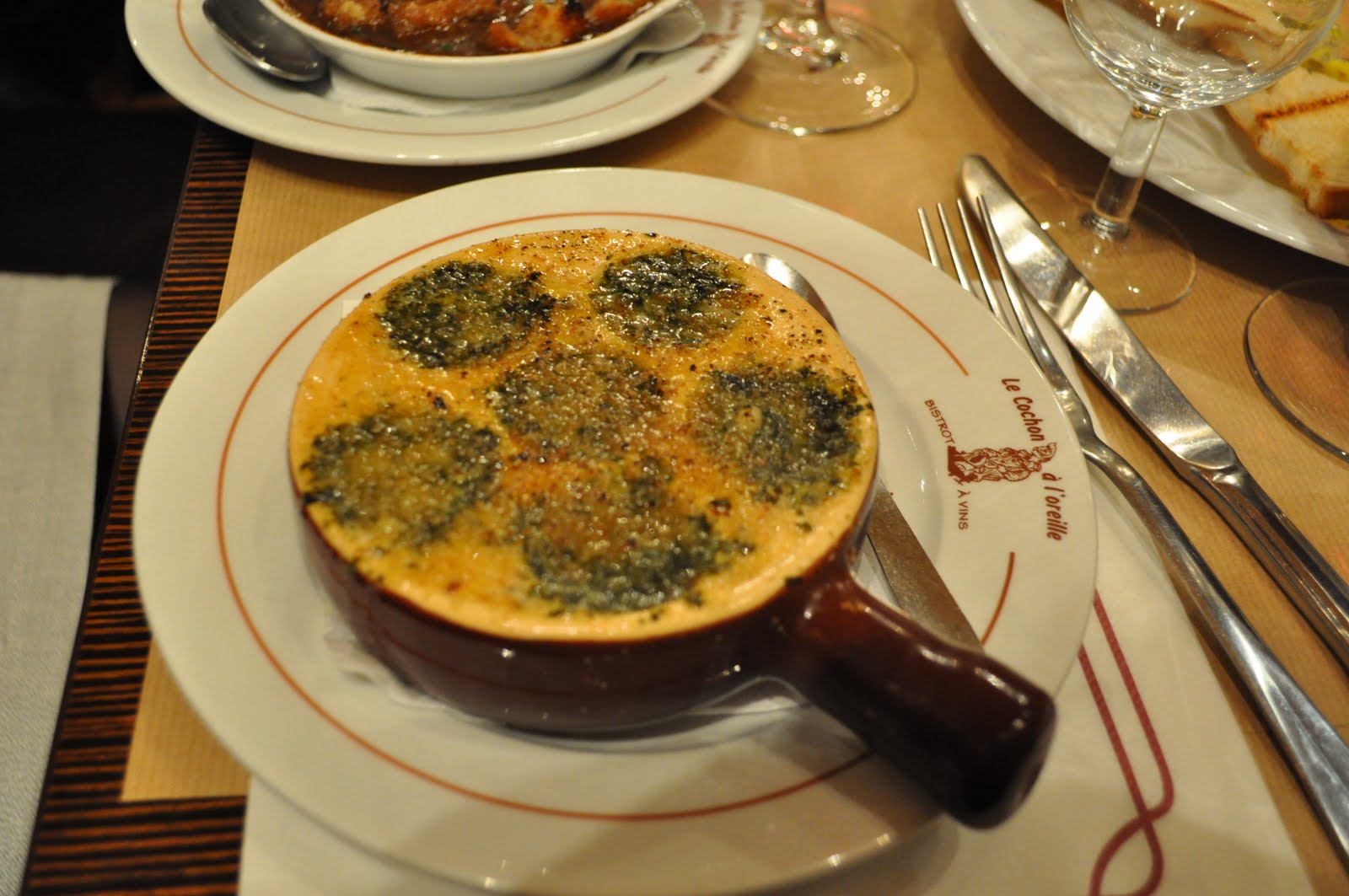
Our starters included escargots.


Oeuf en Meurette, poached egg in a rich reduction of red wine, stock, lardons and croutons.


Foie gras with toast.


Here we are at our "roomy" corner table. We ordered a bottle of the newly released Nouveau Beajolais to accompany our dinners.


For main course, instead of the fillet she originally ordered, Astrid chose the braised jarret d'agneau - lamb shank. It was tender and fell off the bone.


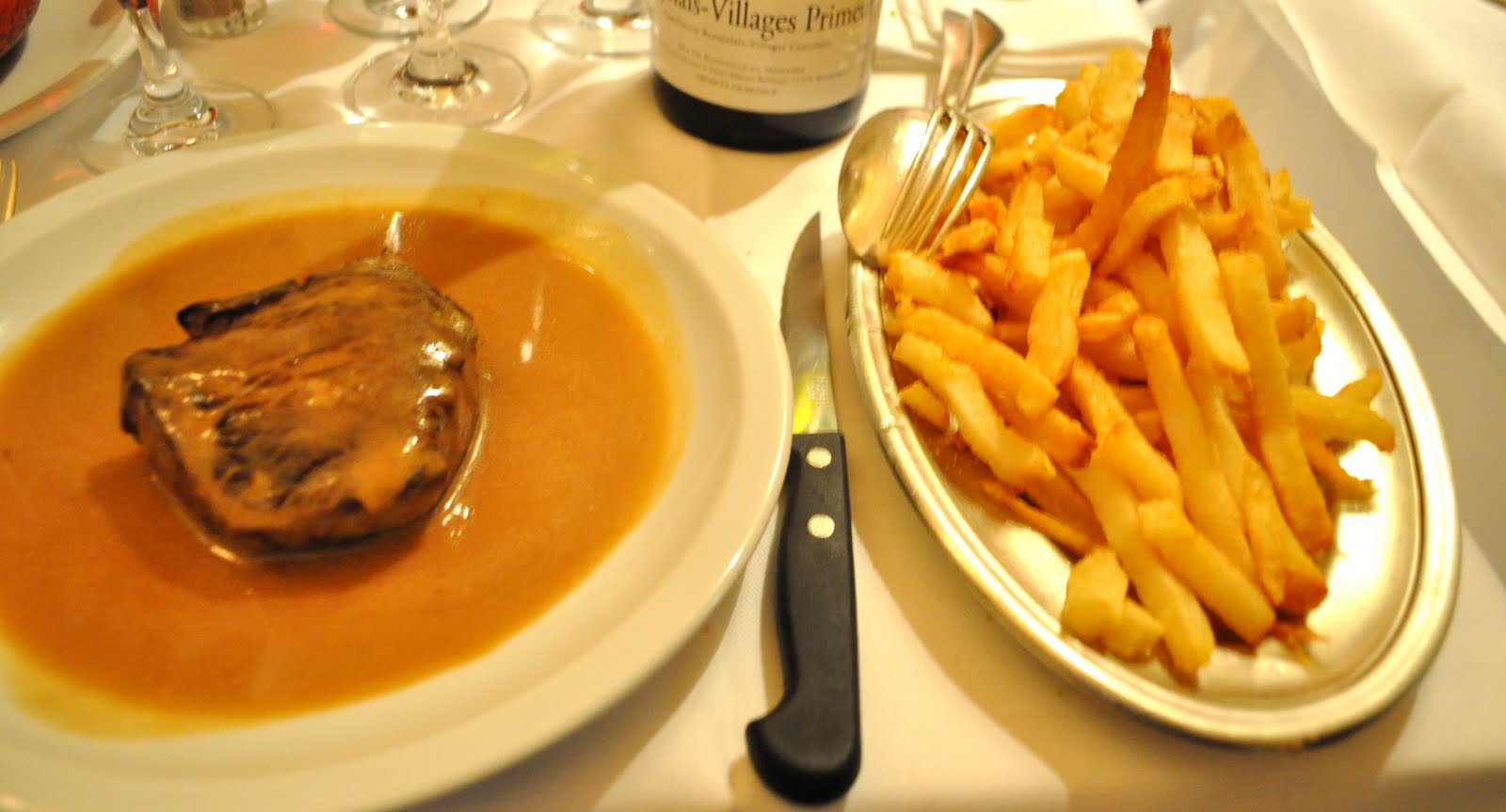
Steak au poivre and fries. I ordered "a point" and to my mind it was pretty close to rare but delicious. The fries were the best I have had in a long time. Delicious and perfectly crispy.


Fillet au poivre with more of those delicious fries.


For dessert, we chose a chocolate pot de creme.


And two tarte aux raisins - raisin tarts. First time, I have ever had a raisin tart and I hope not the last.


After dinner, we walked out to the street. We did la bise - exchanged kisses on alternating cheeks and Matthias and Astrid headed to the Metro station to go home and I grabbed a taxi to go back to my hotel.

Sunday morning, my self-indulgent weekend in Paris coming to an end, I grabbed a taxi to the airport. It was pouring rain! I had a great weekend, good food, wine and weather plus I had a chance to spend time with Matthias. I am sure this won't be the last self-indulgent trip I make to Paris.

Thursday, December 2, 2010

My self-indulgent trip to Paris - Part 3

I woke up Saturday morning in Paris and discovered it was a beautiful sunny day, a little unusual for late November in Paris and opposite from what the taxi driver had told me to expect as we drove into Paris from the airport the day before.

When cousin Matthias and I separated after dinner at A la Biche au Bois the night before, he to his apartment near Place de la Bastille and me back to my hotel near Boulevard du Montparnasse, we agreed to meet up for lunch.

He was going to sleep in and I was going to take a walk and shop for children's clothes. Daughters Tricia and Stephanie love French children's clothing stores, especially Le Petit Bateau, and I had promised to bring love-gifts for Avery, Dylan, Caedon and baby Madison.

Based on Alexander Lobrano's article in the November issue of Saveur Magazine entitled The 23 Best Bistros in Paris, I decided we were going to eat lunch at La Fontaine de Mars in the 7th arrondisesement not too far from the Eiffel Tower. I Googled and found that there was a Le Petit Bateau located on the way to the restaurant. So off I went.

My walk to the area where the restaurant is located took me past Les Invalides. The Les Invalides buildings house the Musée de l'Armée, the military museum of the French Army, a couple of other museums, as well as the burial site for some of France's war heroes, notably Napoleon Bonaparte. You can see what a beautiful day it was in this picture of Les Invalides.


I was headed towards the Eiffel Tower located on the Champ de Mars. For those who don't know, the Eiffel Tower is the tallest building in Paris and it is the most-visited paid monument in the world. Named for its designer, engineer Gustave Eiffel, the tower was built as the entrance arch to the 1889 World's Fair.


I was in no hurry, it was sunny and warm and it was several hours yet before I was to meet Matthias for lunch. So I took my time, looking through windows and wandering in and out of stores that looked interesting including La Grande Epicerie du Bon Marché.

Not living in Paris, I have no idea if there are better food emporiums. I am quite sure there are less expensive places to shop for food but La Grande Epicerie du Bon Marché seems like foodie heaven to me. I would be happy to have a store like that within a 100 miles of where we live.

I found Le Petit Bateau store and walked-in. I buy clothes to bring back for our grand kids every time I am in France but I swear it is such an intimidating experience to walk into stores like Le Petit Bateau or Catimini. Invariably, I am the only man in the store and it seems like every eye is on me wondering what I am up to.

As I said, my daughters love the clothes from Le Petit Bateau but they are, especially Stephanie, very picky about what clothes their children wear. So not being sure of what tops and bottoms coordinated together or sizes, I was happy when a friendly young lady came over and offered her assistance.

With her help, I found cute outfits for all four kids including the outfits being modeled by Avery 4 and Caedon 2 in the picture below. Hey, I did quite well, don't you think?


I arrived at La Fontaine de Mars which is located at the intersection of Rue Saint-Dominique and Rue de l'Exposition, right on time. As I was walking in, Matthias called and said he had overslept but was on his way and would be there as soon as he could. I should have planned for this because Matthias is notorious for being late. Oh well, c'est la vie.

La Fontaine de Mars has been in this spot since 1908. The Bistro was operated by three families in succession until the current owners took over in 1991.


I was seated at a table in one of several small dining rooms near the open kitchen and bar and asked if I would like an aperitif to enjoy while I looked over the menu. Since I had to wait for Matthias, I ordered a glass of sparkling rosé.


Since there were not many diners in the Bistro, a server struck up a conversation with me. When he found out I was an American, he pointed to the sign and offered that President Obama had eaten in the Bistro with his daughters; he got the gigot d'agneau - leg of lamb.

The sign was actually a reprint from La Dépêche, a daily newspaper from Southwest France which said "Obama A Dîner Chez Une Tarbaise". I asked the waiter if that meant the owner was from Tarbes, the area where Tarbais beans are cultivated. He said yes, and with that I knew I was going to order the cassoulet.


Matthias arrived and the waiter took our orders. He started with a deep fried poached egg served over spinach with a saffron sauce. He let me have a taste; I had never eaten or seen an egg preparation like this but it was really good and I want to try it at our Bistro Des Copains.


I ordered the house made duck foie gras. As you would expect from a restaurant whose roots are in Southwest France, the foie gras was delicious.


The server brought out a large cassole filled with steaming cassoulet and ladled out a large serving on my plate. It was rich, aromatic with a big piece of sausage, duck and those wonderful Tarbais white beans. It was so delicious that I gladly took a second helping of this wonderful dish.

It was the best cassoulet I have eaten since Le Languedoc in Carcassonne several years ago. The thing missing from both of these cassoulets was well-browned crust on top because they were ladled out on plates. But I digress.


For his plat - main course, Matthias chose the Poisson du Jour à l'Ardoise - fish of the day as listed on the blackboard which on this day was monk fish in a bourride type sauce.


We were quite full after our meals so we decided to share a rich dark chocolate cake with mandarin sorbet. It was a perfect way to finish.


I highly recommend dining at La Fontaine de Mars if you are in Paris; I will definitely return. Check back to read the final installment about my self-indulgent trip to Paris.

Tuesday, November 30, 2010

My self-indulgent trip to Paris, Part 2

After finishing lunch at Allard, I walked back down rue St. André des Arts to nearby Metro station Saint Michel and got on the six-car train heading south toward Porte d'Orléans and Metro station Vavin near A la Villa des Artistes to see if my room was ready.

Thankfully it was, so I rode the tiny elevator to the second floor. I walked into the typically (for Paris) small but very well appointed room and dropped my suit case and flopped face down on the bed. The next thing I remember, I heard a cell phone ringing (mine) and the number showed it was cousin Matthias.

Matthias -- a law student at the Sorbonne -- wouldn't be free until after 4:00 PM. I was in a sleep-fog and couldn't remember at that moment the name of the hotel, the street where the hotel was located or how to get there. I did recall that it was very close to Brasserie La Coupole so we agreed to meet-up in front of the restaurant on Boulevard Montparnasse.

I had not made reservations yet for dîner - dinner that night, so now being awake, I set about finding a good place to eat with Matthias. As I said in my previous post, I came to Paris with a list of bistros from Alexander Lobrano in the November issue of Saveur Magazine entitled The 23 Best Bistros in Paris and from David Leibowitz's blog.

As you might guess, being late Friday afternoon, I was told by several of the bistros that I called that they were complet - full for that night. I kept calling and my perseverance was rewarded with a reservation for 7:30 at A la Biche au Bois on Avenue Ledru Rollin in the 12th arrondisement.

At 6:30 Matthias called again and said he was a few minutes away from La Coupole. I grabbed my jacket and headed out, remembering to leave the key card for my room at the front desk as is customary in French hotels.

Matthias was already there when I got to La Coupole. I told him where we were going and he said it would be faster at that time of the evening to take the bus rather than ride the crowded Metro and change lines or crawl to our destination near Gare de Lyon in a taxi.

We arrived at A la Biche au Bois a few minutes before 7:30, which is when dinner service begins. A small crowd of people were already standing near the door waiting for the bistro to open. Since I heard primarily French being spoken, I thought that was probably a very good sign of things to come.


We were shown to a small table towards the back of the bistro near the bar. If you look closely at the picture below, you will see what looks like cabinet doors behind the cart with desserts on top. Those doors lead down ladder-stairs to the cave, or underground storage area for the bistro's wines.


Cousin Matthias at our table at A la Biche au Bois. Wife Shirley calls Matthias her "summer son" since he has come to spend time at our home in California every summer for the past 5 years to perfect his English, which is now very good.


We both ordered the 25,90 Euro four-course Petit Menu for dinner. As the name implies, A la Biche au Bois' specialty is game and wild fowl during the season.

The 2010 Nouveau Beaujolais had been uncorked in Paris for the first time the previous day to great fanfare so we decided to order a bottle of Beaujolais-Villages Primeur to drink with our meal.


When our starters were brought to the table, the server also put down a basket of sliced baguette pieces and toasts and a jar of crisp cornichons to accompany our starter dishes.

I chose the salade Périgourdine which came with a slice of house made foie gras for a 4,50 Euro supplement for my first course; a creamy delicious way to start dinner.


Matthias chose the starter of the day which was a house specialty, terrine de faisan - pheasant. It was also a very tasty dish.

The bistro filled up quickly and an American couple from Philadelphia of mixed-race, she caucasion and he black were squeezed into the small table next to us. We helped them with menu translation since they spoke little French and read none.

They ordered the same starters as Matthias and I and when their starters were brought out, they were given a very small dish of cornichons (not a jar like ours) and no toasts for their terrine and foie gras.

They immediately noticed and asked us why they didn't get the same. It was uncomfortable and I was not sure if it was due to their being obviously American or because of mixed race or purely accident. I hope it was the latter.


For his plat - main course, Matthias chose the coq au vin which was brought out to him in a large cast iron pot. There was enough so I could taste all I wanted. It was a rich, winey, delicious dish of braised chicken parts, potatoes, mushrooms and onions in a red wine sauce. The chicken was moist rather than dry and it was hands down the best coq au vin I have ever tasted.


I chose filet de boeuf poêlé au poivre - pan seared beef filet with peppercorn sauce accompanied by house made fries. The filet was tender and flavorful; the fries tasted very good but I would have preferred them to be a little more crispy.


We were already quite full so we skipped the cheese course and went straight for the desserts. Matthias chose île flottante - floating island, sometimes called œufs à la neige, served over crème anglaise - vanilla sauce. This is one of Matthias favorite desserts and he pronounced it very good.


To finish my wonderful meal, I chose the chocolate tart with crème anglaise.


This was a wonderful meal in a classic Parisian bistro and I would return happily the next time I am in Paris. I am indebted to David Leibowitz for his post about this wonderful bistro.

Check back to read my next installment about my self-indulgent trip to Paris in Part 3.