I told you about how I was going to Roquefort-sur-Soulzon to see where Roquefort cheese is produced when I came upon the most beautiful field of red coquelicots (poppies); As you know, I had to stop. A short time later and drive down the road beyond the field of coquelicots, I spotted Combalou Mountain where Roquefort-sur-Soulzon sits and where the cheese caves are located.
When you get to the roundabout with the iron shepherd and flock of sheep in the middle, make the turn and follow the signs to Roquefort-sur-Soulzon. Only one road goes up there and its hairpin turns straighten at the entrance to the town. Then the road squeezes between two rows of gray houses and becomes a steep main street.
The first time I remember hearing about Roquefort cheese is when we visited Meme and Pepe and the aunts and uncles at La Metairie Neuve, the family farm located about 15 km from Lacaune in Southeast Tarn. The farm is small and in a remote mountainous area. They had 80-100 Lacaune sheep, 12-20 cows, and a work horse. They raised chickens, ducks and pigeons and grew all their vegetables. That's me with Meme's sheep.
You see Meme's Lacaune sheep are a breed that originated near Lacaune and notably the milk of the Lacaune sheep is the only breed of sheep that can be used in the production of Roquefort cheese according to the AOC regulations of 1925. The sheep were milked twice a day, in the morning and again at night, yielding 1 to 4 liters a day. Meme looking to see where her prized sheep have wandered off to.
La Metairie Neuve is located 70 km southwest of Roquefort-sur-Soulzon and AOC regulations require that all the milk for Roquefort cheese be produced within 100 km of Roquefort. The Roquefort Société fromagerie, the largest producer in Roquefort, dispatched a truck every day during the lactation period (November to July) to collect the sheep's milk from the farm. I loved to listen to Meme tell stories about when she was a young girl.
Milk from Meme's sheep ended up here at the top of the village at the Roquefort Société fromagerie which was established back in 1863. If the street seems deserted, it's because activity in Roquefort is mostly underground.
Before our group went down into the cave for our tour, our guide reminded us that it is cold and damp in the caves, the temperature is a constant 50 degrees and humidity is 90%. Once we were in the first cave, we see green light streaming out of tunnels called fleurines. Moisture is so thick that it oozes on the walls and ceilings.
Fleurines are natural tunnels in the rock mass and run from the caves to the side of the mountain. The contrast in temperature between the inside and outside of the caves causes drafts of cold, moisture-laden air to blow into the caves both in winter and summer. The hotter it is outside, the stronger the current. The tunnels have been fitted with windows and doors that can be opened or closed to control the temperature and humidity inside the caves.
The cave we visit is 11 stories high and there are fleurines on every level. This is where Société 1863 is produced. We are told that this cave can hold as many as 300,000 loaves of cheese at a time. Société fromagerie has a total of 15 caves. Each cave is unique in terms of size and shape, type of rock, ventilation and with the help of Penicillium Roqueforti, each cave produces its own highly characteristic Roquefort cheese.
Another fleurine. You can see in this fleurine that spotlights have led to growth of different plants such as moss, lichen and bracken by providing the light these plants need for photosynthesis.
Penicillium Roqueforti is added to the sheep's milk at the dairy to make sure there is even distribution of the spores. Three strains of Penicillium Roqueforti are grown on sourdough bread made with a mixture of rye and wheat flour. Once the bread has molded away completely, the penicillium is collected and divided into doses. Société fromagerie is the only company in Roquefort that produces all the penicillium added to its cheese on site.
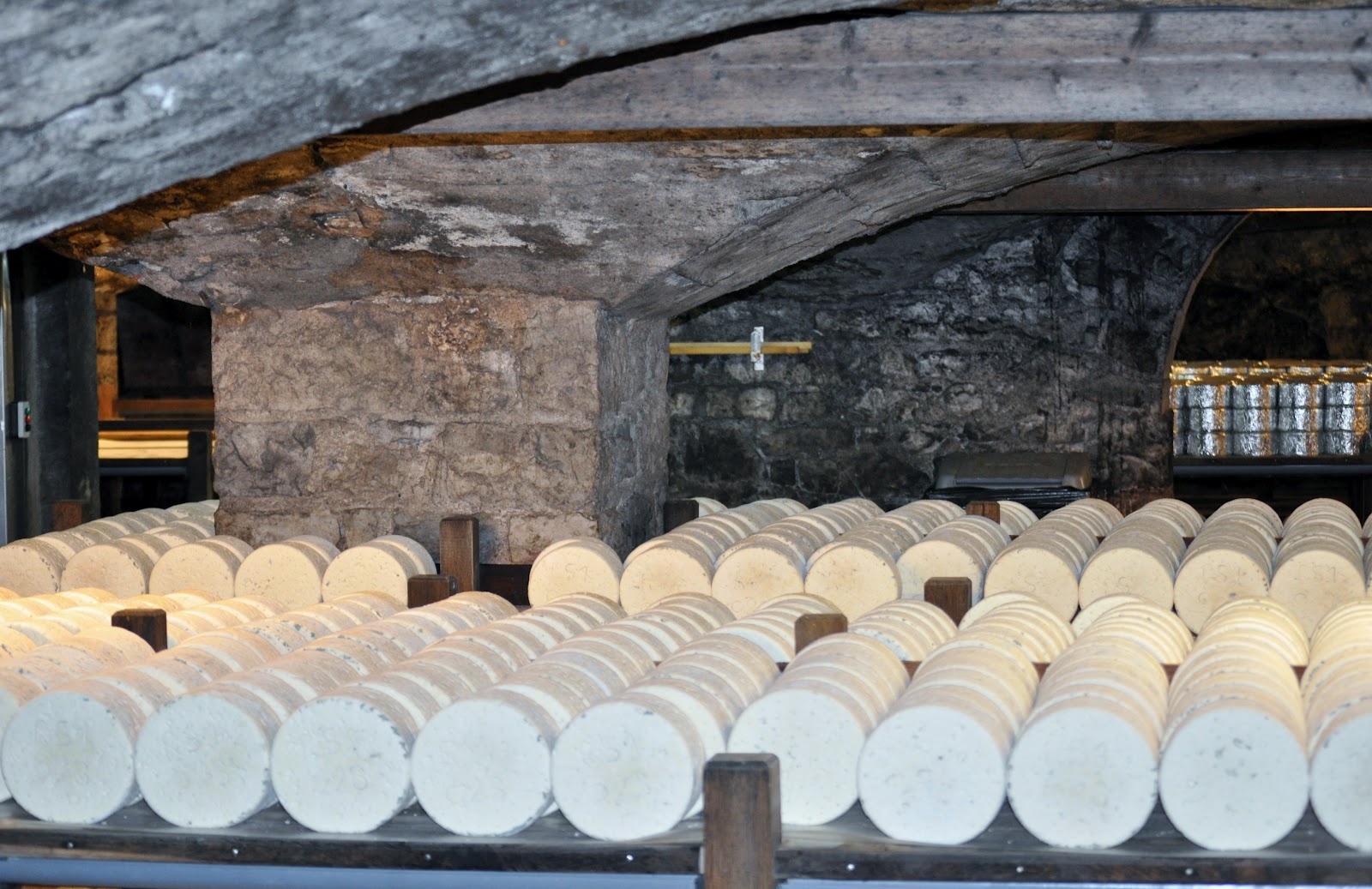
Roquefort cheese is aged for a minimum of three months in accordance with AOC regulations. Société fromagerie ages the majority of their cheese on these oak shelves for five months. I was there in late June near the end of the sheep's lactation period so the oak shelves were mostly bare.
The cheese is placed vertically along the wooden shelving leaving a small space between each one. Through the joint action of the penicillium and the salt on the surface of the cheese, the cheese is left to ripen. The penicillium grows slowly from the center of the cheese outward. This natural fermentation causes the temperature of the cheese to rise melting the salt covering its surface and causes the salt to penetrate into the heart of the cheese. As the penicillium grows, a series of green-blue veins spread throughout the inside of the cheese.
When the ripening stage is completed, the microbial growth on the surface and penicillium on the inside must be stopped. To do this, the cheese is wrapped by hand in tinfoil by female workers known as cabanières who wrap up to 100 loaves an hour. Once the cheese is wrapped, the cheese is placed in a cold chamber and left to mature. It is during this stage that Roquefort cheese acquires its special flavor.
At the end of our tour, we tasted three different Roquefort cheeses from Société; Société 1863, a well balanced Roquefort with delicate green veining, Cave des Templiers, a strong cheese with dark blue green veins and Caves Baragnaudes, a delicate cheese with a creamy texture and pale green veining. The latter was my favorite.
Roquefort-sur-Soulzon sits at 630 meters or 2,066 feet elevation against a rocky cliff below Combalou Mountain.
The main street of Roquefort-sur-Soulzon with the Mairie in the distance.
The memorial to the children of Roquefort-sur-Soulzon who died in wars for France.
The Roquefort-sur-Soulzon church with its modern clock and bell tower.
There are currently seven producers of Roquefort cheese. The largest is Société, Roquefort Papillon is also well known. The five other producers are Carles, Gabriel Coulet, Fromageries Occitanes, Vernieres and Le Vieux Berger. Collectively, there are around three million cheeses produced annually making it after Comté, France's second most popular cheese.
I was happy to finally make it to Roquefort-sur-Soulzon and visit Société. I will go earlier in the season next time and try to see where the milk is turned into curds and poured into molds before they start the aging process. I got to try some new Roquefort cheeses and I really liked the Caves Baragnaudes Roquefort cheese.
Bonne journée mes amis et à bientôt. Have a great day, chat soon!
We have a beautiful stone village house located in the heart of the medieval village of Sablet in the Vaucluse region of Provence France. Dating from the 17th century, the house was renovated by an Italian stone mason with all of the comforts of a modern home while retaining its authentic Provençal character and charm. On this blog, we share experiences from our visits along with those of our families and friends to Sablet and the South of France.
Showing posts with label Roquefort. Show all posts
Sunday, July 29, 2012
Sunday, January 22, 2012
Bastille Day at La Metairie Neuve
As I told you here, there was nothing planned in Sablet to celebrate Bastille Day, July 14, also known as the French Fête Nationale, so we decided to go to La Metairie Neuve, the small family farm near Viane in the Tarn region in Southern France to say bonjour to the aunts, uncles and cousins.
I love going to La Metairie Neuve; I have such good memories especially from my childhood but from more recent return visits like here and here; we would make the trip more often if it was not three and one-half hours each way from Sablet. The same is true about the memories for niece Leslie who was visiting and had not been back to La Metairie Neuve for many years.
So off we went. It was an absolutely beautiful day and we took off under brilliant blue skies early enough so we would arrive at La Metairie Neuve in time for lunch. Our route took us within sight of the Millau Viaduct, the tallest bridge in the world and past the tiny village of Roquefort where the famous sheep's milk blue cheese is created in local caves.
Shortly before arriving at La Metairie Neuve, we drove through Lacaune, famous for its superb charcuterie especially Jambon de Lacaune, ham of Lacaune; the village climate is reportedly perfect for curing ham. We arrived at La Metairie Neuve, the table was set and the aunts and uncles were gathering and cousin Jean Marc was grilling lamb chops on the BBQ grill.
Niece Leslie was happy to be back at La Metairie Neuve and reconnecting with family she had not seen for many years.
After lunch, we went to move some very large rolls of hay into a barn for the horses.
Me resting on the job.
Tonton René wearing his ever present beret hat .
Tonton René and his dog.
At one time, there were 80 - 100 sheep, they were one of the many local farms that supplied sheep's milk for making Roquefort cheese, 12 - 20 cows, a work horse and they raised chickens, ducks and pigeons and grew all their produce. The only live stock which remain are two horses, some chickens, ducks and pigeons. They have a large garden and lots of apple trees, from which they bottle fresh juice each fall.
Cousin Jean Marc with one of his horses.
Tonton René looks out over his garden, actually I should say that its Tata Ida's garden as it is she who plants and takes care of the garden.
Tonton René and tata Ida sit in front of their house; tata Ida is always full of stories. Don't you love the hand made lawn chairs.
One of the barns on the farm with a pretty hydrangea plant.
The family has a long history at La Metairie Neuve. I found out from the aunts that day that they sheltered a Jewish family hiding from the Nazis and their collaborators for several years during WW II, one of several local families who provided shelter and supported the resistance. I hope to find out more about this history and write about it in the future.
Since we were there on the 14th of July, one of the uncles has recently passed away. The other aunts and uncles are aging and La Metairie Neuve will be very different when they are all gone. The future for La Metairie Neuve is uncertain because of French inheritance laws so the cousins are all very anxious. We will be visiting every chance we can.
Bonne journée mes amis et à très bientôt.
I love going to La Metairie Neuve; I have such good memories especially from my childhood but from more recent return visits like here and here; we would make the trip more often if it was not three and one-half hours each way from Sablet. The same is true about the memories for niece Leslie who was visiting and had not been back to La Metairie Neuve for many years.
So off we went. It was an absolutely beautiful day and we took off under brilliant blue skies early enough so we would arrive at La Metairie Neuve in time for lunch. Our route took us within sight of the Millau Viaduct, the tallest bridge in the world and past the tiny village of Roquefort where the famous sheep's milk blue cheese is created in local caves.
Shortly before arriving at La Metairie Neuve, we drove through Lacaune, famous for its superb charcuterie especially Jambon de Lacaune, ham of Lacaune; the village climate is reportedly perfect for curing ham. We arrived at La Metairie Neuve, the table was set and the aunts and uncles were gathering and cousin Jean Marc was grilling lamb chops on the BBQ grill.
Niece Leslie was happy to be back at La Metairie Neuve and reconnecting with family she had not seen for many years.
After lunch, we went to move some very large rolls of hay into a barn for the horses.
Me resting on the job.
Tonton René wearing his ever present beret hat .
Tonton René and his dog.
At one time, there were 80 - 100 sheep, they were one of the many local farms that supplied sheep's milk for making Roquefort cheese, 12 - 20 cows, a work horse and they raised chickens, ducks and pigeons and grew all their produce. The only live stock which remain are two horses, some chickens, ducks and pigeons. They have a large garden and lots of apple trees, from which they bottle fresh juice each fall.
Cousin Jean Marc with one of his horses.
Tonton René looks out over his garden, actually I should say that its Tata Ida's garden as it is she who plants and takes care of the garden.
Tonton René and tata Ida sit in front of their house; tata Ida is always full of stories. Don't you love the hand made lawn chairs.
One of the barns on the farm with a pretty hydrangea plant.
The family has a long history at La Metairie Neuve. I found out from the aunts that day that they sheltered a Jewish family hiding from the Nazis and their collaborators for several years during WW II, one of several local families who provided shelter and supported the resistance. I hope to find out more about this history and write about it in the future.
Since we were there on the 14th of July, one of the uncles has recently passed away. The other aunts and uncles are aging and La Metairie Neuve will be very different when they are all gone. The future for La Metairie Neuve is uncertain because of French inheritance laws so the cousins are all very anxious. We will be visiting every chance we can.
Bonne journée mes amis et à très bientôt.
Subscribe to:
Posts (Atom)


