Showing posts with label Plus Beaux Villages de France. Show all posts

Thursday, April 17, 2025

Roussillon, Our Favorite Village in the Luberon and Most Beautiful

Friends and others headed to Provence often ask where they should go during a once in a lifetime seven-day visit to Provence. This a hard question as most visitors have only 6 days since they usually arrive on Saturday afternoon and depart the following Sunday. There are so many wonderful things to see.

There is something for everyone in Provence; there are amazing Roman ruins and medieval villages for history buffs, lavender, sunflowers and coquelicots (poppies) for artists, weekly marche hebdomadaire (open-air markets with tantalizing displays of fruits and vegetables), great restaurants for foodies, and world-famous vineyards for wine lovers.  

There are perched villages everywhere, summer music and theater festivals, bull fights and the Transhumance for lovers of spectacles, brocantes and vide-greniers for antique hunters, Mont Ventoux for amateur cyclists who want to test their skills on the most famous ascent on the Tour de France, the Dentelles de Montmirail for hikers and picturesque villages with beaches along the Mediterranean Sea. 

We usually suggest a visitors include a trip to the vibrant red-ocher colored town of Roussillon, one of five villages nestled in the Luberon hills which are classified as Plus Beaux Villages de France (Most beautiful villages of France). Roussillon is one of our favorite villages and just one hour from Sablet.

The Luberon stretches 35 miles along a ridge of rugged hills from Cavaillon in the west to Manosque in the east and from the town of Apt south to the Durance River. Much of the area including Roussillon lies within the borders of the Parc Naturel Regional du Luberon, a protected area with outstanding natural beauty.

Ocher colored houses outside Roussillon

Roussillon sits on the southern edge of the Plateau de Vaucluse above one of the world's largest known ocher deposits where 17 shades of ocher -- violet, blood red, orange, yellow, and everything between were once mined. 

Roussillon


Roussillon

Just a few minutes' walk from the village is the beginning of the Sentier des Ocres (Ocher trail). Ocher is a natural pigment in the sandy soil which form the cliffs around Roussillon. Iron oxides color the sands into shades ranging from yellow to violet. The mineral landscape shows the effects of erosion and mining work done by man.

Two different trails, one short, one long takes you through the ocher lands on a 30-minute or 60-minute walk. You can stay as long as you like. Information signs along the way describe the geology, flora and history of the ocher deposits in the Luberon. The trails take you past multi-colored ocher formations set against a backdrop of pine trees. There is a small admission fee. 

Ocher cliff outside Roussillon


Water fountain in Roussillon


Roussillon shop


Historical oil mill in Roussillon

Roussillon must have more restaurants per head of population than any other Luberon village. Most are clustered around Town Hall Square. A little lower down, with its dining room sailing out into the ocher void, is the more upscale David. 

View back toward Town Hall Square and shops and cafes along the street

The belfry was the ancient entrance into the fortified area called the Castrum. The belfry was renovated in the 19th century as a bell tower adjoining the church. The first street on the left takes you along the former watchman's walkway, which ran between the two towers on the rampart wall. There are great views of the village and surrounding area.

Roussillon belfry and clock tower

Saint Michel Church whose origins go back to the 11th century, originally faced the castle, inside the fortified walls. The church has undergone countless renovations over time, necessitated in part by its location by the cliff.

Saint Michel Church

Ocher only became a widespread, industrial product in the late 18th century when Roussillon native son Jean-Etienne Astier came up with the idea of washing the ocher-laden sands to extract the pure pigment.

View towards village cemetery from top of Roussillon


Archway view out over the Luberon valley

The Librairie (bookstore) in La Maison Tacchella to the left and the Hotel de Ville (Town Hall) to the right in Town Hall Square, the main village square.

Town Hall Square

As you can imagine, the beauty of Roussillon draws crowds of visitors during tourist season. It is the most visited village in the Luberon after Gordes, a few miles to the west. Despite this, we have never had any problem finding parking close to the village.

We think its best to visit in the morning when the first sunshine of the day strikes the village, to see the glowing colors at their most stunning. Roussillon is fairly small, so it doesn't take very long to explore. So combine a visit to Roussillon with a visit to Gordes or other hill towns in the Luberon.

Town Hall Square Cafe


Mural painted on a Roussillon garage door

Don't forget your camera when you go, you will definitely want to take a lot of pictures. 

Monday, May 1, 2023

Visit to one of the 7 Most Beautiful Villages in Vaucluse

We usually take daily trips away from Sablet to explore the Vaucluse and surrounding Departments. We probably go most often to the hill-top villages of the Luberon including Venasque, which is what we did a few weeks ago.

Venasque is a small pretty village that clings to a rocky hillside overlooking vineyards, garrigue (areas of shrubby vegetation found in the Mediterranean region), and cherry trees. It is classified as one of the "Plus Beaux Villages de France" (translated as most beautiful villages of France).

Cherries have been grown in this part of Provence since the 17th century and it remains the largest cherry producing region in France. Cherries from Venasque are said to be the best; the village refers to its cherries as diamants rouges (red diamonds). 

Venasque
Venasque is one of the oldest villages of the Comtat Venaissin often referred to simply as the Comtat. Comtat means county in its original sense, or land belonging to a count. Venaissin refers to Venasque, a former bishop seat which gave its name to the Comtat. 

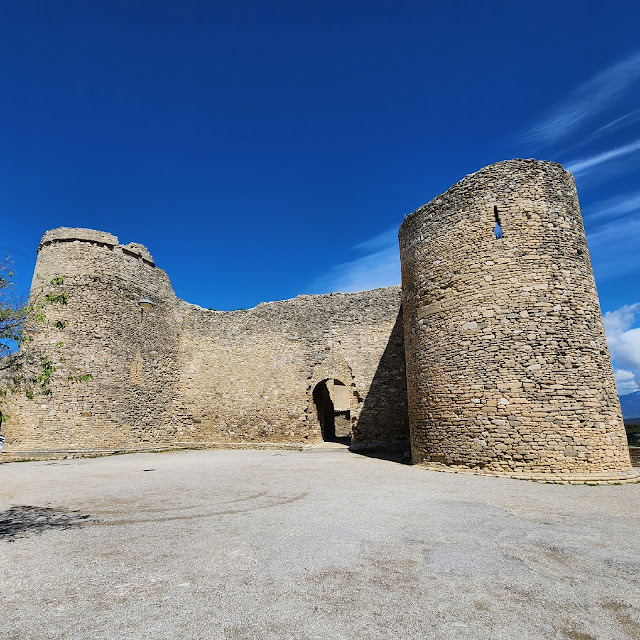
Saracen Towers and Arched Doorway through Defensive Walls
Venasque's location on top of the hill provided a natural defense against attacks from enemies. Nevertheless, in Roman times, a defensive wall with towers was built around the village. The arched doorways were restored at the beginning of the 20th century.

Defensive Wall
The thick walls of the ramparts which survive connect three Saracen towers and two arched doors. Supposedly the stones in the defensive wall that no longer exist were removed as if the walls were a sort of rock quarry and used to build the school and village houses. 

One of the reasons we like to come to Venasque is because of Les Remparts restaurant. At Les Remparts, you can sit in the interior dining room, a large sunroom or a small outdoor terrace with views of the valley on sunny days.

Les Remparts offers a number of prix fixe menus, including a 3-course vegetarian menu currently priced at 39 Euros. Food is always well prepared and beautifully plated. We recommend you reserve ahead. 

Les Remparts Restaurant
As you can see, Venasque is a small village. There are only 1013 people who reside in the village according to the lastest census. 

Water was piped to houses throughout the village between 1959 and 1965. Prior to this time, villagers got their water from the various fountains scattered throughout the village.

The fountain in the center of Venasque at Place de la Fontaine

Artist workshop in Venasque

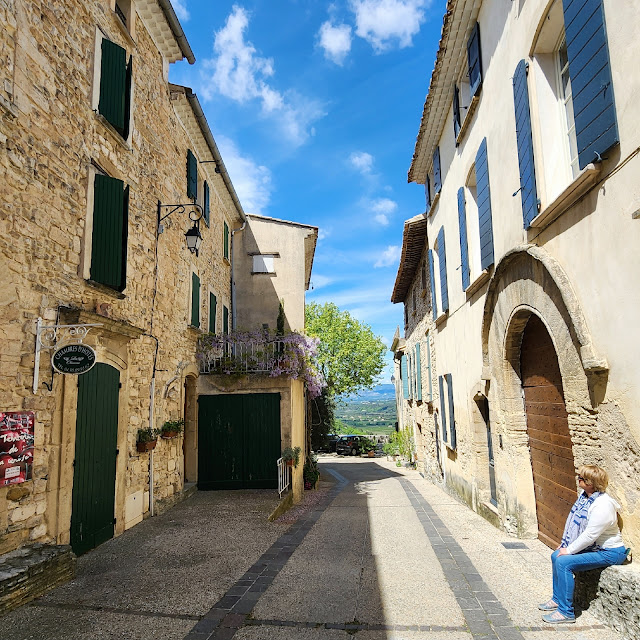
Lady taking in the views down the Venasque street

Hotel de Ville (Town Hall)
The Notre Dame church in Venasque dates from the end of the 12th century. The side chapels date from the 17th and 18th century, and the bell tower from the 17th century. 

Notre Dame Church in Venasque
Inside the church, there is a very beautiful baptistry. Its origins are unclear, but it is believed to be the oldest religious baptistry in the region.

Iron Cross near Notre Dame Church in Venasque

War Memorial in Venasque near Notre Dame Church

Arched Passageway into and out of Venasque
It is worth the trip up the hill off the D-4 to visit Venasque. As I said, it is small and will only take you a couple of hours to walk around the village. Try to time your visit so you can eat lunch at Les Remparts. You will be happy you did.

Les Remparts Restaurant
37 Rue Haute
84210 Venasque
Tel: 04 90 66 02 79

Friday, February 18, 2022

Visit to Grignan, a Plus Beaux Villages de France and Lunch at Long Time Favorite Eatery Le Poeme de Grignan Restaurant

We often make visits to Grignan in the Drome Provencale, an area that falls between the Rhone River and Alps north of the Vaucluse. Since we were last there in the summer of 2019, Grignan was added to the list of Plus Beaux Villages de France.

So on a overcast Sunday in January, we drove to Grignan for a walk-about and lunch at Le Poeme de Grignan Restaurant. Our route took us past olive groves and fields with rows of lavender, which come summer will magically transform into a sea of purple and buzzing honey bees. 

Grignan sits on large rocky hilltop topped by a castle. Construction of the castle began in the 12th century, but it wasn't until the 13th century that the Adhemar family expanded it to a huge fortress. In the 17th century, Francois Adhemar de Monteil transformed the fortress into a luxurious residence.

The castle was completely ruined in 1793 during the French Revolution. Early in the 20th century, a Madame Fontaine spent her entire fortune restoring the castle to its former glory. Today the castle is owned by the Department of the Drome. You can see interior pictures of the castle on my post here.

The Castle and Village of Grignan

Located under the castle terrace is the Collegiate Church of the Holy Savior. The church seen in the right side of the picture below was built between 1535 and 1539. The Renaissance facade is flanked by two square towers and a Gothic rose window. 

Closer View of Castle and Collegiate Church of the Holy Savior

The Lavoir du Mail seen in the picture below is a 19th century wash house with a circular basin inside 16 Doric columns. The lavoir is named after the game of mail that was popular then: a game using a wooden ball and a mallet.

Lavoir du Mail (wash house)

Grignan village square

Grignan became renown in France during the 17th century when Marie de Rabutin-Chantal, the Marquise de Sevigne, a French aristocrat, famous for writing letters, wrote about Grignan and the surrounding area in letters to her daughter. 

Madame de Sevigne caught a "fever" and died in April 1696 in Grignan. She is buried in the Collegiate Church of the Holy Savior. She is revered in France as one of the great icons of French literature. 

The fountain shown in the photograph below was built in 1840 at Place de l'Horloge in the center of Grignan.

Fountain topped by statue of Madame Sevigne

We walked into Le Poeme Restaurant and were asked "avez vous reserve", did we have reservations? "Yes" I said, and immediately we were asked to present our Passe Sanitaires to prove we were fully vaccinated and boosted.  We noted that since we had last dined at Le Poeme, the restaurant's interior had been nicely updated.

Shirley at Le Poeme with complimentary bowl of black olives from Nyons

As is our custom, we passed on aperitifs and went directly to the wine list. I chose a red from the Grignan-les-Adelmar AOC which surrounds Grignan from Domaine du Chardon Bleu. It was 100% Syrah, more typical of Northern Rhone wines than the Southern Rhone wines we are use to.

Me and my wine selection


Amuse Bouche of Mushroom Soup and Duck Breast

In France, it is common for chefs to serve an "Amuse Bouche" to diners to enjoy while waiting for their food orders to arrive. It is a way of saying "welcome" and pampering them with something special. The Amuse Bouche at Le Poeme was delicious and more extravagant than most.

The pictures which follow show our meal as presented to us at our table.

Vegetable Soup with Truffles and Morel Mushrooms for Shirley

Scallops with Sunchoke and Potato Puree with Truffles for me

Filet of Bar (Sea Bass) with Rice, and Spinach in Red Wine Sauce for Shirley 

Veal with Root Vegetables, Mushrooms and Haricots Verts for me

We shared a dessert to finish our meal. 

Yuzu Lemon Souffle with Vanilla Ice Cream and Strawberry Sorbet and Mango

When we walked in, there was only one single gentleman seated in the restaurant. By the time, we left, all the tables were filled with diners enjoying Sunday lunch. 

We highly recommend that you always make reservations in advance for restaurants. We have seen time and again that restaurants with open tables throughout the time we are there will none-the-less turn away diners who arrive without reservations. 

Grignan is a very pretty village and lots to explore as recognized by the Les Plus Beaux Villages de France association. There are several nice restaurants in Grignan, of which Le Poeme is our favorite.

Le Poeme de Grignan Restaurant
8 Rue Saint-Louis
26230 Grignan
France
Tel: +33 4 75 91 10 90
www.poemedegrignan.com

Wednesday, February 2, 2022

Dining recommendation near Les Baux de Provence, a Plus Beaux Villages de France


Les Baux de Provence is a picturesque village about 46 miles southwest of our house in Sablet. The village sits on an elevated site with ancient houses and ruins of a castle perched on top overlooking plains to the south.

The village is classified as one of the "Plus Beaux Villages de France". The beauty of the village and surrounding Alpilles, a small range of mountains, makes Les Baux de Provence a very popular place for visitors all year long.

The name Les Baux refers to its site, in Provencal, a baou is a rocky spur. Bauxite, a rock with high aluminum content, was mined extensively in the area but by the end of the 20th century, all the Bauxite was completely extracted. 

The area surrounding Les Baux de Provence is known for production of high quality olive oil. The olive oil pressed from this area is labeled AOC Vallee des Baux, an area covering about 4,250 acres in the heart of Les Alpilles.

Les Baux de Provence

We headed to Les Baux de Provence on a beautiful day, albeit fairly cold, typical for a winter day in Provence to find hand made pottery for our daughters at Shirley's favorite pottery shop in the center of the village. 

While our favorite local restaurant, Le Bistrot du Paradou was open, we decided to try a new-to-us bistrot called Bistrot de l'Aupiho a little south of Les Baux off the D27 in the direction of Maussanne-les-Alpilles.

The Bistrot is located at Domaine de Manville, a 247 acre property with 5 star hotel, 18-hole golf course, spa, Michelin starred Restaurant l'Aupiho and the aforementioned Bistrot de l'Aupiho.

Bistrot de l'Aupiho

We were seated on a covered terrace with plenty of ventilation as we prefer during time of COVID. We had dressed to be outdoors, but before too long, some diners fled to the interior as they found the terrace a little too cold.

Shirley at Bistrot de l'Aupiho

Bistrot de l'Aupiho does not offer a typical 2 or 3 course menu at lunch so you choose from a nice selection of a la carte offerings. At night, they do offer a 3 course "Menu Decouverte" but everyone at the table must choose this menu. 

For our lunch, I chose a red wine from a local domain called Mas Sainte Berthe which I knew was located at the foot of Les Baux de Provence. We have not been to this winery but as the wine was very good, we will put it on our list of places to visit next time we are in the area.

2019 Mas Sainte Berthe Les Baux de Provence Rouge

It is rare to find simple green salads on menus in France. Sometimes the chef will prepare one if asked. But usually, green salads on menus are accompanied by a protein, not usually cheese. So we were really happy to see a list of "Extra Sides" on the Bistrot's menu that included a Salade Verte (green salad). 

Green Salad from the list of Extra Sides
 
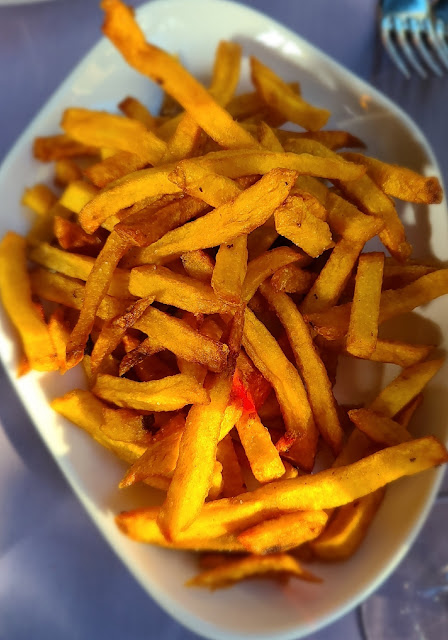
The list of "Extra Sides" also included French Fries so we ordered a plate of those as well.

French fries from the list of Extra Sides

What follows are pictures of our main courses and desserts.

Beef Cheeks braised in Red Wine Reduction served with Mashed Potatoes and Gribiche Sauce


Cod Fillet served with Celery Root puree and Cruciferous veggies


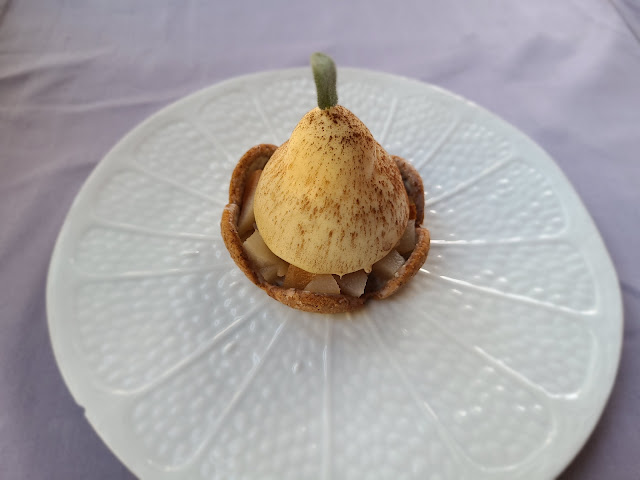
Pear Tarte 


Tarte Tatin with Honey Truffle

We did not take cheese but did take note that the Bistrot's cheese selections come from Lou Canesteou, our favorite cheese shop in Vaison-la-Romaine. 

After our lunch, we walked into the village and discovered our pottery shop was closed. Oh well, at least we discovered a nice new bistrot where we will return on future visits.

Le Bistrot de l'Aupiho
Route de la Terre-des-Baux
13520 Les Baux de Provence
France
+33 4 90 54 40 20
www.domainedemanville.fr