Showing posts with label Sénanque Abbey. Show all posts

Saturday, January 25, 2020

Gordes, A "Most Beautiful Villages of France" and location for many scenes in the "A Good Year" Movie

Every time we come to our home in Sablet, in the Provence region of France, we head toward the Luberon mountain to visit one or more of the small hill top villages in that area. Many times, Gordes is one of the villages we visit, especially if we are touring first time visitors around Provence.

Gordes is a beautiful old village about 1 hour southeast of our home in Sablet. The small village (pop. 1773) sits on a rocky outcrop of the Vaucluse Mountains and dominates the plain and Calavon River Valley, offering a view of the Luberon mountain across the way.

Cubist painter André Lhote discovered Gordes in 1938 followed by Marc Chagall, Victor Vasarely and other artists who visited and summered in Gordes. More recently Gordes gained fame as one of the locations for a movie filmed in the region, "A Good Year" starring Russell Crowe.

If you have not seen the movie, it is based on a novel by Peter Mayle and tells the story of Max Skinner (Russell Crowe), who, when he inherits a château and vineyard in Provence from dear Uncle Henry, he just wants to sell it quickly and get back to his life being a successful London securities trader and miserable loner.

Instead, stuff intervenes to keep him hanging around and before he knows it, he's forgotten how to be lonely and falls for beautiful café owner Fanny Chenal played by Marion Cotillard. OK guys, I know its not an Oscar, great movie as film making goes, but I love the setting in the Luberon and I am a sucker for a love story.

Gordes

The original Romanesque church in Gordes was dedicated to Notre Dame. Rebuilt in 1704, it has a colorful interior and was dedicated to its patron Saint Firmin, a former Bishop of Uzès, the bell tower of which can be seen in the photograph below.

Gordes castle and St Firmin church bell tower in background

The fountain in the square by Hôtel Renaissance seen below, is where Max waits for Fanny Chenal, the character played by Marion Cotillard in a memorable scene from the "A Good Year" movie to get off work.

Fountain near Hôtel Renaissance in Center of Gordes

Some streets in the village are paved with stones called calades - small paved, sometimes stepped alleyways lined with gutters defined by two rows of stone as seen in the photograph below.

White stone house and typical Gordes' street with calades.

Hôtel Renaissance was transformed into Fanny Chenal's bistro for the movie, a location seen several times, and where Max famously tells an obnoxious American couple that "MacDonalds is in Avignon, fish and chips in Marseille. Allez".

Hôtel Renaissance in Gordes

In the picture below, Shirley stands on the steps going down from Fanny Chenal's bistro where a wonderful encounter occurs between Max and Fanny in the "A Good Year" movie.

Shirley doing her best imitation of Marion Cotillard

Around the center of the village near the castle, you will find various cafés, restaurants, art galleries and souvenir shops. Every Tuesday morning is market day. Merchants from around the area set up stalls on Place du Château and sell their wares; fresh fruits and vegetables, Provençale pottery and linens, art work and clothing.

Tourist shop in Gordes

The memorial to the children of Gordes who died in wars for France is in the main square and where Russell Crowe's character, Max Skinner circles several times in his little yellow smart car looking for the notaire, a self-employed legal specialist with public authority to draw up real estate contracts for clients, in the "A Good Year" movie.
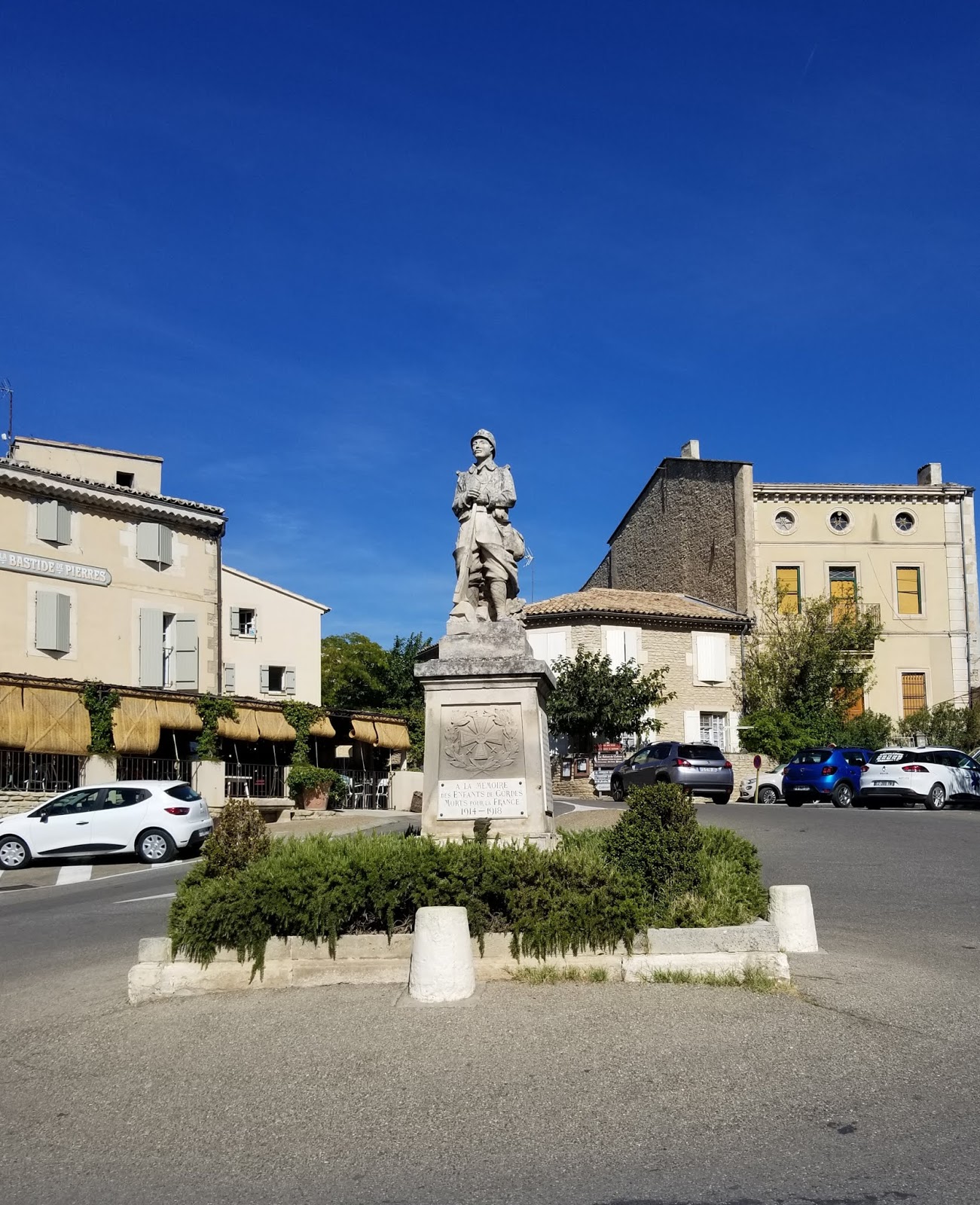
War Memorial in center of Gordes

The Chapelle des Pénitents Blancs, translated into English as the "white penitents chapel" is located near the castle. Dating from the 17th century, the chapel is an art gallery today.

White Penitents Chapel

At the top of Gordes and in the center of the village sits the castle which dominates the village. Built in 1031, reinforced in 1123, the castle was rebuilt in 1525. Today the castle is home to the Pol Mara museum, a contemporary Flemish painter who lived in Gordes, and the Gordes tourist information office. In summer there are concerts and plays in the castle's courtyard.

Gordes castle

Another view of Gordes from the Luberon Valley can be seen in the photograph below. The strategic defensive possibilities of Gordes' location are clearly evident. The village was never taken even during the brutal Wars of Religion.

During World War II, Gordes was an active resistance village and was later awarded a medal, the Croix de Guerre 1939 - 1945. On the 21st of August 1944, just 6 days after the start of Operation Dragoon, the Allied invasion of Southern France, a German patrol was attacked by members of the Gordes resistance and the day after, the village was subjected to violent reprisals and much of Gordes was destroyed.

Gordes

It is definitely worthwhile to visit Gordes. If you are lucky enough to be in Provence between late June through the middle of July, make sure you take time to visit nearby Sénanque Abbey.

It is a beautiful Cistercian abbey located in a deep valley a short distance north of Gordes and well worth a visit anytime you are in the area.

You can drive to the Abbey from Gordes on the narrow D177 road or if you are in the mood for a hike, you can walk there on the GR6 hiking trail. Don't forget, you will have a hike back up.

Along the way, you will come upon an "aerial" view of the Abbey down in the deep Senancole valley where Sénanque Abbey is located.

"Aerial" view of Sénanque Abbey

The Sénanque Abbey is an active community with a handful of elderly monks that I told you about here. The monks grow the lavender and tend to honey bees to earn income for living and upkeep of the Abbey. The Sénanque Abbey along with two other early Cistercian abbeys in Provence, Silvacane Abbey and Le Thoronet Abbey, are sometimes referred to as the "Three Sisters of Provence"

Sénanque Abbey

If you have comments or questions about Gordes, Sénanque Abbey, or elsewhere in Provence, please leave your comments below or send me an email at my address below.

If you are thinking about a trip to the South of France including spending time in Provence, we invite you to visit our website. Our house is available for rent by the week or more. You can reach us for further information by sending an email to chcmichel@aol.com.

Monday, October 31, 2016

Lavender fields in Vaucluse and nearby Drôme Provençale

It's a toss up between coquelicots (red poppies) and lavender but probably no other scent or sight says Provence better than the pungent aroma of a purple field of lavender growing in mounded rows under a brilliant blue summer sky.

We were lucky that it was lavender season when we were in Sablet last summer with our daughter Tricia, husband Alvin and grandkids Avery and Caedon. The pictures which follow show the lavender fields we found during outings to the Drôme Provençale area west of Nyons, the Sénanque Abbey and to Sault.

Three species of lavender grow in Provence: true lavender (lavande) is found high up in dry, rocky soil. Aspic which grows lower down is similar to lavande except it has broader leaves and its branches hold a number of stems. And less refined, lavandin is a hybrid of lavande and aspic.

Lavande is most highly regarded by perfume makers for its sweet essential oils, though aspic and especially lavandin are more productive and therefore more common - ending up in laundry and household products.

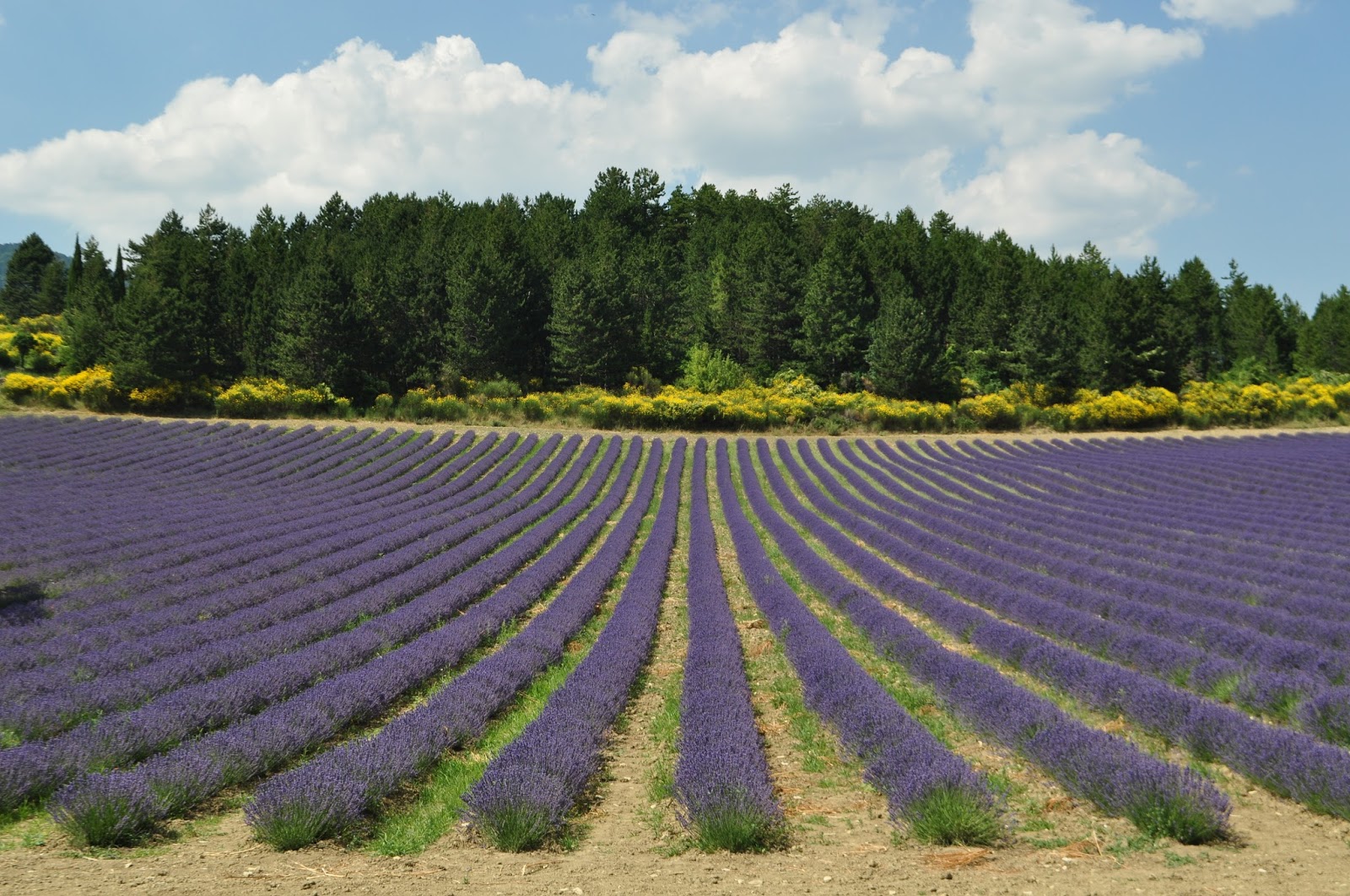
Lavender field in the Drôme Provençale

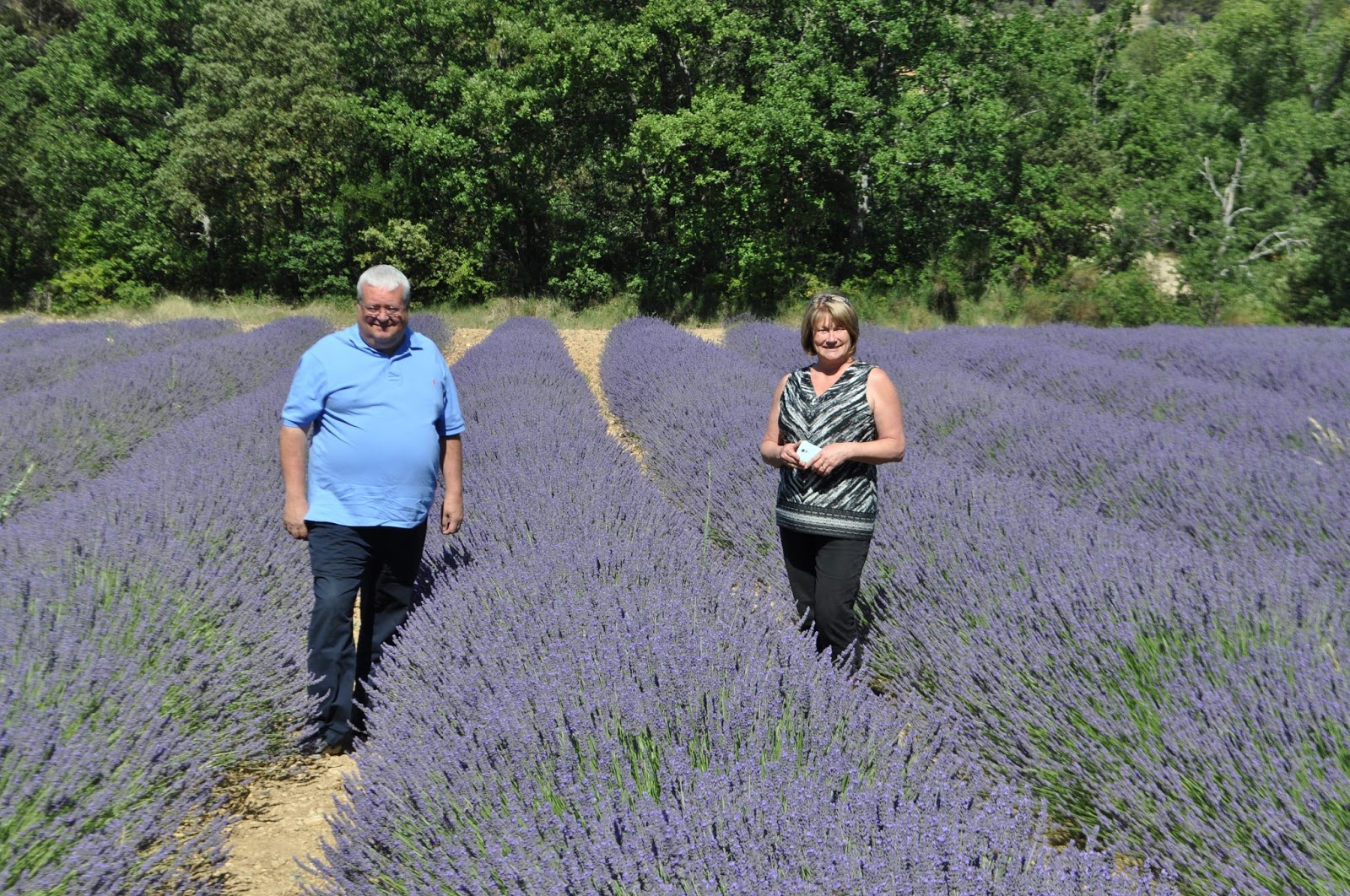
Me and my love in a lavender field in the Drôme Provençale

Alvin and Tricia in a lavender field in the Drôme Provençale

The Sénanque Abbey is a beautiful Cistercian abbey located in the deep Senancole valley a short distance north of Gordes and well worth a visit anytime you are in the area. But the best time to go is when the lavender fields that stretch out from the Abbey are in full bloom.

The Sénanque Abbey was founded in 1148 under the patronage of Alfant, bishop of Cavaillon, and Raymond Berenger II, Count of Provence, by Cistercian monks who came from Mazan Abbey in the Ardeche. In the 13th and 14th centuries, the Abbey reached its greatest height, operating four mills, seven granges and possessing large estates in Provence

During the Wars of Religion, the quarters for the lay brothers were destroyed and the Sénanque Abbey was ransacked by Huguenots. At the French Revolution, the Abbey's lands were nationalized, the one remaining monk was expelled and Sénanque itself was sold to a private individual.

The site was repurchased in 1854 for a new community of Cistercian monks of the Immaculate Conception, under a rule less stringent than that of the Trappists. The community was expelled in 1903 and departed to the Order's headquarters, Lerins Abbey on the island of St. Honorat, near Cannes. A small community returned in 1988.

Sénanque Abbey

The Sénanque Abbey is an active community with a handful of elderly monks. The monks grow the lavender and tend to honey bees to earn income for living and upkeep of the Abbey.

Lavender field near Sénanque Abbey

The Sénanque Abbey along with two other early Cistercian abbeys in Provence, Silvacane Abbey and Le Thoronet Abbey, are sometimes referred to as the "Three Sisters of Provence"

Sénanque Abbey

Lavender field near Sénanque Abbey

Lavender field on the way to Sault

Lavender fields on way to Sault

Lavender field on way to Sault

Lavender field on way to Sault

Lavender field on way to Sault

Lavender field on way to Sault

Lavender field on way to Sault

Lavender field on way to Sault

Lavender field on way to Sault

Lavender field on way to Sault

Lavender field on way to Sault

Lavender field on way to Sault

Lavender field on way to Sault

Lavender field on way to Sault

Lavender field on way to Sault

Another view of same lavender field

Lavender field near Sault

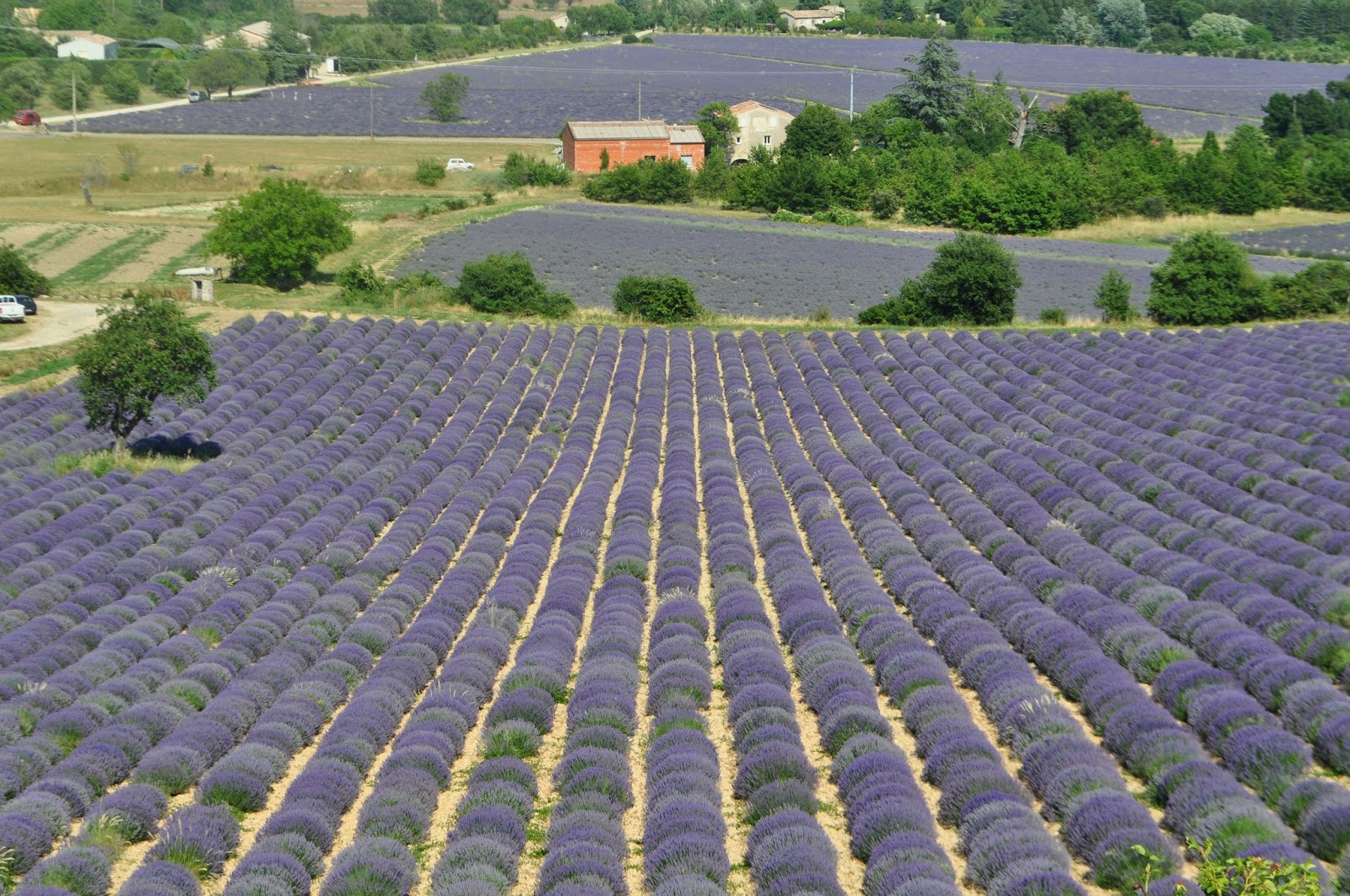
View of the patchwork of lavender fields visible from Sault

Sault is an old fortified village that sits on a ridge overlooking a large valley dotted with lavender fields about one hour from Sablet. The name Sault comes from "Saltus" referring to the forests that covered the area.

Lavender field below Sault

Lavender field near Sault

Lavender field near Sault

Shirley in lavender field near Sault

Lavender field near Sault

Lavender fields near Sault

Lavender fields with Sault in distance

Close up of previous lavender field near Sault

We don't get to be in Sablet during the summer every year so we miss out on the lavender most years, which is obviously a mistake.

Sunday, October 21, 2012

Silvacane Abbey, one of the Three Sisters of Provence

Do you remember that I detoured to visit Saint Saturnin-lès-Apt on the way to cousin Annick's house near Aix-en-Provence? On the road again after my visit, I drove through Apt, passed near Bonnieux and the pretty village of Lourmarin before I reached the Durance River just past Cadenet where I saw the sign for Silvacane Abbey.

I have never been to Silvacane Abbey but I know that Silvacane Abbey is one of the three Cistercian abbeys in Provence known as the "three sisters of Provence," the other two being Sénanque Abbey near Gordes and Le Thoronet Abbey in the Var.

Sénanque Abbey is one of the most beautiful spots in Provence and certainly one of the most frequently photographed sites judging by books, posters, and postcards we see. We drive past Sénanque Abbey on the way to and from Gordes and Roussillon or other villages in the Luberon and are struck by the beauty of the place every time.

We love to visit Sénanque Abbey in July when the lavender is in bloom like the picture below.


I figured that since I already detoured once today, I would take another detour and visit Silvacane Abbey. The Abbey was founded around 1144 as a daughter house of Morimond Abbey. In 1358 the Abbey was plundered by the army of Aubignan, and from then on its financial problems grew, until in 1443 the monks were forced to leave the Abbey.


The Abbey buildings fell into disrepair during the 17th and 18th centuries and were auctioned off during the French Revolution and became a farm. After the property had passed through a number of private hands, the Abbey was bought by the French government in 1846 and declared a historical monument, and restoration work initiated.


The Abbey church was constructed in predominantly Romanesque style with some Gothic elements on the highest part of the property between 1175 and 1230. The building, a basilica with transepts, has a pointed barrel vault, with a plain ribbed vault at the crossing, on substantial cruciform columns.


A view of the Abbey church from the rear of the property.


The Abbey church and other buildings are no longer used for religious purposes. They are open to the public and are sometimes used for cultural events, including the Piano Festival of La Roque-d'Anthéron, the Silvacane Festival of Vocal Music at Silvacane, and the Festival International de Quatuors à Cordes du Luberon.


Finished with my visit to Silvacane Abbey, I drove the last few kilometers to Annick's house. Someday when we are in the Var region, I hope we can visit Le Thoronet Abbey, the third abbey that comprises the "three sisters of Provence." It would be nice to see all three.

Bonne journée mes amis et à bientôt. Have a great week.