Showing posts with label Dentelles de Montmirail. Show all posts

Sunday, February 16, 2020

We live on Grande Rue in Sablet in the Provence Region of France

I have always found it very amusing that the street where our house in Sablet is located is called "Grande Rue". Read on to find out why this is so perplexing to me.

For those of you who don't know, Sablet is a small village (population 1284) located at the base of the jagged Dentelles de Montmirail west of Mont Ventoux in the Vaucluse region of Provence, France. The village sits on a hill near the Ouvèze River.

Sign at entrance to Sablet

Sablet is known for the Côtes du Rhône Villages wines produced by village winemakers. The vineyards were first cultivated by the Counts of Toulouse, to whom the area then belonged. During the 14th century, the vineyards became papal possessions when the papacy moved to Avignon. Sablet was awarded AOC of "Côtes du Rhône Villages Sablet" in 1974.

Sablet

Although the first fortifications of the village were most likely built in the 9th century to ward off attacks by the Saracens, construction on the walls didn't start until the 15th century. These ramparts have recently been restored by the Association des Compagnons des Barrys.

Sablet ramparts and tower

Sablet is filled with charming and picturesque shaded streets adorned with flowers, passageways with exposed beams, and fountains. Stone houses line narrow streets that curl in concentric circles around a beehive shaped hill up to St. Nazaire Church (12th century). St. Nazaire’s bell tower is the highest point in the village.

Our house at intersection of Rue d'Eglise and Grande Rue

Streets were named to reflect the activities of the village residents over the centuries such as climbing the "Escaliers de l'Eglise" to St. Nazaire Church or visiting the shoemaker on "Rue du Cordonnier". Not sure what they were thinking, when they named our street "Grande Rue". In French, "Grande" normally refers to something big, which Grande Rue where our house is located, is definitely not.

Me driving on Grande Rue

One of our favorite pastimes is to watch drivers, usually tourists, struggle to make the left turn from Grande Rue onto Rue d'Église just before our house to go up the hill to Saint Nazaire Church. You can't do it without a partial turn, then back up, then proceed forward up the hill. Only locals make the turn on the first attempt. We also chat with passersby, especially when we hear English being spoken.

Shirley hanging out the kitchen window overlooking the intersection of Grande Rue and Rue de l'Eglise

An interesting thing we have learned is the wine cave under our house was connected to caves under neighboring homes through a network of tunnels that ran under the streets. The locals would travel to their neighbors through the tunnels rather than on the street. The entrance to the network of tunnels was near the fountain and lavoir at Place Yvan Audouard.

Covered passageway on Grande Rue

Shirley stands in "Grande Rue" and stretches her arms between our house and the house across the street. You don't have to worry about traffic as not too many vehicles pass our front door besides the one belonging to the post office.

Shirley can almost touch both sides of Grande Rue

If you have come to visit us in Sablet, you have figured out that one of my favorite places for taking pictures of people in Sablet, is around the pretty fountain at Place Yvan Audouard, just a few steps from our house on Grande Rue.

A favorite place to take pictures is the fountain a few steps from our house

If you have comments or questions about Sablet, or elsewhere in Provence, please leave your comments below or send me an email at my address below.

If you are thinking about a trip to the South of France including spending time in Provence, we invite you to visit our website. Our house is available for rent by the week or more. We still have some weeks open in April, June, last part of July and August. You can reach us for further information by sending an email to chcmichel@aol.com.

Monday, November 25, 2019

Wine tasting in Gigondas and a hike from Col de Cayron to the Dentelles de Montmirail

We are blessed to have a house in Sablet, France and live as locals several times a year. We love our location at the base of the Dentelles de Montmirail surrounded by vineyards as far as you can see. Nearby are several small villages, some known for their beauty and others renown for the wine produced in the village.

Sablet is located between Séguret, a village classified as a "Plus Beaux Village de France," to the north and Gigondas, a village renown for its red wine to the south. We think Gigondas is one of the prettiest of all Côtes du Rhône wine villages and one you should visit especially if you love red wine.

From the road, Gigondas seems little more than a cluster of stone houses set on a hillside with a church below the Dentelles de Montmirail Mountains overlooking vineyard covered slopes and valley below.

Gigondas Village

When you turn off for Gigondas, you follow the road up through the lower village, passing a succession of cafés and tasting rooms (caves) before arriving at Place Gabriel Andéol where the Mairie (town hall) and Caveau du Gigondas (wine growers cooperative), are located.

If you like red wine, plan to stop in at the Caveau du Gigondas (wine cooperative) where you can taste more than 100 different Gigondas wines from 80 wineries and buy them at the same price as at the winery.

Gigondas Town Hall

One of our favorite producers of Gigondas wine is Domaine la Bouïssière. We first became acquainted with this wine when we assembled our wine list for our now closed Bistro Des Copains, in Occidental, California. The tasting room is just a few steps from Place Gabriel Andéol.

Shirley at Domaine la Bouïssière Tasting Room

The Dentelles de Montmirail are short, steep mountains with a distinctive rocky ridge extending west geologically from Mont Ventoux which is located just to the east. When we go out onto the terrace off our bedroom in Sablet, we have a beautiful view of the Dentelles.

The name Dentelles, the French word for lace, refers to the jagged, rocky tops obtained by erosion, while Montmirail is derived from the Latin mons mirabilis meaning "admirable mountain" though the alternative connection with teeth, "dents" in French is equally good in my opinion.

The Dentelles de Montmirail mountain range is about 8 km (5 miles) long and runs from Vaison-la-Romaine on the north end to Beaumes-de-Venise on the south. The tallest peak of the Dentelles de Montmirail range is St-Amand, at 734 m (2,400 feet).

Dentelles de Montmirail

One day last fall, we decided to take the unsurfaced road up to Col de Cayron to get a closer look at the peaks of the Dentelles de Montmirail and see the views out over the vineyard covered Rhone valley.

One of the famous Gigondas vineyards high up over Gigondas at the foot of the Dentelles de Montmirail is seen in the picture below.

I should mention that Gigondas is a wine Appellation d'Origine Contrôlée (AOC) in the southern Rhône wine region of France. It is primarily a red wine region, with a very small amount of rosé wine produced. No white wines carry the Gigondas appellation at this time.

Gigondas Vineyard

The Col de Cayron is 396 m (1300 feet) high and in the center of the Dentelles de Montmirail principle peaks.

Dentelles de Montmirail from Overlook

A splendid view of the Rhone valley with Sablet in the foreground on the left and Séguret on the right against the hill. Séguret is classified as a Most Beautiful Village in France.

View from Overlook towards Sablet and Seguret

We hiked up a trail with steps, one of approximately 600 hiking trails in the Dentelles de Montmirail range, to a peak with great views and an overlook a little farther up for a photo together.

Shirley and I on the Overlook with Mont Ventoux in Distance

There are a many trails to hike up to and around the Dentelles de Montmirail. If you do, you will be rewarded with close up views of the peaks and magnificent views out over the Rhone valley. I am sure we will be making this hike again with grandchildren in tow the next time they come to Sablet.

If you are thinking about a trip to the South of France including spending time in Provence, we invite you to visit our website at www.sablethouse.com. Our house is available for rent by the week or more. You can reach us for further information at chcmichel@aol.com

Saturday, April 29, 2017

Wine tasting at wonderful Domaine la Bouïssière and visit to beautiful Gigondas

Sablet is located between Séguret, a village classified as a "Plus Beaux Village de France," to the north and Gigondas, a small village renown for its red wine to the south. From the road, Gigondas seems little more than a cluster of stone houses set on a hillside with a church below the Dentelles de Montmirail Mountains overlooking vineyard covered slopes and valley below

Turn off the D-7 and follow the road up through the lower village; you will pass a succession of cafés and tasting rooms, before you arrive at Place Gabriel Andéol where the Mairie (Town Hall), and the Caveau du Gigondas (the wine growers cooperative), are located. You can taste most current releases of Gigondas wine at the cooperative free of charge and buy bottles to take with you for the same price as they are sold at the winery.

Gigondas

As most of you know, Shirley and I were partners in a now shuttered French restaurant called Bistro Des Copains in Occidental, California. One of the pleasures of that experience was tasting many new wines as we made selections for our excellent wine list. An early favorite was the Gigondas from Domaine de la Bouïssière.

When we first tasted the wine back in 2006 before the bistro opened, we knew nothing about the village of Gigondas, the vineyards where the grapes are grown or the Faravel family who make the wine at Domaine de la Bouïssière except for what we were told by the wine salesman.

That changed when we visited the area with our partners and some of our bistro team in February 2007 and tasted wines in the Domaine de la Bouïssière cave in Gigondas with the winemaker Thierry Faravel. There is something special about tasting wine where its made and seeing the vineyards where the grapes are grown.

We became instant fans and we have returned to taste the new vintages every year since. Sometimes, we go a second time with friends visiting us in Sablet. That's what we did a few weeks ago when friends Darlene, Bob, Gwen and Ed were visiting.

Shirley and our neighbors Darlene, Bob, Gwen and Ed outside the Domaine de la Bouïssière tasting room

One of the reasons we love to taste wine at the Domaine de la Bouïssière is we are in love with Geneviève Faravel who oversees the tasting room. It was her husband Antonin who in the late 1950s planted vines on steep land high above Gigondas just below the Dentelles de Montmirail. At first, he sold the grapes to Pierre Amadieu. Then in 1978 he started to make his own wine.

Antonin’s sons, winemakers Thierry and Giles Faravel oversee the vineyards and production of wines today. Giles oversees the vineyards and Thierry makes the wine. The grapes for their Gigondas wines come from vines planted between 1963 and 1966 on a large parcel and adjoining terraces below the Dentelles.

The family's Vacqueyras AOC vines sit on a plateau north of Vacqueyras and became part of Domaine de la Bouïssière in 2001 by way of Gile's wife who inherited the vineyards from her father. The Beaumes-de-Venise AOC bottling is a new addition to the family’s lineup, from older-vine vineyards purchased in the early 2000s near the town of Lafare, on the eastern slopes of the Dentelles de Montmirail.

The Faravels pick their grapes by hand and partially destem and lightly crush the grapes depending on the vintage. Fermentation on indigenous yeasts takes place in unlined cement tanks or stainless steel tanks; wines age in a combination of tank, larger foudre and barrel. Wines are bottled by gravity and are unfined and unfiltered.

Shirley and I and the family matriarch Geneviève Faravel

As I said, we love the maman of the family. She wears a constant smile and very energetic. You would not guess she is 83 years old. Don't bother to ask questions, she will explain everything without your asking. Hopefully, your French is good. We have been there enough times that she immediately recognizes us and asks how things are in Sablet.

Check out the array of wines in the picture below, especially the pricing. Look for these wines in retail shops and restaurants. You may find them. Unfortunately, they will be at least twice as much in the USA. But they are worth it and age great.

The wines produced by Domaine de la Bouïssière

After our tasting, we headed out to do a walk-about Gigondas. The pictures are some of the sights we saw. I should mention that the name Gigondas is of Roman origin. Jocunditas means great pleasure and enjoyment in Latin, with the town's origin and production of wine dating back to the Romans.

Pottery workshop on Rue de la Libération

Religion has played an important role in the history of Gigondas: no less than six churches were located in the village district in the 16th century. Today, the parish church Saint Catherine of Alexandria still stands, as well as the superb Romanesque chapel of Saint-Côsme et Saint-Damien, built in the 12th century, destroyed in the 16th century and restored in the 17th century that I told you about here and the chapel of Notre-Dame-des-Pallières.

Saint Catherine of Alexandria Church


Spring blossoms in Gigondas

A large, very old afternoon-only sundial is on the front of Saint Catherine of Alexandria church at the top of Gigondas village.

Gigondas Sundial

The original castle and its ramparts were built in the 13th or 14th century. From the beginning it was dedicated to the poor and the sick, serving as a distribution center for food and medical assistance for the needy. In 1678, Father Albert of the Order of Minims founded the Friary of Saint-Calvaire and Saint-Sépulcre hospice on the ground floor of the castle.

Gigondas defensive fortifications

Later, at the beginning of the 19th century, the hospice’s roof beams and tiles were sold to build the village wash house. The building was then neglected and fell into ruin. In 1984, the town hall took the initiative to restore the site and founded the non-profit organization "Gigondas d’Hier et d’Aujourd’hui" ("Gigondas of yesterday and today"), which became responsible for the restoration work carried out by local people.

Steps up to hospice constructed in 17th century

In 1971, Gigondas was designated as an AOC; previously it had been classified as Côtes du Rhône-Villages. There are 1202 hectares planted with vines within the Gigondas appellation. The wine produced is largely red (99%) with a small amount of rosé wine (1%) being produced. No white wine is produced with a Gigondas label.

Vineyards with a backdrop of the Gigondas defensive fortifications

The natural boundaries of the Gigondas wine appellation are the Dentelles de Montmirail mountains to the east, the River Ouvèze to the west, the mountain stream of Trignon on the border of Sablet to the north, and the hills extending from the Dentelles to the south.
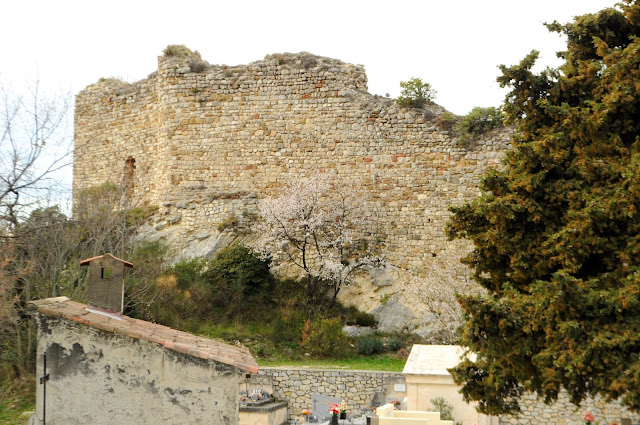
Gigondas defensive fortifications

The Saint Catherine of Alexandria parish church with its central clock tower flanked by a campanile belfry seen below dates from the beginning of the 17th century. A hollow on the front façade shelters a statue of the Virgin Mary.

Gigondas

If you go to Gigondas, make sure you save time to stroll the pretty narrow streets lined with stone houses up to the parish church of Saint Catherine of Alexandria. On the way, you can find pretty views out over the region and the vineyards of Gigondas and the surrounding communes.

Shirley, Darlene and Gwen at one of the several fountains in Gigondas

Shirley and friends in front of our rental "car"

Writing this post made me go to a nearby wine store and buy several bottles of Domaine la Bouïssière Gigondas wines. Decided I couldn't wait till we get to Sablet to pull out bottles from our cellar there. Cheers!


Sunday, February 15, 2015

Domaine de Coyeux, a winery with top tasting wine at the top of the Dentelles de Montmirail

A few months back, I received a text from friends Steve and Mary, I told you about them here, who were in the middle of a séjour in Sablet, saying they had visited Domaine de Coyeux, a winery located high above Beaumes de Venise near the top of the Dentelles de Montmirail.

They said the wines were delicious and the location and views from the winery were spectacular. By the time we arrived in Sablet a few weeks later, we had already decided we would go to the winery and see the sights and taste their wines for ourselves.

Domaine de Coyeux vineyards near the Dentelles de Montmirail

So off we went one Friday morning to Beaumes-de-Venise, a small village about 12 km south of Sablet at the foot of the southern slope of the Dentelles de Montmirail. Beaumes-de-Venise is one of several wine-making villages along the 78 km wine road that circles the Dentelles de Montmirail.

Just outside of Beaumes-de-Venise on the D90 heading toward Lafare, we found a sign pointing the direction for Domaine de Coyeux. We drove up the road until we arrived at a place where there was nothing but vineyards and the Dentelles de Montmirail in front of us. As Steve and Mary said, the views were spectacular. I stopped to take pictures, while Shirley walked ahead.

Road through vineyards up to Domaine de Coyeux

As I said, Domaine de Coyeux is located near the top of the Dentelles de Montmirail, short, steep mountains with a distinctive vertical comb of rock. The name Dentelles, the French word for lace, refers to the jagged, rocky tops obtained by erosion, while Montmirail is derived from the Latin mons mirabilis meaning "admirable mountain".

The Dentelles de Montmirail mountain range is about 8 kms (5 miles) long and runs from Vaison-la-Romaine on the north end to Beaumes-de-Venise on the south. The tallest peak of the Dentelles de Montmirail range is St-Amand, at 734 m (2,400 ft).

Domaine de Coyeux vineyards

The scenery around the vineyards that produce Beaumes-de-Venise wines would fit perfectly into a Tuscan landscape. Grapevines and olive groves mingle, rooted in soil well cared for by the winegrowers. While the name “de Venise” conjures up romantic images, it is of no relation to the Italian city. The name is a distortion of “de Venisse”, meaning “of the Comtat Venaissan”.

Located at the foot of the Dentelles de Montmirail, the terroir’s earth contains three types of soils, as well as deposits of Triassic rock that produces an exceptional type of soil that produces unique wines. Officially granted cru status in 2005, the AOC produces deep colored red wines, in shades ranging from cherry red to purple, as well as the famous dessert wine, Muscat.

Domaine de Coyeux vineyards

Muscat de Beaumes-de-Venise wine was awarded AOC status in 1945. These wines are made through a process of arrested fermentation, to produce what is known in French as a vin doux naturel (naturally sweet wine). This technique is based on adding grape spirit (at a minimum of 96 degrees proof) to the semi-fermented grape must, killing the yeasts and thus stopping the fermentation.

This results in a high level of residual sugar and increases the alcohol content (to about 15%). The finished wines are pale gold when young, with delicate vegetal notes and hints of tropical fruits. With age, they develop a rich golden hue and acquire more-prominent flavors of honey, dried apricot and raisins.

Dentelles de Montmirail

The vineyards around Beaumes-de-Venise are very old; the wines can be traced back to 600 years before Christ, when a Greek community moved into the foothills of the Dentelles de Montmirail. The first vines at Domaine de Coyeux were planted back in the 1950s. The Domaine was taken over by Hugues de Feraudy in 2013, whose family history in the Vaucluse dates back to the tenth century.

Olive tree lined entrance to Domaine de Coyeux

Domaine de Coyeux is located on the southern side of the Dentelles de Montmirail and includes one continuous parcel with 112 hectares (277 acres). The estate has Trias soil with pores filled with clay which capture the winter water from the soil that when released in the summer nourishes the root system of the vines, leaving grape berries thirsting for the sun.

Vines are planted on the Coyeux mountains at 300m (984 feet) elevation, the air currents bring freshness in the summer, contributing to healthy grapes and delicate aromatic wines. The Mistral winds quickly dry the foliage which minimizes the risks of parasites.

Shirley inside the tasting room at Domaine de Coyeux

The Domaine's Muscat wine is produced from vines on contiguous plots, the oldest of which will soon be 65 years old. Domaine de Coyeux produces approximately 140,000 bottles of Muscat wine every year from a unique grape variety called Muscat petit grain. This grape variety splits itself into two varieties, one with black berries and the other with golden berries. Regardless of their color, these two sub-varieties produce sweet Muscat wine.

Domaine de Coyeux

There are 17 hectares planted for production of Beaumes-de-Venise red wine. The age of the vines are between 35 and 65 years. Current production is about 72,000 bottles per year. Domaine de Coyeux farms three red grape varieties which are assembled together for the Domaine's red Cru wine, each with its own characteristics: Grenache, Syrah, and Mourvèdre.

Views from Domaine de Coyeux

Domaine de Coyeux produces a small amount of Gigondas red Cru wine from a vineyard southeast of the village of Gigondas and Muscadin, dry and semi-dry white wines from the same grape variety, Muscat petit grain, as that of the Muscat sweet wine.

View toward Dentelle de Montmirail from Domaine de Coyeux

Muscat sweet wine should be served chilled (6° to 8° C). In addition to serving as a nice aperitif, it perfectly accompanies your meals: Appetizer: melons, foie gras, and warm oysters, Cheese: blue-veined cheeses (Roquefort, Stilton), and Dessert: coffee cakes and red fruit gratins.

Domaine de Coyeux

Steve and Mary were right; the Domaine de Coyeux wines are delicious and the scenery and views are spectacular. We will return when we are back in Sablet with our friends. If you are a wine lover, you should definitely go. If you are looking for spectacular views of the Dentelles de Montmirail, you should go too.

Monday, September 1, 2014

A Ladies' Hike in the Dentelles de Montmirail

OK, I will say it; Shirley enjoys hiking more than I do. Probably not a surprise to those who see us together. One day last spring, Shirley and friend Kari hiked up onto the Dentelles de Montmirail while I walked about our neighboring village of Gigondas and tasted wine at Domaine du Grapillon D'Or.

The Dentelles de Montmirail are short, steep mountains with a distinctive rocky ridge extending west geologically from Mont Ventoux which is located just to the east. When we go out onto the terrace off our bedroom in Sablet, we have a beautiful view of the Dentelles.

The name Dentelles, the French word for lace, refers to the jagged, rocky tops obtained by erosion, while Montmirail is derived from the Latin mons mirabilis meaning "admirable mountain" though the alternative connection with teeth, "dents" in French is equally good in my opinion.

The Dentelles de Montmirail mountain range is about 8 km (5 miles) long and runs from Vaison-la-Romaine on the north end to Beaumes-de-Venise on the south. The tallest peak of the Dentelles de Montmirail range is St-Amand, at 734 m (2,400 ft).

Time to get going, so we drove the short distance to Gigondas. While I wandered off to visit the village and taste wine, camera in hand, Shirley and Kari set off for the top of the Dentelles de Montmirail. The pictures which follow were taken by Shirley on their hike that day.

Dentelles de Montmirail. The little hole was their destination.

Signs point the direction for the top of the Dentelles de Montmirail

Scenic views on the hike

Dentelles de Montmirail

Dentelles de Montmirail

Dentelles de Montmirail

Dentelles de Montmirail

Kari makes it to the portal that looks out over the Dentelles de Montmirail

View over the vineyards from the portal

The ladies returned with a great sense of satisfaction and superiority that they had made it to the top. I didn't mind as I had a good time wandering around the village and dégustation at Domaine du Grapillon D'Or. I will show you what I saw on my visit and tell you about tasting wine at Domaine du Grapillon D'Or in a future post.

Have a good evening. Chat soon.