Showing posts with label Sainte Cécile les Vignes. Show all posts

Monday, April 10, 2023

Sainte-Cecile-les-Vignes, the best Saturday market in the Vaucluse for fresh produce, fish, and flowers

One of the best things about coming to Sablet is shopping at the weekly outdoor "marches" in towns and villages throughout the region ... or at least it is for "foodies" like me. Why would you buy fruits and vegetables, cheese, meats, or fish at one of those supermarkets on the outskirts of town when you can leisurely stroll through a market and choose what you want for the next couple of days. 

Depending on what day we arrive in Sablet, we pick up staples from Alain and Mimi at Vival in Sablet and wait for the next market in the area to buy fresh, perishable foods. We arrived midweek this time and missed the Tuesday morning market in Vaison-la-Romaine. So, on Saturday, we got up early and headed to Sainte-Cecile-les-Vignes for the Saturday morning market. 

Sainte-Cecile-les-Vignes is a small village located 15 kms northwest of Sablet on the border of the Vaucluse and the Department of the Drome. As the name suggests (les "vignes" means the vines), Sainte-Cecile-les-Vignes is an agriculture village devoted to making wine. Vineyards surround the village.

The biggest challenge about going to these markets is finding parking, especially if you are not there bright and early. We always try to go early so we find parking within a reasonable distance of the market. Sainte-Cecile-les-Vignes has proved to be more challenging than others in our opinion, although it is not easy to find parking at any of them. This morning we were lucky.

Entrance through the Belltower into the center of Saint-Cecile-les-Vignes
I don't go to the "marches" with a list of things to buy like I do when I go to the supermarket. No, I walk through the market and buy what is fresh, in season, and local. I never buy anything on my first walk through the market. After I have surveyed what is for sale, I take a second walk through and buy what I liked on my first walk-through. 

There was locally grown green and white asparagus. Did you know there is no difference between green and white asparagus. White asparagus comes from depriving the asparagus of light. Dirt is mounded around the emerging stalk, depriving it of light. The plant can't produce chlorophyll without light, thus there is no green color to the stalks. 

Fresh white and green asparagus from nearby Department of the Gard
Invariably, whenever I buy produce on my first walk through a market, I wish I had waited to buy those tomatoes, eggplants or zucchinis a little way further up the street. The only exception I make to buying at the "marches" is if there is a fantastic poissonnier or fromager in the area whose products are better than what you can find in the marches or for staples like flour, sugar, and milk.

Make up your menus as you walk through the market. Don't worry if you don't have a recipe. Between Google, Instagram and Pinterest, you can find lots of recipes when you search for a particular fruit or vegetable. Choose one that sounds good to you. That way you are trying new dishes which is part of the fun of spending time in Provence.

One of the poissonnier at the Sainte-Cecile-les-Vignes market
The market in Sainte-Cecile-les-Vignes takes place every Saturday between 8:00 AM and 1:00 PM at Le Cour du Portalet, La Place de la Marie and La Place de la Fontaine including in front of the parish church of Sainte-Cecile-les-Vignes. This church replaced a church that the villagers had decided was obsolete. Built between 1854 and 1860, the new church was consecrated in 1860 by the archbishop of Avignon. The church was built from stones brought from Saint-Restitut, a village in the Department of the Drome known for its old stones. Inside the church, you can see alters, pictures, and statues saved from the old church.

Sainte-Cecile-les-Vignes parish church
Tomatoes from the Drome
More asparagus and the famous strawberries of Carpentras
Strawberries have been grown around Carpentras since the late 19th century. Carpentras strawberries means they come from the area around Carpentras, not what variety.  You can find them at markets around Sablet between March and June. 

We were going to visit my elderly cousins who reside in a retirement community in Villeneuve-les-Avignons later in the afternoon. So, we bought a box of strawberries from Carpentras to take them as a treat. Cousin Mauricettes spent the first 21 years of her life in Carpentras. You have never seen a bigger smile on someone's face than when we told them we had brought them a box of Carpentras strawberries. I called them on Sunday morning to wish them Happy Easter and they told me they ate the entire box that evening.

Enjoy your trips to the local marches when you are in the South of France. We recommend you go early. Later in the day, it will be difficult to move around, let alone find parking.  

Thursday, June 27, 2013

Sainte-Cécile-les-Vignes, home to vignerons and a wonderful Saturday morning market

One of the best things about Provence is shopping at weekly outdoor "marchés" in towns and villages throughout the region...or at least it is for a "foodie" like me. Why would you buy fruits, vegetables, cheese, meats or fish at one of those super markets on the outskirt of town when you can leisurely stroll through a market and pick up what you need for the next couple of days?

I say don't go to the "marché" with a list of things to buy like you are going to a super market. No, do like I do and walk through the market and buy what is fresh, in season and local, but don't buy anything the first time through. After you have surveyed what's for sale, take a second walk through the market and buy what you liked during your first walk-through.

Invariably, whenever I buy produce on my first walk through a market, I wish I had waited to buy those tomatoes, eggplants or zucchini a little ways further up the street. The only exception to buying at the "marchés" is if there is a fantastic boucherie, poissonnier or fromager in the area whose products are better than what you can find at the "marchés" or for staples like flour, sugar, and milk.

Make up your menus as you walk through the market. Don't worry if you don't have a recipe. If you are staying at our house, there are quite a few cookbooks to browse through and you can Google the fruit or vegetable and you will get lots of links to recipes. Just choose one that sounds tasty to you. That way you are trying new dishes which is part of the fun of visiting Provence.

We generally arrive and leave Sablet on Saturday. So we pick up staples from Alain and Mimi in Sablet and wait for the Tuesday market in Vaison-la-Romaine to buy fresh, perishable foods. Several guests have told us they like the Saturday morning market in nearby Sainte-Cécile-les-Vignes. Since we got to Sablet on Friday on our last sojourn, we decided to go check out this market.

Sainte-Cécile-les-Vignes is a small village located 15 kms northwest of Sablet on the border of the Vaucluse and the Department of the Drôme. As the name suggests (les "vignes" means the vines), Sainte-Cécile-les-Vignes is an agricultural village devoted to making wine. So you will not be surprised to see vineyards all around the village.

The only door through the ramparts that remains in tact, just happens to lead to the center of the village where the market takes place. As you can see below, the Clock Tower door is topped by a wrought iron campanile with bell.

Clock Tower into the center of Sainte-Cécile-les-Vignes

The market in Sainte-Cécile-les-Vignes takes place every Saturday morning between 8:00 AM and 1:00 PM at Le Cours du Portalet, La Place de la Mairie and La Place de la Fontaine.

The main market street in Sainte-Cécile-les-Vignes

As you can see below, you can choose from a wide variety of fresh fruit. But as I said above, it's best to choose what's locally grown in Provence if you can. Here, strawberries and cherries were locally grown but the melon and cantaloupe came from Spain. But in a few weeks, there will be loads of sweet Cavaillon melons at every market. These are locally grown. You must try one.

A wide variety of fresh fruit is available

Locally grown green and white asparagus. Did you know there is really no difference between green and white asparagus? White asparagus comes from depriving the asparagus of light. Dirt is kept mounded around the emerging stalk, depriving it of light. The plant cannot produce chlorophyll without light, thus there is no green color to the stalks.

Green and white asparagus

Lots of cut flowers. We take several bunches home to put on the table.

Cut flowers

More cut flowers

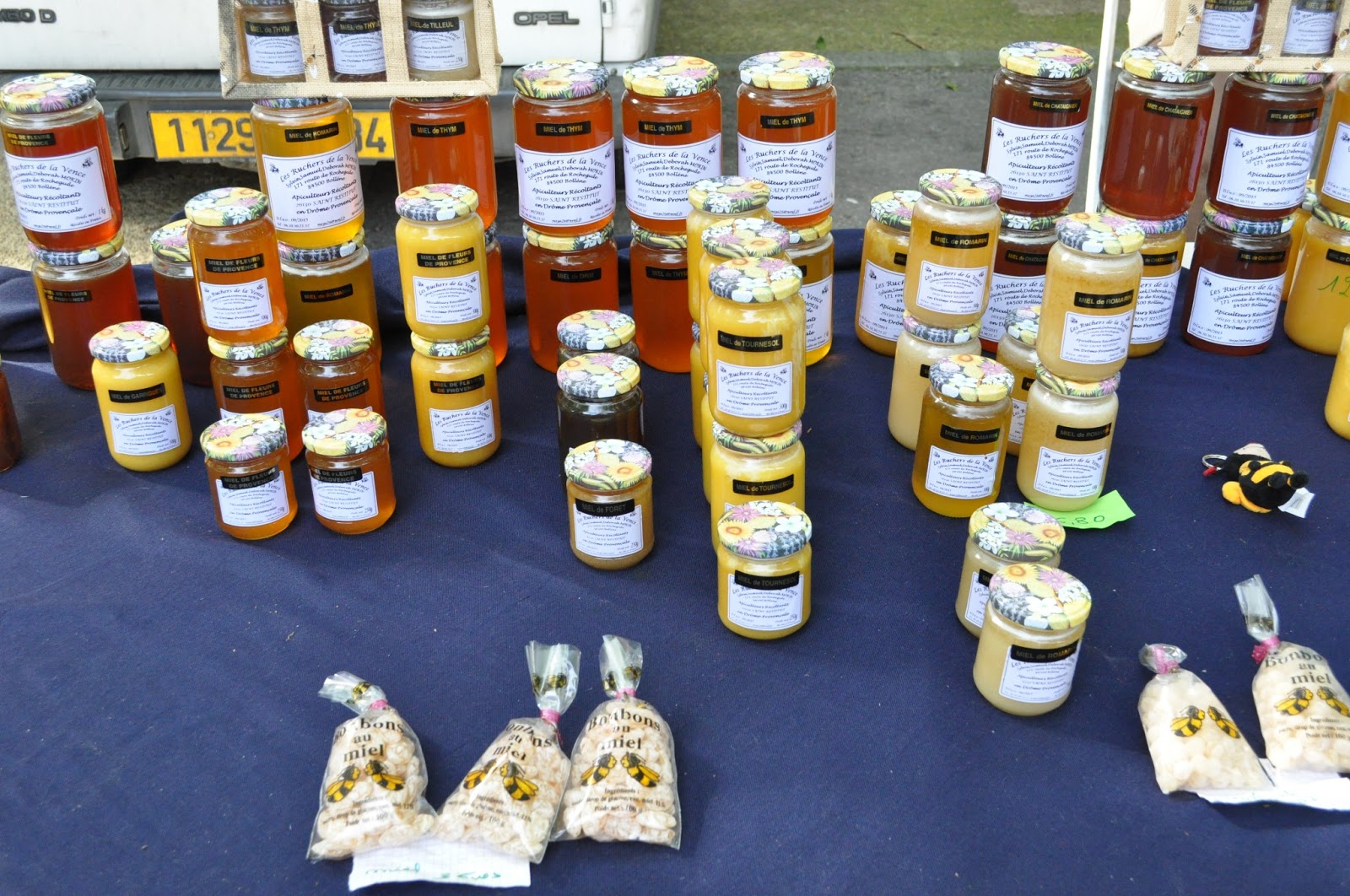
Infused with the flavors of the surrounding landscape, Provence honey is sweet and delicious. Bees generally have a range of no more than about a mile-and-a-half, so if the beekeeper places his hives near an abundant field of one plant—say lavender, rosemary, or chestnut trees—the honey will retain the distinctive flavor of its source material.

Honey

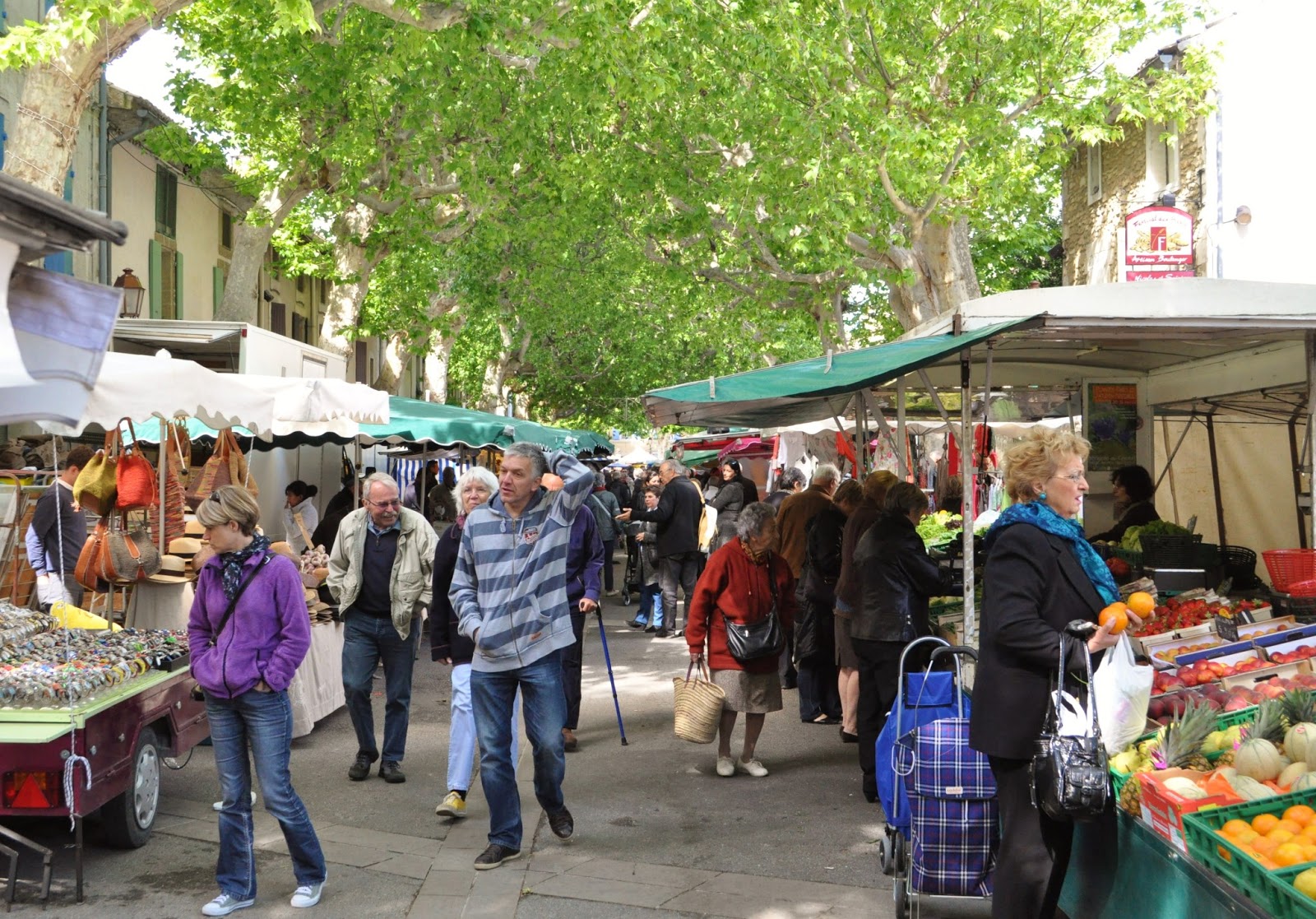
The weather was nice so the market was full of shoppers.

Another view of the main market street

An amazing variety of seafood and whole and filleted fish from the Mediterranean Sea and Atlantic Ocean.

Seafood

Whole fish

Whole fish

The parish church of Sainte-Cécile-les-Vignes seen below replaced a church that the villagers had decided was obsolete. Built between 1854 and 1860, the new church was consecrated in 1860 by the archbishop of Avignon.

The market spreads out on the square in front of the church of Sainte-Cécile-les-Vignes

In front of the Sainte Cécile Church is a statue that honors the men who died for France in WWI. This stone statue by sculptor Félix Charpentier depicts a "poilu", an informal term for French World War I infantrymen, meaning, literally, hairy one. The word carries the sense of the infantryman's typically rustic, agricultural background. Beards and bushy moustaches were often worn.

The sculpted figure below the statue represents a mother crying for her son under a willow tree.

Memorial to men who died during WWI

The Sainte Cécile parish church was built from stones brought from Saint-Restitut, a village in the Department of Drôme known for its old stones. Inside the church, you can see alters, pictures and statues saved from the old church.

The interior of the church of Sainte-Cécile-les-Vignes

The fountain below was inaugurated by Mayor Goudareau in 1881. Market vendors set up their stalls all around the fountain.

Fountain near the Town Hall

Mayor Goudareau was a busy man. He also inaugurated the Town Hall seen below in 1886.

Sainte-Cécile-les-Vignes Town Hall

There is an old winery (dates from the 18th century) in Châteauneuf-du-Pape called Château Fortia. In the early 20th century, management of the winery was taken over by Pierre Le Roy de Boiseaumarie, a decorated WWI pilot.

Baron Le Roy later co-founded the Institut National des Appellations d'Origine (INAO) and helped create the AOC system which is the basis for French wine laws. To show their appreciation, the local vignerons commissioned the bronze bust by sculptor Marcel Courbier seen below near the church.

Bronze bust dedicated to Baron Le Roy

We came across a few nice old fountains as we walked around the town.

Fountain

The streets are lined with houses, most of them picturesque, with their Provencal colors and contrasting shutters.

House with bright shutters and flowers

Unusual stone fountain

The Sainte Cécile Sainte Croix Chapel seen below sits in the heart of the village. It is the oldest religious building in Sainte-Cécile-les-Vignes with the first mention found in 1177. It is thought to be located on the site of a Roman temple. The chapel was reconstructed in 1624 and again in 1843.

Sainte Cécile Sainte Croix Chapel

The village cemetery was located next to the Sainte Cécile Sainte Croix Chapel until 1870 when it was relocated to its present location.

Sainte Cécile Sainte Croix Chapel

Notre Dame de Consolation Chapel is at the entrance to the village on the road to Cairanne. This Chapel was built on the site of an ancient chapel built in 1507. Unfortunately, that chapel was destroyed between 1560-1562 during the Wars of Religion.

The Romanesque Notre Dame de Consolation Chapel seen below was built in 1858 to replace the destroyed chapel.

Notre Dame de Consolation Chapel

If you are hungry after wandering around the market and through the village, we can recommend Campagne Vignes et Gourmandises Restaurant which we told you about here. It has been designated as a Bib Gourmand restaurant in the 2013 edition of the Michelin Guide.

Have fun at the market. Bonne journée mes amis et à bientôt.

Friday, May 6, 2011

Campagne Vignes et Gourmandises, Sainte Cécile les Vignes

One of my favorite restaurants in the Vaucluse is located not very far from Sablet just outside of Sainte Cécile les Vignes along the road to Suze-la-Rousse. The restaurant Campagne, Vignes et Gourmandises, is owned by Sylvain who oversees the kitchen and wife Sylvia who graciously cares for guests in the dining room.

My first meal at the restaurant was with friends Allison and Adam when they visited last spring. Shirley had returned to California and Allison and Adam were leaving the next morning and they took me out to eat as a thank you for staying with us. We had a wonderful meal and I made a mental note to return with Shirley.

We went to Campagne Vignes et Gourmandises last fall on our first evening back in Sablet. We sat on the terrace and the food was wonderful but Shirley couldn't enjoy her meal as she was struggling to stay awake due to jet lag. It must have been pretty obvious because Sylvia came by and said "its too bad madame is not enjoying her meal".

I was in Sablet a few weeks ago with friends Steven and Susan and we decided to go to Campagne Vignes et Gourmandises. As I said, there is a terrace for dining outdoors during good weather and a small very pretty dining room. As the weather was still cool, we were seated in the dining room.

We enjoyed some olives while we considered the options for dinner in the printed menu and on the blackboard which detailed the Retour du Marché menu for 21 Euros. All three of us chose the 3-course Campagne menu for 32 Euros.


We selected a bottle of 2007 Côtes du Rhône-Villages Rasteau from Domaine Beaurenard from the large wine list, a delicious blend of Grenache (80%) and Syrah (20%) to enjoy with our dinner.


Our entrées - starters included Des Ravioles, des petits Gris dans un bouillon aux herbes - ravioles with little escargots in an herb bouillon


and dans une cocotte, un velouté d’Asperges, un Œuf poché, quelques Morilles et crème fouettée - asparagus soup with a poached egg, some morilles mushrooms and whipped cream.


For our plat - main courses, we chose un filet de bœuf, réduction de vin de pays du Vaucluse et Morilles - fillet of beef with a red wine reduction and morille mushrooms and


un filet de Sar, Poivrons et Ail nouveau confit à l’huile d’Olive de Pays - fillet of sea bream, roasted red pepper with garlic confit in local olive oil.


Our dessserts included Des Sacristains, une sauce Araguani, Coriandre et Ananas - sweet puff pastry on a bittersweet chocolate sauce made from a blend of Criollo and Trinitario cocoa beans from Venezuela, coriander and pineapple and


des Fraises de Pays et de Rhubarbe, mousse légère au Lait de Brebis - local strawberries and rhubarb with a light sheep's milk mousse


We also shared a selection of cheeses aged by our favorite cheese lady Josianne from Lou Canestéou in Vaison-la-Romaine.


This was a wonderful meal and I can't wait to go back. Don't hesitate to go to Campagne Vignes et Gourmandises if you are going to be in the Northern Vaucluse.

Bon appétit et à bientôt mes amis.

Saturday, April 30, 2011

La Farigoule, Sainte Cécile les Vignes

As I mentioned in my previous post, we knew Sainte Cécile les Vignes for two of the restaurants in the village. As you know by now, good food is one of my passions in life so we are always looking for good places to eat.

We had tried many times to go eat at La Farigoule, a restaurant located on the main street of Sainte Cécile les Vignes but never succeeded because it was either closed for fermeture annuelle - annual closing, fermeture hebdomadaire - weekly closing or complet - fully reserved.

So after tasting wine at several domaines in Rasteau one morning, it was getting close to noon and time for déjeuner - lunch, I decided I would try again to eat at La Farigoule. This time I was successful; they were open and they were not full.

As I said, La Farigoule is located on the main street of Sainte Cécile les Vignes and there is small terrace for outdoor dining along the street. La Farigoule is a hotel and restaurant.


The day was very gray and cool and it was way too early in the season for outdoor dining so I entered the front door into the pretty dining room with adjoining bar.


I was seated at a linen covered table along the wall with a view of the entire dining room. In addition to the printed menu, there was a menu ardoise - blackboard menu, with the chef's lunch menu for that day.

I chose the four course Sélection du Terroir from the printed menu for 29,00 Euros and a glass of local rosé wine. Very unusual from our experience in the South of France, there was no amuse bouche brought to the table to nibble on while I waited for my entrée - starter.


For my entrée - starter, I chose gratinéed moules with velouté de légumes -gratinéed mussels with vegetable soup.


For my plat - main course, I chose braised chicken with a herb flan and balsamic braised fennel and mashed potatoes.


After my plat, I was brought a plate with greens dressed with vinaigrette and a round of fresh goat cheese.


For dessert, I decided on molten chocolate cake with a little pot of crème anglaise accompanied by a scoop of honey milk ice cream.


The food was simply prepared but very tasty and service was warm and attentive. I will definitely return with Shirley on one of our future visits to Sablet.

Bon appétit et à bientôt. 

Thursday, April 28, 2011

Sainte Cécile les Vignes

Sainte Cécile les Vignes is a small village located 15 kms northwest of Sablet on the border of the Vaucluse and the Department of the Drôme. As the name suggests (les "vignes" means the vines), Sainte Cécile les Vignes is an agricultural village devoted to making wine.

Sainte Cécile les Vignes is one of 95 communes in the Côtes du Rhône Villages area making red, white and rosé wine. Red and rosé wines must be at least 50% Grenache along with at least 20% Syrah and/or Mourvèdre with a minimum 12% alcohol. White wines must be made of 80% Grenache, Clairette, Marsanne, Roussanne, Bourboulenc or Viognier with a minimum of 12% alcohol.

We knew Sainte Cécile les Vignes as a village with two very good restaurants (more about the restaurants in future posts), but didn't know anything else as we had never explored the village. So one day after lunch at one of the aforementioned restaurants, I decided to take a walk around the village.

As you wander the streets around the village, you will find the clock tower topped by its wrought iron campanile with a small bell.


The Mairie festooned with flags.


In olden times (from 1370 onwards) the village was surrounded by ramparts, traces of which can be seen to this day. There are pretty old mansions throughout Sainte Cécile les Vignes.


The Sainte Cécile church.


Memorial in front of the Sainte Cécile church honoring the Ceciliens who have died for France in wars.


The Sainte Cécile chapel which was built in the 12th century and restored in the 17th century.


On the road at the entrance to Sainte Cécile les Vignes sits this pretty, old church, surrounded by the vineyards for which the village is known.


Enjoy your visit to Sainte Cécile les Vignes. Bonne journée et à bientot.