Showing posts with label France. Show all posts

Thursday, April 17, 2025

Roussillon, Our Favorite Village in the Luberon and Most Beautiful

Friends and others headed to Provence often ask where they should go during a once in a lifetime seven-day visit to Provence. This a hard question as most visitors have only 6 days since they usually arrive on Saturday afternoon and depart the following Sunday. There are so many wonderful things to see.

There is something for everyone in Provence; there are amazing Roman ruins and medieval villages for history buffs, lavender, sunflowers and coquelicots (poppies) for artists, weekly marche hebdomadaire (open-air markets with tantalizing displays of fruits and vegetables), great restaurants for foodies, and world-famous vineyards for wine lovers.  

There are perched villages everywhere, summer music and theater festivals, bull fights and the Transhumance for lovers of spectacles, brocantes and vide-greniers for antique hunters, Mont Ventoux for amateur cyclists who want to test their skills on the most famous ascent on the Tour de France, the Dentelles de Montmirail for hikers and picturesque villages with beaches along the Mediterranean Sea. 

We usually suggest a visitors include a trip to the vibrant red-ocher colored town of Roussillon, one of five villages nestled in the Luberon hills which are classified as Plus Beaux Villages de France (Most beautiful villages of France). Roussillon is one of our favorite villages and just one hour from Sablet.

The Luberon stretches 35 miles along a ridge of rugged hills from Cavaillon in the west to Manosque in the east and from the town of Apt south to the Durance River. Much of the area including Roussillon lies within the borders of the Parc Naturel Regional du Luberon, a protected area with outstanding natural beauty.

Ocher colored houses outside Roussillon

Roussillon sits on the southern edge of the Plateau de Vaucluse above one of the world's largest known ocher deposits where 17 shades of ocher -- violet, blood red, orange, yellow, and everything between were once mined. 

Roussillon


Roussillon

Just a few minutes' walk from the village is the beginning of the Sentier des Ocres (Ocher trail). Ocher is a natural pigment in the sandy soil which form the cliffs around Roussillon. Iron oxides color the sands into shades ranging from yellow to violet. The mineral landscape shows the effects of erosion and mining work done by man.

Two different trails, one short, one long takes you through the ocher lands on a 30-minute or 60-minute walk. You can stay as long as you like. Information signs along the way describe the geology, flora and history of the ocher deposits in the Luberon. The trails take you past multi-colored ocher formations set against a backdrop of pine trees. There is a small admission fee. 

Ocher cliff outside Roussillon


Water fountain in Roussillon


Roussillon shop


Historical oil mill in Roussillon

Roussillon must have more restaurants per head of population than any other Luberon village. Most are clustered around Town Hall Square. A little lower down, with its dining room sailing out into the ocher void, is the more upscale David. 

View back toward Town Hall Square and shops and cafes along the street

The belfry was the ancient entrance into the fortified area called the Castrum. The belfry was renovated in the 19th century as a bell tower adjoining the church. The first street on the left takes you along the former watchman's walkway, which ran between the two towers on the rampart wall. There are great views of the village and surrounding area.

Roussillon belfry and clock tower

Saint Michel Church whose origins go back to the 11th century, originally faced the castle, inside the fortified walls. The church has undergone countless renovations over time, necessitated in part by its location by the cliff.

Saint Michel Church

Ocher only became a widespread, industrial product in the late 18th century when Roussillon native son Jean-Etienne Astier came up with the idea of washing the ocher-laden sands to extract the pure pigment.

View towards village cemetery from top of Roussillon


Archway view out over the Luberon valley

The Librairie (bookstore) in La Maison Tacchella to the left and the Hotel de Ville (Town Hall) to the right in Town Hall Square, the main village square.

Town Hall Square

As you can imagine, the beauty of Roussillon draws crowds of visitors during tourist season. It is the most visited village in the Luberon after Gordes, a few miles to the west. Despite this, we have never had any problem finding parking close to the village.

We think its best to visit in the morning when the first sunshine of the day strikes the village, to see the glowing colors at their most stunning. Roussillon is fairly small, so it doesn't take very long to explore. So combine a visit to Roussillon with a visit to Gordes or other hill towns in the Luberon.

Town Hall Square Cafe


Mural painted on a Roussillon garage door

Don't forget your camera when you go, you will definitely want to take a lot of pictures. 

Monday, October 14, 2024

All My Friends in France Dream about Eating at this All-You-Can-Eat Buffet

About one year ago at this time (April 2024), The New Yorker Magazine published an article entitled "The Hottest Restaurant in France is an All-You-Can-Eat Buffet". Being a Foodie and person who attempts to stay current about the best restaurants, I immediately read the article.

The next thing I did was call Cousin Jean-Marc who lives near Montpellier France about 100 km from this All-You-Can-Eat buffet called Les Grands Buffets and asked if he had ever dined there. He said "no", but he has wanted to go there for a long time. 

So, we decided he would get us reservations for lunch in October when we would be back in France. To make reservations, you must go to the restaurant's website and enter your email address for a secure link to make a reservation online. A few days later, I got a message from Jean-Marc that we had reservations for 12:00 on Monday, October 7.   

On the appointed day, we departed from the cousin's house in plenty of time so we would not be late for our reservations. Les Grands Buffets is located in a large rec center built by the local government in the city of Narbonne.

Les Grands Buffets is owned by Louis Privat, a native of Narbonne. He sees his restaurant as something like the "Louvre of Dishes" and serves only what he considers to be traditional French food, in the style of Auguste Escoffier. In 2023, more than three hundred eighty thousand people dined at Les Grands Buffet. It is considered to be the highest grossing restaurant in France.

From the lobby of the rec center, you can enter a bowling alley, an ice rink, or Les Grands Buffets. We arrived a few minutes early, so we were invited to go to the bar and wait until we were called to be seated at our table. 

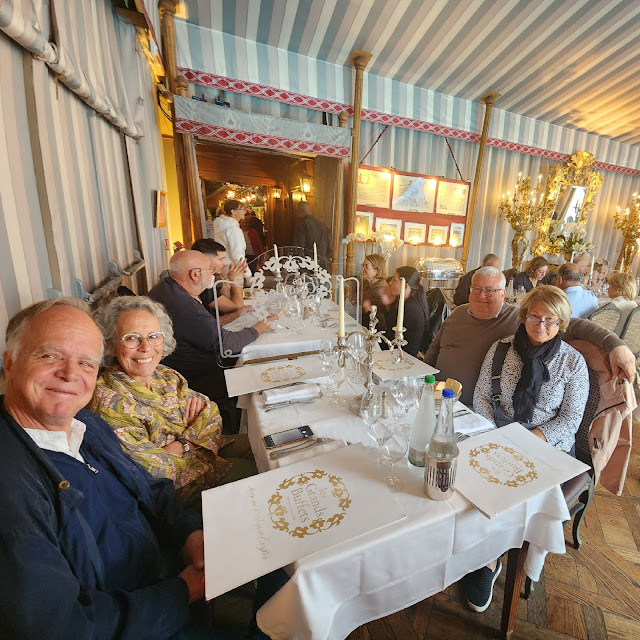
Les Grands Buffets has four dining rooms, decorated in different styles. We were seated in the tented room, which pays tribute to Louis XIV, including an original map from Jean-Baptiste Nolin, the official map maker of the King, engraved in 1697 to celebrate the completion of the predecessor canal to the Canal du Midi. 

Tables are set in a manner similar to a 3-star Michelin restaurant down to fish knives. Waiters' clear plates and serve drinks. 

Crystal surrounds this 7-layer lobster tower


Shellfish Station


Charcuterie Station


There are 5 Pates en Croute, meat pates wrapped in pastry dough and baked until golden brown


Cote de Boeuf with choice of sauces such as peppercorn, red wine, and bearnaise

There is a rotisserie, where guests line up in front of an open kitchen, and cooks in tall, round, pleated, starched white hats, prepare dishes ordered by the guests waiting in line. There is a list of twenty-six specialties that guests can choose to have prepared in front of them. 

Cheese "Platter" with 111 varieties certified by Guinness as the largest known in the world


More of the cheese "platter"


Made to order Crepes Suzette


Chocolate Fountain


There are 50 different choices of dessert


A table in the Tented Room


Shirley and me with cousins Jean-Marc and Christine in the Tented Room

Les Grands Buffets is open 365 days a year for lunch and dinner. The current all-inclusive price for a meal is 62.90 Euros per person. Drinks are extra, but they are sold at the same price as at the producer so there is minimal markup on champagne and wine. Everything else is unlimited. 

Last year, the city of Narbonne pledged fifteen million euros to renovating the rec center and creating a separate entrance for Les Grands Buffets. Privat committed five million euros to the creation of new attractions including a separate tea salon and shop selling regional products. 

As we plan outings with friends and family from around Sablet, so many have said they dream of going to eat at Les Grands Buffets. It seems that it has been featured on French television on more than one occasion. 

There is a note on the restaurant's website at this time that says "Reservations are currently not possible for meals after September 30, 2025, due to an overhaul of the Grands Buffets reservation software. Reservations for later meal dates are expected to open in July 2025. 

Les Grands Buffets
Rond Point de la Liberte
11100 Narbonne
France
Tel: +33 4 68 42 20 01
Website: lesgrandsbuffets.com

Saturday, February 24, 2024

Our Visit to the Breathtaking Valensole Plateau Lavender Fields

Every year, thousands of tourists' travel to the sun-drenched South of France region of Provence. One of its biggest draws, field upon field of perfect rows of sweet-scented, violet-colored lavender. 

There are four main regions where lavender is grown in Provence. They are the Plateau de Valensole, the Luberon Valley, Pays de Sault, and the Drome Provençale. We have visited all of these areas several times except for the Plateau de Valensole. 

Last summer, with friends from Washington DC in tow, we loaded into our car in Sablet and headed out for the 122 km drive to the famous Valensole plateau to tour the lavender fields in the Alpes-de-Haute-Provence.  

The lavender fields on the Valensole plateau are the most photographed in Provence. This plateau, at 500 meters elevation is dedicated to the cultivation of cereals, olive trees and lavender. The plateau extends over 800 square km and offers a breathtaking panorama of the Provencal countryside. 


Lavender Field in Valensole

Lavender attracts thousands of tourists and bees, hoping to time their visit for the peak of the flowering cycle. The precise timing of flowering changes annually, depending on the weather. Typically, some fields are in full bloom by late June, and the harvest is mostly complete by mid-August.


Lavender Field in Valensole

There are many varieties of lavender. Although we typically associate lavender with purple flowers, the varietals include many colors, from deep blue to white. The plants love the dry, sandy, rocky soil that is typical of southern France.


Lavender Field in Valensole

Lavender has been cultivated at least all the way back to biblical times. Lavender is referenced in the bible as a holy herb nard. The Greeks and Romans used lavender for personal hygiene and medicinal purposes. The Romans used lavender flowers to scent bath water. The flowers and essential oils have been used throughout the ensuing centuries for everything from repelling insects to treating burns to sleep therapy. 


Lavender Field in Valensole

Two main lavender varieties are grown in Provence. The “real” lavender is a small, tufted plant with a single floral spike. Each plant is unique. The plants grow naturally at elevations between 600 and 1,400 meters, but cultivation is generally above 800m. Each plant is unique.


Lavender Field in Valensole

Lavandin is a hybrid, the result of a cross between lavender and a wild varietal, lavender aspic. It’s a hardy plant, less susceptible to disease, and it grows at lower altitudes (200 – 1,000m above sea level) than fine lavender. Since lavandin is a clone, the plants have identical biological footprints, propagated by cuttings. A single lavandin stem has three blue-purple flower spikes.


Lavender Field in Valensole

Be forewarned, lavender season brings traffic congestion. Bus tours and cars clog typically quiet roads while their passengers walk into the lavender fields to snap selfies and photos of each other in the fields. 


Lavender Field in Valensole

Much of the lavender grown in Provence is distilled for essential oil and fragrant water. The plants are also dried for scented objects. Tourist shops in Provence carry lots of lavender products, soap, perfume, honey, tea, ice cream and scented packages. Be aware, some of the products sold in stores are mass-produced outside of France and hardly artisanal.


Lavender Field in Valensole

Because of the size of the lavender fields, the lavender harvest is usually not done by hand. A tractor passes through the field, cutting the lavender and leaving small bundles in its wake. The cuttings then dry in the sun for 2-3 days before being gathered into giant bundles similar to large hay bales. 

At the distillery, the bales are dropped into cauldrons with water where the steam passes over the flowers creating the essential oil and lavender water. To produce one liter of essential oil requires 200 kg (440 lbs) of lavender flowers. 


Shirley and I on our 50th Wedding Anniversary in a Valensole Lavender Fields

Walking through lavender fields in Provence on your wedding anniversary is about as romantic a setting as you can find in my opinion. 

Just before we left California for our trip to Sablet, Shirley played her one and only pickleball game and fell and broke her wrist in 4 places. We were grateful the doctor was able to put her wrist in a cast. We were hoping it would fully heal that way but unfortunately, she had to undergo surgery a few months later.

After touring around the Valensole plateau for a few hours, we drove into the town of Valensole, to find a place to eat and drink. 

Valensole

You can find lots of guides online that identify where the prettiest shots of lavender can be found on the Valensole plateau. However, because harvest occurs at different times and growers replant fields as they age, it is not always possible to find all of the recommended locations. Yes, it was a long drive from Sablet, but worth the effort in our opinion. 

If you are still searching for a house to make your home during your sojourn in Provence this year or in future years, please don't hesitate to visit our website at www.sablethouse.com You can also email me at chcmichel@aol.com  

Monday, May 1, 2023

Visit to one of the 7 Most Beautiful Villages in Vaucluse

We usually take daily trips away from Sablet to explore the Vaucluse and surrounding Departments. We probably go most often to the hill-top villages of the Luberon including Venasque, which is what we did a few weeks ago.

Venasque is a small pretty village that clings to a rocky hillside overlooking vineyards, garrigue (areas of shrubby vegetation found in the Mediterranean region), and cherry trees. It is classified as one of the "Plus Beaux Villages de France" (translated as most beautiful villages of France).

Cherries have been grown in this part of Provence since the 17th century and it remains the largest cherry producing region in France. Cherries from Venasque are said to be the best; the village refers to its cherries as diamants rouges (red diamonds). 

Venasque
Venasque is one of the oldest villages of the Comtat Venaissin often referred to simply as the Comtat. Comtat means county in its original sense, or land belonging to a count. Venaissin refers to Venasque, a former bishop seat which gave its name to the Comtat. 

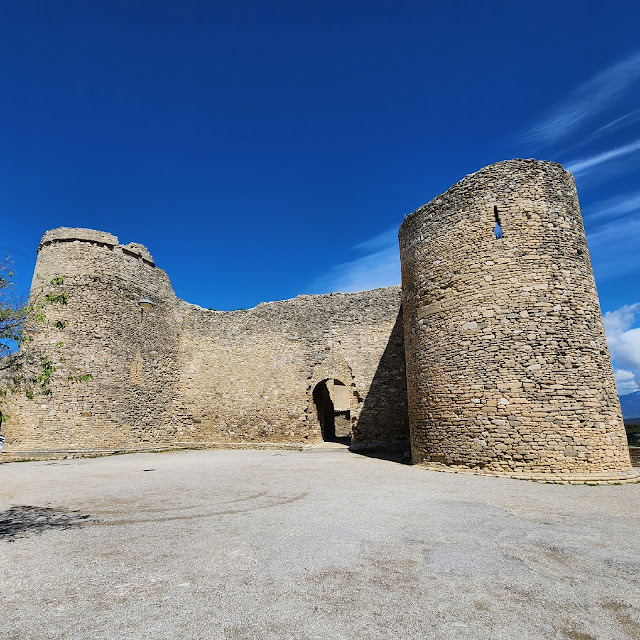
Saracen Towers and Arched Doorway through Defensive Walls
Venasque's location on top of the hill provided a natural defense against attacks from enemies. Nevertheless, in Roman times, a defensive wall with towers was built around the village. The arched doorways were restored at the beginning of the 20th century.

Defensive Wall
The thick walls of the ramparts which survive connect three Saracen towers and two arched doors. Supposedly the stones in the defensive wall that no longer exist were removed as if the walls were a sort of rock quarry and used to build the school and village houses. 

One of the reasons we like to come to Venasque is because of Les Remparts restaurant. At Les Remparts, you can sit in the interior dining room, a large sunroom or a small outdoor terrace with views of the valley on sunny days.

Les Remparts offers a number of prix fixe menus, including a 3-course vegetarian menu currently priced at 39 Euros. Food is always well prepared and beautifully plated. We recommend you reserve ahead. 

Les Remparts Restaurant
As you can see, Venasque is a small village. There are only 1013 people who reside in the village according to the lastest census. 

Water was piped to houses throughout the village between 1959 and 1965. Prior to this time, villagers got their water from the various fountains scattered throughout the village.

The fountain in the center of Venasque at Place de la Fontaine

Artist workshop in Venasque

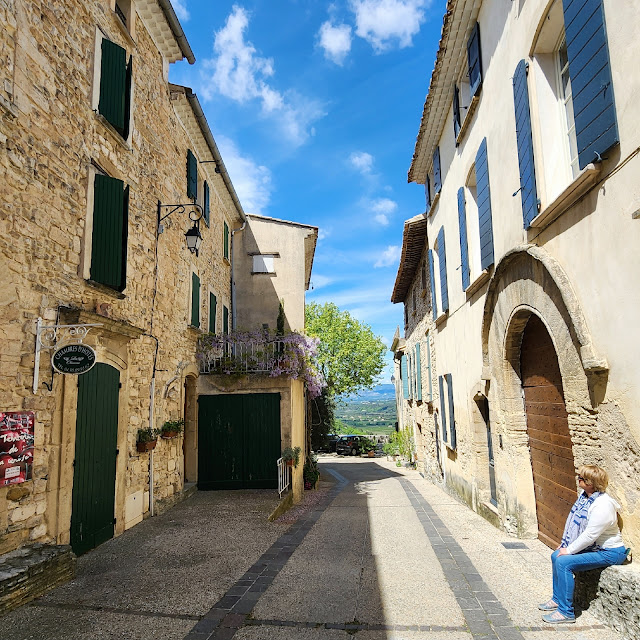
Lady taking in the views down the Venasque street

Hotel de Ville (Town Hall)
The Notre Dame church in Venasque dates from the end of the 12th century. The side chapels date from the 17th and 18th century, and the bell tower from the 17th century. 

Notre Dame Church in Venasque
Inside the church, there is a very beautiful baptistry. Its origins are unclear, but it is believed to be the oldest religious baptistry in the region.

Iron Cross near Notre Dame Church in Venasque

War Memorial in Venasque near Notre Dame Church

Arched Passageway into and out of Venasque
It is worth the trip up the hill off the D-4 to visit Venasque. As I said, it is small and will only take you a couple of hours to walk around the village. Try to time your visit so you can eat lunch at Les Remparts. You will be happy you did.

Les Remparts Restaurant
37 Rue Haute
84210 Venasque
Tel: 04 90 66 02 79

Friday, April 14, 2023

Friday is Market Day in Sablet

In previous posts, I have shared the criteria that we considered as we searched for a house to buy in the South of France. Near the top of the list after Shirley's #1, "no-fixer-uppers", was our desire to own a house in a village that was active year around so we could visit whenever we wished. 

This meant we wanted a "living village" which for us meant, not tourist dependent as they essentially shut down from early November to middle of March. This eliminated a lot of villages in the Alpilles, Luberon or near the Mediterranean Sea. 

We discovered as we searched that small villages in the Cotes du Rhone and other wine making regions are open year around as wine making is a year around process. Thus, we considered these villages "living villages".

It seems that our village has only gotten better as a place to live or visit since we bought back in 2008. The village of Sablet has a population of 1381. We have a boulangerie that is open 365 days a year. We have a butcher shop; a very well stocked grocery store called an épicerie, a bar/cafe in the center of the village, a pizzeria, and a fine dining restaurant called La Table de Magali.

We have a pharmacy, a medical office, a dentist, a floral shop, two salons, a dress shop, a tourist information center where they sell local wines, and a tabac where they sell stamps, and French, English, and German newspapers and magazines. There are two churches and a bank with ATM machine. 

More recently, the village has seen their Friday morning market in the center of Sablet expand with the addition of new vendors, some of whom are shown in the pictures below. While the market is small (we recommend you go to one or more of the larger weekly markets in the area), the quality of fish, cheese and fruits and vegetables sold at the Sablet market is excellent. 


View of Sablet from Rue du Stade

Fruit and Vegetable Seller

Mobile Fromagerie

Le Poissonier

Seller of All Things Related to Honey

Something akin to a Mobile Italian Alimentari 

A Close-up Look at the Products on Offer from the Mobile Italian Alimentari 

Another Fruit and Vegetable Seller

Freshly Made Paella to Go

I have written posts about weekly markets in Vaison-la-Romaine, Nyons, Carpentras, Sainte-Cecile-les-Vignes, and Uzes, I have never written about our own smallish market that takes place every Friday morning on Place De L'Aire De La Croix, in front of Bar des Sports. 

Between the shops in the village and the Friday weekly market, you can live very well in Sablet and never venture out to shop anywhere else. Parking gets a little tight late Thursday night until after market on Friday as there is no parking on Place De L'Aire De La Croix, which normally is full of cars. 

If you are looking for a home to rent for a holiday in Provence, we still have multiple weeks available in May and June as well as a few single weeks through the end of October.  I hope to hear from you.