Showing posts with label Gard. Show all posts

Monday, September 5, 2022

Excellent Seafood Restaurant near the Port of Le Grau-du-Roi and a Water Jousting Match to Boot

On a warm Saturday a couple of weeks ago, we headed seaside to Le Grau-du-Roi, a fishing port and beach resort, with cousins Jean-Marc and Christine. We figured we would find cooler temperatures near the Mediterranean Sea and bonus, we could try out a new restaurant I had read about.  

Le Grau-du-Roi is a commune in the Gard Department about 1.5 hours south from Sablet. Le Grau-du-Roi is the only commune in the Gard Department to have frontage on the Mediterranean Sea. Le Grau-du-Roi is the second largest French fishing port on the Mediterranean. 

Port of Le Grau-du-Roi

I made reservations at Le Vivier Restaurant early in the day. As we made our way toward Le Grau-du-Roi, it became clear we would be quite late for our reservation because of heavy traffic on the A-9. So I called and they said come ahead, but get there as soon as possible.

When we finally got there, we were kindly welcomed and seated at a table on the terrace. The charming owner told us they didn't mind tardy arrivals but since the chef works by himself in the kitchen, they try to keep to their posted hours as closely as possible. 

Le Vivier in Le Grau-du-Roi

The menu offers a wonderful selection of seafood and fresh fish with very tempting accompaniments. I debated between Couteaux, Razer Clams in English, that were dressed with a Safran Cream sauce and Tellines also in a cream sauce. For those who don't know, Tellines are tiny triangular shaped multi-colored clams. 

Cousin Jean-Marc order a platter of mixed seafood that includes oysters, sea snails, and shrimp. The ladies passed on starters and said they would order dessert instead. 

The owner steered me to the Couteaux, saying the Tellines were really tiny right now. I didn't know what to expect as I had not tried Couteaux before but was really happy I took her advice. They were perfectly tender and delicious with their sauce. 

Couteaux (Razer Clams)

The main courses offer a nice selection of fish, any of which I would have been happy to try. Cousin Christine chose the "Poisson du Jour" which this day were Rougets accompanied by veggies and a sweet potato puree. 

Rougets with Sweet Potato Puree and Vegetables

Shirley opted for the filet of Daurade (Sea Bream) with a mint, dill and citrus broth accompanied by tomatoes and zucchini. 

Filet of Daurade (Sea Bream) with a Mint, Dill and Citrus Broth accompanied by Tomatoes and Zucchini

Jean-Marc and I both ordered Whole Wild Fish which were a duo of whole fish, which changes plate to plate with a citrus cream sauce accompanied by crushed potatoes and veggies.

Duo of Wild Whole Fish with a Citrus Cream Sauce and Crushed Potatoes and Vegetables

Our dessert selections were Frozen Citrus Souffle accompanied by a citrus coulis and fresh fruit,

Frozen Citrus Souffle with Citrus Coulis and Fresh Fruit

Lingot Glace accompanied by caramelized peanuts and fresh fruit,

Lingot Glace with Caramelized Peanuts and Fresh Fruit

Frozen Chocolate Souffle and fresh fruit. 

Frozen Chocolate Souffle with Fresh Fruit

After lunch, we walked along the canal that connects the fishing port to the Mediterranean to see the lighthouse at the entrance. As we walked, we watched the water jousters (Joutes Nautique in French) in combat on the canal. 

In water jousting, two wooden boats are rowed towards each other by eight or ten oarsmen. One jouster on each boat stands on a raised platform at the stern of the boat about 10 feet above the surface of the water. In addition to the jouster and rowers, the crew consists of a helmsman and two musicians, and jousters who will participate in the next match.

Water Jousting Team

Jousters carry a shield 70 cm high and 40 cm wide and a lance 2.8 meters long. They must wear white outfits and white shoes. As the boats approach each other propelled by the rowers, the jousters crouch with their lances directed towards their opponent. A direct hit will propel the unlucky jouster into the air before he falls into the water. 

Water Jousting Team

In case you think these matches have been created as tourists attractions, you will be interested to learn that jousts have been carried out since ancient times. There are records of jousts going all the way back to the time of Christ. This form of jousting is practiced in eight towns in the Herault Department and one town in the Gard, Le Grau-du-Roi. 

The Water Jousting Teams Meet in "Combat".

Our meal at Le Vivier with the dishes of very fresh fish and seafood prepared by an excellent chef made the trip from Sablet worthwhile. Finding out they were jousting on the canal was just icing on the cake.  

I would recommend making reservations at Le Vivier as its a very good restaurant and very popular, especially during tourist season. Parking is available a short distance away. 

Le Vivier Restaurant
7 Rue du Commandant Marceau
Le Grau-du-Roi
Tel: 33 (0) 4 66 53 23 36
website: https//levivier-restaurant.fr

Friday, January 14, 2022

Delicious Lunch at Le Comptoir du 7 in Uzès

Every day trip almost always includes lunch. Before we go, I Google for local restaurants and check out those that were chosen by the inspectors to be in included in the red Michelin guidebook for the area. During our time in Provence now, we have run across more than a few who are closed for vacance annuelle for a week or more. 

Despite the challenges of les vacances annuelles, we have been fortunate to discover some old favorites and new to us restaurants that are open.  When cousin Jean-Marc called me the night before our rendezvous in Uzes to confirm plans that I told you about here, he said make sure you make reservations for lunch tomorrow. 

We have dined at several restaurants in Uzes over the years that have been quite good. I was curious if there might be one that was new to us and going to be open the next day. I like to call during dinner service as you usually reach someone to answer the telephone. Sure enough, they answered the phone at Le Comptoir du 7. They would be open for dejeuner the next day and had a table for 4 of us. 

After walking around the weekly market in Uzes for a while, we ran into Jean-Marc and Christine and headed over to the Le Comptoir du 7 restaurant. It was close by on the ring road that surrounds Uzes. We walked in and were immediately asked to present our Pass Sanitaire showing that we are fully vaccinated.    

Le Comptoir du 7 Restaurant in Uzes
l
The interior of the building is a long half-pipe with stone arch ceilings and walls which we found were from the days when the building was a relay station for France's version of the pony express. Le Comptoir du 7 Restaurant is the 2nd of 2 restaurants owned by the Maison St George Group.


The menu changes seasonally based on what is fresh locally and what arrives on a daily basis at the market. The cousins went with the 3 course menu of the day and we went with choices from the a la carte menu.

Shirley's Filet de Bar with Beet Puree


My Lamb Shoulder


The Cousins Filet of Salmon from the Menu of the Day

The ambience was pleasant and our meal was very good and service was friendly and attentive. Definitely would return here again if we are in Uzes for the market or after a trip to the Pont du Gard.  

Le Comptoir du 7 Restaurant
7 Boulevard Charles Gide
30700 Uzes
France
http://www.maisonsaintgeorges.com/
Tel: +33466221154

Sunday, January 9, 2022

Meet up with Cousins in Historical Uzès

There are towns and villages we happily visit time and again because of their uniqueness, proximity to historical sites, special markets, or cultural attractions. As Uzes has it all, a well-preserved chateau, cobblestone streets, 2 wonderful weekly markets, close to the Pont du Gard, and a Duke, it was an easy decision to meet cousins Jean-Marc and Christine in Uzes a few days ago.

Uzes is a well-preserved medieval town in the Gard Department on a promontory above the Alzon River. The old town, population 8,454, is surrounded by boulevards shaded by plane trees that have replaced the medieval defensive walls. Inside there is a maze of small streets and shaded squares lined with beautiful old houses and mansions from the 17th and 18th century. 

Pictured below is the 12th century Bishop Tower which was the seat of the bishop's secular powers, used as a tribunal and prison. This tall square tower is topped by an octagonal clock tower and belfry added in the 19th century.

Bishop Tower (clock tower)

The Saint-Theodorit Cathedral seen below, was formerly a Roman Catholic cathedral, but is now a parish church, named in honor of Saint Theodoritus. It was the seat of the Bishops of Uzes until the diocese was abolished under the Concordat of 1801 and its territory passed to the Diocese of Avignon.

The cathedral was destroyed during the Albigensian Crusades, rebuilt and destroyed again in the 16th century Wars of Religion and rebuilt again in the 17th century before it was gutted during the French Revolution. In the 19th century, a new west front was added.

The Fenestrelle Tower avoided destruction in 1621 and is the only part of the cathedral which survives from the medieval structure. The tower is built in the style of the medieval Italian Lombard towers and is the unique example in France of a round clock tower.

Saint-Theodorit Cathedral and Fenestrelle Tower

Saint-Etienne Church, the belfry can be seen below, was built between 1763 and 1775 on the location of an ancient church that was destroyed  during the Wars of Religion.

Clock and belfry on top of the St-Etienne church tower

The Duche is the defensive feudal castle standing in the center of Uzes old town. The castle was never attacked or damaged and is in very good condition. Uzes is the "First Duchy of France", France's oldest and most important ducal peerage. Uzes was made a Duchy in 1565. 


The exterior courtyard of the Duche (Duke's castle) of Uzes

The Bermonde Tower is the Duche's keep, built in the 11th century by Bermond 1st. The corner watch towers seen below were added during a restoration in the 15th century. 

Another view of an exterior courtyard of the Duche of Uzes

Since we had never visited the castle, we decided to take a tour of the areas open to the public. First things first, we began our visit by climbing 135 steps up a narrow drill-bit like stairway to the top of Bermonde Tower.

At the top, there is a wonderful view of Uzes. This day was sunny but very cold and extremely windy, the Mistral and all. I had to hold on to my glasses because I feared they would get blown off my face and sent over the side of the Tower. 

View of Saint-Theodorit Cathedral and Fenestrelle Tower from atop the Bermonde Tower

The castle is a blend of architecture from the different periods of French history. It features 1000 year old wine cellar, feudal towers, ramparts, and both a Renaissance and 18th century facade. The apartments house fascinating collections of furniture.

A "French" girl standing at the entrance to Duche castle


An interior courtyard at the Duche castle

Jacques de Crussol is the current duke of Uzes and owner of the castle. Born in 1957, he divides his time between France, Switzerland and Italy. Just like the Queen of England, his family's flag flies over the castle when he is in residence. 

A portrait of Jacques de Crussol, the current duke of Uzes

The castle's gothic chapel with its magnificent stained glass windows seen below is consecrated and masses are still held there.  

Consecrated chapel inside the Duche castle

The Uzes market is held every Wednesday and Saturday morning throughout the year on Place des Herbes and along the neighboring streets. With its fountain, arcades and terrace cafes, Place des Herbes is a great place to shop for regional specialties. Afterwards pause for coffee or a leisurely terrace lunch. Parts of Cyrano de Bergerac starring Gerard Depardieu were filmed there.

Despite all there is to see and do in Uzes, the Gard Department's most impressive attraction is a 15 minutes drive to the Pont du Gard, a short span across the Gardon River built by the Romans to bring water from the Eure Springs near Uzes to Nimes. The Pont du Gard is definitely not to be missed.

Wednesday, May 19, 2021

A Visit to Uzès is a Great Idea After a Visit to Nearby Pont du Gard

Loyal readers who follow my musings about Provence know that visits to the Pont du Gard are a regular part of our annual visits to the South of France. However, after you have walked out to the Roman acqueduct and walked across the bridge and hiked to the top of the hill on the other side to marvel at its beauty, the question inevitably arises about what are we going to do for the rest of our day. Visits to the Pont du Gard do not require a full day unless you are going to paddle a kayak down the Gardon river which by the way is great fun.

Many times, we head to nearby Uzès, a short 15 minute drive. Uzès is a well-preserved medieval town in the Gard department set on a promontory above the Alzon River. The old town is encircled by boulevards shaded by plane trees that have replaced the medieval defensive walls. Inside, there is a maze of small streets and shaded squares lined with beautiful old houses and mansions from the 17th and 18th century.

Cobblestone street to center of Uzès with Bermonde Tower in background


In the mid-16th century, many citizens of Uzès were Calvinist and the town was the 5th largest Protestant town in the kingdom. Religious wars resulted in the destruction of all the churches and of the temple that Uzès had at the time. In 1685, the revocation of the Edict of Nantes caused many to leave for Protestant countries in Europe, or their colonies.

 
Clock and belfry on top of the St-Etienne church tower


Starting in the 15th century, Uzès produced woolen, twill and cloth, then stockings and finally silk, until a mulberry tree disease deprived the town of its textile industry, which provided employment for 2000 people. This decline took the town with it, despite the development of the pottery industry and the licorice factory at the end of the 19th century.

Clock and belfry on top of the St-Etienne church tower


In the 20th century, Uzès gained a new lease on life when its town center was classified as a “protected zone” in January 1965. Ever since, Uzès has been upgrading and improving the town: roads have been paved, electricity cables hidden, facades renovated and the “protected zone” has been enlarged from 29 acres in 1965 to 101 acres today.
 
Pretty Uzès Shop


The Duché is the defensive feudal castle standing in the center of Uzès old town. Uzès is the "First Duchy of France", France's oldest and most-important ducal peerage. Uzès was made a Duché in 1565. The current owner of the castle, Jacques de Crussol, is the 17th Duke of Uzès. He grew up in the castle but these days, he actually lives in Paris but makes a point of coming to Uzès once a month, and spends most of the summer at the castle. Just like the Queen of England, his family’s flag flies over the castle when he is in residence.

Bermonde Tower (castle keep)


The Saint-Théodorit Cathedral seen below, was formerly a Catholic cathedral, but is now a parish church, named in honor of Saint Theodoritus. It was the seat of the Bishops of Uzès until the diocese was abolished under the Concordat of 1801 and its territory passed to the Diocese of Avignon. 

The cathedral was destroyed during the Albigensian Crusades, rebuilt, and destroyed again in the 16th century Wars of Religion and rebuilt again in the 17th century before it was gutted during the French Revolution. In the 19th century, a new west front was added. 

The Fenestrelle Tower avoided destruction in 1621 and is the only part of the cathedral which survives from the Medieval structure. The tower is built in the style of the Medieval Italian Lombard towers, and is the unique example in France of a round clock tower.

Saint-Théodorit Cathedral and Fenestrelle Tower


Uzès passageway to Place aux Herbes


Saturday morning, a huge traditional Provençal market fills the Place aux Herbes to overflowing with fruits, vegetables and flowers, but also jams and honey, ceramics and linens, pots and pans, clothes and shoes. There’s another, smaller version on Wednesday mornings too. 

The square itself, large and asymmetrical, is planted with plane trees around its central fountain and surrounded by medieval houses transformed in the 17th and 18th centuries, perched above stone arcades housing shops, restaurants and cafés.

Place aux Herbes

If you are looking for a place to have a tasty meal after the market, we really like Les Terroirs which is located off of Place aux Herbes.
 
Les Terroirs - 5 Place aux Herbes

Thursday, January 21, 2016

Return to Uzès, the first Duché of France

There are towns and villages we happily visit time and again which is good because our friends are getting to know the Vaucluse and surrounding area almost as well as we do. So it was an easy decision last fall to drive to Uzès; we love the town and Steve and Mary had not been there.

Uzès is a well-preserved medieval town in the Gard department on a promontory above the Alzon River. The old town is encircled by boulevards shaded by plane trees that have replaced the medieval defensive walls. Inside, there is a maze of small streets and shaded squares lined with beautiful old houses and mansions from the 17th and 18th century.


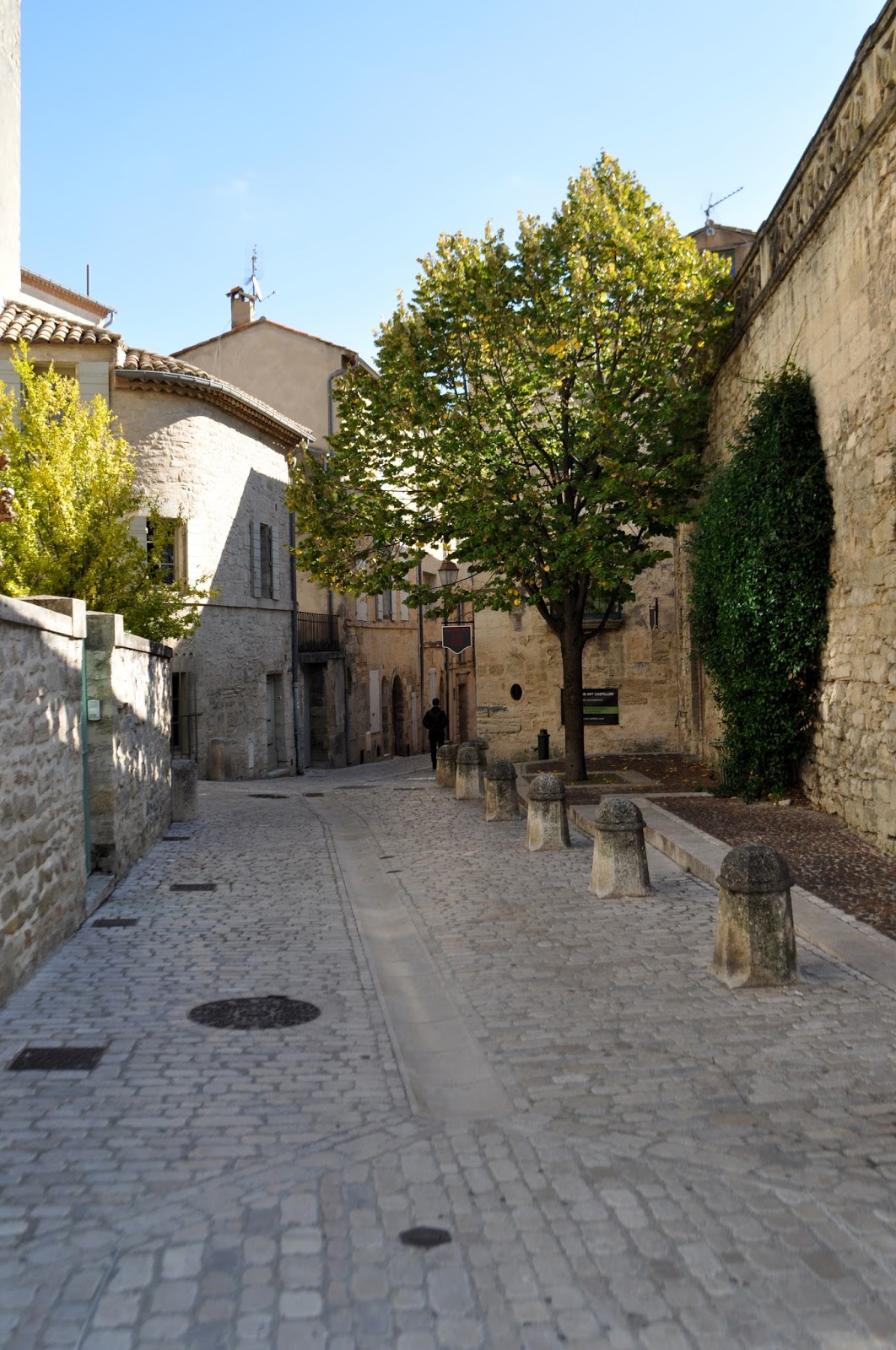
Street to center of old Uzès

Uzès is near the Eure springs which was the source of water for the Roman aqueduct built in the first century BC, to supply water to the town of Nîmes, 25 kms away. The most famous stretch of the aqueduct is the Pont du Gard, which carried fresh water across the Gardon River.

A medieval cobblestone street in the heart of Uzès old town

In the mid-16th century many citizens of Uzès were Calvinist and the town was the 5th largest Protestant town in the kingdom. Religious wars resulted in the destruction of all the churches and of the temple that Uzès had at the time. In 1685, the revocation of the Edict of Nantes caused many to leave for Protestant countries in Europe, or their colonies.

Bishop Tower (clock tower)

Starting in the 15th century, Uzès produced woolen, twill and cloth, then stockings and finally silk, until mulberry tree disease deprived the town of its textile industry, which gave work to 2000 people. This decline took the town with it, despite the development of the pottery industry and the licorice factory at the end of the 19th century.

L'atelier des Ours (the bear's workshop)

In the 20th century, Uzès gained a new lease on life when its town center was classified as a “protected zone” in January 1965. Ever since, Uzès has been upgrading and improving the town: roads have been paved, electricity cables hidden, facades renovated and the “protected zone” has been enlarged from 29 acres in 1965 to 101 acres today.

Bermonde Tower (castle keep)

As you wander around the center of Uzès, keep your eye out for the Hôtel Dampmartin with its tower with a staircase seen below, built in the 16th century on Place Dampmartin.

Hôtel Dampmartin

Uzès arcade

Bermonde Tower (castle keep)

Pottery shop

The old town is effectively a car-free zone. You walk everywhere because you have to, it is easy, and there is a lot to see.

Bishop Tower (clock tower)

The Uzès Town Hall seen below was built in the 18th century between 1767 and 1773.

Hotel de Ville (Town Hall)

Duché coat of arms

Olive tree growing next to Duché castle wall

The Duché is the defensive feudal castle standing in the center of Uzès old town. The castle was never attacked or damaged and is in very good condition. Uzès is the "First Duchy of France", France's oldest and most-important ducal peerage. Uzès was made a Duché in 1565. The current owner of the castle, Jacques de Crussol, is the 17th Duke of Uzès.

He grew up in the castle but these days, he actually lives in Paris but makes a point of coming to Uzès once a month, and spends most of the summer at the castle. Just like the Queen of England, his family’s flag flies over the castle when he is in residence.

Duché Palace with Vicomté Tower (King's tower/Royal tower) on left and Bermonde Tower (castle keep) on right;

The Bermonde tower is the Duché's keep, built in the 11th century by Bermond 1st. The corner watch towers were added during a restoration in the 15th century. You can visit the castle and climb to the top of the Bermonde Tower (135 steps) for a wonderful view of Uzès.

Bermonde Tower (castle keep)

The castle is a harmonious blend of architecture from different periods of French history: it features thousand-year old caves, feudal towers, ramparts, a Renaissance façade featuring Ionic, Doric and Corinthian elements, and an 18th-century façade. The castle’s apartments house fascinating collections of furniture.

Place aux Herbes

The Uzès market is held all year long on Saturday mornings and Wednesday mornings on the Place aux Herbes in the old town. With its fountain, arcades and terrace cafés, it is a great place to shop and visit and pause for a café or leisurely terrace lunch. Parts of Cyrano de Bergerac starring Gerard Depardieu were shot here.

One of the arcades which line Place aux Herbes

Terrace café on the Place aux Herbes

If you like beautiful ceramic pieces and happen to pass the shop below, you should go in and check out the ceramics by Swiss born and educated Heidi Caillard. Her beautiful guinea fowl figurines which you will find in our home in Sablet are her most famous works.

Lussan ceramic shop in the center of Uzès

Street in center of Uzès

Uzès cobblestone street

The 12th-century Bishop's tower was the seat of the bishop's temporal powers, used as a tribunal and prison. This tall, square tower is topped by an octagonal clock tower and belfry, added in the 19th century.

Bishop Tower (clock tower)

Bermonde Tower (castle keep)

Pretty Uzès shop

Uzès passageway

The Saint-Théodorit Cathedral seen below, was formerly a Catholic cathedral, but is now a parish church, named in honor of Saint Theodoritus. It was the seat of the Bishops of Uzès until the diocese was abolished under the Concordat of 1801 and its territory passed to the Diocese of Avignon.

The cathedral was destroyed during the Albigensian Crusades, rebuilt, and destroyed again in the 16th century Wars of Religion and rebuilt again in the 17th century before it was gutted during the French Revolution. In the 19th century, a new west front was added.

Saint-Théodorit Cathedral and Fenestrelle Tower

The Fenestrelle Tower avoided destruction in 1621 and is the only part of the cathedral which survives from the Medieval structure. The tower is built in the style of the Medieval Italian Lombard towers, and is the unique example in France of a round clock tower.

The Fenestrelle Tower

Saint-Étienne Church, the belfry can be seen below, was built between 1763 and 1775 on the location of an ancient church that was destroyed during the Wars of Religion.

Clock and belfry on top of the St-Etienne church tower

Cobblestone street to center of Uzès with Bermonde Tower in background

The Georges Borias Museum, the entrance is seen blow, is a museum of history, archeology and local traditions, located in the old Bishop's Palace, next to Saint-Théodorit Cathedral and the Fenestrelle Tower.

Georges Borias Museum next to Saint-Théodorit Cathedral and the Fenestrelle Tower

By the end of the day, we had walked all around Uzès, found a nice restaurant for lunch, where we were introduced to a stunning rosé wine, ending up going to the winery that crafted the aforementioned wine, so we could buy some to take home. All of which I will tell you about in the next post.

Here in Northern California, we are finally getting some significant rain giving hope that our four-year drought might come to an end soon. We feel blessed to have the rain but I hope it is sunny where you are. Have a great weekend. À bientôt.