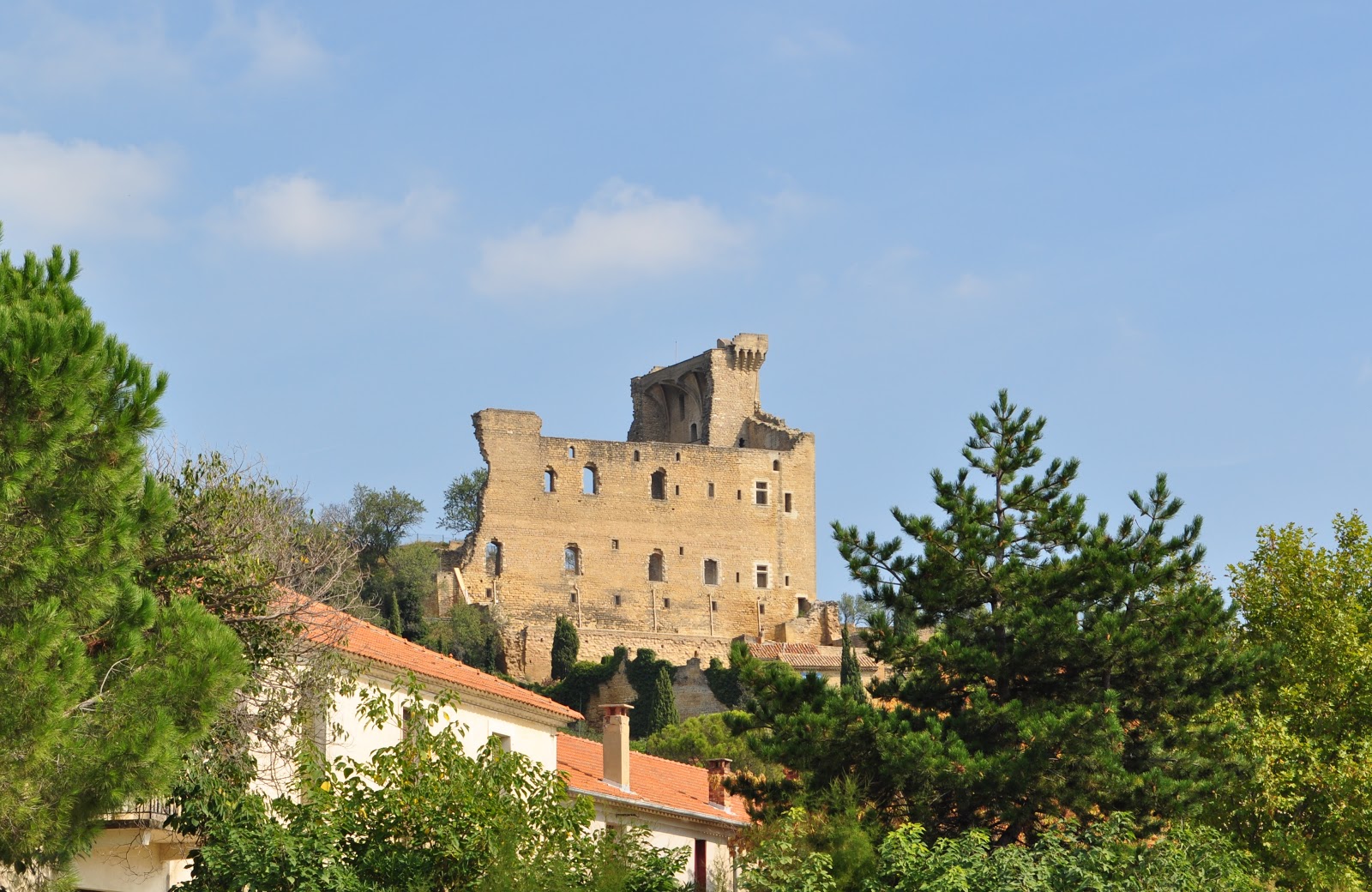
After our dégustation (tasting) at the winery, we headed back to Châteauneuf-du-Pape for lunch. Châteauneuf-du-Pape is the most famous wine-making village in the Southern Côtes du Rhône AOC. It's a medieval village on the side of a hill below the ruins of a castle built by Pope John XXII in 1320 as a summer getaway from Avignon.
The village of Châteauneuf-du-Pape was once circled by two walls, of which there are just a few traces which remain. The outer wall enclosed the lower part of the village and an inner wall enclosed the castle and the upper part of the village.
We found a little spot to park near Place du Portail which is the center of Châteauneuf-du-Pape.
The village streets are narrow and wind around the hillside and up to the castle which sits at the summit of the village. The buildings are old, but they have been carefully restored. As you walk around, you can see this is a village devoted to making and selling wine.
A magnificent tower with a clock at the top stands next to the Hôtel de Ville.
In the center of Châteauneuf-du-Pape and on the nearby side streets there are a large number of caveau (wine cellars) where you can taste and buy wine. The caveaux are all different from each other. Some are very fancy, others are very simple. Some are on the ground floor of a village house, others you need to go down a narrow passageway.
There are several restaurants around the center of Châteauneuf-du-Pape including La Mère Germaine near the fountain. Somewhat surprisingly, despite all of the great wine produced in Châteauneuf-du-Pape, we have not found a great restaurant there. We were headed to Le Verger des Papes which had been recommended as the "best in the village" by our friends at Domaine de la Charbonnière.
It is not known for sure when the church of Notre Dame de l'Assomption was built but it is thought that construction probably occurred around the end of the 11th century when the first fortifications were built in the village.
As I said, we were on our way to Le Verger des Papes which is just below the castle. Apart from the foundations, only two walls of the Pope's castle remain, but they are the walls that face the village, and as they are high up and impressive in size, they give a good sense of what it was like in the village centuries ago
The gated entrance to Le Verger des Papes restaurant is just a few steps below the Pope's castle.
The terrace which is shaded by pine and olive trees has a great view of the Pope's castle and provides a panoramic view of the Comtat Venaissin and Mont Ventoux to the east, Avignon, the Pope's Palace and the Luberon mountains to the south and the vineyards of Châteauneuf-du-Pape out to the Rhône River.
The Le Verger des Papes restaurant has been in business for 21 years and caters to a mix of local wine makers and tourists. Tables were simply set and decorated with a small lavender pot.
As you can imagine, the restaurant has an extensive selection of wines from Châteauneuf-du-Pape. We chose a bottle of the 2009 Clos du Mont Olivet, a selection on our wine list at Bistro Des Copains pretty much since day 1. They also have a shop next to the restaurant where you can choose from among 200 different bottles of Châteauneuf-du-Pape wine.
I decided on the 19 Euro three-course Menu du Jour. Shirley ordered off the La Carte menu. The first course on the Menu du Jour was salmon cooked on a plancha, which is a metal flat top. The chef made Shirley a green salad like she wanted even though it was not on the menu. Unfortunately, I did not get a picture.
For her main course, Shirley chose a tasty fusilli (corkscrew shaped) pasta with pesto sauce garnished with a few partially cooked tomatoes.
For my main course, I ordered the sauteed veal and mushrooms accompanied by a few vegetables on the side.
For dessert, we shared the Vacherin de Citron, baked meringue with ice cream with lots of whipped cream which was included with my three-course menu.
At the end of our meal, I can say we were very happy we came to Le Verger des Papes. Here is Shirley relaxing on the terrace with a good view of the sights you can see from Le Verger des Papes.
While Le Verger des Papes is not a great restaurant, at least based upon what we had for lunch, it is the best we have tried in the village and a very good option for a pleasant lunch between your visit to the Pope's castle, a tour of the village and tastings at the many caveaux and wineries in the area.
Have a great day and we hope you will have a very Merry Christmas. Here the house is festively decorated and the tree has an embarrassing number of presents piled around it. I will be trying to relax this week as I recover from Friday's arthroscopic knee surgery.
Bonne journée mes amis et à bientôt.
Le Verger des Papes
4 Rue du Chateau
84230 Châteauneuf-du-Pape
Tel: 04 90 83 50 40
www.vergerdespapes.com
We have a beautiful stone village house located in the heart of the medieval village of Sablet in the Vaucluse region of Provence France. Dating from the 17th century, the house was renovated by an Italian stone mason with all of the comforts of a modern home while retaining its authentic Provençal character and charm. On this blog, we share experiences from our visits along with those of our families and friends to Sablet and the South of France.
Sunday, December 23, 2012
Saturday, December 8, 2012
Le Clos du Caillou, a wonderful enclave of Côtes du Rhône in Châteauneuf-du-Pape
We were headed to Châteauneuf-du-Pape, a French wine Appellation located around the village of the same name in the Rhône wine region in Provence. It is one of the most renowned Appellations of France. Vineyards are located around Châteauneuf-du-Pape and in the neighboring villages of Bédarrides, Courthézon and Sorgues between the towns of Avignon and Orange and cover slightly more than 3,200 hectares or 7,900 acres.
Châteauneuf-du-Pape roughly translates to "The Pope's new castle" and the history of the Appellation is firmly intertwined with papal history. In 1308, Pope Clement V, former Archbishop of Bordeaux, moved the papacy from Rome to the town of Avignon. At that time, wine produced from grapes grown around the area was not anything to write home about.
Clement V was succeeded by John XXII who regularly drank wines from the vineyards to the north of Avignon and did much to improve viticulture practices there. Under John XXII, the wines of this area came to be known as "Vin du Pape" which translates to wine of the Pope, this term later became Châteauneuf-du-Pape. John XXII is also responsible for erecting the famous castle which stands over the village of Châteauneuf-du-Pape and is a symbol for the Appellation.
At its highest point, the Châteauneuf-du-Pape Appelation reaches 120 meters elevation. There are at least three distinct types of soil or terroirs. In the north and north-east the famous galets roulés, round rocks or pebbles cover the clay soil. The rocks are famous for retaining the heat from the plentiful sun, some 2800 hours a year, releasing it at night, ripening the grapes faster than in the eastern part of the Appellation, where the soil is mostly sand, as well as to the south where the soil is more gritty.
Red and white wine is produced in Châteauneuf-du-Pape with the large majority of the wines produced being red. The Appellation rules do not allow rosé wines. The Châteauneuf-du-Pape Appellation is traditionally said to allow thirteen grape varieties to be used, but the 2009 version of the Appellation rules list eighteen varieties, since white, rose and black versions of some grapes are now explicitly listed as separate varieties.
Both red and white grape varieties are allowed in both red and white Châteauneuf-du-Pape wine. There are no rules about the proportion of grape varieties that can be used and unlike many other appellations, permitted grape varieties are not differentiated as principal varieties and accessory varieties. Thus, it is theoretically possible to make Châteauneuf-du-Pape wine from any of the eighteen allowed varieties. In reality, most Châteauneuf-du-Pape wines are blends with a majority of Grenache.
We were headed to Le Clos du Caillou to visit and taste wines at this winery which makes one of my favorite French wines at Bistro Des Copains, the French country bistro I co-own with friend Cluney in Occidental, California. We have served their Côtes du Rhône, a tasty blend of largely Grenache, by the glass for the last several years; it pairs well with many of our classic bistro dishes.
Le Clos du Caillou winery is located in the commune of Courthézon. As you can see on the map above, the winery is adjacent to the boundary for the Châteauneuf-du-Pape Appellation.
Le Clos du Caillou has 44 hectares or 109 acres classified as Côtes du Rhône and 9 hectares or 22 acres in the Châteauneuf-du-Pape Appellation.
The winery is owned by Sylvie Vacheron. Formerly hunting grounds surrounded by walls, Sylvie's father Claude Pouizin purchased the property in 1956 and cleared woodlands and planted vines on the best located parcels. The vineyards have been expanded since through additional planting and purchase of land.
In 1995, Sylvie and her husband Jean-Denis Vacheron, a member of a family of wine growers in Sancerre in the Loire Valley took over the winery from her father. Tragically, Jean-Denis' was killed in an accident in 2002 and since that time, Sylvie has been sole proprietor of Le Clos du Caillou.
Le Clos du Caillou has a small well lit room for dégustation or tasting wine.
Shirley and I tasted through all of the domaine's wines that day and left with a case of the 2009 Les Safres, Châteauneuf-du-Pape, Rouge for our cellar in Sablet. Although the wine was delicious, we have left the bottles to age for a few years before we open a bottle.
I should mention that a case of wine in France is 6 bottles rather than the 12 bottles we get from California wineries or those shipped from France to the US.
After we finished our tasting, the young lady who poured our wines offered to take us on a tour of the cellars. Le Clos du Caillou has 4 underground cellars excavated out of soft sandstone.
Sylvie is assisted by wine-maker Bruno Gaspard. The red wines are aged in large casks and oak barrels for a year or more in the domaine's cellars which naturally retain a temperature of between 13 and 15 Celsius or 55 to 59 Fahrenheit.
The owner of the property where Le Clos du Caillou is today refused in 1936 to let the expert charged with determining the boundaries for the Châteauneuf-du-Pape Appellation visit his property so Le Clos du Caillou property was not included in the Appellation. Today, Le Clos du Caillou is an enclave of Côtes du Rhône surrounded by Châteauneuf-du-Pape Appellation.
With terroir identical to the Châteauneuf-du-Pape Appellation which surrounds Le Clos du Caillou, it is not surprising that the domaine's Côtes du Rhône wines have a richness and finesse very similar to Châteauneuf-du-Pape wines.
As is typical for wineries in the eastern part of the Châteauneuf-du-Pape Appellation, the soils that surround the Le Clos du Caillou winery are sandy. As of 2010, the vineyards and production of wine at Le Clos du Caillou is certified as Organic.
They are now in the process of getting the vineyards certified as Biodynamic, a method of organic farming that emphasizes the holistic development and interrelationships of the soil, plants and animals as a self-sustaining system.
If you are near Châteauneuf-du-Pape, don't hesitate to go visit and taste at this winery; I guarantee you won't be disappointed. And if you happen to come and dine at Bistro Des Copains or you are at another restaurant that has Le Clos du Caillou on the wine list, order it; you will be happy you did.
After thinking so much about great wine as I wrote this post, I think I need to go and pour myself a glass of red wine. Bonne journée mes amis et à bientôt. Have a great week.
Châteauneuf-du-Pape roughly translates to "The Pope's new castle" and the history of the Appellation is firmly intertwined with papal history. In 1308, Pope Clement V, former Archbishop of Bordeaux, moved the papacy from Rome to the town of Avignon. At that time, wine produced from grapes grown around the area was not anything to write home about.
Clement V was succeeded by John XXII who regularly drank wines from the vineyards to the north of Avignon and did much to improve viticulture practices there. Under John XXII, the wines of this area came to be known as "Vin du Pape" which translates to wine of the Pope, this term later became Châteauneuf-du-Pape. John XXII is also responsible for erecting the famous castle which stands over the village of Châteauneuf-du-Pape and is a symbol for the Appellation.
At its highest point, the Châteauneuf-du-Pape Appelation reaches 120 meters elevation. There are at least three distinct types of soil or terroirs. In the north and north-east the famous galets roulés, round rocks or pebbles cover the clay soil. The rocks are famous for retaining the heat from the plentiful sun, some 2800 hours a year, releasing it at night, ripening the grapes faster than in the eastern part of the Appellation, where the soil is mostly sand, as well as to the south where the soil is more gritty.
Red and white wine is produced in Châteauneuf-du-Pape with the large majority of the wines produced being red. The Appellation rules do not allow rosé wines. The Châteauneuf-du-Pape Appellation is traditionally said to allow thirteen grape varieties to be used, but the 2009 version of the Appellation rules list eighteen varieties, since white, rose and black versions of some grapes are now explicitly listed as separate varieties.
Both red and white grape varieties are allowed in both red and white Châteauneuf-du-Pape wine. There are no rules about the proportion of grape varieties that can be used and unlike many other appellations, permitted grape varieties are not differentiated as principal varieties and accessory varieties. Thus, it is theoretically possible to make Châteauneuf-du-Pape wine from any of the eighteen allowed varieties. In reality, most Châteauneuf-du-Pape wines are blends with a majority of Grenache.
We were headed to Le Clos du Caillou to visit and taste wines at this winery which makes one of my favorite French wines at Bistro Des Copains, the French country bistro I co-own with friend Cluney in Occidental, California. We have served their Côtes du Rhône, a tasty blend of largely Grenache, by the glass for the last several years; it pairs well with many of our classic bistro dishes.
Le Clos du Caillou winery is located in the commune of Courthézon. As you can see on the map above, the winery is adjacent to the boundary for the Châteauneuf-du-Pape Appellation.
Le Clos du Caillou has 44 hectares or 109 acres classified as Côtes du Rhône and 9 hectares or 22 acres in the Châteauneuf-du-Pape Appellation.
The winery is owned by Sylvie Vacheron. Formerly hunting grounds surrounded by walls, Sylvie's father Claude Pouizin purchased the property in 1956 and cleared woodlands and planted vines on the best located parcels. The vineyards have been expanded since through additional planting and purchase of land.
In 1995, Sylvie and her husband Jean-Denis Vacheron, a member of a family of wine growers in Sancerre in the Loire Valley took over the winery from her father. Tragically, Jean-Denis' was killed in an accident in 2002 and since that time, Sylvie has been sole proprietor of Le Clos du Caillou.
Le Clos du Caillou has a small well lit room for dégustation or tasting wine.
Shirley and I tasted through all of the domaine's wines that day and left with a case of the 2009 Les Safres, Châteauneuf-du-Pape, Rouge for our cellar in Sablet. Although the wine was delicious, we have left the bottles to age for a few years before we open a bottle.
I should mention that a case of wine in France is 6 bottles rather than the 12 bottles we get from California wineries or those shipped from France to the US.
After we finished our tasting, the young lady who poured our wines offered to take us on a tour of the cellars. Le Clos du Caillou has 4 underground cellars excavated out of soft sandstone.
Sylvie is assisted by wine-maker Bruno Gaspard. The red wines are aged in large casks and oak barrels for a year or more in the domaine's cellars which naturally retain a temperature of between 13 and 15 Celsius or 55 to 59 Fahrenheit.
The owner of the property where Le Clos du Caillou is today refused in 1936 to let the expert charged with determining the boundaries for the Châteauneuf-du-Pape Appellation visit his property so Le Clos du Caillou property was not included in the Appellation. Today, Le Clos du Caillou is an enclave of Côtes du Rhône surrounded by Châteauneuf-du-Pape Appellation.
With terroir identical to the Châteauneuf-du-Pape Appellation which surrounds Le Clos du Caillou, it is not surprising that the domaine's Côtes du Rhône wines have a richness and finesse very similar to Châteauneuf-du-Pape wines.
As is typical for wineries in the eastern part of the Châteauneuf-du-Pape Appellation, the soils that surround the Le Clos du Caillou winery are sandy. As of 2010, the vineyards and production of wine at Le Clos du Caillou is certified as Organic.
They are now in the process of getting the vineyards certified as Biodynamic, a method of organic farming that emphasizes the holistic development and interrelationships of the soil, plants and animals as a self-sustaining system.
If you are near Châteauneuf-du-Pape, don't hesitate to go visit and taste at this winery; I guarantee you won't be disappointed. And if you happen to come and dine at Bistro Des Copains or you are at another restaurant that has Le Clos du Caillou on the wine list, order it; you will be happy you did.
After thinking so much about great wine as I wrote this post, I think I need to go and pour myself a glass of red wine. Bonne journée mes amis et à bientôt. Have a great week.
Sunday, December 2, 2012
Pernes-les-Fontaines, a town with 40 old fountains and pretty kitty cats
Back to Pernes-les-Fontaines the next morning, we parked our car near St Augustine Church in the center of town. As I told you in my previous post, we had gone to dinner at Au Fil du Temps restaurant. Since we got there just before dinner, it was too dark and late to walk around town. So we decided to return the next morning to do a proper visit.
We had not been to visit Pernes-les-Fontaines previously even though Pernes is not very far from Sablet, only about 25 miles south between Carpentras and L'Isle-sur-la-Sorgue. There are a little over 10,000 people who reside in Pernes-les-Fontaines. The residents of Pernes are called Pernois (males) and Pernoises (females).
Pernes-les-Fontaines dates back to medieval times. There are defensive walls and portal gates that date back to the 16th century. As the name implies, Pernes-les-Fontaine's name comes from the 40 fountains that are located around the town. Although the fountains date from the 18th century, the fountain descriptor was not added to the original name Pernes till 1936.
The following are pictures of some of the sights we saw as we walked around Pernes-les Fontaines that morning including this house with its brightly colored shutters.
Another house with pretty shutters and plants in the window.
A narrow street with a sign for one of the shops.
The Au Fil du Temps restaurant with one of the 40 fountains near St. Augustine Church at Place Louis Giraud. Pernes-les-Fontaines is the birthplace of Louis Giraud, the creator of the 69 km long Carpentras Canal.
The 19th century St. Augustine Church was converted into a cultural center in 1986.
The war memorial to the children of Pernes-les-Fontaines who have died in wars for France in front of St. Augustine Church.
The Louis Giraud primary school.
This is one of the many cats we encountered as we walked around Pernes-les-Fontaines.
The Gigot fountain, built in 1757, sits at the foot of the 17th century Tower of Ferrande. Gigot translates as leg of lamb which is what this fountain's design is said to resemble. Do you see it? I don't.
On the ledge of the second story a black cat enjoys the morning sun.
A close up of the cat relaxing in the sun.
This cat guards the door to this home.
The privately-owned Château d'Anselme dates from the 15th and 16th centuries.
Notre-Dame-de-Nazareth Church with it bell tower dates from the 11th century.
Shirley sits on a bridge that crosses the Nesque River, leading to the Notre Dame Gate which is flanked by two round towers. The Notre Dame Gate is one of three portals through the 14th century ramparts which remains in tact. The gate was built in 1548
The Notre Dame Gate.
The Tour de l'Horloge (clock tower) with its iron campanile is the old dungeon of the Château of the Counts of Toulouse. The clock was added to the tower in the 15th century and the iron campanile was added in 1764.
The Cormoran fountain built in 1761 is considered to be the most beautiful fountain in Pernes-les-Fontaines. It is classified as a historic monument.
The 17th century covered market hall.
The Villeneuve Gate is another one of the portals through the 14th century ramparts which remains in tact.
A pretty statue sits above this door.
A door with pretty carvings on the door frame.
Another cat.
This is one of several archways we encountered as we visited Pernes-les-Fontainess.
It is always fun to walk through archways and discover what is hidden on the other side.
An old archway entrance into a private home.
The Reboul fountain.
The Rue Raspail fountain.
The St. Gilles Gate, the other portal through the 14th century ramparts which remains in tact.
The round-about near St. Gilles Gate through the old defensive ramparts into Pernes-les-Fontaines.
The Lavoir de Saint-Gilles, is as is commonly found in French towns and villages, the old public laundry facility for washing clothes in Pernes-les-Fontaines.
We will return again to Pernes-les-Fontaines to discover the rest of the fountains as we didn't see anywhere near 40. We will make sure we do so on a day when Au Fil du Temps is open so we can eat there again.
Bonne journée mes amis et à bientôt. Have a great week.
We had not been to visit Pernes-les-Fontaines previously even though Pernes is not very far from Sablet, only about 25 miles south between Carpentras and L'Isle-sur-la-Sorgue. There are a little over 10,000 people who reside in Pernes-les-Fontaines. The residents of Pernes are called Pernois (males) and Pernoises (females).
Pernes-les-Fontaines dates back to medieval times. There are defensive walls and portal gates that date back to the 16th century. As the name implies, Pernes-les-Fontaine's name comes from the 40 fountains that are located around the town. Although the fountains date from the 18th century, the fountain descriptor was not added to the original name Pernes till 1936.
The following are pictures of some of the sights we saw as we walked around Pernes-les Fontaines that morning including this house with its brightly colored shutters.
Another house with pretty shutters and plants in the window.
A narrow street with a sign for one of the shops.
The Au Fil du Temps restaurant with one of the 40 fountains near St. Augustine Church at Place Louis Giraud. Pernes-les-Fontaines is the birthplace of Louis Giraud, the creator of the 69 km long Carpentras Canal.
The 19th century St. Augustine Church was converted into a cultural center in 1986.
The war memorial to the children of Pernes-les-Fontaines who have died in wars for France in front of St. Augustine Church.
The Louis Giraud primary school.
This is one of the many cats we encountered as we walked around Pernes-les-Fontaines.
The Gigot fountain, built in 1757, sits at the foot of the 17th century Tower of Ferrande. Gigot translates as leg of lamb which is what this fountain's design is said to resemble. Do you see it? I don't.
On the ledge of the second story a black cat enjoys the morning sun.
A close up of the cat relaxing in the sun.
This cat guards the door to this home.
The privately-owned Château d'Anselme dates from the 15th and 16th centuries.
Notre-Dame-de-Nazareth Church with it bell tower dates from the 11th century.
Shirley sits on a bridge that crosses the Nesque River, leading to the Notre Dame Gate which is flanked by two round towers. The Notre Dame Gate is one of three portals through the 14th century ramparts which remains in tact. The gate was built in 1548
The Notre Dame Gate.
The Tour de l'Horloge (clock tower) with its iron campanile is the old dungeon of the Château of the Counts of Toulouse. The clock was added to the tower in the 15th century and the iron campanile was added in 1764.
The Cormoran fountain built in 1761 is considered to be the most beautiful fountain in Pernes-les-Fontaines. It is classified as a historic monument.
The 17th century covered market hall.
The Villeneuve Gate is another one of the portals through the 14th century ramparts which remains in tact.
A pretty statue sits above this door.
A door with pretty carvings on the door frame.
Another cat.
This is one of several archways we encountered as we visited Pernes-les-Fontainess.
It is always fun to walk through archways and discover what is hidden on the other side.
An old archway entrance into a private home.
The Reboul fountain.
The Rue Raspail fountain.
The St. Gilles Gate, the other portal through the 14th century ramparts which remains in tact.
The round-about near St. Gilles Gate through the old defensive ramparts into Pernes-les-Fontaines.
The Lavoir de Saint-Gilles, is as is commonly found in French towns and villages, the old public laundry facility for washing clothes in Pernes-les-Fontaines.
We will return again to Pernes-les-Fontaines to discover the rest of the fountains as we didn't see anywhere near 40. We will make sure we do so on a day when Au Fil du Temps is open so we can eat there again.
Bonne journée mes amis et à bientôt. Have a great week.
Subscribe to:
Posts (Atom)
