Thursday, June 27, 2013

Sainte-Cécile-les-Vignes, home to vignerons and a wonderful Saturday morning market

One of the best things about Provence is shopping at weekly outdoor "marchés" in towns and villages throughout the region...or at least it is for a "foodie" like me. Why would you buy fruits, vegetables, cheese, meats or fish at one of those super markets on the outskirt of town when you can leisurely stroll through a market and pick up what you need for the next couple of days?

I say don't go to the "marché" with a list of things to buy like you are going to a super market. No, do like I do and walk through the market and buy what is fresh, in season and local, but don't buy anything the first time through. After you have surveyed what's for sale, take a second walk through the market and buy what you liked during your first walk-through.

Invariably, whenever I buy produce on my first walk through a market, I wish I had waited to buy those tomatoes, eggplants or zucchini a little ways further up the street. The only exception to buying at the "marchés" is if there is a fantastic boucherie, poissonnier or fromager in the area whose products are better than what you can find at the "marchés" or for staples like flour, sugar, and milk.

Make up your menus as you walk through the market. Don't worry if you don't have a recipe. If you are staying at our house, there are quite a few cookbooks to browse through and you can Google the fruit or vegetable and you will get lots of links to recipes. Just choose one that sounds tasty to you. That way you are trying new dishes which is part of the fun of visiting Provence.

We generally arrive and leave Sablet on Saturday. So we pick up staples from Alain and Mimi in Sablet and wait for the Tuesday market in Vaison-la-Romaine to buy fresh, perishable foods. Several guests have told us they like the Saturday morning market in nearby Sainte-Cécile-les-Vignes. Since we got to Sablet on Friday on our last sojourn, we decided to go check out this market.

Sainte-Cécile-les-Vignes is a small village located 15 kms northwest of Sablet on the border of the Vaucluse and the Department of the Drôme. As the name suggests (les "vignes" means the vines), Sainte-Cécile-les-Vignes is an agricultural village devoted to making wine. So you will not be surprised to see vineyards all around the village.

The only door through the ramparts that remains in tact, just happens to lead to the center of the village where the market takes place. As you can see below, the Clock Tower door is topped by a wrought iron campanile with bell.

Clock Tower into the center of Sainte-Cécile-les-Vignes

The market in Sainte-Cécile-les-Vignes takes place every Saturday morning between 8:00 AM and 1:00 PM at Le Cours du Portalet, La Place de la Mairie and La Place de la Fontaine.

The main market street in Sainte-Cécile-les-Vignes

As you can see below, you can choose from a wide variety of fresh fruit. But as I said above, it's best to choose what's locally grown in Provence if you can. Here, strawberries and cherries were locally grown but the melon and cantaloupe came from Spain. But in a few weeks, there will be loads of sweet Cavaillon melons at every market. These are locally grown. You must try one.

A wide variety of fresh fruit is available

Locally grown green and white asparagus. Did you know there is really no difference between green and white asparagus? White asparagus comes from depriving the asparagus of light. Dirt is kept mounded around the emerging stalk, depriving it of light. The plant cannot produce chlorophyll without light, thus there is no green color to the stalks.

Green and white asparagus

Lots of cut flowers. We take several bunches home to put on the table.

Cut flowers

More cut flowers

Infused with the flavors of the surrounding landscape, Provence honey is sweet and delicious. Bees generally have a range of no more than about a mile-and-a-half, so if the beekeeper places his hives near an abundant field of one plant—say lavender, rosemary, or chestnut trees—the honey will retain the distinctive flavor of its source material.
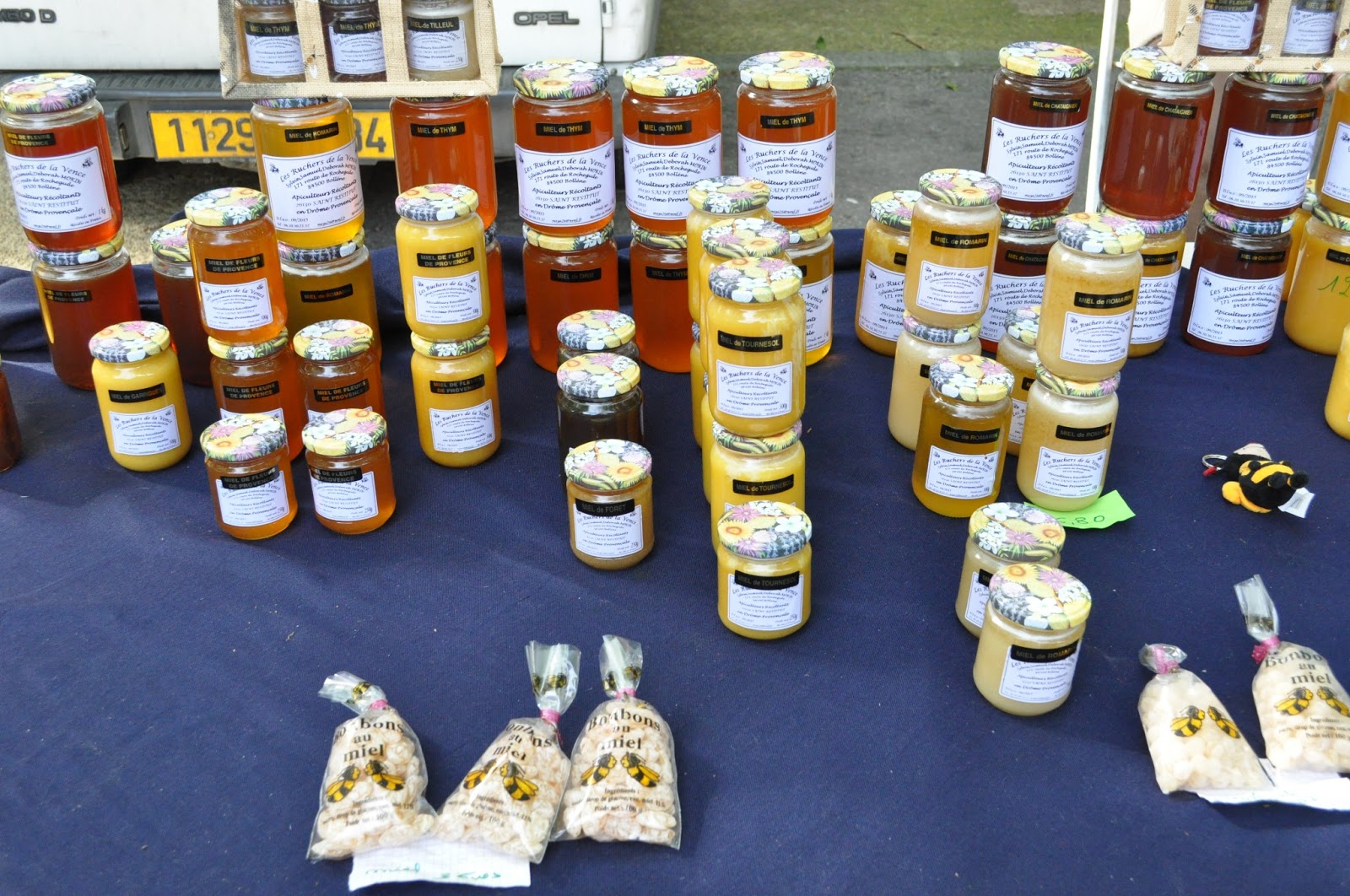
Honey

The weather was nice so the market was full of shoppers.
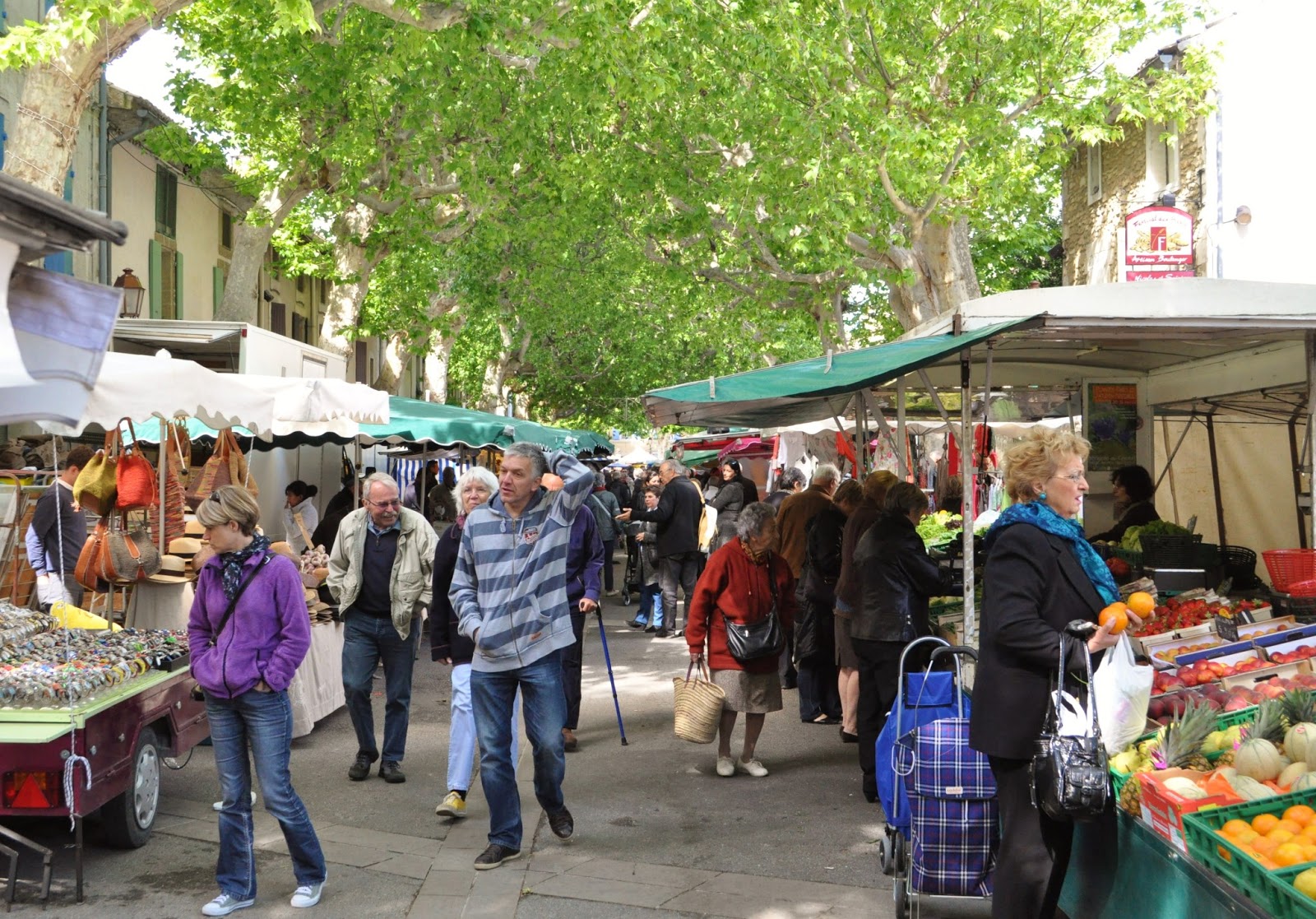
Another view of the main market street

An amazing variety of seafood and whole and filleted fish from the Mediterranean Sea and Atlantic Ocean.

Seafood

Whole fish

Whole fish

The parish church of Sainte-Cécile-les-Vignes seen below replaced a church that the villagers had decided was obsolete. Built between 1854 and 1860, the new church was consecrated in 1860 by the archbishop of Avignon.

The market spreads out on the square in front of the church of Sainte-Cécile-les-Vignes

In front of the Sainte Cécile Church is a statue that honors the men who died for France in WWI. This stone statue by sculptor Félix Charpentier depicts a "poilu", an informal term for French World War I infantrymen, meaning, literally, hairy one. The word carries the sense of the infantryman's typically rustic, agricultural background. Beards and bushy moustaches were often worn.

The sculpted figure below the statue represents a mother crying for her son under a willow tree.

Memorial to men who died during WWI

The Sainte Cécile parish church was built from stones brought from Saint-Restitut, a village in the Department of Drôme known for its old stones. Inside the church, you can see alters, pictures and statues saved from the old church.

The interior of the church of Sainte-Cécile-les-Vignes

The fountain below was inaugurated by Mayor Goudareau in 1881. Market vendors set up their stalls all around the fountain.

Fountain near the Town Hall

Mayor Goudareau was a busy man. He also inaugurated the Town Hall seen below in 1886.

Sainte-Cécile-les-Vignes Town Hall

There is an old winery (dates from the 18th century) in Châteauneuf-du-Pape called Château Fortia. In the early 20th century, management of the winery was taken over by Pierre Le Roy de Boiseaumarie, a decorated WWI pilot.

Baron Le Roy later co-founded the Institut National des Appellations d'Origine (INAO) and helped create the AOC system which is the basis for French wine laws. To show their appreciation, the local vignerons commissioned the bronze bust by sculptor Marcel Courbier seen below near the church.

Bronze bust dedicated to Baron Le Roy

We came across a few nice old fountains as we walked around the town.

Fountain

The streets are lined with houses, most of them picturesque, with their Provencal colors and contrasting shutters.

House with bright shutters and flowers

Unusual stone fountain

The Sainte Cécile Sainte Croix Chapel seen below sits in the heart of the village. It is the oldest religious building in Sainte-Cécile-les-Vignes with the first mention found in 1177. It is thought to be located on the site of a Roman temple. The chapel was reconstructed in 1624 and again in 1843.

Sainte Cécile Sainte Croix Chapel

The village cemetery was located next to the Sainte Cécile Sainte Croix Chapel until 1870 when it was relocated to its present location.

Sainte Cécile Sainte Croix Chapel

Notre Dame de Consolation Chapel is at the entrance to the village on the road to Cairanne. This Chapel was built on the site of an ancient chapel built in 1507. Unfortunately, that chapel was destroyed between 1560-1562 during the Wars of Religion.

The Romanesque Notre Dame de Consolation Chapel seen below was built in 1858 to replace the destroyed chapel.

Notre Dame de Consolation Chapel

If you are hungry after wandering around the market and through the village, we can recommend Campagne Vignes et Gourmandises Restaurant which we told you about here. It has been designated as a Bib Gourmand restaurant in the 2013 edition of the Michelin Guide.

Have fun at the market. Bonne journée mes amis et à bientôt.

Monday, June 17, 2013

Beaumes-de-Venise, a bustling village and producer of excellent sweet wines

We don't spend a lot of time hanging around Sablet. It's not that we don't like our village, but we are usually at one of the weekly marchés, exploring new villages, visiting family or friends, looking for fields of coquelicots, lavender and sunflowers, or doing "dégustation de vins" (wine tasting). Hey, we have only tasted at a handful of the 1,837 private wineries and 103 cooperatives in the Rhône Valley.

As we are out and about, we repeatedly traverse the villages of Violès, Vacqueyras, and Aubignan on our way to and from Sablet, but never stop to visit. Another village we drive through but have never stopped to visit is Beaumes-de-Venise. So a few weeks ago, with friends Scott and Jean-Pierre in tow, we decided to pay a visit to Beaumes-de-Venise.

Beaumes-de-Venise is a small village (2,305 inhabitants) about 12 km south of Sablet that climbs up the foot of the southern slope of the Dentelles de Montmirail. Beaumes-de-Venise is one of several wine-making villages along the 78 km "Route des Vin" that circles the Dentelles de Montmirail (a small chain of mountains I told you about here).

Beaumes-de-Venise

The word "beaumes" comes from the Provençal word bauma meaning "cave" or "grotto". There are many caves carved into the surrounding hillside which were shelter for the regions first inhabitants during the Iron Age.

Arched doorway from Raspail Avenue to Place du Marché

The Saint Nazaire Church seen below was built in 1849. There is also a Saint Nazaire Chapel, but all that remains of the latter are ruins which date from the 8th century.

Saint Nazaire Church

Close to Saint Nazaire Church, is the arched doorway seen below which leads through the ramparts into the center of the village.

Arched doorway into the center of the village

Vestiges of the 12th century feudal castle with its ramparts nicknamed “Des Barons” stand above the village in the picture seen below. This castle made Beaumes-de-Venise one of the most powerful villages in the Comtat Venaissin, in the Middle Ages.

View toward Place de la Liberté with castle ruins at top of village

A brightly colored house near the fountain at Place de la Liberté.

Fountain at Place de la Liberté

Come along with us as we walk around Beaumes-de-Venise.

The wrought-iron campanile and bell tower of Saint Nazaire Church

A pretty village house

The ramparts were probably erected in the 12th century. There are two doorways which remain; one as I said before is near Saint Nazaire Church and the second seen below is at Place du Portail Neuf.

The arched doorway and fountain at Place du Portail Neuf

We decided to follow the path up to the castle ruins at the top of the village. I would not recommend the way we went since it was not much more than a narrow footpath that wound its way through brush. When we got as high as we could go, we could see the ruins just above us but we could not get up to them. There may be a way to get there but we did not find it.

One of the views over Beaumes-de-Venise we saw as we hiked to the castle ruins

Another view over Beaumes-de-Venise with Saint Nazaire Church in the middle of the picture.

Another view over Beaumes-de-Venise

Beaumes-de-Venise is probably best known for Muscat de Beaumes de Venise, a sweet fortified wine produced by village winemakers from the small berried Muscat à Petits Grains grapes grown in vineyards surrounding the village. The color of the wine can vary from amber to rosé, and even purple.

The grapes ripen from the warmth of the sun as it reflects and radiates over the vines from the huge vertical limestone slabs of the Dentelles de Montmirail. There are just over 1200 acres currently under cultivation.

Beaumes-de-Venise is also home to two other appellations: red wines were classified in 2005 as AOC Beaumes-de-Venise and whites and rosé wines were classified in 1978 as AOC Côtes-du-Rhône-Villages Beaumes-de-Venise.

A Beaumes-de-Venise vineyard

A house built right up against the rocks

17th Century Fountain at Place du 8 Mai

Saint Nazaire Church

The Saint Roch Chapel seen below was built during the midst of the plague in 1586. Beaumes-de-Venise was spared.

Saint Roch Chapel

In addition to wine, olive oil has been produced in Beaumes-de-Venise since 1789. At the entrance to the village is La Balméenne olive oil mill which is open to the public. All of the olive oil is pressed from "Verdale de Carpentras" (or Aglandau) olives from the Vaucluse harvested by hand between the middle of November and beginning of January.

There is a cute shop on site which sells olive oil and a variety of products produced in the region including soap, honey, tapenades, jams, olives and souvenirs.

La Balméenne Olive Oil Mill

A house with pretty flowers near La Balméenne Olive Oil Mill

An olive tree near La Balméenne Olive Oil Mill

As we enter and exit Beaumes-de-Venise, we go around this striking roundabout near the Vignerons de Beaumes-de-Venise wine cooperative.

Roundabout at the entrance to Beaumes-de-Venise

So that's it! Thanks for joining us on our walk around Beaumes-de-Venise. Bonne journée mes amis et à bientôt.

Tuesday, May 28, 2013

Uzès, the First Duchy of France and one of the best markets in the South of France.

If you've been following "Our House in Provence" for a while, you know that cousins Jean Marc and Christine live near Montpellier and although it's 75 miles from Sablet, we are always looking for ways to meetup. So when Shirley's friends came to visit, we decided to combine a visit to Uzès with Sunday lunch with the cousins followed by a visit to the Pont du Gard.

Uzès is a beautiful historic town in the Gard (a part of Languedoc-Roussillon) with a history dating from Roman times. Uzès is surrounded by garrigue (low growing bushy plants including oak, juniper, broom and wild herbs such as rosemary and thyme) covered hills and valleys about 30 miles west of Avignon and less than 10 miles from the Roman Pont du Gard.

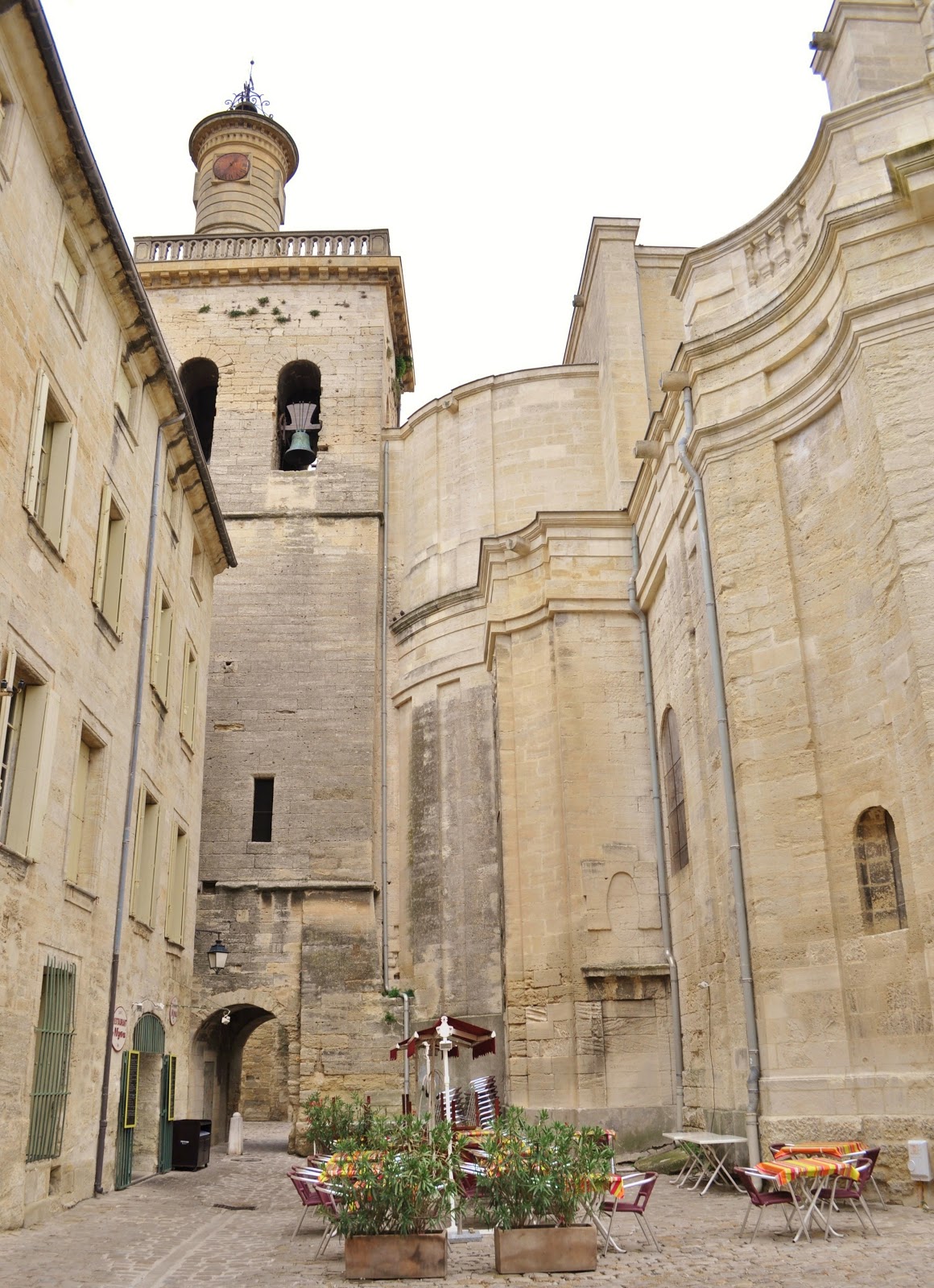
The Saint-Théodorit Cathedral seen below, was formerly a Catholic cathedral, but is now a parish church, named in honor of Saint Theodoritus. It was the seat of the Bishops of Uzès until the diocese was abolished under the Concordat of 1801 and its territory passed to the Diocese of Avignon.

The cathedral was destroyed during the Albigensian Crusades, rebuilt, and destroyed again in the 16th century Wars of Religion and rebuilt again in the 17th century before it was gutted during the French Revolution. In the 19th century, a new west front was added.

Saint-Théodorit Cathedral and the Fenestrelle Tower

Adjacent to the cathedral is the 12th century Fenestrelle Tower which is the only part of the cathedral which survives from the medieval structure. This kind of round bell tower is unique in France; it rises 138 feet above a square base, its six storeys recede one above the other.

The interior of Saint-Théodorit Cathedral

Uzès is near the Eure springs which was the source of the water for the Roman aqueduct built in the first century BC, to supply water to the town of Nîmes, 25 kms away. The most famous stretch of the aqueduct is the Pont du Gard, which carried fresh water across the river Gardon.

A narrow street that leads to the center of Uzès

Please join me as I wander around the heart of Uzès old town

An Uzès street

An olive tree next to a wall of the Duchy castle

The center of Uzès old town is full of medieval streets for wandering and exploring.

A narrow cobblestone street in Uzès

The Duchy is the defensive feudal castle standing in the center of Uzès old town. The castle was never attacked or damaged and is in very good condition. Uzès is the "First Duchy of France", France's oldest and most-important ducal peerage. Uzès was made a Duchy in 1565. The current owner of the castle, Jacques de Crussol, is the 17th Duke of Uzès.

He grew up in the castle but these days, he actually lives in Paris but makes a point of coming to Uzès once a month, and spends most of the summer at the castle. Just like the Queen of England, his family’s flag flies over the castle when he is in residence.

The Duchy of Uzès

Part of the Duchy castle

Part of the Duchy castle

Tower of the Duchy castle

An Uzès street

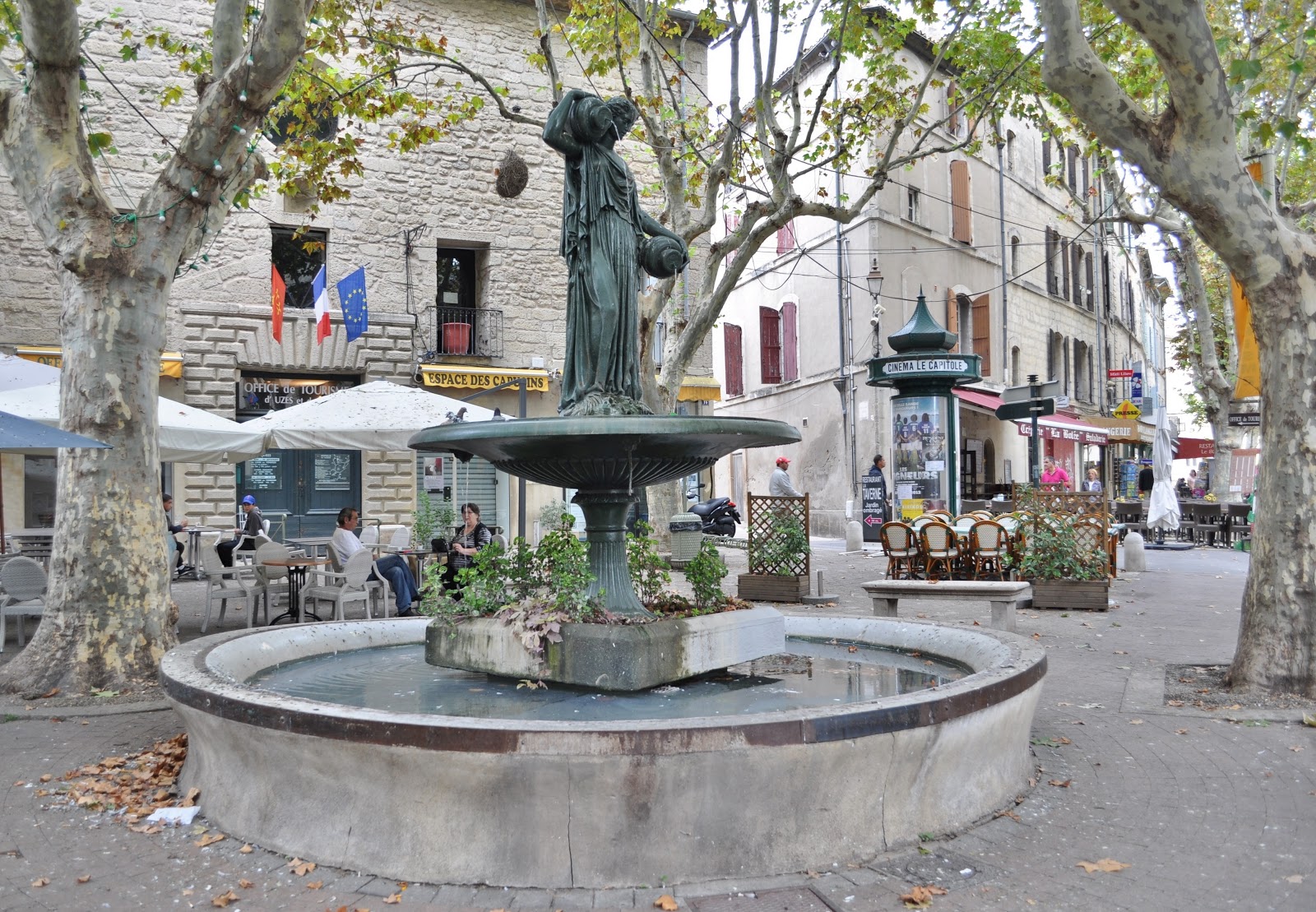
Large fountain in Uzès

Uzès shop

A house decorated on the side with a turret near Place aux Herbes

Terrace café on the Place aux Herbes

Terrace café on the Place aux Herbes

The Uzès market is held all year long on Saturday mornings and Wednesday mornings on the Place aux Herbes in the old town. With its fountain, arcades and terrace cafés, it is a great place to shop and visit and pause for a café or leisurely terrace lunch. Parts of Cyrano de Bergerac starring Gerard Depardieu were shot here.

Place aux Herbes

Pretty window in Uzès

One of the arcades which line the Place aux Herbes

Unique door in Uzès

House of the truffle

Clock and belfry on top of the Saint-Etienne Church tower.

Saint-Étienne Church seen below, was built between 1763 and 1775 on the location of an ancient church that was destroyed during the Wars of Religion.

Saint-Étienne Church

Rectangular bell tower of Saint-Étienne Church

An Uzès restaurant

The 12th-century Bishop's tower was the seat of the bishop's temporal powers, used as a tribunal and prison. This tall, square tower is topped by an octagonal clock tower and belfry, added in the 19th century.

The Bishop's Tower

The Bermonde tower is the Duchy's keep, built in the 11th century by Bermond 1st. The corner watch towers were added during a restoration in the 15th century. You can visit the castle and climb to the top of the Bermonde Tower (135 steps) for a wonderful view of Uzès.

The Bermonde Tower at the Duchy

One of the museums in Uzès

Shirley with friends Liz and Jennifer

Uzès is special town for several reasons; first, the Uzès market on Saturday mornings is one of our favorites in the South of France and second, Uzès is where we sat and debated the pros and cons of various villages and houses with cousins Jean Marc and Christine in one of the cafés on Place aux Herbes. As you know, we chose Sablet and we are so glad we did.

Bonne journée mes amis et à bientôt.