Thursday, August 8, 2013

Thursday Morning Is A Great Time To Be In Sablet

One Thursday last Spring, I went out for my usual morning walk-about Sablet, which means a visit to the "Pain Medieval Boulangerie" for a palmier, "Tabac-Presse" for the International Herald Tribune, and "Café des Sports" for an express, Nikon camera in hand, just in case I come upon some photo opportunities.

In this post, I was going to tell you about the vendors who set up shop in Sablet on Thursday mornings but since I took a bunch of other pictures in the village that morning, I am going to include some shots of Sablet that I have not shown you in previous posts like here.

Our house is on a very narrow street (see below), so narrow that although small trucks go down the street, Shirley can practically stretch across and touch both walls at the same time.

Our Street

We watch visitors struggle on a daily basis to turn left where Grande Rue intersects with Rue de l'Eglise (see below), without hitting the steps of the neighbor's house, or walls on either side of the street, to go up the hill to St. Nazaire Church. Local's make it in one try, it takes me three or four tries with Shirley directing me.

We don't drive up except when we have lot's of stuff to unload as it is a nightmare to turn the car around and go back to the parking lot. When we do go, we creep along with the car's mirrors pulled in. I swear it seems like there is not much more than one inch to spare on either side of the car.

Intersection of Grande Rue and Rue de l'Eglise

A short distance from our house is a pretty fountain and lavoir (wash basin) at Place Yvan Audouard, named after a writer and journalist with ties to Provence. Yvan Audouard was born in 1914 in Saigon, now Hồ Chí Minh City, his father was in the military from Avignon and his mother was a librarian from Marseille. He died in 2004 in Paris. He spent quite a bit of his life in Arles and Nimes.

Fountain and Lavoir at Place Yvan Audouard

Except for early in the morning or late in the evening, there always seems to be people near the fountain; a group of older men sitting on the stone wall overlooking the street or a couple of ladies standing in the shade of the adjacent wash basin in animated conversation.

Fountain and Wash Basin at Place Yvan Audouard

Throughout the day, the area around the fountain and wash basin is alive with activity as it is near the Pain Medieval boulangerie and the village bibliotèque (library). However, at the end of the day, Place Yvan Audouard is usually quiet except for feral cats and water trickling from the fountain.

Fountain and Wash Basin at Place Yvan Audouard

Below you see the fountain and the view down Rue des Barrys through one of the many vaulted passageways in Sablet.

Looking Down Rue Des Barrys

Sablet is a circular village and the streets curl up in concentric circles to St. Nazaire Church at the top of the village. There are quite a few stairways, some adorned with flowers that go from one level to another.
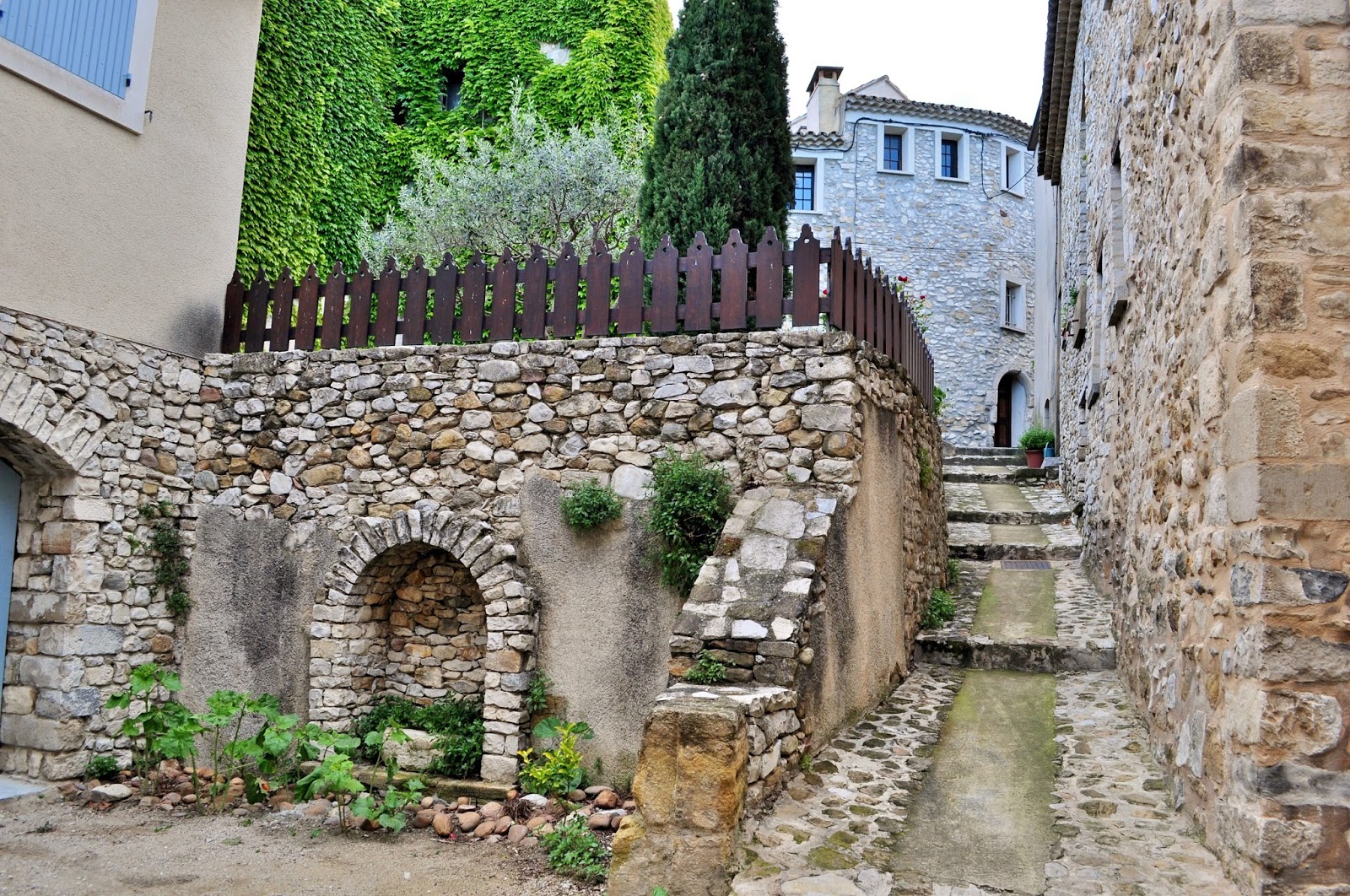
Steps to Walk Down Between Grande Rue and Rue des Barrys

The vaulted passageway below leads to a lookout over the old defensive walls.

House Over Vaulted Passageway on Rue des Barrys

The village walls and towers are thought to have been started in the 14th century and completed in 1500. They were restored by the Association des Compagnons des Barrys; they are a great reminder of what life was like in the village during old times.

Defensive Wall and Tower

Defensive Tower

On top of the hill around which Sablet is built, stands St. Nazaire Church with a tall bell tower lit each night, marking Sablet in the surrounding countryside. First built in the 12th Century, it was renovated and rebuilt with additions on the west side during the 14th Century. The church bells ring hourly between 7 and 10 PM.

Église St. Nazaire - St. Nazaire Church

Grande Rue With Alert That Ahead, It's Only 4 Feet 11 Inches Wide

Streets are named after activities of the villagers in old times, for example climbing the "Escaliers de l'Eglise" to St. Nazaire Church or visiting the shoemaker on the "Rue du Cordonnier" seen below.

Rue du Cordonnier

The Tabac-Presse stocks the International Herald Tribune and some British newspapers along with a wide array of French newspapers and magazines. They also have a very nice selection of souvenirs.

Sablet's Tabac Presse

Le Tilleul d'Or Retirement Home is located across the street from Café des Sports.

Le Tilleul d'Or Retirement Home

There is a small market, unfortunately nothing special, which takes place every Friday morning in Sablet across the street from Café des Sports at Place de l'Aire de la Croix.

On Thursday mornings, a wonderful poissonnier (fishmonger) parks his refrigerated truck with an amazing assortment of fresh fish and seafood next to the Vival mini-mart. You can assume we are having fish for dinner on Thursday nights if you are invited to dine chez nous.

Monsieur Lafont of Maree du Comtat Venaison

A young man from Buis-les-Baronnies sets up tables in front of the fish truck and sells an assortment of fresh goat cheeses, jam, fruit juice and olive oil his family makes on their farm. Their goat cheese makes a wonderful chèvre chaud salad or addition to a cheese plate.

Fresh Goat Cheese, Jam, Fruit Juice and Olive Oil from Buis-les-Baronnies

The Vendors Set Up Their Displays Next to Vival Mini-mart

Dogs Are Ever Present and Welcome in French Markets

If you are in Sablet or one of the nearby villages on Thursday mornings, you should stop by and pick up fish and goat cheese for dinner. As it says in the Michelin Guide, it is worth a detour.

Shirley and Julia Wait Patiently For Me to Finish Taking Pictures

As it usually the case, Shirley ends up standing around waiting for me to take pictures and check them and then generally retake them once or twice to make sure I get a good picture. Here she waits with our sweet little friend Julia.

Have a great day. See you soon.

Sunday, August 4, 2013

Domaine de la Damase, a Family-run Winery for 5 Generations in the Côtes du Rhône

A few months ago, I came back to the office and Cluney, my partner at Bistro Des Copains told me that while I was out, Kenny from Hobo Wine Company had stopped in with a young Frenchman whose family owns a winery near our house in Sablet.

Cluney handed me Sébastien's card and told me he extended an invitation for us to visit and taste wines the next time we were there. A few weeks later we were back, and one day after lunch we headed to Domaine de la Damase in Violès with friends Scott and Jean-Pierre in tow.

Domaine de la Damase

As I mentioned, Domaine de la Damase is located in Violès, a small village in front of the Dentelles de Montmirail. The village is surrounded by a sea of vineyards. Quite truthfully, prior to today, we had never stopped in Violès, I guess because it's the last village before Sablet from the toll road, and we are in a hurry to get home.

Courtyard at Domaine de la Damase

The Latour family has been making wine at Domaine de la Damase since 1872 when the estate was purchased. Sébastien Latour works the vineyards and makes wine with parents Bernadette and Serge. He is the 5th generation of the Latour family to make wine there.

House at Domaine de la Damase

Domaine de la Damase is small (they have about 30 acres of vineyards), organically farmed, and might have remained obscure to Americans, at least, if it weren’t for Kenny Likitprakong, a Sonoma County winemaker and owner of Hobo Wine Company who befriended the Latour family and imports some of their wines.

Sébastien did a one-year internship with Kenny Likitprakong in Santa Cruz in 2002 which was the first vintage for Hobo Wine Company.

Pretty Petunias in a Stone Planter at Domaine de la Damase

World War II Ordinance Found in Field

Sébastien took us to a room filled with the heady aroma of wine. He pulled wine for tasting in a long pipette from the top of oak barrels full of Grenache and Mourvedre aging until ready for bottling.

Sébastien Latour Fills Glasses From Barrel

Old Wine Barrels

Domaine de la Damase Barrel Room

In the middle of our tasting, Sébastien's 98 year old grandfather Joffre walked into the "cave" (tasting room) and took a glass from Sébastien. We said "bonjour" and commented about the wine. He responded but we couldn't understand and Sébastien explained that he only speaks Provençal, a dialect of the Occitan language, spoken in the southeast part of France.

Joffre Latour

Joffre Latour seems to be a remarkable person for a man of 98 years of age; maybe there is some truth to the French paradox and red wine.

Shirley with Joffre Latour

Joffre Latour Walking in the Courtyard

The wines of Domaine de la Damase

Sébastien and his parents make wines labeled as Côtes du Rhône and Côtes du Rhône Villages Plan-de-Dieu. They also make single varietal bottlings of Grenache and Mourvedre, which because they put “Grenache” and "Mourvedre" on the label instead of Côtes du Rhône, French law says these wines are technically “Vin de Pays de Vaucluse."

They also make and package “Vin de Pays de Vaucluse" red, white and rosé wines in the "Le Bag in Box" format.

Shirley and I with Sébastien Latour

Upon our return from France, we added the 2011 Côtes du Rhône, a blend of Grenache, Syrah, and Carignane, to our wine list at Bistro Des Copains. Modestly priced, it pairs very well with our daube, rabbit, macaroni and cheese, pissaladière or braised lamb shank like I had Friday night.

A Pretty Wine Barrel

Our favorite wineries are those that make good wines and with whom we develop a connection with the winemaker's family and staff. I would add Domaine de la Damase to that list.

If you are in the area, you should go by and meet Sébastien and taste the Domaine de la Damase wines. If you can't do that, come to Bistro Des Copains and order a glass or bottle of the 2011 Côtes du Rhône.

Domaine de la Damase
271 Route d'Orange
84150 Violès
France
06 19 13 37 85

Have a great day! Chat Soon.

Monday, July 22, 2013

Côteaux et Fourchettes, a Wonderful Place to Dine in the Northern Vaucluse

After wandering around Sainte-Cécile-les-Vignes and loading our basket with fruits and vegetables at the "marché" I told you about here, it was time for "déjeuner" (lunch). Seeing table after table piled with ripe fruits and vegetables, olives, sausages, meat and fish, and smelling chicken and pork roasting on spits and big pans of paella redolent of saffron makes you hungry.

So we headed back to Sablet by way of the village of Cairanne to see if we could get seated without a reservation at Côteaux et Fourchettes, a restaurant designated a Bib Gourmand (“Inspectors' Favorites for Good Value") in the 2013 Michelin Guide. Bib Gourmand "Restos" offer a three-course meal (starter, main course and dessert) for €31 or less. But I digress.

Cairanne is a small village in the heart of the Côtes du Rhône wine country about 8 kms northwest of Sablet. The newer part of Cairanne is below the old village on a low hilltop with great views across the landscape of fields and vineyards and tiny villages and the Dentelles de Montmirail in the distance.

Cairanne

Côteaux et Fourchettes restaurant is located south of Cairanne at the roundabout where the D975 and D8 intersect in an area surrounded by a sea of vineyards that stretch across the Plan de Dieu. Côteaux et Fourchettes is both a restaurant and wine store that sells wines on the restaurant's 250 bottle wine list at producer prices. The chef is Cyril Glémot.

Côteaux et Fourchettes Restaurant

We were offered the last table in the cool, understated dining room. Large sliding doors connect to an outside dining area with tables set amongst trees and shrubs.

Côteaux et Fourchettes Dining Room

Chef Glémot offers two fixed-price menus: Côteaux and Fourchette. We chose the three-course Côteaux menu for €31 and a bottle of 2010 Domaine la Soumade Rasteau.

Wine Selection

To warm up our appetites, as if we needed any help, the chef sent out shot glasses of chilled Heart of Beef Tomato Soup with Brousse de Brebis Fromage for amuse bouche.

Chilled Heart of Beef Tomato Soup with Brousse de Brebis Fromage

Shirley eats fish but no seafood, poultry or meat. There were no fish or vegetarian options for starter that day, so the chef prepared an arugula and cherry tomato salad for her.

Arugula Salad with Cherry Tomatoes

It is now illegal to produce or sell foie gras in California so I choose it almost every time I get a chance in Provence. Chef Glémot offered Foie Gras with Pineapple Ginger Marmalade that day as one of the starter options, one of the best preparations I have had in a long time.

Foie Gras with Pineapple Ginger Marmalade

For main course, Shirley chose the Pan-roasted Daurade over Quinoa with Fava Beans and Carrots.

Pan-roasted Daurade over Quinoa with Fava Beans and Carrots

I chose the 1/2 Roasted Pigeon over Sautéed Red Cabbage with Asparagus, Red Pepper and Saffron Clafoutis.

1/2 Roasted Pigeon over Sautéed Red Cabbage with Asparagus, Red Pepper and Saffron Clafoutis

To finish, I chose the Chocolate Mousse in a Tuile with Grillot Sorbet.

Chocolate Mousse in Tuile with Grillot Sorbet

Shirley chose the Plate of Cheese from Josiane Deal with two cheeses made from goats milk, two from sheep's milk and two from cow's milk.

Cheese Plate from Josiane Deal with Duos of Cheese Made From Goat, Sheep and Cows' Milk

If your live or visit the Northern Vaucluse and are looking for a very good place to eat, you should not hesitate to go to Côteaux et Fourchettes.

Côteaux et Fourchettes
Croisement de la Couronçonne
84290 Cairanne
04 90 66 35 99
info@coteauxetfourchettes.com

Bonne journée mes amis et à bientôt.

Tuesday, July 16, 2013

White Bean "Brandade", a Wonderful Dish to Accompany l'Apero

Shirley and I were strolling down Ocean Avenue in Santa Monica California a while time back looking in store windows and reading menus posted in front of restaurants and keeping an eye on people, some with dogs, enjoying the picture perfect day in Southern California.

We skipped dessert at lunch and decided that now would be a good time for a coffee and dessert break with a potty stop thrown in for good measure. We climbed the steps of a pretty beach front hotel to a porch filled with tables and chairs that ran the length of the hotel along Ocean Avenue.

After being seated and we ordered desserts, Shirley went off to find a bathroom. I called friends Steve and Mary in Michigan while I waited for Shirley to return. After a few minutes, our conversation turned to Sablet, Steve and Mary love Sablet as much as we do, and then to food. Mary said she had bought some new cookbooks including "Mediterranean Harvest" by Martha Rose Shulman.

"Mediterranean Harvest" by Martha Rose Shulman

Mary mentioned several recipes her son tried, he is a personal chef, which she thought were wonderful including one for "White Bean Brandade." A little later our walk took us to a Barnes and Noble bookstore and we went in and a short time afterwards came out with my own copy of the "Mediterranean Harvest."

I know that many of you love aperitifs and the tradition of l'apero. Some of you have written posts about your favorite aperitif and snacks for l'apero and my post about aperitifs here is one of my most widely viewed posts in terms of page views.

So in the spirit of adding to the enjoyment of l'apero, I offer you this tasty and very easy recipe from Martha Rose Shulman for White Bean "Brandade."

White Bean "Brandade"
Makes about 3 cups

"Brandade," a creamy purée of salt cod, is a signature dish of Provence. This version -- without the fish -- is considered a "poor man's brandade." In Marseille, the dish is often garnished with pressed dried tuna roe (poutargue, or bottarga). I sprinkle rosemary over mine.

Ingredients

2 garlic cloves
Salt
4 tablespoons extra virgin olive oil
2 cans (15 1/2 ounces each) white beans (cannellini or navy), drained and rinsed
1/4 cup milk (more as needed)
2 tablespoons fresh lemon juice
Freshly ground white pepper
1 tablespoon chopped fresh rosemary
Crostini or crudités

Directions

1. In a mortar and pestle, purée the garlic with 1/2 teaspoon salt and 1 tablespoon olive oil.

2. Purée the white beans with the mashed garlic in a food processor fitted with steel blade or blender. With the machine running, add the remaining 3 tablespoons olive oil, the milk, and lemon juice. Add pepper to taste and adjust the salt. The consistency should be like hummus. If the purée is too stiff, thin out with more milk. Taste and adjust seasoning.

3. Transfer to a serving bowl or platter. Sprinkle with the herbs. Serve warm or room temperature, with crostini or crudités.

Advance Preparation: The brandade will keep for about 5 days in the refrigerator. It will become thicker with time. Thin out as desired with milk.

Ingredients for White Bean "Brandade"

White Bean "Brandade"

Here is a picture of the White Bean "Brandade" on the table ready for the arrival of our guests for l'apero.

Ready for Aperitif

I hope you will try this recipe the next time you invite friends for l'apero. As I said, the dish is very easy and tasty. I have tried a number of other recipes from the "Mediterranean Harvest" cookbook including a wonderful recipe for tomato gazpacho. I like the book so much, that I bought a second copy for the cookbook library at our house in Sablet. Thanks Mary for the recommendation.

In the words of Chef Jacques Pepin, one of my favorite television chefs and cookbook authors, I wish you happy cooking. Bonne journée mes amis et à bientôt.

Monday, July 8, 2013

Venasque, a Most Beautiful Village in France

One of our favorite day trips from Sablet is exploring the hill-top villages of the Luberon, especially Gordes and Roussillon. To get there, we take the D4, a scenic route that traverses Carpentras and then becomes a narrow winding road flanked by cherry orchards until it passes below the village of Venasque.

A few weeks back, Greg, Jennifer and baby Julia came to visit from Lake Como and we departed for the Luberon but when we got to Venasque, we turned off the road and went up the hill since we had not been there for a long time. The temperature was cool but the sun was shining and sky blue, ideal for a walk around the village.

Venasque

It was the beginning of cherry season and the trees along the road were loaded with ripening fruit. The area is particularly beautiful when the cherry trees are covered with white and pink blossoms.

Cherry trees loaded with ripe fruit

Venasque is a small picturesque village that sits on top of a steep hill. It is classified as one of the Plus Beaux Villages de France (translated as most beautiful villages of France), one of seven villages with that designation in the Vaucluse region where we live.

The view to Venasque over the village cemetery

Venasque is one of the oldest villages of the Comtat Venaissin often referred to simply as the Comtat. Comtat means county in its original sense, or land belonging to a count and Venassin refers to Venasque, a former bishop seat which gave its name to the Comtat.

Arched doorway through the defensive walls

Venasque's location on top of the hill provided a natural defense against attacks from enemies. Nevertheless, in Roman times, a defensive wall with towers was built around the village. The arched doorways were restored at the beginning of the 20th century.

Tower and an arched doorway through the defensive walls

The thick walls of the ramparts which survive connect three Saracen towers and two arched doors "portes."

Close up view of the defensive Saracen towers

Supposedly the stones in the defensive wall that no longer exist were removed as if the wall was a sort of rock quarry and used to build the school and houses in the village.

Arched doorway through the defensive walls into the center of Venasque

Venasque is small and compact with a few shops, restaurants and hotels. It can be easily visited in a few hours.

Venasque street

There are lots of flowers and plants which decorate the stone houses and shops which line the streets of Venasque.

Venasque door

Venasque house

Water fountain

Venasque house;

As you wander the winding streets in Venasque you come upon the House with the Blue Shutters.

La Maison aux Volets Bleus

Flowers on a Venasque house

Venasque street

As you can see, Venasque is a small village, there are only 1,156 people who reside in the village. The people who live in Venasque are called Venasquais.

Venasque house

Venasque street

Arched passageway

Water was piped to houses throughout the village between 1959 and 1965. Prior to this time, villagers got their water from the various fountains throughout the village.

Venasque fountain at Place de la Poste

Venasque B and B

Venasque fountain at Place de la Planette

The Notre Dame church in Venasque dates from the end of the 12th century. The side chapels date from the 17th and 18th century, the bell tower from the 17th century.

Notre Dame Church in Venasque

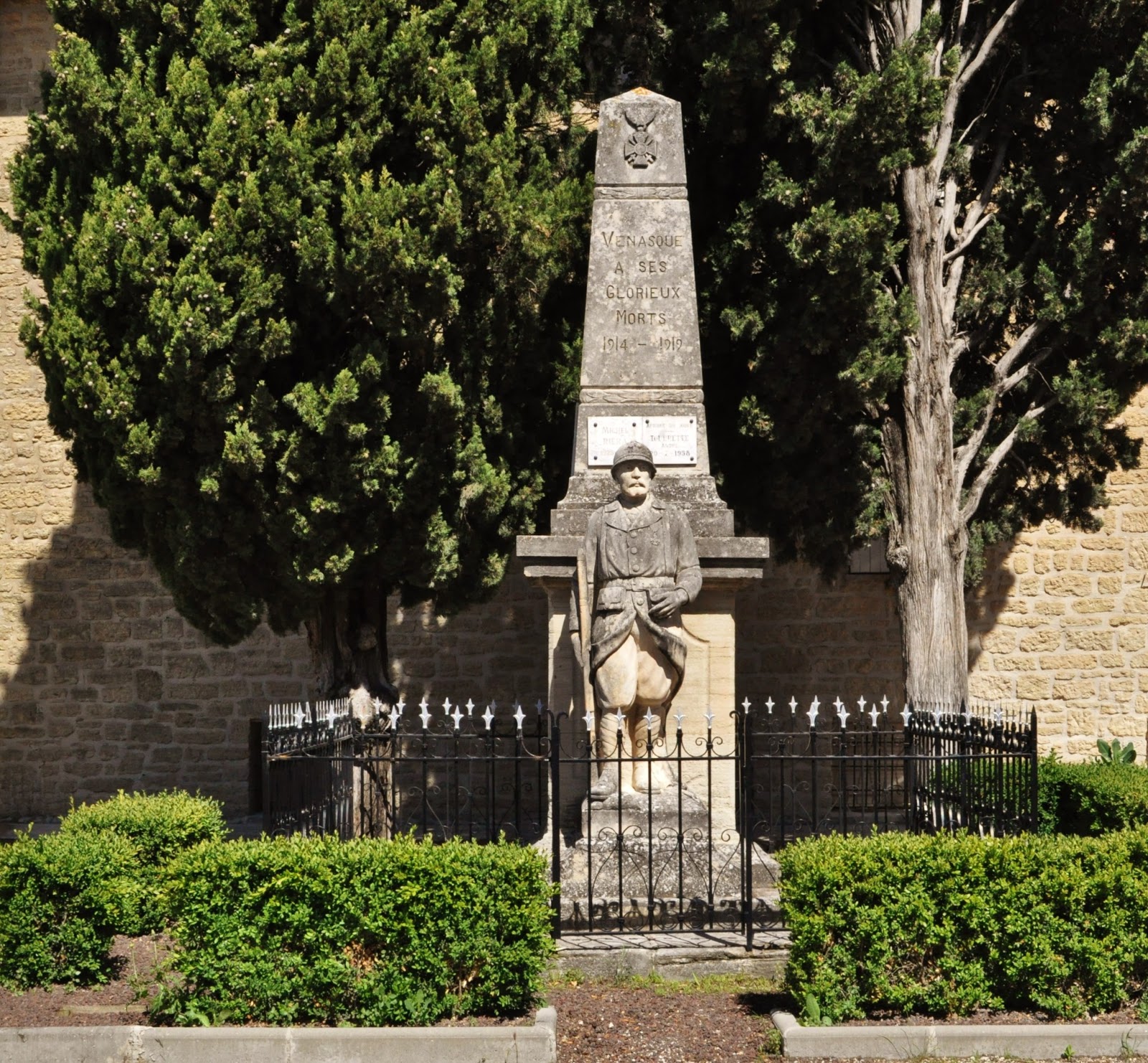
War Memorial near Notre Dame Church

Side door entrance to Notre Dame Church

Pretty house near Notre Dame Church

The fountain in the center of Venasque at Place de la Fontaine

The Venasquais are known for the cherries and table grapes (Muscat de Venasque) they grow.

View from Venasque

If you find yourself in Venasque and looking for a place to eat, you might try Les Remparts which I told you about here.

Bonne journée mes amis et à bientôt.