Tuesday, January 7, 2014

La Charrette Bleue, an excellent restaurant on the road through the Drôme Provençale

We found our car, not always easy to do with a rental car in a strange town, and headed toward Route de Gap for the 7 km drive east to La Charrette Bleue restaurant near Les Pilles, a tiny village in Drôme Provençale.

We had dined at the restaurant once before some years back after a Tuesday morning market in Vaison-la-Romaine. On that day, it was gray and gloomy and pouring down rain, so we sat in the cozy dining room.

Today, it was the opposite, a sunny warm day, with brilliant blue sky. It didn't take long to get to La Charrette Bleue, the restaurant sits right off the road, and a blue cart (for that is what the name means) sits on the roof.

We had good memories of our first meal and the restaurant was now designated a Bib Gourmand, an inspector's favorite for good value and listed in Michelin's Guide to Bonnes Petites Tables. As I have told you, we generally have very good meals in restaurants designated Bib Gourmand.

La Charrette Bleue Restaurant

We were among the first to arrive for lunch and were immediately seated on the covered terrace. The building was formerly a "relais de poste" or a place where fresh horses were kept along the postal route to replace tired horses. The restaurant is owned by the chef Paul Roussel.

Terrace at La Charrette Bleue

We made our selections and sat back to enjoy the chilled Château La Courançonne Séguret Rosé and the amuse bouche of zucchini gazpacho with fresh goat cheese from the chef. Pictures of our other dishes follow.

Amuse bouche of zucchini gazpacho with fresh goat cheese

Goat cheese creme brulee with herb salad

Market vegetable salad with light vinaigrette

Fillet of sole with champagne sauce with a dill risotto and caviar

Roast saddle of lamb stuffed with herbs and pine nuts with a thyme sauce

Potato fennel gratin

Duo of ile flottante and creme caramel on creme anglaise

Warm orange chocolate tart, lightly caramelized with house made chocolate ice cream

While our mouths and stomachs savored every bite of the excellent food prepared by the chef, our eyes took in the beautiful countryside which surrounds the restaurant.

Countryside next to La Charrette Bleue

As I told you here, we were on an excursion through the Drôme Provençale near our house in Sablet. We had started our day at the Thursday morning market in Nyons and we had just finished a wonderful lunch at La Charrette Bleue.

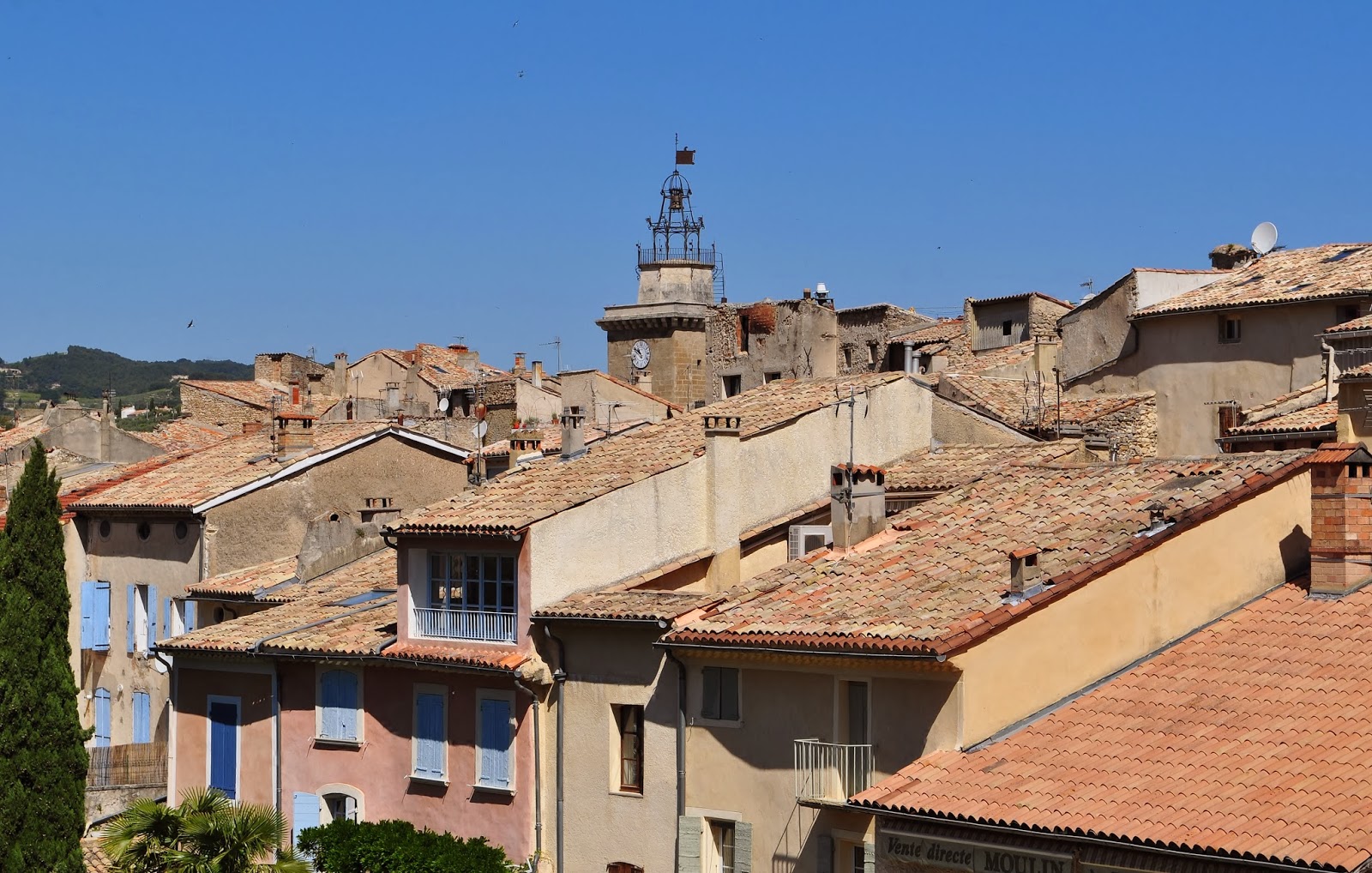
Our plan for the afternoon was to drive a circuit starting on the D64 heading toward Buis-les-Baronnies and then follow the D5 back to Vaison-la-Romaine and home to Sablet. As I drove along, I spotted a pretty church steeple above the roof tops and slowed down to enter the little village of Curnier. Here are a few sights that caught my eye.

Pretty house in Curnier

Curnier fountain and lavoir

Flowers on house in Curnier

Flowers on house in Curnier

Curnier church

I wanted to visit Buis-les-Baronnies because the young man who comes to Sablet every Thursday morning as I told you here to sell goat cheese, jam, fruit juice and olive oil made by his family, comes from Buis-les-Baronnies. He has told me several times that we should visit.

Buis-les-Baronnies is located in a fertile high valley of the Ouvèze river in Drôme Provençale that produces lavender, olives, apricots and limes; the surrounding mountains form a natural shelter around the village, within sight of Mont Ventoux.

Arcades surround Place du Marché

The houses and buildings of Buis-les-Baronnies are largely on the right bank of the Ouvèze river. The town built a large dike in 1776 to protect itself from periodic floods of the river, bordered by a beautiful promenade of plane trees.

Buis-les-Baronnies street

Arcades surround Place du Marché

La place du Marché has been crowded since before 1291 with artisan shops of various kinds. It is surrounded by pretty arcades, for the most part Gothic, reminding you of towns in Germany and Switzerland. The resemblance is due to construction which took place in the 15th century when Louis XI sent Germans troopers to rebuild Buis-les-Baronnies after a terrible plague in 1348 reduced the population by half.

Place du Marché

Pretty house above arcade at Place du Marché

Old, narrow street in Buis-les-Baronnies

Buis-les-Baronnies war memorial

The Rocher Saint Julien (literally translates as the rock Saint Julien) is a long, thin and tall limestone formation just over the village of Buis-les-Baronnies. Buis-les-Baronnies is a favorite destination for rock climbers (there are routes in the Gorges d'Ubrieux and on the rock Saint-Julien, as well as a rock climbing school.

Rocher Saint Julien

Notre-Dame de Nazareth Church

We finished up our visit to Buis-les-Baronnies with drinks at a café near Place du Marché before heading off for the final leg of our drive through Drôme Provençale; back to Sablet. All in all, one of our favorite ways to spend a day in Provence; a bustling market, an excellent lunch, wandering through a new village, and spending time together with drinks at a local café.

La Charrette Bleue
Route de Gap
26110 Condorcet
Tel: 04 75 27 72 33
Website: http://restaurant-la-charrette-bleue.com/

Monday, December 30, 2013

We visit the market in Nyons on our day trip through the Drôme Provençale

I think I have mentioned that we don't spend much time vegging out at home in Sablet. We are usually off visiting family, tasting wine, touring friends or exploring new corners of the region, usually with a leisurely Provençal lunch in the middle of the day.

One day a few months back, we headed off to explore the nearby Drôme Provençale. Being it was Thursday morning, our first stop would be Nyons (28 kms) so we could wander around the bustling Provençal market that takes place in the center of town every Thursday morning throughout the year.

Nyons sits in a natural basin on the right bank of the Eygues river, surrounded by hills and small mountains, which provides shelter from wind. The town gets an unusual amount of sunshine, earning Nyons the nickname "Little Nice" for its great climate.

When we get close to town, we see the Randonne Tower headed by pyramid arches on which stands a statue of Virgin Mary. The tower was erected around 1280, and at the time was used as a keep and military prison for the castle. In the 19th century it was converted to a chapel and renamed "Notre-Dame de Bon-Secours".

Nyons with Randonne Tower at the highest point

Probably the most famous historical monument in Nyons, is the "Roman Bridge," a single arch bridge across the Eygues river built in Romanesque style between 1341 and 1409. Until the 19th century, the bridge was the main access road into Nyons.

The Roman bridge over the Eygues river

The Olive tree in the roundabout in the center of town is a reminder that olives are celebrated in Nyons year-around with the Festival of Pitted Olives the weekend before Christmas, the Festival of New Olive Oil, the first Sunday in February, and Fête des Olivades, the weekend which follows Bastille Day.

The roundabout in the center of Nyons

In 1994, Nyons became the first region in France to be awarded its own appellation or AOC, for olives and oil, similar to that of wine regions. The rules of the AOC dictate what can be called Nyons olives or oil. For example, oils in this AOC must contain at least 95% of a variety of olives called Tanche.

Market stalls set up around the war memorial

We walk through the Saint Jacques gate, the only gate intact from the medieval defensive walls, to "Place des Arcades" and "Place de la Liberation" where the market is underway. "Place des Arcades" dates from the 14th century when it was set aside for markets and fairs in Nyons. The square gets its name from the arcades that surround the square.

Shops and cafés line "Place des Arcades"

Here are a few of the sights that caught my eye as we walked around Nyons that morning.

Street musicians perform on market day

Saint Vincent's Church with Saint-Césaire monastery and two nearby cemeteries formed the religious center of Nyons in the Middle Ages. Most of the modern-day building dates from the beginning of the 17th century.

The bell tower of Saint Vincent Church

Narrow street in historic center of Nyons

Brightly colored shopping baskets for sale on market day

The bell tower of Saint Vincent Church

Fruit and vegetable stand

The Roman Bridge

The bell tower of Saint Vincent Church peaks above the roofs of Nyons

Cafés line the arcades

Vendors set up under the plane trees on market day

Nyons fountain

As usual, we couldn't make it through a market without buying something such as linens, soaps, pottery, artwork, or something tasty to eat. Since it was getting close to noon and time for déjeuner (lunch), we headed for the car and to our next stop at La Charrette Bleue which I will tell you about in my next post.

Have a great day. A bientôt. See you soon.

Saturday, December 28, 2013

Domaine Catherine Le Goeuil in Cairanne, an outstanding producer of organic wines

Small villages dot the hillsides throughout the Northern Vaucluse, a geographic area bordered by the Rhône river near Orange in the west and the Dentelles de Montmirail, a small chain of mountains with dramatically jagged peaks in the east just to the south of Vaison-la-Romaine.

The Northern Vaucluse is the heart of the Southern Côte du Rhône wine region with famous wine villages like Châteauneuf-du-Pape, Gigondas, and Vacqueyras and lesser known villages like Rasteau, Séguret and our own Sablet, the village we call home in Provence.

Cairanne is a village on a small hill east of Sablet known for producing very good wines. The lower part of the village is newer with a few shops, the Town Hall, and school. The oldest part of the village is on top of the hill. Cairanne was a fortified village of the Knights Hospitallers in Medieval times.

As I told you here, there is a hierarchy of wines in the Côtes du Rhône. Cairanne is classified at the third level, Côtes du Rhône-Villages (named village), which means Cairanne along with 17 other villages including our own Sablet, are authorised to put their village name on wine labels.

We recently added a red wine from Domaine Catherine Le Goeuil in Cairanne to our wine list at Bistro Des Copains, the small French bistro I co-own with friend Cluney in west Sonoma County California. Although we tasted the wine before adding it to the list, I had never visited the winery.


So one day earlier this year, I called and set a rendez-vous (made an appointment) with Madame Le Goeuil to visit the winery and déguster (taste) her wines.


Born to French parents in the Congo, Catherine returned to her homeland and in 1993 having lots of determination but not much experience, she and her family bought the 6 hectares (nearly 15 acres) domaine in Cairanne.

Friend Greg, Catherine Le Goeuil, and me

Shortly after applying one of their first chemical treatments to the vines, Catherine became very ill. Convinced the illness was caused by the chemicals, she decided that going forward, she would farm as naturally as possible. Over time, she converted to organic farming and in 1999 was organic certified.


The Mistral wind blows often on the vineyards which rids the vines of excess moisture when it is not wreaking havoc on her flowers. As is typical for organic farming, there is a grassy cover crop in between the vineyard rows that provides nutrients and microbiotic growth and well-aerated soils in a typically tough and relatively impermeable sandy soil.

Stainless steel tanks for fermenting white wine


Friends Julia and Jennifer with Catherine's helper


We have the 2010 Domaine Catherine Le Goeuil Côtes du Rhône-Villages Cairanne red wine seen below on our list at Bistro Des Copains. The wine is a blend of Grenache (51%), Syrah and Mourvèdre.

The grapes are harvested by hand from 50 year old vines and naturally fermented with indigenous yeasts. The wine is bottled unfined and unfiltered which makes it more flavorful but also prone to more sediment.

Wine we have on list at Bistro Des Copains

Showing Catherine pictures of Bistro Des Copains

Lots of flowers


Friends Julia and Jennifer

She doesn't make a lot of wine, only 1600 - 2100 cases a year, so it may be hard to find. If you are in Sonoma County, come to the Bistro and enjoy it with dinner; its a great food wine. If you are lucky enough to be in the Southern Côte du Rhône wine region, you should visit Domaine Catherine Le Goeuil. You will be warmly received.

Domaine Catherine Le Goeuil
Quartier les Sablières
84290 Cairanne
Tel: 04 90 30 82 38

We hope you are enjoying the holiday season. Have a great weekend. Chat soon.