Wednesday, November 2, 2016

Tomato Tarte Tatin, Delicious for First Course or Light Lunch

A few weeks ago, we ate lunch at a lovely restaurant which offered an unusual, at least for France unusual, three-course vegetarian menu option. The choices looked so yummy, that most of us chose the vegetarian option. I will soon write a post about our visit to Venasque and lunch at Les Remparts. For now, I will say our starter of "Tarte Tatin aux Tomates" was to die for. It was so good!

When we got back to California, I was happy to see that there were lots of Roma tomatoes in the garden along with an abundant crop of Oregano. So I began a quest to duplicate that yummy tart by searching my collection of cookbooks, as well as online at Google and Pinterest. The recipe which follows draws from multiple sources. I hope you like it.

Michel's Tarte Tatin Aux Tomates with Arugula

In a large skillet, large enough to hold 2 3/4 pounds of Roma tomatoes, melt butter and sugar over medium heat until they caramelize like shown below. Just before you take it off the stove, add 2 finely diced garlic cloves. Don't let them burn.

Caramelized butter and sugar

Arrange the halved and seeded Roma tomatoes, cut sides up in your large skillet as shown below. Lower the heat and cook for 10 minutes until the tomatoes release most of their juice.

Halved and seeded Roma tomatoes arranged on top of caramelized butter, sugar and garlic

Add balsamic vinegar and cook 2 minutes more. Arrange the tomatoes in an 11 or 12-inch tart pan with removable base, cut sides up. Spoon some of the juices from the pan over the tomatoes, there is a lot of flavor in the juices.

Cooked tomatoes in tart pan

Oregano from the garden

Sprinkle with Oregano, salt and pepper to taste.

Cooked tomatoes with fresh Oregano, salt and pepper, ready for pie pastry

Roll the pie pastry and with sharp knife or scissors, cut it into a 12-inch round. Place it on top of the tomatoes, tucking it in at the edges. With a fork, make small holes in the pastry.


Set the tart on a rimmed baking sheet and transfer to a preheated oven. Immediately reduce the oven temperature to 375 degrees. Bake the tart for 30 minutes, or until the pastry is golden brown.


Let the tart sit for 5 minutes after you take it out of the oven. Run a knife around the pastry to loosen it from the pan. Now if you have a fluted tart pan like me, don't worry about running a knife around the edge of the pan. It pulled away on its own while it was resting.

Set a large plate upside down on the tart and using pot holders, turn the plate right side up so the tart comes out. Garnish with oregano.


Ingredients

3 tablespoons butter
1 tablespoon brown sugar
2 finely diced garlic cloves
2 3/4 pounds Roma tomatoes, halved and seeded
2 tablespoons Balsamic vinegar
1 tablespoon chopped fresh Oregano
Salt and pepper to taste
Pie pastry for a 12-inch tart
Extra fresh Oregano for garnish

Directions

1. Preheat the over to 400 degrees. Have on hand an 11 or 12-inch tart pan with removable base and a rimmed baking sheet.

2. In a large skillet of sufficient size to hold all the tomatoes, melt the butter over medium heat. Add the brown sugar and cook it until it is fully dissolved. When it starts to caramelize, add the diced garlic. Take it off the heat.

3. Add the tomatoes and arrange them cut sides up in the skillet. Put back on the heat and lower the temperature and cook for 10 minutes or until the tomatoes release most of their juice.

4. Add the Balsamic vinegar and cook for 2 minutes more. Remove from heat.

5. Arrange the tomatoes in an 11 or 12-inch tart pan with removable base, cut sides up. Spoon some of the juices from the pan over the tomatoes.

6. Sprinkle with the Oregano and salt and pepper to taste.

7. Roll the pie pastry and with sharp knife or scissors, cut it into a 12-inch round. Place it on top of the cooked tomatoes, tucking it in at the edges. With a fork, make small holes in the pastry.

8. Set the tart on a rimmed baking sheet and transfer to a preheated oven. Immediately reduce the oven temperature to 375 degrees. Bake the tart for 30 minutes, or until the pastry is golden brown. Remove from oven.

9. Let the tart sit for 5 minutes after you take it out of the oven. Run a knife around the pastry to loosen it from the pan.

10. Set a large plate upside down on the tart and using pot holders, turn the plate right side up so the tart comes out. Garnish with oregano.

11. Cut the tart into wedges and garnish with oregano. Serve with dressed greens.

Bon appétit.

Monday, October 31, 2016

Lavender fields in Vaucluse and nearby Drôme Provençale

It's a toss up between coquelicots (red poppies) and lavender but probably no other scent or sight says Provence better than the pungent aroma of a purple field of lavender growing in mounded rows under a brilliant blue summer sky.

We were lucky that it was lavender season when we were in Sablet last summer with our daughter Tricia, husband Alvin and grandkids Avery and Caedon. The pictures which follow show the lavender fields we found during outings to the Drôme Provençale area west of Nyons, the Sénanque Abbey and to Sault.

Three species of lavender grow in Provence: true lavender (lavande) is found high up in dry, rocky soil. Aspic which grows lower down is similar to lavande except it has broader leaves and its branches hold a number of stems. And less refined, lavandin is a hybrid of lavande and aspic.

Lavande is most highly regarded by perfume makers for its sweet essential oils, though aspic and especially lavandin are more productive and therefore more common - ending up in laundry and household products.

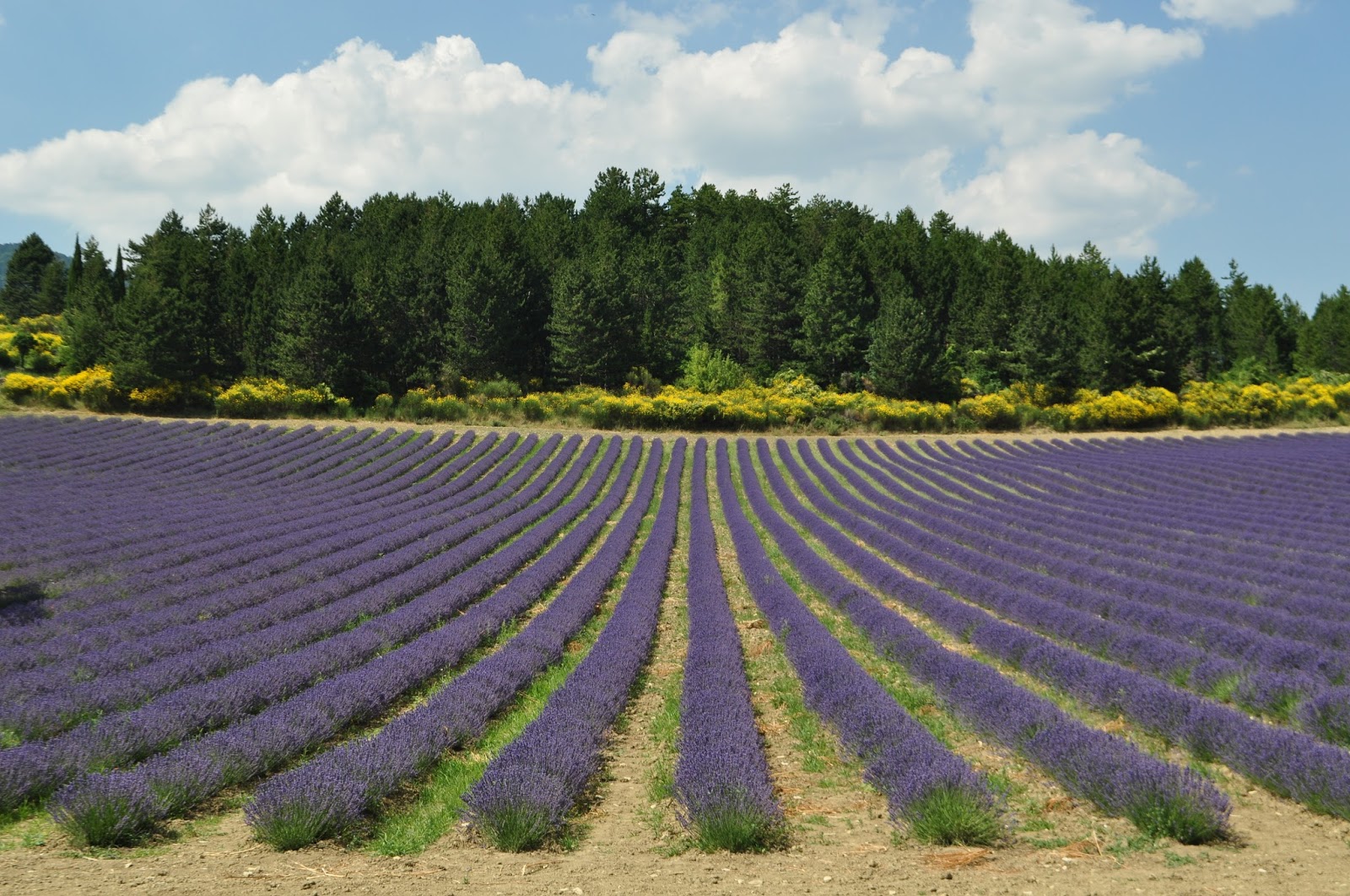
Lavender field in the Drôme Provençale

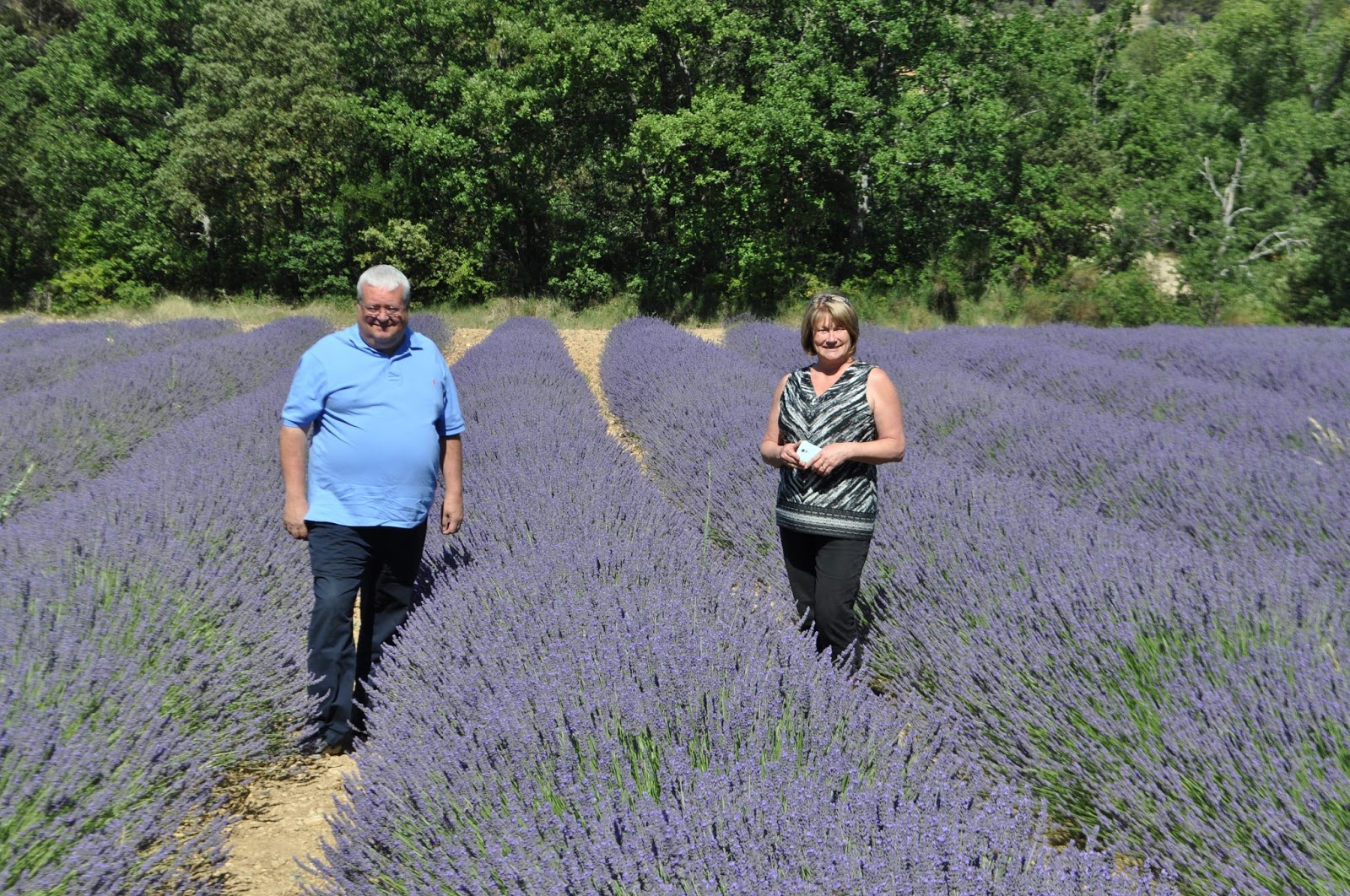
Me and my love in a lavender field in the Drôme Provençale

Alvin and Tricia in a lavender field in the Drôme Provençale

The Sénanque Abbey is a beautiful Cistercian abbey located in the deep Senancole valley a short distance north of Gordes and well worth a visit anytime you are in the area. But the best time to go is when the lavender fields that stretch out from the Abbey are in full bloom.

The Sénanque Abbey was founded in 1148 under the patronage of Alfant, bishop of Cavaillon, and Raymond Berenger II, Count of Provence, by Cistercian monks who came from Mazan Abbey in the Ardeche. In the 13th and 14th centuries, the Abbey reached its greatest height, operating four mills, seven granges and possessing large estates in Provence

During the Wars of Religion, the quarters for the lay brothers were destroyed and the Sénanque Abbey was ransacked by Huguenots. At the French Revolution, the Abbey's lands were nationalized, the one remaining monk was expelled and Sénanque itself was sold to a private individual.

The site was repurchased in 1854 for a new community of Cistercian monks of the Immaculate Conception, under a rule less stringent than that of the Trappists. The community was expelled in 1903 and departed to the Order's headquarters, Lerins Abbey on the island of St. Honorat, near Cannes. A small community returned in 1988.

Sénanque Abbey

The Sénanque Abbey is an active community with a handful of elderly monks. The monks grow the lavender and tend to honey bees to earn income for living and upkeep of the Abbey.

Lavender field near Sénanque Abbey

The Sénanque Abbey along with two other early Cistercian abbeys in Provence, Silvacane Abbey and Le Thoronet Abbey, are sometimes referred to as the "Three Sisters of Provence"

Sénanque Abbey

Lavender field near Sénanque Abbey

Lavender field on the way to Sault

Lavender fields on way to Sault

Lavender field on way to Sault

Lavender field on way to Sault

Lavender field on way to Sault

Lavender field on way to Sault

Lavender field on way to Sault

Lavender field on way to Sault

Lavender field on way to Sault

Lavender field on way to Sault

Lavender field on way to Sault

Lavender field on way to Sault

Lavender field on way to Sault

Lavender field on way to Sault

Lavender field on way to Sault

Another view of same lavender field

Lavender field near Sault

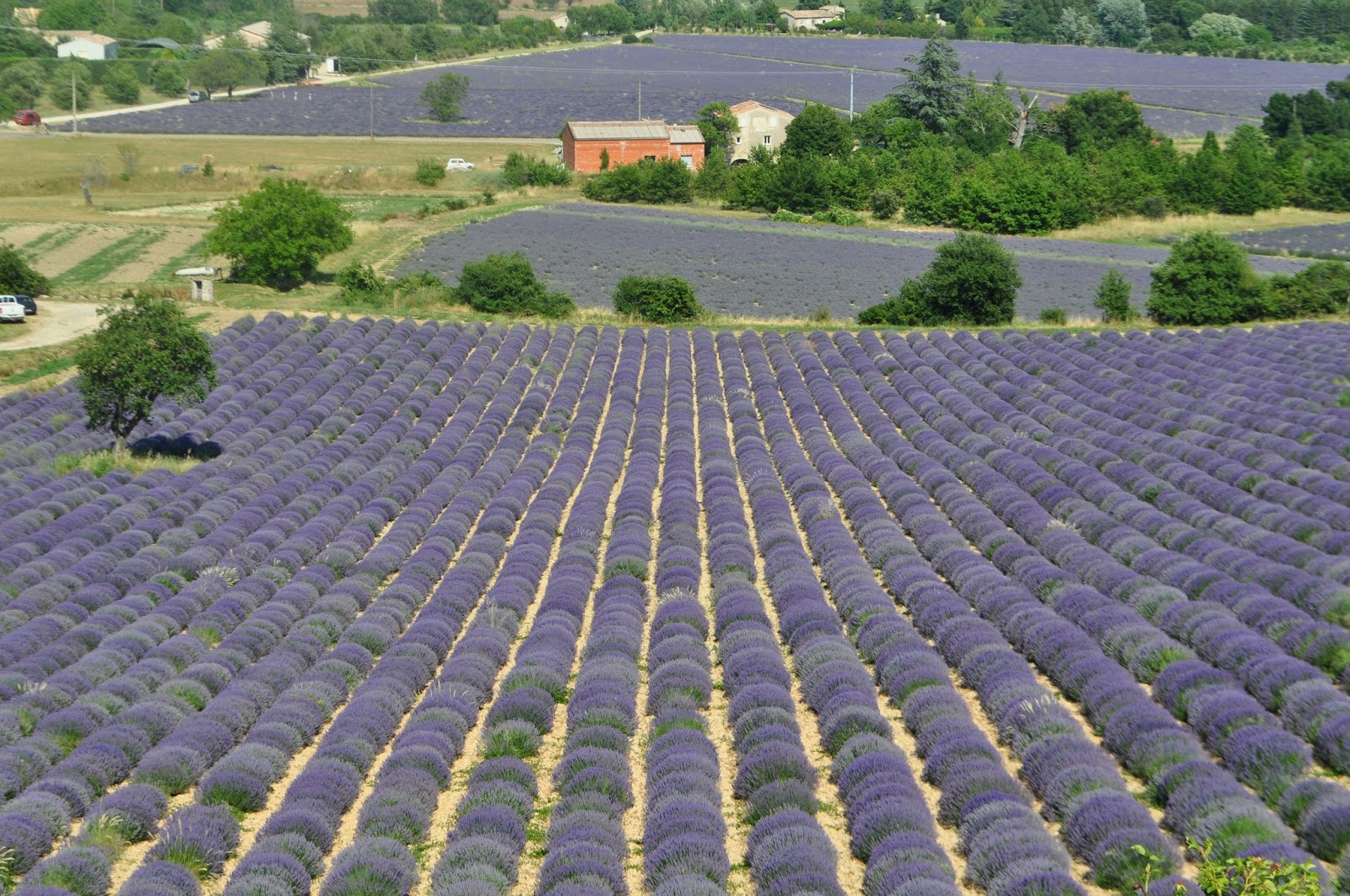
View of the patchwork of lavender fields visible from Sault

Sault is an old fortified village that sits on a ridge overlooking a large valley dotted with lavender fields about one hour from Sablet. The name Sault comes from "Saltus" referring to the forests that covered the area.

Lavender field below Sault

Lavender field near Sault

Lavender field near Sault

Shirley in lavender field near Sault

Lavender field near Sault

Lavender fields near Sault

Lavender fields with Sault in distance

Close up of previous lavender field near Sault

We don't get to be in Sablet during the summer every year so we miss out on the lavender most years, which is obviously a mistake.

Saturday, October 29, 2016

2016 Stage 12 Tour de France, Montpellier to Mont Ventoux

The moment we saw that the 2016 Tour de France included a climb up 6,273 foot Mont Ventoux, we decided we would be in Sablet that day. As you can see below, the stage was to begin in Montpellier and the riders would pedal 184 km before finishing at the top of Mont Ventoux.

Stage 12 Tour de France Route

We had been told that thousands of people had been camping for days on Mont Ventoux and it would be impossible to find a place to park or see the race with good visibility on the mountain. So we opted to stay below and watch the caravan and riders from a location in Bédoin, a pretty village that sits at the foot of Mont Ventoux.

The first thing you'll notice when you get close to Bédoin is a large, imposing, Spanish-looking church, quite different from most others in Provence. In fact, Saint-Pierre Church is Jesuit, built in 1702 and restored in the 19th century. In spite of the different style, the church does have a wrought-iron belfry so typical of the region.

From a distance, the houses of this compact, old village look small compared to the church, and are clustered up against the hill. Inside the old village it's looks typically Medieval, with long, narrow streets between tall old buildings, many with ancient stone doorways and some colorful Provencal facades.

Saint-Pierre Church in Bedoin

Stage 12 of the Tour de France began with 125kph winds moving the finish from the moonscape of the summit down the mountain 7 km to Chalet Reynard, where the forest gives way to the more exposed road that leads to the summit. There was a fear that riders would be blown off their bikes as soon as they came out of the forest.

Big screen TV set up at entrance to village where you can watch the progress of the peloton

We found a place to park in a field that had been turned into a parking lot for the day just outside of Bédoin on the road that leads to Crillon-le-Brave and walked into the village. Since it was several hours before the first cars in the Caravan were due to arrive, Shirley went shopping and I went to look for a place for lunch.

Tour fans arrive in Bedoin

I got the last open table at Le Gousse d'Ail and waited for Shirley to arrive. We had a really nice meal which included Cannelloni of zucchini and goat cheese, Filet of Merlan with cheesy polenta, and Parmentier of Guardian and finished with a Fig gratin. During the course of the meal, I got into a conversation, as I often do, with the French lady sitting at the table next to us.

As we got up to leave and said our goodbyes to our new friend, she said "take my wrist bands and go sit in the VIP review stands so you have a good view of the race. I will go and watch from the street. We were thrilled and thanked her repeatedly.

My VIP wrist band

Shirley sitting in the reviewing stand reading a book on her ipad while we wait for the caravan to arrive in Bedoin

Fans lining up along the street where the peloton will arrive. By the time they arrived, people were hanging out of those windows

View across the street from the reviewing stand. The street has been cleared for the arrival of the caravan.

Those who have not seen the Tour caravan in person may find it difficult to understand the allure. It’s just a parade, right? It is, but on a scale seen nowhere else on earth. It’s a parade that covers 3,360 kilometers, every last meter of the Tour de France route, passing by millions of fans, throwing 14 million tiny trinkets and gifts; a parade that represents, directly and indirectly, a significant portion of Tour revenue.

The caravan is a 45-minute string of vehicles, each modified and decorated by advertisers, that rolls ahead of the Tour peloton. It was founded in 1930, conjured up by Tour founder Henri Desgrange, conceived originally as a way to pay for the organizer-supplied bicycles that riders had to use at the time. Its commercial success was immediate, and has never waned.

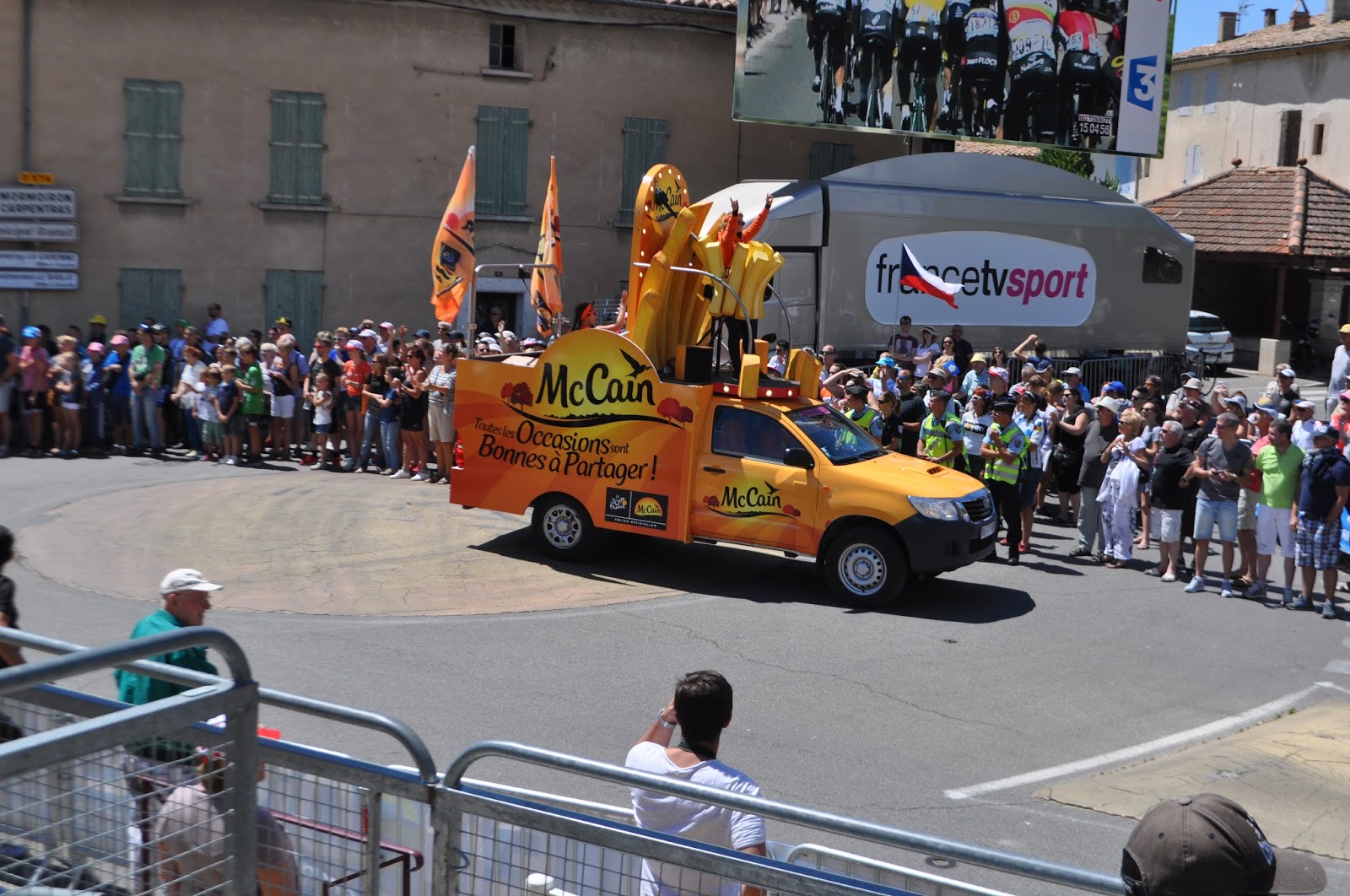
Tour de France sponsor car

In the pictures which follow, you can see a lot of the action that occurred in front of the reviewing stand.

Tour de France sponsor car

Tour de France sponsor car

Tour de France sponsor car

Tour de France sponsor car

Tour de France sponsor car

Tour de France sponsor car

Tour de France sponsor car

Tour de France sponsor car

Tour de France sponsor car

Tour de France sponsor car

Tour de France sponsor car

Tour de France sponsor car

Tour de France sponsor car

Tour de France sponsor car

Tour de France sponsor car

Tour de France sponsor car

Tour de France sponsor car

Tour de France sponsor car

Shirley's favorite Tour de France sponsor car

Tour de France sponsor car

Tour de France sponsor car

First group of riders

Tour de France breakaway riders

Tour de France riders

Tour de France riders

Tour de France riders

Tour de France riders

Tour de France riders

There are 5 camera-equipped motorbikes in the convoy. These are registered to Euro Media Group which provides the live-feed for all coverage. Near the finish, one of these camera-equipped motorbikes stopped without warning directly in front of Richie Porte of BMC, Bauke Mollema of Trek-Segafredo, and Chris Froome in the yellow jersey. Porte smashed directly into the camera, followed by Mollema and Froome, but only Froome’s bike came out of the tangle completely unrideable.

Camera-equipped motorbikes

Main group of Tour de France riders

Main group of Tour de France riders

Main group of Tour de France riders

Main group of Tour de France riders

Chris Froome wearing the yellow jersey of the race leader arrives with the main group of Tour de France riders

Chris Froome in yellow jersey

Main group of Tour de France riders

Main group of Tour de France riders

Main group of Tour de France riders

Main group of Tour de France riders

Main group of Tour de France riders

Main group of Tour de France riders

Main group of Tour de France riders

Main group of Tour de France riders

Main group of Tour de France riders. Adam Yates is wearing the white jersey for the best under-25 rider in overall standings

Last of the main group of Tour de France riders

Last of the main group of Tour de France riders

Last of the main group of Tour de France riders

A straggling Tour de France rider

A straggling Tour de France rider

Last of the Tour de France riders

Last group of Tour de France riders

As I told you earlier, Chris Froome's bike was broken when he, Richie Porte and Bauke Mollema collided with a television bike on the crowded road a little over a kilometer before the finish line. Mollema disentangled his bike and remounted, but Porte’s chain was off and Froome’s was unrideable.

Chris Froome took off running just as fast as his cycling shoes would allow up the mountain before taking a bike from the neutral service car, but struggled to gain traction on the ill-fitting bike and had to swap it again when his team car finally made it through.

Froome lost around a minute and a half on the road and slipped to sixth on the provisional general classification, 53 seconds behind fellow Briton Adam Yates, before the race jury intervened.

They ruled that Porte and Froome should receive the same time as Mollema who got back on his bike and stayed clear of the chasing rivals. Thus Chris Froome retained the overall general classification lead of the Tour de France.

Crowd in front of the reviewing stand watching the drama unfold up at the finish of the Tour de France

At the end, Thomas de Gendt of Belgium (Team Lotto-Soudal) was the winner of Stage 12 after he outsprinted fellow Belgian Serge Pauwels of Team Dimension Data after surviving a day-long breakaway.

The route for the 2017 Tour de France has just been announced. See map from Tour de France below.