Thursday, April 6, 2017

Visit to the beautiful hilltop village of Venasque and lunch at Les Remparts Restaurant

We frequently take day trips from Sablet to explore the hill-top villages of the Luberon. To get there, we drive down the D4, a scenic route that takes you across Carpentras before it becomes a narrow winding road flanked by cherry orchards until it passes below the village of Venasque.

Venasque is a small pretty village that clings to a rocky hillside overlooking vineyards, garrigue and cherry trees. It is classified as one of the "Plus Beaux Villages de France" (translated as most beautiful villages of France), one of seven villages with that designation in the Vaucluse region where Sablet is located.

Cherries have been grown in this part of Provence since the 17th century and it remains the largest producer in France. Those from Venasque are said to be the best: the village refers to its cherries as diamants rouges (red diamonds).

Arched doorway through the defensive walls

Venasque is one of the oldest villages of the Comtat Venaissin often referred to simply as the Comptat. Comptat means county in its original sense, or land belonging to a count and Venaissin refers to Venasque, a former bishop seat which gave its name to the Comptat.

The fountain in the center of Venasque at Place de la Fontaine

You will recall that last fall, dear friends Steve and Mary visited from Michigan. They love Sablet and have been with us several times plus they have visited on their own with family and friends several more times.

I am telling you this not as a complaint for sure, we love their visits, but to say they know the area almost as well as we do, so its not easy to find new interesting places to visit or excellent new restaurants to try.

Sign for Les Remparts Restaurant

As I was studying the map one morning, my eye caught "Venasque" and I immediately recalled that there was a nice restaurant with good food and excellent views in the middle of the village. I called and confirmed that Les Remparts was open and made reservations for noon.

As we were slow to get away from Sablet that morning, by the time we got to Venasque and found parking and walked into the village, it was noon and time for lunch. The restaurant is located just a few steps from the fountain in the center of the village.

Les Remparts Restaurant

At Les Remparts, you can sit in the interior dining room, a large sun room or on a small outdoor terrace with views of the valley on sunny days. We hadn't reserved soon enough to sit in the sun room so we were seated in the interior dining room.

Shirley and I at Les Remparts Restaurant

Les Remparts offers a number of prix fixe menus, including a vegetarian menu for 27 Euros. We made a very important decision right away, choose a wine, a 2015 bottle of Château La Canorgue Rosé, an organic wine made of Provençal staples Syrah, Grenache and Mourvèdre.

2015 Château La Canorgue Rosé wine

We all chose the vegetarian menu for 27 Euros. The starter of Tomato Tarte Tatin with salad was a  huge delicious hit. Both Mary and I vowed to try and replicate this at home. The crust was perfect and the caramelized tomatoes were so good.

Tomato Tarte Tatin with salad

The main course choices for the vegetarian menu were a Vegetarian Crumble that sat on a roasted tomato sauce seen below or;

Vegetarian Crumble (ratatouille vegetables, mozzarella and crumble) with roasted tomato sauce

a plate of creamy Porcini ravioli with a Porcini mushroom sauce. It was the heart of mushroom season and I couldn't resist a dish with Porcini mushrooms. The dish fully lived up to my expectations.

Porcini Ravioli with a Porcini mushroom sauce

Next came a cheese course with a selection of 5 goat cheeses and two cow's milk cheeses seen below.

Cheese course (5 goat cheeses and two cow's milk cheeses)

Dessert choices included Chocolate Mozart Cake;

Chocolate Mozart cake

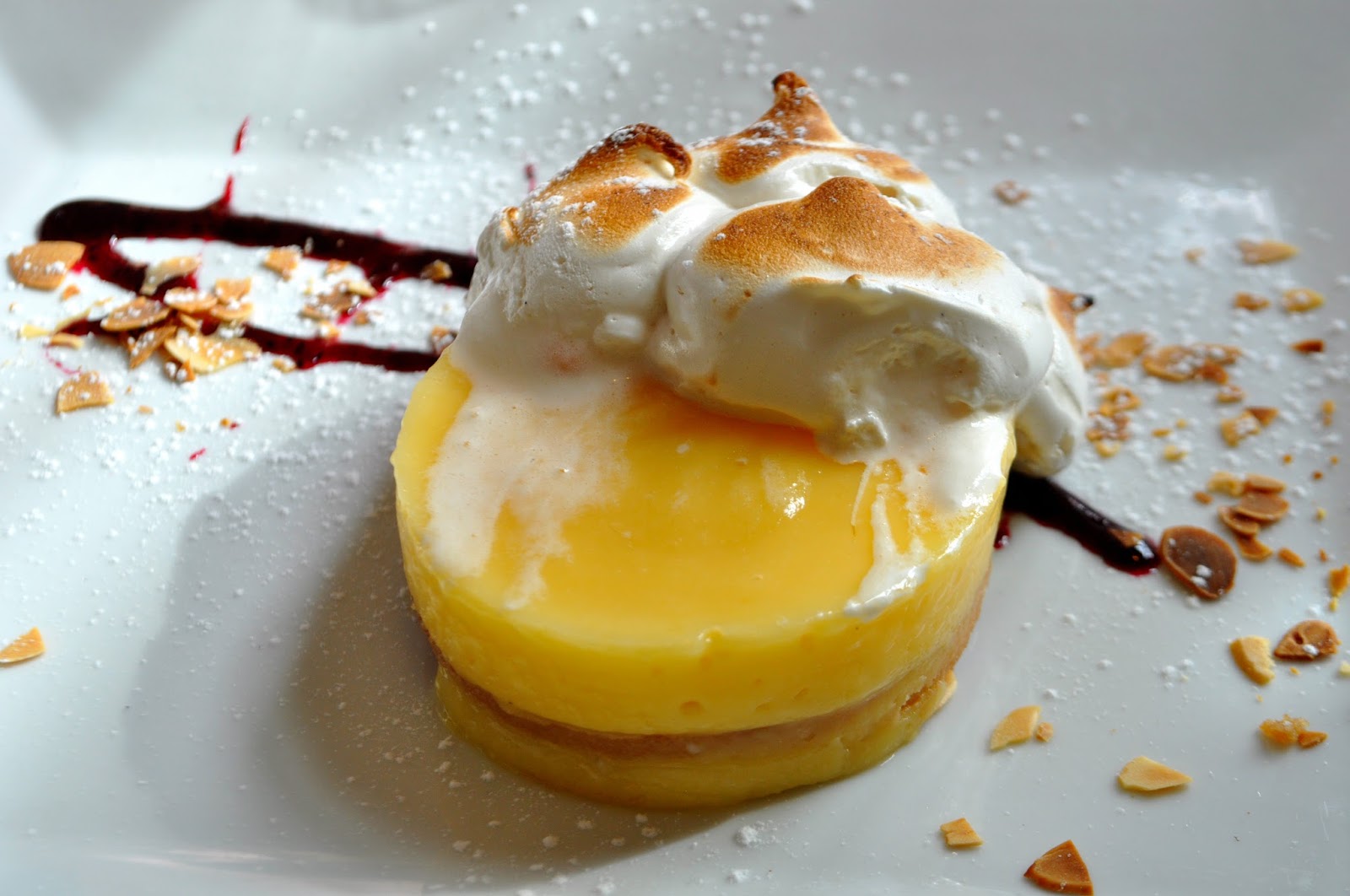
a yummy Lemon Tart;

Lemon Tart

Lavender Crème Brulee.

Lavender crème brulee

As soon as we were brought "l'addition" (the bill), we paid and headed out to walk about the village and take come pictures. The restaurant was as good or better than what I remember. I think Steve and Mary liked it a lot too. The first thing I saw was this old building seen below with the words carved in stone which said "Ecole des Filles"

Old Girl's School

Venasque's location on top of the hill provided a natural defense against attacks from enemies. Nevertheless, in Roman times, a defensive wall with towers was built around the village. The arched doorways were restored at the beginning of the 20th century.
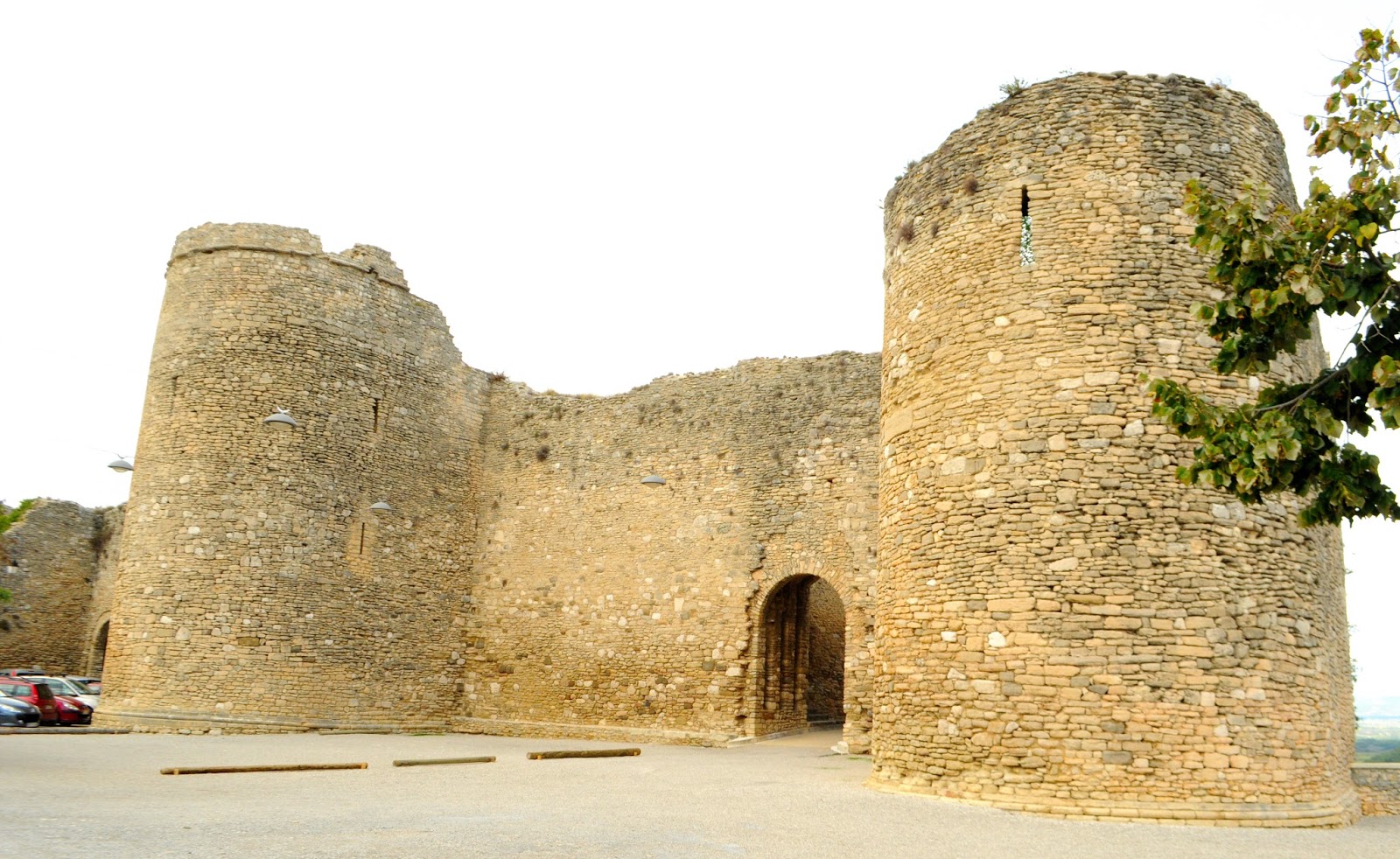
Tower and an arched doorway through the defensive walls

The thick walls of the ramparts which survive connect three Saracen towers and two arched doors "portes". Supposedly the stones in the defensive wall that no longer exist were removed as if the wall was a sort of rock quarry and used to build the school and village houses.

Mary and Shirley in front of the defensive Saracen towers

There are over 200 bories in the area around Venasque. These simple stone huts first appeared before even the Romans arrived, and continued to be used as housing until the 20th century, more recently as shepherds' shelters or sheep pens.

View of village cemetery from Venasque

Venasque is a very long and narrow village, like most settlements built on the crest of a hill, with superb panoramic views.

Arched doorway through the defensive walls into the center of Venasque

As you wander around Venasque, you will come upon the "House with Blue Shutters."

La Maison aux Volets Bleus (The House with Blue Shutters)

One of the many pretty streets you will come across as you wander around the village. They are deserted at the moment while everybody stops for their mid-day meal.

Steve and Mary walk down Venasque street

As you can see, Venasque is a small village. There are only 1,099 people who reside in the village according to the latest census. They are known for the cherries and table grapes (Muscat de Venasque) they grow around the village.

Arched passageway called Impasse Du Moulin

The village is artfully decorated with plants and flowers and even the post office, with its vine-covered terrace, is a little gem.

La Poste (The Post Office)

Pretty house with statue in wall

Water was piped to houses throughout the village between 1959 and 1965. Prior to this time, villagers got their water from the various fountains throughout the village.

Venasque fountain at Place de la Planette

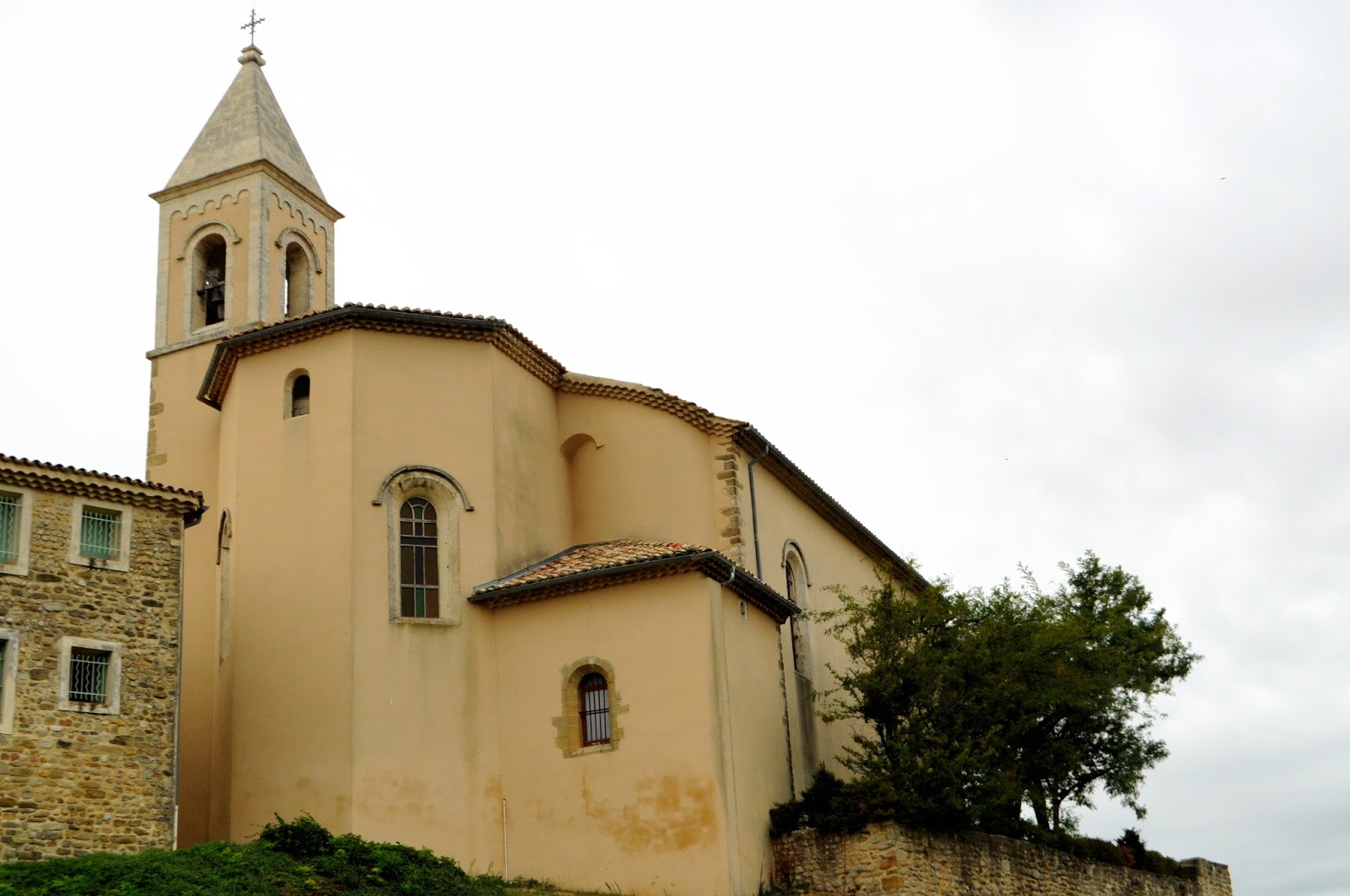
The Notre Dame Church in Venasque dates from the end of the 12th century. The side chapels date from the 17th and 18th century, the bell tower from the 17th century.

View of the Notre Dame Church Bell Tower in Venasque

Inside the church, there is a very beautiful baptistry. Its origins are unclear, but it is believed to be the oldest religious baptistry in the region.

Notre Dame Church in Venasque

Iron cross near Notre Dame Church in Venasque

War Memorial near Notre Dame Church

Notre Dame Church in Venasque

Statue above side door entrance to Notre Dame Church

Hotel de Ville (Town Hall)

It is definitely worthwhile to turn off the D-4 and drive up the hill to Venasque. As I said, it is small and will only take you a couple of hours to do a walking visit through the village. Try to time your visit so you can eat lunch at Les Remparts. Make sure you reserve a table. You will be happy you did.

Les Remparts Restaurant
36 Rue Haute
84210 Venasque
Tel: 04 90 66 02 79
www.hotellesremparts.com

Saturday, March 25, 2017

Learn to Cook at Cuisine de Provence

We have just returned from a wonderful time in Sablet. Windsor neighbors Ed and Gwen and Bob and Darlene traveled with us. We were on the go every day but spent most evenings at home. We took day trips, hiked through villages, visited with French family, shopped the markets, caught up with friends and ate a lot of great food accompanied by excellent wines and of course took lots of pictures.

We were very pleased some years back when a fellow blogger invited us for aperitifs at the beautiful home she shares with her husband Robert in nearby Vaison-la-Romaine. I met Barbara Schurenberg through her wonderful Cuisine de Provence blog where she wrote about food and life in Provence. While she is no longer writing new posts, you can still read all of the posts she wrote over the 5 plus years she maintained the blog.

Barbara is a contemporary art critic turned chef/cooking instructor at the Cuisine de Provence cooking school she runs out of her home. While quite a few of our guests have taken classes and she is recommended in Rick Steves' guide to "Provence and the French Riviera" I had never taken a class myself.

While Barbara doesn't normally offer classes during February and March, I emailed her to see if she would be willing to do a class for my friends and me. She said absolutely yes, but that it would have to be limited to 3 people since it was still cold, we couldn't work outside and her kitchen can only accommodate she and 3 students.

After chatting with our friends during our planning get together for our trip to Sablet, we decided that Ed, Darlene and I, the true foodies of the group, would take the class and Shirley would lead Gwen and Bob on a hike from Gigondas to the top of the Dentelles de Montmirail.

Shirley dropped us off at 9:30 and headed off to Gigondas. The foodies walked up to the house where we were greeted by Barbara and Robert. After chatting a few minutes, Barbara presented each of us with a personalized Cuisine de Provence apron and packet of six recipes we were going to be cooking that day.

Cuisine de Provence's Barbara Schurenberg

We were each assigned various tasks to perform as Barbara guided us through the menu of dishes we were going to prepare that day.

Our instructor Barbara Schuerenberg and students Darlene Brown and Ed Kinney

We started with the tapenade since it was going to be used in a second recipe. Tapenade is a Provençal dish consisting of puréed or finely chopped olives, anchovies, olive oil and other ingredients. It is a popular dish in Provence, where it is generally eaten as an hors d'œuvre spread on bread, but it is also used as a component for other dishes. Barbara's recipe includes black and green olives and sun dried tomatoes.

Tapenade

The next recipe we tackled was Mini Onion Tarte Tatins. Tarte Tatin is an upside-down tart, historically made with butter, sugar, apples and a pastry crust — but it doesn’t have to be. Creative cooks like Barbara have found interesting ways to reinvent the classic French dish with vegetables instead of fruit, making what was once a sweet treat a savory indulgence such as the onion Tarte Tatins we were making that day.

Mini Onion Tarte Tatins

The Tomato Puff recipe consisted of slightly caramelized cherry tomatoes, puff pastry and the tapenade we had made earlier. I was assigned responsibility for assembling the Tomato Puffs. Barbara warned us that you have to really indent the puff pastry or the tapenade will slide off when the puff pastry rises during baking. I didn't indent the puff pastry enough for the tapenade and sure enough some slid off during baking.

Tomato Puffs

A Tian is an earthenware vessel of Provence used both for cooking and serving. It is also the name of the dish prepared in it and baked in an oven. The next dish that we made with Barbara was a Lamb Tian. Her recipe included sliced onions, herbs de Provence, diced zucchini, cubed lamb, and tomato sauce mixed together and topped with slices of fresh tomato in the Tian, which is baked in the oven. It smelled wonderful and tasted even better.

Lamb Tian

For dessert, Barbara taught us how to make a raspberry clafoutis. Clafoutis is a baked dessert of fruit, often cherries, arranged in a buttered dish and covered with a thick flan-like batter. The clafoutis is dusted with powdered sugar and served lukewarm. The clafoutis comes from the Limousin region of France, and while black cherries are traditional, there are numerous variations using other fruits, including raspberries like Barbara's recipe.

Clafoutis aux Framboises

While dishes were finishing in the oven, Barbara invited us to sit in her beautiful parlor and enjoy some wine and the hors d'oeuvres we had made together under her guidance. After nibbling on the Mini Onion Tarte Tatins and Tomato Puffs between sips of white wine, we moved to the dining room.

Students enjoying l'apero in Barbara's beautiful home

There we found a long table set with a bowl of the bright yellow Velouté de Butternut soup we had made at the beginning of our class. The term velouté is from the French adjective form of velour, meaning velvet, which is how the soup felt in the mouth and can also refer to one of the five sauces of French cuisine that were designated the "mother sauces" by Auguste Escoffier in the 19th century. Barbara's recipe included a roasted head of garlic.

Beautifully set table with bowls of Velouté de Butternut

By the time we finished our delicious meal and petit cafes, it was 2:00 and the door bell rang signaling that Shirley and the other hikers were back to pick us up. The class with Barbara was a thoroughly delightful and delicious experience and I understand why our guests give her rave reviews.

The "foodies" are planning to replicate this meal for the Vanessa Court neighbors who were not along with us for our trip to Provence. It won't be the same without our gracious instructor and hostess but I am sure the food will be delicious.

If you like to cook and are interested in learning how to make some traditional Provencal dishes, reserve a cooking date at Cuisine de Provence. I am sure that during the summer when she has access to her kitchen garden and the class can move outdoors, it is even more special.

Thank you Barbara for making time for us to come and cook with you. It was a very special experience. If you want to schedule a class, here is her contact information:

Barbara Schurenberg
www.cuisinedeprovence.com
Tel: 011 33 4 90 35 68 43
cuisinedeprovence@gmail.com

Saturday, February 25, 2017

A visit to Cairanne and lunch at Le Tourne au Verre Restaurant

As I have told you previously, we were in Sablet last fall with our Michigan friends Steve and Mary. The wines of Cairanne have recently been elevated to cru status—placing them in the same category as those of Gigondas and Châteauneuf-du-Pape (though they cost far less).

Our friends had not tasted in Cairanne so we headed there one morning to explore the village and taste the wines. Cairanne is an old village set in the heart of wine country, on the D8 road crossing the broad Aigues River valley, northeast of Orange and 8 kms west of Sablet.

The oldest part of the village seen below sits on a low hilltop with a magnificent view out across the broad landscape of fields and vineyards, with views of other tiny villages scattered out in the distance. The old village is beautifully restored, keeping the feeling of when the Knights Hospitalers lived here in the 12th century. Only some of the walls remain from the days of the Knights.

The newer part of Cairanne which includes a few shops, the Town Hall, and school sits below the old village on the top of the hill.

Cairanne

Cairanne church

Cairanne defensive wall and tower


The Saint Roch Chapel, built into the old wall besides the Autanne Gate seen below was constructed in 1726 at the end of an epidemic of plague that spared Cairanne. The chapel was dedicated to Saint Roch the patron saint of plagues.

Autanne Gate

The ancient bell tower seen below belonged to the Knights Hospitalers. It dates from the 11th century. The building houses a wine museum. It is the oldest building in the village. The door was built at a height that was only accessible by ladder.

Ancient tower of the Templar Hospitaliers

The restaurant Le Tourne au Verre is in a strategic location in the center of new Cairanne on Route de Sainte Cécile which is where we headed for lunch. Le Tourne au Verre is a restaurant wine bar with a terrace shaded with 100 year old Sycamores for outdoor dining and a large bar where lunch is served and an adjoining dining room.

Le Tourne au Verre Restaurant

The menu changes daily and is presented on a blackboard. There are three choices for starters, main course and dessert. We chose the three course option for 17€, about 18 USD. Diners can also get one course for 14€ or two courses for 15.50€. Prices are higher at dinner.

The restaurant offers over 350 selections of wine by the bottle representing all of the terroirs of the region and over 30 choices of wine by the glass.

Shirley seated at the table while we make up our minds about what to order

For our first course we chose the pepper terrine with aioli sauce with greens and

Pepper terrine with aioli sauce with greens

the beet and chopped egg salad.

Beet and chopped egg salad with greens

For main courses, we chose the fresh tagliatelle with a creamy salmon sauce

Fresh tagliatelle with a creamy salmon sauce

and the Charolais beef fillet with frites. This dish had a supplemental charge of 4.50€.

Charolais beef with frites

For dessert we chose the chocolate mousse

Chocolate mousse

and the prune tart

Prune tart

and finally the apple clafoutis.

Apple clafoutis

This is simple cooking using locally sourced and seasonal products. Le Tourne au Verre Restaurant provides excellent value in terms of food quality, portions and presentation for the very reasonable price charged for the menu.

As a result, reservations are strongly recommended as the dining rooms fills rapidly. I have called to make reservations on short notice a number of times and heard the words "nous sommes complets" (translated we are fully booked).

Le Tourne au Verre
5 Route de Carpentras
84290 Cairanne
Tel: 04 90 30 72 18
www.letourneauverre.com