Monday, February 28, 2022

Visited Wine Friends and Best Lunch Ever in Chateauneuf-du-Pape

One of the many things that drew us to Sablet was its location in the Cotes-du-Rhone wine appellation and proximity to renown villages such as Gigondas, Vacqueyras, and Chateauneuf-du-Pape. We like all the wines from this region but our favorites are the wines produced in the AOP located around the village of Chateauneuf-du-Pape

Chateauneuf-du-Pape is a small medieval village spread out on the hillside at the foot of ruins of an ancient chateau. From the chateau hill, you have an impressive view in all directions, mostly of vineyards and the Rhone River 1.9 miles to the east. It is best known for the wine that is produced from the vineyards surrounding the village. 

Chateauneuf-du-Pape

Our favorite Chateauneuf-du-Pape winery is located just outside the village on the Route de Courthezon. We first became acquainted with Domaine de la Charbonniere when we tasted wines for our first wine list at Bistro des Copains in Occidental, CA. We have been fans ever since. 

The domaine is owned by the Maret family, daughters Veronique and Caroline and parents Michel and Mireille. They have been making wine since 1912 when Michel Maret's grandfather bought the domaine as a gift for his wife who was the daughter of a local vigneron. Michel took over in 1978 and started bottling and selling wine, most of it out the winery door.

Veronique took over winemaking from Michel in 2012 after working alongside her father beginning in 2009. Michel, although now retired, still drives the tractor and helps her in the cellar. Veronique and Caroline are the 4th generation of Maret's to oversee the domaine. Mother Mireille continues to manage the vineyard team.


Domaine de la Charbonniere

There are several cafes with outdoor terraces and a gastronomic restaurant with one Michelin star in the center of the village. Although this is a tourist town, there are not many tourists shops besides those selling wine as the business of Chateauneuf-du-Pape is wine.

The village streets are narrow, curving around the hillside or climbing up and down between the houses up to the chateau. The buildings are old but everything seems to have been completely restored. 

You can get to the chateau ruins at the top of the village by walking up Rue Joseph Ducos past the front of the Town Hall to the Church at Rue des Papes. Just to the left of the church are steps that lead up the wide stone-step street to the chateau.


Michel in the Center of Chateauneuf-du-Pape

One morning back in January, we headed to Chateauneuf-du-Pape for a degustation (wine tasting) at Domaine de la Charbonniere. We had read reports that the 2019 vintage was outstanding throughout the Cotes du Rhone and we were eager to see our friends and taste their wines.

As our visit came to an end, they said La Mere Germaine Restaurant opened a sister restaurant in the village last summer that we should try. We are always up for new restaurants so Veronique called and made a reservation for us to have lunch at Le Comptoir de la Mere Germaine.    

Le Comptoir de la Mere Germaine

Le Comptoir de la Mere Germaine is in a new complex a few steps from the center of the village. There is a terrace with views of Chateauneuf-du-Pape. I imagine it would be a lovely place to dine when the weather is a little warmer.

The view from the terrace of Le Comptoir de la Mere Germaine

We entered at the time set for our reservation and after the obligatory checking of our Pass Sanitaires, we were offered a choice of all the tables since we were the first diners to arrive. Although, it was a beautiful day outside, it was a little brisk so we decided to sit at the comptoir in front of the rotisserie.  

La Rotisserie au Le Comptoir de la Mere Germaine

The Comptoir de la Mere Germaine has an extensive wine list including many selections from Chateauneuf-du-Pape. Since we had just come from Domaine de la Charbonniere, we chose the AOP Chateauneuf-du-Pape 2015 Cuvee Domaine Rouge.  

Domaine de la Charbonniere 

We chose the leeks in vinaigrette and chickpea hummus with little rolls to share as starters for our meal. 

Leeks in Vinaigrette

Our position at the comptoir was conducive to chatting with the cooks preparing our meals. They told us the Comptoir de la Mere Germaine opened on July 14, 2021, so quite new. 

Chickpea Hummus with little rolls with herbs and spices

I went with the farm chicken from the Luberon roasted on the rotisserie. It was accompanied by roasted potatoes. 

Rotisserie Farm Chicken from Luberon with Roasted Potatoes 

Shirley selected the filet of Bar (seabass). 

Filet of Bar (Seabass)

We were happy to see the restaurant menu included a selection of sides including a pan of seasonal vegetables.

Sauteed Pan of Vegetables

We shared a Lemon Meringue Tart to finish. 

Lemon Meringue Tart

The culinary team working in the open kitchen on the other side of the comptoir were happy to pose for a picture. 

We have not been to the La Mere Germaine since long before it was awarded a Michelin star during the pandemic. In fact, it was not very good as I recall. Also, we have not found any dining establishments in the village that we would recommend. 

So I am pleased to say the Comptoir de la Mere Germaine offers a welcoming mix of friendly, professional team, comfortable, well lit dining room and last but not least, generous portions of very good food, albeit not quite as refined as at some restaurants we frequent. 

Having said that, we will return again and again. In fact, we enjoyed our meals so much that we made a reservation before we left for the next Saturday for lunch.   

The Culinary Team

Here some different dishes we tried at the aforementioned Saturday lunch. 

We shared a vegetarian board of confit eggplant, zucchini and focaccia to start.

Vegetarian Board with Confit Eggplant, Zucchini and Focaccia

For my meal, I chose the rumsteak a la Rossini which is essentially a steak pan-fried and topped with a hot slice of fresh whole foie gras, briefly pan-fried at the last minute. I will be honest that I didn't know that "a la Rossini" means it comes with a slice of foie gras. Having said that, hey when in France...it was delicious. 

Rumsteak (Sirloin) a la Rossini 

Shirley ordered a filet of trout from l'Isle sur la Sorgue. 

Trout from l'Isle sur la Sorgue

From the list of sides on the menu, we chose a bowl of crispy, hot frites. 

Side dish of Crispy French Fries

To finish, we got the Mille-Feuille to share. This was sort of deconstructed and I didn't think it was all that special and would not order again. This was the only disappointing dish we had during our two meals there.

Mille-Feuille to share

If you are in the area to taste wines from AOP Chateauneuf-du-Pape or just looking for a good place to have lunch in wine country, I recommend that you make a reservation at Comptoir de la Mere Germaine.  There is a large public parking lot a short walk from the restaurant. You will not be sorry. 

Le Comptoir de la Mere Germaine
4 Rue des Consuls
84230 Chateauneuf-du-Pape
France
Tel: +33 4 28 69 00 60
website: www.lameregenermaine-chateauneufdupape.fr/le-comptoir/

Friday, February 18, 2022

Visit to Grignan, a Plus Beaux Villages de France and Lunch at Long Time Favorite Eatery Le Poeme de Grignan Restaurant

We often make visits to Grignan in the Drome Provencale, an area that falls between the Rhone River and Alps north of the Vaucluse. Since we were last there in the summer of 2019, Grignan was added to the list of Plus Beaux Villages de France.

So on a overcast Sunday in January, we drove to Grignan for a walk-about and lunch at Le Poeme de Grignan Restaurant. Our route took us past olive groves and fields with rows of lavender, which come summer will magically transform into a sea of purple and buzzing honey bees. 

Grignan sits on large rocky hilltop topped by a castle. Construction of the castle began in the 12th century, but it wasn't until the 13th century that the Adhemar family expanded it to a huge fortress. In the 17th century, Francois Adhemar de Monteil transformed the fortress into a luxurious residence.

The castle was completely ruined in 1793 during the French Revolution. Early in the 20th century, a Madame Fontaine spent her entire fortune restoring the castle to its former glory. Today the castle is owned by the Department of the Drome. You can see interior pictures of the castle on my post here.

The Castle and Village of Grignan

Located under the castle terrace is the Collegiate Church of the Holy Savior. The church seen in the right side of the picture below was built between 1535 and 1539. The Renaissance facade is flanked by two square towers and a Gothic rose window. 

Closer View of Castle and Collegiate Church of the Holy Savior

The Lavoir du Mail seen in the picture below is a 19th century wash house with a circular basin inside 16 Doric columns. The lavoir is named after the game of mail that was popular then: a game using a wooden ball and a mallet.

Lavoir du Mail (wash house)

Grignan village square

Grignan became renown in France during the 17th century when Marie de Rabutin-Chantal, the Marquise de Sevigne, a French aristocrat, famous for writing letters, wrote about Grignan and the surrounding area in letters to her daughter. 

Madame de Sevigne caught a "fever" and died in April 1696 in Grignan. She is buried in the Collegiate Church of the Holy Savior. She is revered in France as one of the great icons of French literature. 

The fountain shown in the photograph below was built in 1840 at Place de l'Horloge in the center of Grignan.

Fountain topped by statue of Madame Sevigne

We walked into Le Poeme Restaurant and were asked "avez vous reserve", did we have reservations? "Yes" I said, and immediately we were asked to present our Passe Sanitaires to prove we were fully vaccinated and boosted.  We noted that since we had last dined at Le Poeme, the restaurant's interior had been nicely updated.

Shirley at Le Poeme with complimentary bowl of black olives from Nyons

As is our custom, we passed on aperitifs and went directly to the wine list. I chose a red from the Grignan-les-Adelmar AOC which surrounds Grignan from Domaine du Chardon Bleu. It was 100% Syrah, more typical of Northern Rhone wines than the Southern Rhone wines we are use to.

Me and my wine selection


Amuse Bouche of Mushroom Soup and Duck Breast

In France, it is common for chefs to serve an "Amuse Bouche" to diners to enjoy while waiting for their food orders to arrive. It is a way of saying "welcome" and pampering them with something special. The Amuse Bouche at Le Poeme was delicious and more extravagant than most.

The pictures which follow show our meal as presented to us at our table.

Vegetable Soup with Truffles and Morel Mushrooms for Shirley

Scallops with Sunchoke and Potato Puree with Truffles for me

Filet of Bar (Sea Bass) with Rice, and Spinach in Red Wine Sauce for Shirley 

Veal with Root Vegetables, Mushrooms and Haricots Verts for me

We shared a dessert to finish our meal. 

Yuzu Lemon Souffle with Vanilla Ice Cream and Strawberry Sorbet and Mango

When we walked in, there was only one single gentleman seated in the restaurant. By the time, we left, all the tables were filled with diners enjoying Sunday lunch. 

We highly recommend that you always make reservations in advance for restaurants. We have seen time and again that restaurants with open tables throughout the time we are there will none-the-less turn away diners who arrive without reservations. 

Grignan is a very pretty village and lots to explore as recognized by the Les Plus Beaux Villages de France association. There are several nice restaurants in Grignan, of which Le Poeme is our favorite.

Le Poeme de Grignan Restaurant
8 Rue Saint-Louis
26230 Grignan
France
Tel: +33 4 75 91 10 90
www.poemedegrignan.com

Wednesday, February 2, 2022

Dining recommendation near Les Baux de Provence, a Plus Beaux Villages de France


Les Baux de Provence is a picturesque village about 46 miles southwest of our house in Sablet. The village sits on an elevated site with ancient houses and ruins of a castle perched on top overlooking plains to the south.

The village is classified as one of the "Plus Beaux Villages de France". The beauty of the village and surrounding Alpilles, a small range of mountains, makes Les Baux de Provence a very popular place for visitors all year long.

The name Les Baux refers to its site, in Provencal, a baou is a rocky spur. Bauxite, a rock with high aluminum content, was mined extensively in the area but by the end of the 20th century, all the Bauxite was completely extracted. 

The area surrounding Les Baux de Provence is known for production of high quality olive oil. The olive oil pressed from this area is labeled AOC Vallee des Baux, an area covering about 4,250 acres in the heart of Les Alpilles.

Les Baux de Provence

We headed to Les Baux de Provence on a beautiful day, albeit fairly cold, typical for a winter day in Provence to find hand made pottery for our daughters at Shirley's favorite pottery shop in the center of the village. 

While our favorite local restaurant, Le Bistrot du Paradou was open, we decided to try a new-to-us bistrot called Bistrot de l'Aupiho a little south of Les Baux off the D27 in the direction of Maussanne-les-Alpilles.

The Bistrot is located at Domaine de Manville, a 247 acre property with 5 star hotel, 18-hole golf course, spa, Michelin starred Restaurant l'Aupiho and the aforementioned Bistrot de l'Aupiho.

Bistrot de l'Aupiho

We were seated on a covered terrace with plenty of ventilation as we prefer during time of COVID. We had dressed to be outdoors, but before too long, some diners fled to the interior as they found the terrace a little too cold.

Shirley at Bistrot de l'Aupiho

Bistrot de l'Aupiho does not offer a typical 2 or 3 course menu at lunch so you choose from a nice selection of a la carte offerings. At night, they do offer a 3 course "Menu Decouverte" but everyone at the table must choose this menu. 

For our lunch, I chose a red wine from a local domain called Mas Sainte Berthe which I knew was located at the foot of Les Baux de Provence. We have not been to this winery but as the wine was very good, we will put it on our list of places to visit next time we are in the area.

2019 Mas Sainte Berthe Les Baux de Provence Rouge

It is rare to find simple green salads on menus in France. Sometimes the chef will prepare one if asked. But usually, green salads on menus are accompanied by a protein, not usually cheese. So we were really happy to see a list of "Extra Sides" on the Bistrot's menu that included a Salade Verte (green salad). 

Green Salad from the list of Extra Sides
 
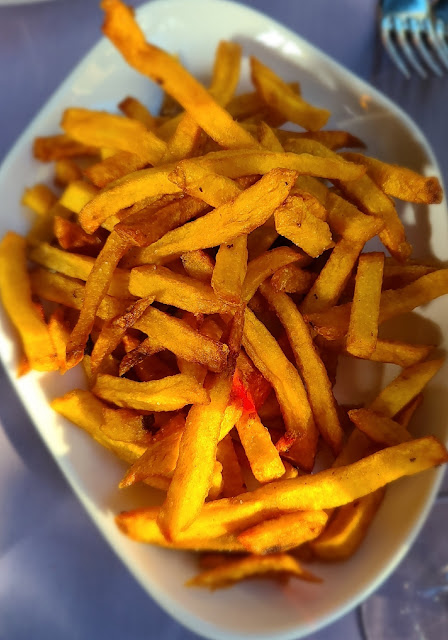
The list of "Extra Sides" also included French Fries so we ordered a plate of those as well.

French fries from the list of Extra Sides

What follows are pictures of our main courses and desserts.

Beef Cheeks braised in Red Wine Reduction served with Mashed Potatoes and Gribiche Sauce


Cod Fillet served with Celery Root puree and Cruciferous veggies


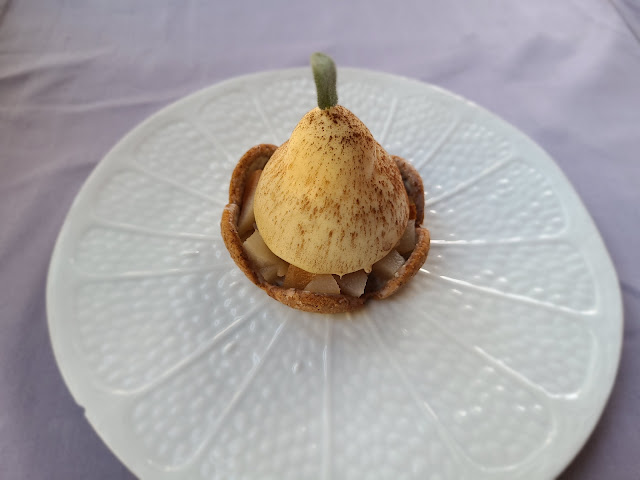
Pear Tarte 


Tarte Tatin with Honey Truffle

We did not take cheese but did take note that the Bistrot's cheese selections come from Lou Canesteou, our favorite cheese shop in Vaison-la-Romaine. 

After our lunch, we walked into the village and discovered our pottery shop was closed. Oh well, at least we discovered a nice new bistrot where we will return on future visits.

Le Bistrot de l'Aupiho
Route de la Terre-des-Baux
13520 Les Baux de Provence
France
+33 4 90 54 40 20
www.domainedemanville.fr

Sunday, January 16, 2022

Visit to Aigues-Mortes and discovery of family ties to French Huguenots

It had been quite a few years since we visited Aigues-Mortes so when cousin Jean-Marc suggested we go somewhere on the sea, I suggested we go there. I still recall the first time we went to Aigues-Mortes, years before we bought our house in Sablet, that time with Tante Edith, Jean-Marc's mother.

Aigues-Mortes was founded in 1240 by Louis IX, who was to become Saint Louis on a swampy strip of land along the Mediterranean Sea. The 1st King of France to have a Mediterranean port, he built the future Tower of Constance and a castle which no longer exists, and developed canals towards the sea, Arles and Montpellier. He left from the port of Aigues-Mortes on his crusades in 1248 and 1270.

The Tower of Constance seen below was completed in 1248. The tower is all that remains from the castle built during Louis IX's reign. It was almost certainly the gatehouse tower, designed to be impregnable with its 18 feet thick walls. A spiral staircase leads to the different levels of the tower. 

On the top level is a terrace which was used as an outlook post and a lighthouse to guide boats and ensure that they paid their custom duties. 


The Tower of Constance

The 5,380 feet of city walls were built in two phases; the first during the reign of Philippe III the Bold and the second during the reign of Philippe IV the Fair, who had the enclosure completed between 1289 and 1300. The canal leading to the original port was on the north side of town.

We parked and entered into Aigues-Mortes through the Porte de la Gardette, the town's military gate. It is the only gate with the remains of a drawbridge. It was the only way into town from the 16th to the 18th century. 

Porte de la Gardette (The Gardette Gate)

Place Saint Louis is the main square of Aigues-Mortes in the center of town opposite Porte de la Gardette. In the center stands a monument to Saint Louis installed by James Pradier in 1849.

Monument to Saint-Louis at Place Saint-Louis in Aigues-Mortes


Aigues-Mortes Street

The North Wall

Aigues-Mortes street seen from the north wall

The Tower of Villeneuve seen below is a good example of a corner tower, designed to provide additional protection.

A view of the north wall from the east wall. The tower of Villeneuve is seen on the right.

The towers on the east wall were often places of refuge during the fighting between Roman Catholics and Protestants. Marks left by missiles can still be seen.

View through barred window to the Tower of Constance

View toward the north wall and the Porte de la Gardette

The south wall seen below is protected naturally by water where boats have sailed since ancient times. The bottom of the south wall was strengthened with earth excavated to make the Beaucaire canal in the 18th century. 

South wall and the Salins du Midi salt marsh

Aigues-Mortes marina seen from the west wall

Between 1575 and 1622, Aigues-Mortes was one of eight safe havens granted to Protestants. Upon revocation of the Edict of Nantes (the Edict was promulgated by Henri IV in 1598 and recognized the Protestant religion in the kingdom of France) in 1685, Protestants were subjected to severe repression marked in Languedoc and the Cevennes in the early 18th century by the "Camisard War". 

Beginning in 1715, ordinary women, often from the Cevennes (a cultural region and range of mountains in South-Central France on the south-east edge of the Massif Centrale) were imprisoned for having simply attended religious services or simply being suspected of having done so. 

Marie Durand, a French Protestant was imprisoned in the Tower of Constance on the 25th August 1730. The exact reason for her imprisonment is not known; perhaps because she attended a Huguenot gathering with her mother, maybe because her brother Peter was a well-known preacher, or perhaps because of her marriage. 

Marie was not released until April 14, 1768 after being imprisoned for 38 years. All she needed to do to be released from prison was to renounce her Protestant faith. The word "resister" scratched by her or one of her cell mates with a knitting needle into the stone wall was an expression of her faith. It was recorded that she was asked daily if she would renounce her faith but daily refused.  

Upon her release, she returned to her childhood home where she died in September 1776.

Tower of Constance

View of north wall and Porte de la Gardette

The Salins du Midi which is shown below is a salt company in Aigues-Mortes which produces the famous "sel du Camargue". Each year, this area produces 500,000 tons of sea salt. Salt production in Aigues-Mortes goes back to antiquity. In 1856, the various salt marsh owners united to form the Salins du Midi salt company. 

Salins du Midi salt marsh

A few days after our visit to Aigues-Mortes, I was texting cousin Annick about our visit to Aigues-Mortes. She texted back to say "your grandmother on your father's side was related to the chief Huguenot Pierre Laporte, better known as Roland". 

I discovered he was the leader of the Camisards, a band of 1000 men he turned into a disciplined army. He refused to lay down arms until the protections of the Edict of Nantes were restored. He was betrayed to his enemies and was shot on August 14, 1704 while defending himself against his captors. 

My cousin ended by saying "you too are linked to this history by your grandmother born in the Cevennes and married to your grandfather Ulysse. Did you know this?" I found out that Roland was born in Mas Soubeyran very close to where my grandmother Jean-Louis was born in the Cevennes.

Going to Aigues-Mortes during the off-season is much better than during the tourist season when it is run over with tourists.  This was a very enjoyable visit and we encountered only a few people as we walked the defensive wall and around town.