Friday, March 15, 2013

Bragging on Bistro Des Copains

OK, all of you who read Our House in Provence blog regularly probably get a little tired of my mentioning the little French country bistro called Bistro Des Copains that I co-own with friends in Occidental, California.


Well two weeks ago, we received an unexpected visit from the food critic for the Press Democrat, our local newspaper here in Northern California. We figured out who the diner was pretty quickly because of the number of dishes they ordered to eat. I say "they" because Mr. Cox came into dine with John Ash, one of the most recognizable chefs, authors and teachers in Northern California.

Chef John Ash is known as the “Father of Wine Country Cuisine”. In 1980 Chef John Ash opened his namesake restaurant, John Ash in Santa Rosa, CA. It was the first restaurant in Northern California wine country to focus on local, seasonal ingredients used to create dishes that complemented the wines being made in the region.

We have been waiting on pins and needles since that night for the review to appear. Then last Friday, the Press Democrat sent out a staff photographer to take pictures of the Bistro and some of the dishes we serve. So we knew that the review would be on the paper's website and in the Sunday edition soon.


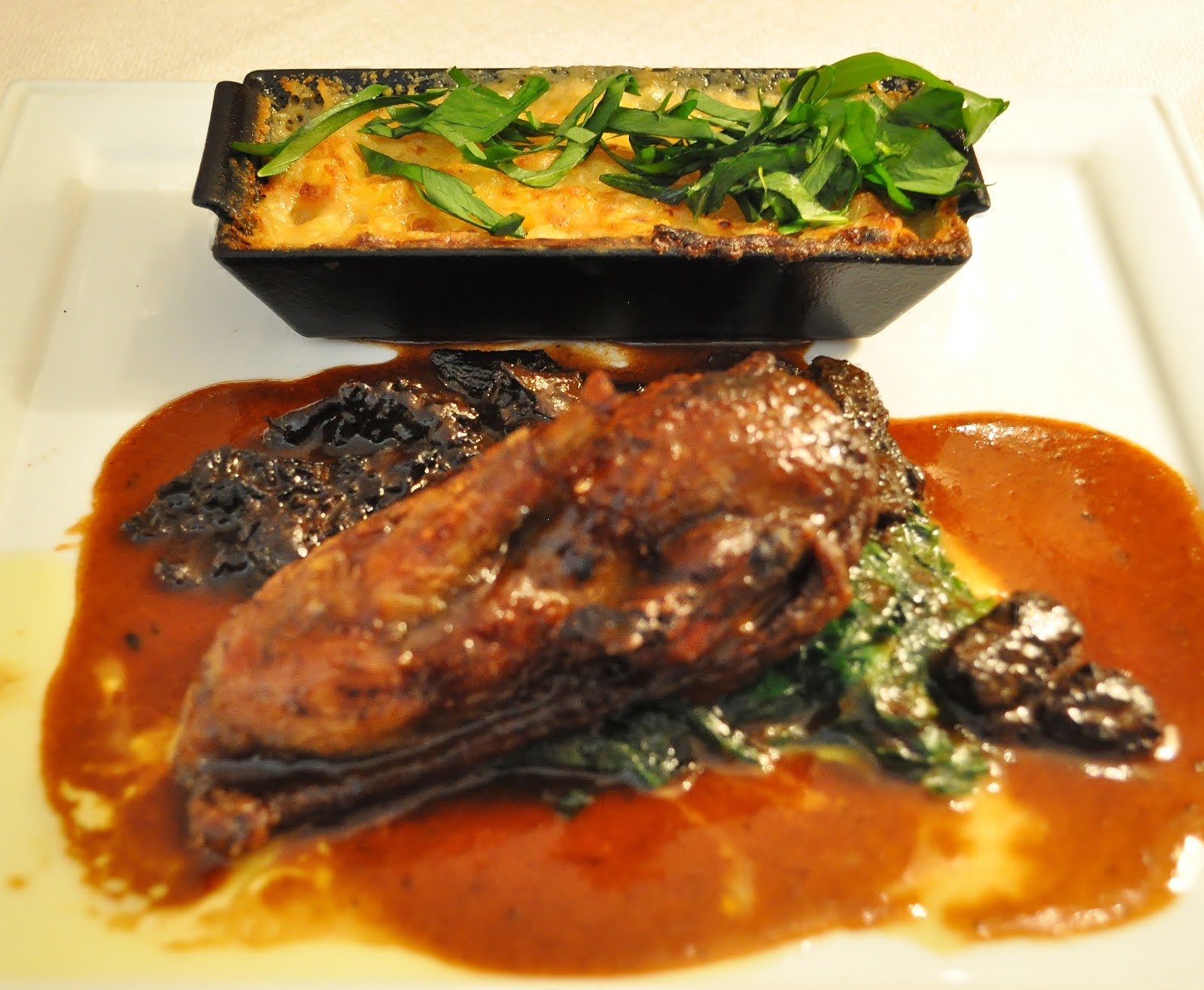
Well here it is folks; the review was posted on the Press Democrat's website this morning and will appear in print on Sunday in the Living Section. Except for the Apple Tart Tatin which was obviously not good the night he was there, I am pleased with Jeff Cox's review. Make sure you check out the photo gallery with his review. What do you think? When you read the review and see the gallery pictures, you will see why I posted a picture of our Pissaladière; looks pretty good, no?

Have a great weekend. À bientôt.

Saturday, March 2, 2013

A Visit to Saint Pantaléon les Vignes and a Very Good Lunch in Grignan

After our visit to Nyons and walk around the market we headed east toward Grignan (24 kms) and lunch at Le Poème de Grignan Restaurant. We drove past olive groves and fields with row after row of lavender which in a few months would be a sea of purple and buzzing honey bees.

About halfway to Grignan, we saw a sign announcing that the next village was Saint Pantaléon les Vignes, a small village with a population of 433 in the Drôme Provençale, the area between the Rhône River and the Alpes north of the Vaucluse.

Saint Pantaléon les Vignes

Saint Pantaléon les Vignes sits at the foot of Lance Mountain surrounded by vineyards, lavender fields, olive groves and apricot orchards. Since we had not driven this way before or know anything about the village, we decided to stop and have a look around before continuing on to lunch. What caught our eye was the handsome Mairie (town hall) with its clock built in 1902.

The Mairie (town hall) of Saint Pantaléon les Vignes

As indicated by the name of the village and the cork-decorated roundabout at the entrance to the village, the primary reason to make a trip to Saint Pantaléon les Vignes is for the local wine. I told you here, here, here, here, and here, how much we like roundabouts with decorations that tell you something about the village or town where they are located.

A roundabout decorated with corks at the entrance to Saint Pantaléon les Vignes

As we walked around the village, we came upon the 11th century Saint Pantaléon les Vignes Church with its Romanesque bell tower.

The Saint Pantaléon les Vignes Church

Stone houses line the narrow streets of Saint Pantaléon les Vignes. In the center of the village at Place du Village is the village fountain seen below.

The Saint Pantaléon les Vignes fountain

Wine has a long history in the area going back long before 1918 when the town council voted to add the words “les vignes” (the vines) to the name of the village. Saint Pantaléon les Vignes was designated as an Appellation d’Origine Contrôlée (AOC) “Côtes du Rhône Villages" in 1969, one of 17 villages with this classification in the Southern Côtes du Rhône.

If you don't know, "Côtes du Rhône Villages" is a French wine Appellation d'Origine Contrôlée (AOC) in the southern Rhône wine region. This AOC consists of a list of villages around the region which supposedly produce a high quality of wine. It is above the more generic "Côtes du Rhône" AOC but below appellations such as Châteauneuf-du-Pape and Gigondas.

You might be interested to know that every year a ceremony is held in Saint Pantaléon les Vignes, where the oldest and the youngest wine producer, along with the village Mairie, decide when to begin the annual harvest of grapes.

Wine related "sculptures" at the entrance to Saint Pantaléon les Vignes

Finished with our visit to Saint Pantaléon les Vignes, we were back on the road to Grignan. The village of Grignan sits on the flanks of a large rocky peak crowned by a large castle, formerly owned by Adhémar de Monteil. The medieval village is a labyrinth of picturesque, winding streets and shaded squares. There are 1,521 people who reside in Grignan.

The village of Grignan and the Castle of Adhémar de Monteil

Construction on the Grignan castle began in the 12th century, but it wasn't until the 13th century that the Adhémar family expanded it to a huge fortress. In the 17th century, François Adhémar de Monteil transformed the fortress into a luxurious residence. Reduced to ruins in 1793 during the French revolution, it was rebuilt in the early 20th century by Madame Fontaine who spent her entire fortune restoring the castle to its former grandeur. The castle now belongs to the Department of the Drôme.

The Castle of Grignan

Farming plays a major role in local life and vineyards cover much of the area. Truffles are also a big business here. When some of the grapevines were killed off by disease in the 19th century, oak trees took their place and truffle hunters with their dogs in tow now search the area for black truffles - the countryside around Grignan accounts for 70% of France's truffle production. Another crop you see when you drive around the area is lavender - rows and rows of the fragrant purple plant are cultivated in the area.

A pretty restaurant near the car park in Grignan

The ramparts (defensive walls) of Grignan were built in the 13th century. The circular protective wall included a dozen defensive towers and six entries (portes).

One of the narrow streets in Grignan

Grignan became renowned in France during the 17th century when Marie de Rabutin-Chantal, the Marquise de Sévigné, a French aristocrat, famous for writing letters, wrote about Grignan and the surrounding area in her letters; Most were written to her daughter Françoise, who was married to François Adhémar de Monteil, Comte (Count) de Grignan.

Madame de Sévigné caught a "fever" and died in April 1696 at Grignan and is buried in the Collégiale Saint-Sauveur Church which was built below the Grignan castle terrace between 1535 and 1539. She is revered in France as one of the great icons of French literature.

A Grignan home courtyard with plants and flowers

We found Le Poème de Grignan Restaurant in a village house in the historic part of Grignan. We came here because it was listed in the 2012 Michelin Guide to Bonne Petite Tables for earning a "Bib Gourmand" award for being a "pleasurable" restaurant that offers three courses for under 29 euros. As I have told you before, we have had very good dining experiences at "Bib Gourmand" restaurants.

Le Poème de Grignan Restaurant

Le Poeme de Grignan Restaurant is owned by the chef Hervé Dodane and Valérie Chareyre who takes care of the front of the house. The dining room is pretty, decorated with the colors of Provence, roses for which Grignan is famous are set on each table. There is a single dining room which can accommodate 22 diners, so if you decide to go, make sure you get reservations.

Shirley pauses for a picture at Le Poème de Grignan Restaurant

We chose the Menu Promenade Gourmande for 29 Euros with amuse bouche, starter, main course and dessert. We passed on the cheese course. As soon as we gave our choices to the server, we were brought a plate with Feuilletés à la tapenade (puff pastry with olive purée) and Gougères (cheese puffs).

Feuilletés à la tapenade and Gougères

This was followed by an amuse bouche consisting of a soup verrine with a little parmesan cookie served by the chef to warm up our taste buds for the dishes to follow.

Amuse bouche

I have to admit we drink rosé wine year around and we like to try them from the different villages we visit. Today was no exception; We chose a locally produced wine, the 2010 Domaine de Montine Gourmandises Rosé, a blend of Cinsault, Grenache, and Syrah.

Domaine de Montine Gourmandises Rosé

Unfortunately, the phone with my notes about our meal was lost so I don't have all the details about the food we ate at Le Poeme de Grignan Restaurant that day. For starter, Shirley began with spring asparagus, blanched so it still had a bite and served with greens (instead of the smoke salmon on the menu) and strips of roasted red and yellow peppers.

Spring asparagus with greens

I began with the same fresh asparagus served with pesto and smoked salmon.

Spring asparagus with smoked salmon

For her plat (main course), Shirley chose a fillet of fish with spinach risotto.

Filet de Poisson et risotto aux épinards

For my main course, I had a delicious magret de canard (duck breast) accompanied by a gratin. Unfortunately, I don't remember anything about the gratin or the sauce for the duck breast.

Magret de canard with gratin

For dessert, I chose a trio of desserts that included a fondant au chocolat (molten chocolate cake) and ice cream.

Trio of desserts

Shirley had what looks like an affogato café, an Italian dessert that consists of ice cream "drowned" in espresso.

Shirley's dessert

At the end of a great meal, it's always nice when the chef sends out a plate of mignardises, tiny bite sized desserts, to enjoy before you head on your way.

Mignardises

We will definitely return to Grignan, to eat at Le Poème de Grignan Restaurant, the food was great, and I want to see more of the village. I was happy to see Le Poeme de Grignan Restaurant was again awarded a "Bib Gourmand" in the just released 2013 Michelin Guide for offering three courses for under 31 euros.

Le Poème de Grignan Restaurant
Rue Saint-Louis
26230 Grignan
Tel: 04 75 91 10 90
www.lepoemedegrignan.com

Bonne journée mes amis et à bientôt.

Saturday, February 23, 2013

Market Day in Nyons, the Land of All Things Olive

Our village in Provence is 6 miles south of Vaison-la-Romaine, a town we pass with Roman ruins on our way to Nyons across the 15th century Pont Roman (Roman Bridge) on the right bank of the Eygues River in the Drôme. Nyons is in a natural basin, surrounded by hills and small mountains, sheltered from wind and gets an unusual amount of sunshine, earning Nyons the nickname "Little Nice" for its great climate.

I told you here, that we came to Nyons to watch the peloton pedal across the "new" bridge which spans the Eygues River out of Nyons on their way to Gap during the 16th stage of the 98th Tour de France. On this early spring day, we were headed to the weekly Provençal market which takes place every Thursday morning in the center of Nyons (28 kms).

Nyons is the largest town of Les Baronnies region, the historic name for the area East and North of Mont Ventoux, the tallest peak in Provence. The 6950 residents of Nyons are called "Nyonsais." As the old capital of the Barons de Montauban and later the administrative center for the region, Nyons has many historic buildings.

The Randonne Tower is a chapel with an ornamental bell tower with a tall statue of the Virgin Mary on top overlooking the town of Nyons. The tower was erected around 1280 by the Baronness of Montauban, and at the time was used as both a keep and a military prison for the castle. In the 19th century it was converted into a chapel and renamed "Notre-Dame de Bon-Secours".

The Randonne Tower

Saint Vincent's Church with the Saint-Césaire monastery and two nearby cemeteries formed the religious center of Nyons in the Middle Ages. Most of the modern-day building dates from the beginning of the 17th century.

The bell tower of Saint Vincent Church

The church has a nave (center) with five bays, a choir bay with flat chevet ("headpiece") and eleven side chapels built in various styles.

Saint Vincent Church

We had not come to Nyons to see the church or other historical monuments this morning but to walk around the Provençal market underway on "Place de la Liberation" and "Place des Arcades" in the center of town. Our friend Bruce from Villedieu knows we like outdoor markets and suggested we should check this one out.

The roundabout in the center of Nyons

We love to wander through markets even if we don't have anything specific to buy. I can say with 100% confidence that we have never gone through a Provençal market without buying something; linens, soaps, pottery, artwork, or something tasty to eat.

A square full of vendor stalls on market day

In Provence, people go to socialize and meet-up with friends as much or more than shop. As you wander through markets in Provence, you will see friends greeting each other at their favorite vendor's stall with "la bise," face-kissing while they wait for their turn to be served or pay for their purchase.

Shoppers at the Nyons market

You can buy fruits, vegetables, cheeses, meat and poultry, seafood, sausages, spices, honey, candied fruits, olives, and flowers. In the larger markets, you can also buy clothing, shoes, items for the kitchen and many other useful and not so useful knickknacks from Provence.

Market stalls with Mairie (town hall) in background

"Place du Docteur Bourdongle" also known as the "Place des Arcades" dates from the 14th century when it was set aside for markets and fairs in Nyons. The square gets its name from the arcades full of shops that surround the square. Here in this picture, we see the plant sellers that set up shop at the Thursday morning market.

Plant sellers in "Place des Arcades"

Lucky for us, we could go to a different market every day of the week if we so choose. There is a large market in l'Isle-sur-la-Sorgue on Sunday, Bedoin on Monday, Vaison-la-Romaine on Tuesday, Saint-Rémy-de-Provence on Wednesday, the Nyons market on Thursday, Carpentras on Friday, and Sainte-Cécile-les-Vignes or Uzès on Saturday. All are within one hour of our home in Sablet. There are almost as many markets as towns in Provence.

More vendor stalls

Dogs are welcome in outdoor markets in Provence unlike in Northern California where signs are posted at the entrance to farmer's markets saying "No Dogs Allowed" by order of this or that health department. Not in Provence; here you see ladies and gentlemen walking through the market with their dogs on leash.

A dog left in a van does a little "dog" watching

Besides the weekly market and monuments like the Pont Roman and the Randonne Tower, Nyons is also known for its culture, oleiculture (olive culture) that is.

An impressive passage through the wall

Nyons is home to the "Institute of the World of the Olive Tree," a cultural, scientific and economic center that in addition to conferences and exhibitions, offers weekly olive oil tasting seminars to the public.

The "Coopérative Agricole du Nyonsais" (the Nyons olive oil cooperative) shop has everything related to olives and olive oil, as well as tapenades, anchoiades, local wine, honey, jams and olive soap.

Next door to the Coopérative is the "Museum of the Olive Tree" with its exhibit of tools and information about ancient and new methods for picking and curing olives to eat and for making olive oil, all set among millstones and different types of olive oil presses.

There is also a 4 kilometer Olive Tree Trail marked with directional signs. Along the way there is a series of informational signs about olive trees and at the 1/2 way point, there is a picnic area. You can pick up a trail map in the Tourist Information Office.

Near the Roman Bridge, you can visit two defunct 18th and 19th century olive oil mills and a soap factory dating from 1730.

Besides the vendors in the market,stores are open with merchandise displayed out front

Olives are celebrated in Nyons year-around with the Fête des Olives Piquées (Festival of pitted olives) the weekend before Christmas, Fête de l'Alicoque (Festival of new olive oil), the first Sunday in February, and Fête des Olivades, the weekend which follows July 14 (Bastille Day). This year is the 50 year anniversary of the Fête des Olivades and will be on July 18 - 21, 2013.

We wandered down this narrow street

In 1994 Nyons became the first region in France to be awarded its own appellation or AOC, for olives and oil, similar to that of wine regions. The rules of the AOC dictate what can be called Nyons olives or oil. For example, oils in this AOC must contain at least 95% of a variety of olives called Tanche.

A butcher with the country of origin for his meats posted on the exterior wall of his shop

Along with the Niçoise olive, the Tanche is probably the best known French olive variety, grown primarily in the Drôme and Vaucluse regions of Provence. The olives grown around Nyons are normally referred to as "Olive de Nyons", or simply "Nyons," and this is the name under which the olive is best known to the rest of the world.

Rose, yellow and blue houses with pretty shutters

The olives can be harvested at smaller size in late November, while for larger olives they wait until December or January. When fully mature, the color of the fruit is a violet black. The plumpest Tanche olives end up as eating olives, after being cured in brine or salt. The rest are used for making olive oil. I should mention that Shirley cured green olives with lye and marinated them in a brine for the first time this year. They turned out really yummy.

Market stalls set up around the war memorial

If you are in the area and thinking about going to shop at a Provençal market on a Thursday, go to Nyons. Shirley asked me this morning what I was going to post about next and I told her the Nyons market. She replied without hesitation: "That was a great market, I want to go back." There are many fields of lavender around Nyons so make sure you go when the lavender is in bloom.

Bonne journée mes amis et à bientôt.

Monday, February 18, 2013

Michelin Announces the 2013 Stars and Bib Gourmand Restaurants for France

One of the most anticipated occurrences in France, or at least for foodies and restaurateurs is the annual announcement by Michelin of which restaurant and chefs have been deemed worthy by Michelin's infamous inspectors to keep or earn one, two or three stars in a run up to the release of the Michelin Red Guide.

The days and weeks leading up to publication day are given to endless debate, speculation and rumor on TV and in newspapers over who might lose or gain, a star. The results, provide either a very public triumph or a very public humiliation for the chefs concerned, and a corresponding rise or drop in revenues for their restaurants.


The complete list of Michelin star ratings for France was announced today for the 2013 edition of the Michelin Guide. One new restaurant, La Vague d'Or, a Saint-Tropez restaurant headed by the 35-year old chef Arnaud Donckele, was awarded the coveted three stars. This brings the total of three-star restaurants in France to 27.

In addition, there are five new two-star restaurants, bringing the total number of two-star restaurants in France to 82 and 39 restaurants got their first star, including two restaurants in the Vaucluse (the region in Provence where our house is located), La Closerie in Ansouis and Prévôt in Cavaillon, bringing the total number of one star restaurants in France to 487.

Earlier this month, Michelin announced that 632 restaurants earned the Bib Gourmand award, Michelin's designation for good cuisine at a reasonable price. Defined as “Inspectors Favorites for Good Value,” Bib Gourmand restaurants offer two courses and a glass of wine or dessert for under 31 euros.

In 1933 André Michelin and his brother Édouard introduced the first countrywide French restaurant listings and introduced the Michelin star system for ranking food. One star indicates "very good cuisine in its category"; two stars represent "excellent cuisine, worth a detour"; and the rare three stars are awarded to restaurants offering "exceptional cuisine, worth a special journey."

Michelin "inspectors" are completely anonymous; they do not identify themselves, and their meals and expenses are paid for by Michelin, never by a restaurant being reviewed. Supposedly, Michelin goes to extraordinary lengths to maintain the anonymity of its inspectors. It is said that many of the company’s top executives have never met an inspector and inspectors themselves are advised not to disclose their line of work.

Here are the starred and Bib Gourmand restaurants listed in the 2013 Michelin guide located in the Vaucluse (there are no three-starred restaurants in the Vaucluse at this time). I have indicated which restaurants are newly starred or designated as Bib Gourmand restaurant plus provided links to the Bib Gourmand restaurants I have written about on Our House in Provence blog.

Star Restaurants in the Vaucluse

Bonnieux (La Bastide de Capelongue) **

Ansouis (La Closerie) * New
Avignon (Christian Etienne) *
Avignon (Le Diapason) *
Avignon (Le Saule Pleureur) *
Avignon (La Vielle Fontaine) *
Cavaillon (Prévôt) * New
Cucuron (La Petite Maison de Cucuron) *
Gargas (Domaine de la Coquillade) *
Gordes (Les Bories) *
L'Isle-sur-la-Sorge (Le Vivier) *
Joucas (Hostellerie Le Phébus et Spa) *
Lourmarin (Auberge La Fenière) *
Roaix (Le Grand Pré) *
Sérignan-du-Comtat (Le Pré du Moulin) *
Vaison-la-Romaine (Le Moulin à Huile) *

Bib Gourmand Restaurants in the Vaucluse

Avignon (L'Essentiel)
Avignon (Hiély-Lucullus) New
Bonnieux (L'Arôme) New
Cairanne (Coteaux et Fourchettes)
Caseneuve (Le Sanglier Paresseux)
Fontaine-de-Vaucluse (Philp) New
La Motte-d'Aigues (Le Lac)
Sainte-Cécile-les-Vignes (Campagne, Vignes et Gourmandises)
Uchaux (Côté Sud)
Vaison-la-Romaine (Le Brin d'Olivier)
Villars (La Table de Pablo)

There are 4282 restaurants in total listed in the 2013 Michelin guide. All restaurants listed in the Guide, regardless of star status, also get a "fork and spoon" designation, as a subjective indication of the overall comfort and quality of the restaurant. Rankings range from one to five: One fork and spoon represents a "comfortable restaurant" and five signifies a "luxurious restaurant".

Restaurants that Michelin deems unworthy are not included in the guide. Having said that, we have had many wonderful meals in little cafes and restaurants not included in the Guide. So don't let the Michelin Guide be your only consideration.

If you are interested in learning more about how Michelin does their inspections, here is one of the few on-the-record interviews with an inspector, actually more of an observation of an inspector at work.

Bon Appetit mes amis.

Monday, February 11, 2013

L'Isle-sur-la-Sorgue, Antique Capital of the South of France

L'Isle-sur-la-Sorgue, literal translation is "Island on the Sorgue (River)," is a small town about 22 miles south of our home in Sablet that straddles five branches of the Sorgue River. As you can imagine, there is water pretty much at every turn.

The area was swampland in the 12th century when a handful of fisherman and their families built houses on stilts where the town now stands. The Sorgue River has been essential to this area's economy for centuries providing fish, water for crops and power for industries.

Le Bassin where the Sorgue River enters town and divides into branches

Canal waterwheels provided the power for silk, wool, rugs, dyeing, and paper-making industries making l'Isle-sur-la-Sorgue the most important town of the Comtat-Venaissin, now known as the Vaucluse. It is said that at one time, there were approximately 70 waterwheels, only a few remain today.

Pretty shutters on a house along the Sorgue River

As the town modernized, these industries disappeared and today the town's economy is driven by tourism and sales of brocante (second hand goods) and antiquaires (antiques).

A little house sits right on a canal

Today, l'Isle-sur-la-Sorgue has the second largest concentration of antique dealers in France after the market in Saint-Ouen in the northern suburbs of Paris. Over 300 antique dealers exhibit in l'Isle-sur-la-Sorgue on a permanent basis.

Waterside restaurants and cafes

There are two international antique fairs held in 'Isle-sur-la-Sorgue every year - one at Easter and one on August 15 - when over 500 dealers come to town. On Sunday mornings, the permanent antique shops and antique villages are joined by sellers who set up stalls along the canals.

A statue of Alphonse Benoît and one of the canals of l'Isle-sur-la-Sorgue

The town holds weekly Provençal markets on Thursday and Sunday mornings in the streets of the old town. The Sunday market is huge, the one on Thursdays is more intimate. Once a year on the 1st Sunday of August, there is a floating market.

One of the moss-covered waterwheels that remain

L'Isle-sur-la-Sorgue is fun to explore and it's interesting to check out the antiques even if you are not looking to furnish your home. Be forewarned, it's not cheap! Parking is a challenge almost anytime but especially on the weekend.

After walking around l'Isle-sur-la-Sorgue and in and out of antique shops all morning, where to eat is the next thing to figure out. We generally fore go the view and opt for good food which is what we got at Le Jardin du Quai Restaurant.

The entrance to Le Jardin au Quai Restaurant

The restaurant is owned by the Chef Daniel Hebet who opened the restaurant on April 1, 2004. Prior to opening the restaurant, Chef Hebet worked in various kitchens including a stint as Chef des Cuisines at La Mirande in Avignon where he was awarded a Michelin star. In March 2010, he was named Maître Cuisinier de France (Master Chef of France).

The garden dining area for Le Jardin au Quai Restaurant

The menu changes daily based upon the season and the whims of the chef. As soon as we sat down, a tray with tapenades and a basket of sliced baguettes was brought to the table.

Amuse bouche tapenades

That day, Chef Hebet offered only a single three-course menu for 35 Euros.


We chose a bottle of pale Domaine de Jale La Moure Rosé, a crisp blend of 30% Grenache and 70% Cinsault, AOC Côtes de Provence.

Domaine de Jale La Moure Rosé

To start, we had a brandade made with fresh cod served with celery root in mayonnaise, topped with a few leaves of fresh spinach dressed in a vinaigrette.

Brandade de Cabillaud et Céleri en Mayonnaise

As I said, the Chef offered just a single option for each course and since the main course was a preparation of beef which Shirley doesn't eat, he graciously substituted a piece of pan-roasted fish set over coco beans prepared in a Provencal style with a light tomato sauce and Nicoise olives.

Poisson et Coco à la Provençale

I had the roast fillet of beef set over coco beans prepared in the same fashion as Shirley's roast fish.

Filet de Boeuf Rôti et Coco à la Provençale

For dessert, we had a fruit tart accompanied by a refreshing strawberry sorbet.

Tartelette aux Fruits Rouges

To complete a perfect lunch, the server brought out a large container of a house-made marshmallow type of confection.


Le Jardin du Quai Restaurant
91 Avenue Julien Guigue
84800 L'Isle-sur-la-Sorgue
Tel: 04 90 20 14 98
www.danielhebet.com

One of the great things about our corner of Provence is that there is something for everyone, no matter what your passion is, be it sunshine, food, wine, art, historic ruins and monuments, biking, hiking, or antiques, all in a beautiful setting. If you have not been to Provence, you must put it on your bucket list. If you make it, you will be most happy you did.

Bonne journée mes amis et à bientôt.