Showing posts with label Beaumes-de-Venise. Show all posts

Sunday, January 3, 2016

What a great day, wine tasting, a leisurely alfresco lunch, and a visit to Carpentras,

We always devote at least 1/2 day to shopping for kid's clothes for our precious grandkids. Shirley's favorite shops for kids are in the town of Carpentras, which is about 12 miles from Sablet. As we chatted one morning about going to Carpentras, it came out that friends Steve and Mary do not like driving around Carpentras so avoid going there.

I will admit we have made wrong turns more than a few times trying to leave Carpentras to return home or crossing town to get to the other side to go to Venasque. But after a fair amount of trial and error, I think we have it figured out.

As we were late getting started that day, we decided stores would be closed for lunch by the time we got to Carpentras, so we should do a quick tasting at a winery on the way and then have lunch in Carpentras. By then stores would be opened and Shirley could shop to her heart's content.

Since Steve and Mary introduced us to Domaine de Coyeux, a winery located high above Beaumes de Venise near the top of the Dentelles de Montmirail, that I told you about here, I decided to introduce them to Domaine de Durban, another Beaumes-de-Venise winery.

Domaine de Durban and its vineyards sit on a picturesque plateau in the Vaucluse, sheltered by the Dentelles de Montmirail, where the Gigondas and Beaumes-de-Venise appelations meet just above the village of Beaumes-de-Venise.
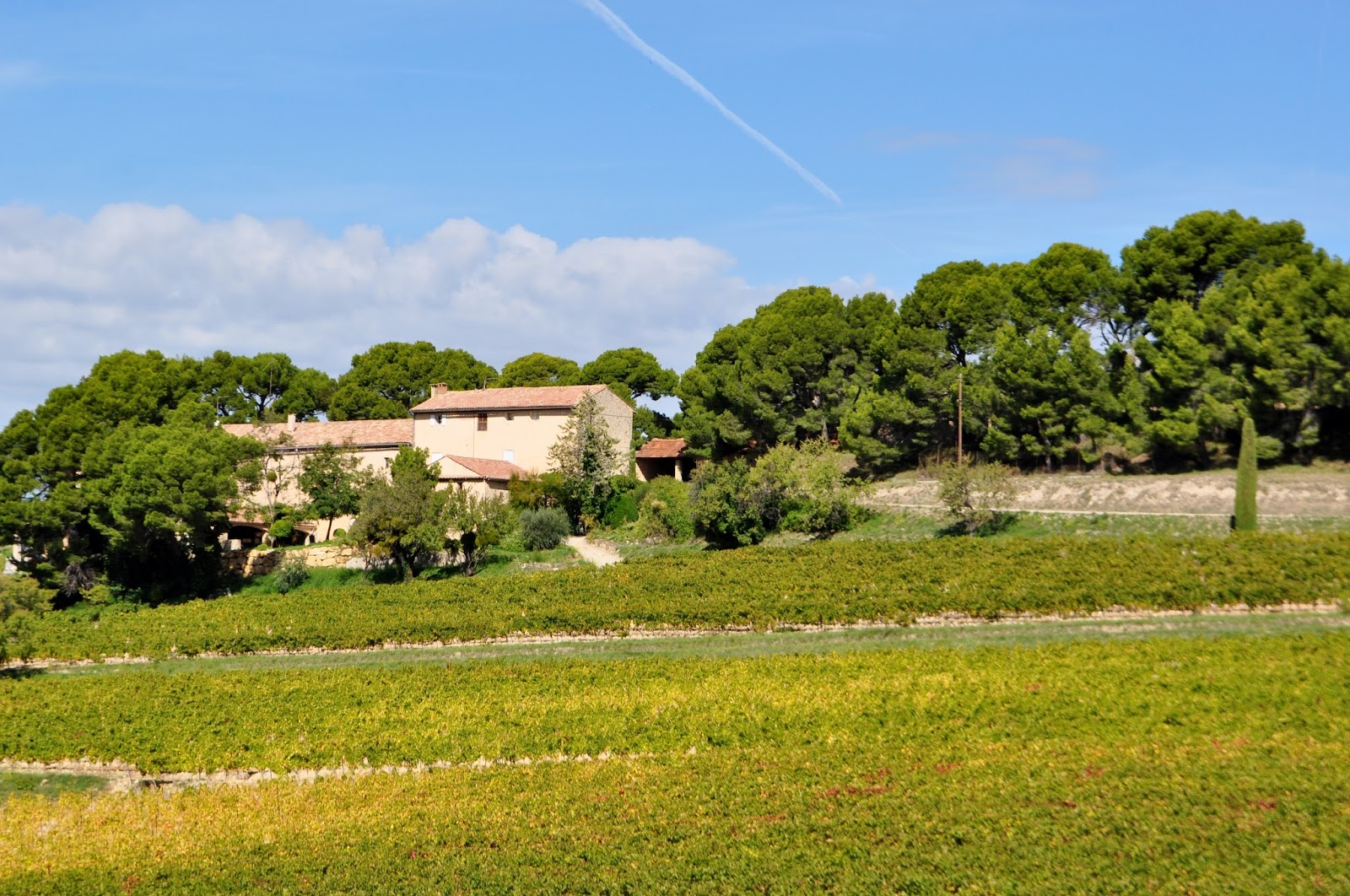
Domaine de Durban

The scenic views make you pause as you consider that wine has been part of the culture here for hundreds of years and ancient philosopher Pliny the Elder was the first person known to praise the Muscat from this place. During the Middle Ages, Domaine de Durban was a fortified farm, which it has been since 1159.

Panoramic View from Domaine de Durban

Jacques Leydier bought the property in the 1960s when the farm had fallen into disrepair. Today, his grandsons, Henri who is in charge of the cellar and Philippe who takes care of the vines, run the domaine.

Tasting Room and Cave at Domaine de Durban

The Leydiers farm fifty-five hectares of vineyards for Gigondas (6 hectares), a Beaumes-de-Venise Rouge (21 hectares), and by all accounts, the most celebrated Muscat (25 hectares) in the Beaumes-de-Venise appellation. The vines are all 35 years of age and over.

Friend Steve in Tasting Room at Domaine de Durban

Pine trees protect the area from the Mistral winds. The soils are rich and deep, a mixture of clay-limestone (60%) and Trias (40%), lending finesse and freshness to the wines. The vineyards high altitude means a slightly cooler microclimate with strong sun exposure, a blessing the Leydiers credit for the amazing consistency their wines enjoy year after year.

View of Dentelles de Montmirail from Domaine Durban

After we finished tasting the wines, bought a few bottles, and admired the views a final time, we loaded up into the car, and headed down the hill and on the road to Carpentras.

Carpentras sits along the banks of the Auzon River. As capital of the Comtat Venaissin, it was often the residence of the Avignon popes; the Papal States retained possession of the Venaissin until the French Revolution. Nowadays, Carpentras is a commercial center for Comtat Venaissin and is famous for the black truffle market held from winter to early spring.

Our go to restaurant in Carpentras is Chez Serge Restaurant which is located on the ring road near Allée des Platanes. The Restaurant has been owned by Serge Ghoukassian since 1987. We usually order from the 3-course "La Formule du Midi" selections which are presented on l’ardoise (slate) for 17 Euros.

Friends Steve and Mary at Chez Serge

Shirley at Chez Serge

Potato Leek Soup

Chèvre Chaud Salad

Roast Veal with Wild Rice and Vegetables

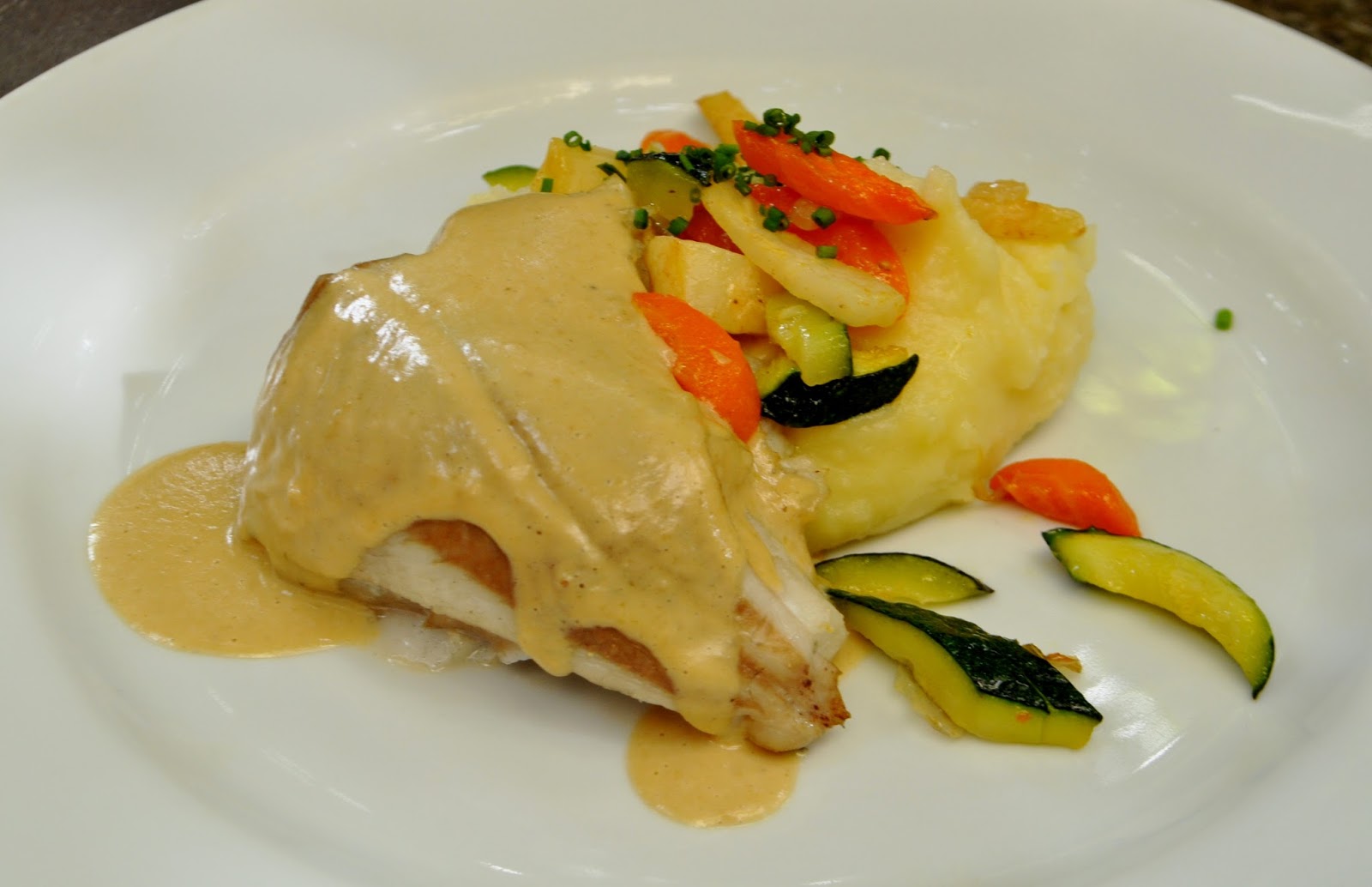
Fillet of Lieu with mashed potatoes and vegetables with beurre blanc sauce

Crème Caramel Renversée

Faiselle with Red Fruit Sauce

After a very tasty lunch accompanied by a chilled bottle of Domaine de Fondrèche Rosé, Shirley headed off to shop and I to wander around the center of Carpentras seeing the sights and taking pictures of whatever caught my eye.

Several chapels can be seen as you walk through the streets of Carpentras, evidence of the many religious orders and congregations which thrived in Carpentras during the 17th and 18th centuries.

The chapel seen below was built by the brotherhood of the black Penitents between 1738 and 1741. The building, has a single nave and side chapels located between the buttresses that support the nave. Outside the apse and side walls are included in buildings that adjoin the chapel.

The Black Penitents Chapel

The 28 foot Roman arch in Carpentras is the only remaining testimony to the Roman period. It was built in the 1st century AD under Emperor Augustus to commemorate the Roman victory over the Barbarians. The single arch is decorated with sculpted figures representing chained prisoners on its lateral sides.

Roman Arch in Carpentras

In the center of Carpentras is Saint-Siffrein Cathedral which was built on the ruins of a Roman church. The cathedral was constructed in Gothic style by order of Pope Benedict XIII. The work lasted for more then a century, from 1404 to 1519. One of the cathedral's most unusual features is the south doorway known as the Porte Juive (Jews' Gate). This ornate Gothic doorway was designed as an entrance for Jews who wished to be baptized.

Saint-Siffrein Cathedral

In 1792, the first Carmélite convent established in 1627 was pillaged and closed (A second convent was built in a new location and operated until it was permanently closed in 2008). The door of the original convent seen below was miraculously saved and incorporated into the north wall of the Palace of Justice in 1930.

Door of the Old Carmelite Convent

Saint Siffrein Cathedral, named after the Bishop, patron of Carpentras in the 7th century, is an example of southern Gothic architecture, characterized by unified space and strong wall space. It is the biggest church in the Dioceses: 190 feet long, a 138 foot long nave with six ribbed bays. The cathedral was built on top of two previous churches, and vestiges of the 13th century Romanesque church can be seen on the northern side of the apse.

The interior of the cathedral testifies to the great artistic fervor during the papal presence in the Comtat Venaissin. Painted panels of the Crowning of the Virgin, 15th century stained glass windows, precious marble Genoan altarpieces, gilded wood sculptures by the Bernus family, outstanding wrought iron work by the Mille family, paintings signed by G.E. Grève, N. Mignard, E. Parrocel and Carpentras artist J.S. Duplessis.

The Roman Arch next to Saint-Siffrein Cathedral at Place d'Inguimbert

Boyer Passage, also known as "rue vitrée" (glass-roofed street), is a covered passage built in 1848 by the unemployed put to work by the Ateliers Nationaux (National Workshops). The street was built to connect the little Halles and the market.

The Boyer Passage

The Synagogue was built in 1367 and restored in the 18th century. It is the oldest active synagogue in France. It stands as testimony to the Jewish community which sought pontifical protection after being persecuted in the Kingdom of France, and settled here in the Comtat Venaissin in the 13th century.

The discreet façade dates from 1909. The prayer room has an 18th century Baroque décor, with pillars and faux marble. The ground floor holds the oldest parts of the building, the ritual baths and 2 bakeries, one reserved for daily bread, the other for the preparation of the unleavened bread, and a room dedicated to Jerusalem within the prayer space.

The Synagogue of Carpentras

The town of Carpentras has a long history connected with agriculture and has been an important place of trading since Greek times and served as a grain station for the Gallo-Romans. The Town Hall is one of the center pieces of the old town and was built with the significant finances that the public purses had gained through being such a prominent part of the agriculture industry for so long.

Market day in Carpentras is Friday and takes place at Place de l'Hôtel de Ville, which was the center of the Jewish community until the 19th century, when the houses were cleared away to make way for this large open square.

Hotel de Ville (Town Hall) of Carpentras

On the north side of Carpentras stands the last vestige of the 14th century ramparts, the Porte d'Orange, the Orange entrance. seen below was originally part of a defensive wall with 32 round and semi-round towers. This last tower stands proud and tall at 78 feet high. The Orange entrance was saved from destruction during a major urban renewal project which took place in the late 19th century.

Porte d'Orange (Orange Entrance)

Oh by the way, the best way to get out of Carpentras back to Sablet is to make a sharp hairpin right turn at the light by the Porte d'Orange and go down the hill and follow the signs for the D7 toward Aubignan.

I hope everyone enjoyed the holidays. We wish you and yours a very Happy, Healthy and Safe New Year. I appreciate the comments on the blog or emails I get from you telling me you are enjoying my pictures and ramblings about our life in Provence. It makes the effort all worthwhile. A bientot.

Chez Serge
Rue Cottier
84200 Carpentras
Tel: 04 90 63 21 24
www.chez-serge.fr

Sunday, February 15, 2015

Domaine de Coyeux, a winery with top tasting wine at the top of the Dentelles de Montmirail

A few months back, I received a text from friends Steve and Mary, I told you about them here, who were in the middle of a séjour in Sablet, saying they had visited Domaine de Coyeux, a winery located high above Beaumes de Venise near the top of the Dentelles de Montmirail.

They said the wines were delicious and the location and views from the winery were spectacular. By the time we arrived in Sablet a few weeks later, we had already decided we would go to the winery and see the sights and taste their wines for ourselves.

Domaine de Coyeux vineyards near the Dentelles de Montmirail

So off we went one Friday morning to Beaumes-de-Venise, a small village about 12 km south of Sablet at the foot of the southern slope of the Dentelles de Montmirail. Beaumes-de-Venise is one of several wine-making villages along the 78 km wine road that circles the Dentelles de Montmirail.

Just outside of Beaumes-de-Venise on the D90 heading toward Lafare, we found a sign pointing the direction for Domaine de Coyeux. We drove up the road until we arrived at a place where there was nothing but vineyards and the Dentelles de Montmirail in front of us. As Steve and Mary said, the views were spectacular. I stopped to take pictures, while Shirley walked ahead.

Road through vineyards up to Domaine de Coyeux

As I said, Domaine de Coyeux is located near the top of the Dentelles de Montmirail, short, steep mountains with a distinctive vertical comb of rock. The name Dentelles, the French word for lace, refers to the jagged, rocky tops obtained by erosion, while Montmirail is derived from the Latin mons mirabilis meaning "admirable mountain".

The Dentelles de Montmirail mountain range is about 8 kms (5 miles) long and runs from Vaison-la-Romaine on the north end to Beaumes-de-Venise on the south. The tallest peak of the Dentelles de Montmirail range is St-Amand, at 734 m (2,400 ft).

Domaine de Coyeux vineyards

The scenery around the vineyards that produce Beaumes-de-Venise wines would fit perfectly into a Tuscan landscape. Grapevines and olive groves mingle, rooted in soil well cared for by the winegrowers. While the name “de Venise” conjures up romantic images, it is of no relation to the Italian city. The name is a distortion of “de Venisse”, meaning “of the Comtat Venaissan”.

Located at the foot of the Dentelles de Montmirail, the terroir’s earth contains three types of soils, as well as deposits of Triassic rock that produces an exceptional type of soil that produces unique wines. Officially granted cru status in 2005, the AOC produces deep colored red wines, in shades ranging from cherry red to purple, as well as the famous dessert wine, Muscat.

Domaine de Coyeux vineyards

Muscat de Beaumes-de-Venise wine was awarded AOC status in 1945. These wines are made through a process of arrested fermentation, to produce what is known in French as a vin doux naturel (naturally sweet wine). This technique is based on adding grape spirit (at a minimum of 96 degrees proof) to the semi-fermented grape must, killing the yeasts and thus stopping the fermentation.

This results in a high level of residual sugar and increases the alcohol content (to about 15%). The finished wines are pale gold when young, with delicate vegetal notes and hints of tropical fruits. With age, they develop a rich golden hue and acquire more-prominent flavors of honey, dried apricot and raisins.

Dentelles de Montmirail

The vineyards around Beaumes-de-Venise are very old; the wines can be traced back to 600 years before Christ, when a Greek community moved into the foothills of the Dentelles de Montmirail. The first vines at Domaine de Coyeux were planted back in the 1950s. The Domaine was taken over by Hugues de Feraudy in 2013, whose family history in the Vaucluse dates back to the tenth century.

Olive tree lined entrance to Domaine de Coyeux

Domaine de Coyeux is located on the southern side of the Dentelles de Montmirail and includes one continuous parcel with 112 hectares (277 acres). The estate has Trias soil with pores filled with clay which capture the winter water from the soil that when released in the summer nourishes the root system of the vines, leaving grape berries thirsting for the sun.

Vines are planted on the Coyeux mountains at 300m (984 feet) elevation, the air currents bring freshness in the summer, contributing to healthy grapes and delicate aromatic wines. The Mistral winds quickly dry the foliage which minimizes the risks of parasites.

Shirley inside the tasting room at Domaine de Coyeux

The Domaine's Muscat wine is produced from vines on contiguous plots, the oldest of which will soon be 65 years old. Domaine de Coyeux produces approximately 140,000 bottles of Muscat wine every year from a unique grape variety called Muscat petit grain. This grape variety splits itself into two varieties, one with black berries and the other with golden berries. Regardless of their color, these two sub-varieties produce sweet Muscat wine.

Domaine de Coyeux

There are 17 hectares planted for production of Beaumes-de-Venise red wine. The age of the vines are between 35 and 65 years. Current production is about 72,000 bottles per year. Domaine de Coyeux farms three red grape varieties which are assembled together for the Domaine's red Cru wine, each with its own characteristics: Grenache, Syrah, and Mourvèdre.

Views from Domaine de Coyeux

Domaine de Coyeux produces a small amount of Gigondas red Cru wine from a vineyard southeast of the village of Gigondas and Muscadin, dry and semi-dry white wines from the same grape variety, Muscat petit grain, as that of the Muscat sweet wine.

View toward Dentelle de Montmirail from Domaine de Coyeux

Muscat sweet wine should be served chilled (6° to 8° C). In addition to serving as a nice aperitif, it perfectly accompanies your meals: Appetizer: melons, foie gras, and warm oysters, Cheese: blue-veined cheeses (Roquefort, Stilton), and Dessert: coffee cakes and red fruit gratins.

Domaine de Coyeux

Steve and Mary were right; the Domaine de Coyeux wines are delicious and the scenery and views are spectacular. We will return when we are back in Sablet with our friends. If you are a wine lover, you should definitely go. If you are looking for spectacular views of the Dentelles de Montmirail, you should go too.

Monday, June 17, 2013

Beaumes-de-Venise, a bustling village and producer of excellent sweet wines

We don't spend a lot of time hanging around Sablet. It's not that we don't like our village, but we are usually at one of the weekly marchés, exploring new villages, visiting family or friends, looking for fields of coquelicots, lavender and sunflowers, or doing "dégustation de vins" (wine tasting). Hey, we have only tasted at a handful of the 1,837 private wineries and 103 cooperatives in the Rhône Valley.

As we are out and about, we repeatedly traverse the villages of Violès, Vacqueyras, and Aubignan on our way to and from Sablet, but never stop to visit. Another village we drive through but have never stopped to visit is Beaumes-de-Venise. So a few weeks ago, with friends Scott and Jean-Pierre in tow, we decided to pay a visit to Beaumes-de-Venise.

Beaumes-de-Venise is a small village (2,305 inhabitants) about 12 km south of Sablet that climbs up the foot of the southern slope of the Dentelles de Montmirail. Beaumes-de-Venise is one of several wine-making villages along the 78 km "Route des Vin" that circles the Dentelles de Montmirail (a small chain of mountains I told you about here).

Beaumes-de-Venise

The word "beaumes" comes from the Provençal word bauma meaning "cave" or "grotto". There are many caves carved into the surrounding hillside which were shelter for the regions first inhabitants during the Iron Age.

Arched doorway from Raspail Avenue to Place du Marché

The Saint Nazaire Church seen below was built in 1849. There is also a Saint Nazaire Chapel, but all that remains of the latter are ruins which date from the 8th century.

Saint Nazaire Church

Close to Saint Nazaire Church, is the arched doorway seen below which leads through the ramparts into the center of the village.

Arched doorway into the center of the village

Vestiges of the 12th century feudal castle with its ramparts nicknamed “Des Barons” stand above the village in the picture seen below. This castle made Beaumes-de-Venise one of the most powerful villages in the Comtat Venaissin, in the Middle Ages.

View toward Place de la Liberté with castle ruins at top of village

A brightly colored house near the fountain at Place de la Liberté.

Fountain at Place de la Liberté

Come along with us as we walk around Beaumes-de-Venise.

The wrought-iron campanile and bell tower of Saint Nazaire Church

A pretty village house

The ramparts were probably erected in the 12th century. There are two doorways which remain; one as I said before is near Saint Nazaire Church and the second seen below is at Place du Portail Neuf.

The arched doorway and fountain at Place du Portail Neuf

We decided to follow the path up to the castle ruins at the top of the village. I would not recommend the way we went since it was not much more than a narrow footpath that wound its way through brush. When we got as high as we could go, we could see the ruins just above us but we could not get up to them. There may be a way to get there but we did not find it.

One of the views over Beaumes-de-Venise we saw as we hiked to the castle ruins

Another view over Beaumes-de-Venise with Saint Nazaire Church in the middle of the picture.

Another view over Beaumes-de-Venise

Beaumes-de-Venise is probably best known for Muscat de Beaumes de Venise, a sweet fortified wine produced by village winemakers from the small berried Muscat à Petits Grains grapes grown in vineyards surrounding the village. The color of the wine can vary from amber to rosé, and even purple.

The grapes ripen from the warmth of the sun as it reflects and radiates over the vines from the huge vertical limestone slabs of the Dentelles de Montmirail. There are just over 1200 acres currently under cultivation.

Beaumes-de-Venise is also home to two other appellations: red wines were classified in 2005 as AOC Beaumes-de-Venise and whites and rosé wines were classified in 1978 as AOC Côtes-du-Rhône-Villages Beaumes-de-Venise.

A Beaumes-de-Venise vineyard

A house built right up against the rocks

17th Century Fountain at Place du 8 Mai

Saint Nazaire Church

The Saint Roch Chapel seen below was built during the midst of the plague in 1586. Beaumes-de-Venise was spared.

Saint Roch Chapel

In addition to wine, olive oil has been produced in Beaumes-de-Venise since 1789. At the entrance to the village is La Balméenne olive oil mill which is open to the public. All of the olive oil is pressed from "Verdale de Carpentras" (or Aglandau) olives from the Vaucluse harvested by hand between the middle of November and beginning of January.

There is a cute shop on site which sells olive oil and a variety of products produced in the region including soap, honey, tapenades, jams, olives and souvenirs.

La Balméenne Olive Oil Mill

A house with pretty flowers near La Balméenne Olive Oil Mill

An olive tree near La Balméenne Olive Oil Mill

As we enter and exit Beaumes-de-Venise, we go around this striking roundabout near the Vignerons de Beaumes-de-Venise wine cooperative.

Roundabout at the entrance to Beaumes-de-Venise

So that's it! Thanks for joining us on our walk around Beaumes-de-Venise. Bonne journée mes amis et à bientôt.