Showing posts with label Sablet. Show all posts

Saturday, May 17, 2025

A Visit to the Vaison-la-Romaine Weekly Market in March

We look forward to Tuesday mornings because it's the day for the weekly market in Vaison-la-Romaine. That morning, rain or shine always finds us leaving the house early for the trip to Vaison-la-Romaine. 

Vaison-la-Romaine is 6 miles north of Sablet on a winding road and then left around the round-about and across the bridge over the Ouveze River. You know you are close to your destination, when you see the Medieval castle on top of the hill. 

Medieval castle in Vaison-la-Romaine

We generally park our car near Notre Dame de Nazareth Cathedral. From there we head toward the market. On the way, we walk past some of the Roman ruins which are located in and about Vaison-la-Romaine.

The Roman ruins lie in the valley on the right bank of the Ouveze River in two main areas: La Villasse and Puymin. Some of the ruins of La Villasse are shown in the picture below.

Roman ruins

The weekly market is a kaleidoscope of colors and smells of Provence with up to 450 vendors in the summer. Vendor stalls are mostly located on Avenue General de Gaulle, Cours Taulignan, and Place Montfort. 

Avenue General de Gaulle

On our most recent visit, I headed to the upper end of Avenue General de Gaulle in search of herbs and flowers for our terrace. 

Some of the plant vendors on Avenue General de Gaulle

I wish we had room on our terrace for a few Hydrangea plants.

Hydrangeas for sale

Herbs for sale

The market is a tradition dating back to 1483.

I get inspired to cook as I walk past tables piled with beautiful vegetables 


Market baskets for sale

Cours Taulignan


One of several vendors who sell olives, peeled garlic, and preserved lemons


A vendor selling cheese and charcuterie


Dry sausages of every type


Beautiful mixed greens and roquette (Argula)


Dried fruits of all kinds and homemade tapenade


First local strawberries from Carpentras


Olive oil and black olives from Nyons


Spices are sold in a manner that would probably not be allowed by US health departments


Our favorite fish monger. Fish are fresh and they scale and clean them perfectly. 


Vendors on Place Montfort

After we finish our morning shopping, me for fruits, vegetables, cheese and fish, and Shirley for soap, pottery, linens and souvenirs, we gather at one of the cafes on Place Montfort.

After shopping, we meet up at one of the cafes on Place Montfort for beverages

Vaison-la-Romaine is separated by the Ouveze River into two parts connected by a bridge built by the Romans in the 1st century AD. On the left bank is the old medieval town with the Castle of the Counts of Toulouse at the highest point and on the right bank is the ancient Roman colony and modern town.

Roman bridge in Vaison-la-Romaine

If you go to the market in Vaison-la-Romaine, we recommend you go early as close by parking fills up and the streets get very crowded with locals and tourists checking out the offerings of the vendors. 

I can't wait to return to the market this summer when the vendor tables will be overflowing with tomatoes of all colors and shapes, squash, stone fruit, and cantaloupes, to name a few of my favorite things. 

www.sablethouse.com 

Thursday, March 28, 2024

Tulips grown in the Vaucluse for sale in Holland.

We just returned from a short sojourn in Provence after an unusually long absence for us. Sadly, this was the longest time between visits since we bought our home in Sablet in 2008. 

One of our favorite things about Provence are the fields of flowers and orchard blossoms that we find at various times of the year. There are orchards with cherry blossoms in April and early May all around the village of Venasque.

Then, red poppies, known as Coquelicots in France, make their appearance in May. Coquelicots generally grow wild rather than cultivated so you never know where you are going to come across them as you drive around Provence.

Lavender, the most famous flowering plant in Provence, blooms from mid-June to late July depending upon elevation. Sunflowers adorn the landscape from late June to the end of July and are typically harvested in August.

A few years back, we discovered that tulips are grown around Jonquieres, a small village about 20 minutes from Sablet. I am not sure if one person owns all the land where they are planted as the location of the tulip fields changes year to year.  

Dutch tulip farmers outsource growing bulbs to farmers in Provence. While the flowers are still in full bloom, they cut the flower with a lawn mower type machine to save the plant's energy for the bulbs.  The first few times we passed by the tulip fields, it did not appear that they sold any flowers. Now, signs indicate flowers are for sale.  

Since the tulips are in bloom in early spring, from late March to early April, we headed out one recent morning toward Jonquieres to see if any tulips were in bloom. The following pictures are what we found.


Jonquieres tulip field

We have been told that tulips are also grown in the triangle between Lurs, Forcalquier and La Brillanne in the Department of Alpes-de-Haute-Provence. Maybe the next time we are in Sablet in late March, we will head here to explore this area. 


Jonquieres tulip field


Jonquieres tulip field


Jonquieres tulip field


Jonquieres tulip field


Jonquieres tulip field

Another flowering plant we see at this time of year is Colza, in English, Rape Seed. The plant is grown to produce oil for cooking and industrial processes. In the United States, we know the edible version of this oil as canola oil. 


Field of Colza (Rape Seed)

Watch this blog for new posts about visits to new restaurants and villages during our most recent visit to Sablet.

www.sablethouse.com 

Saturday, February 24, 2024

Our Visit to the Breathtaking Valensole Plateau Lavender Fields

Every year, thousands of tourists' travel to the sun-drenched South of France region of Provence. One of its biggest draws, field upon field of perfect rows of sweet-scented, violet-colored lavender. 

There are four main regions where lavender is grown in Provence. They are the Plateau de Valensole, the Luberon Valley, Pays de Sault, and the Drome Provençale. We have visited all of these areas several times except for the Plateau de Valensole. 

Last summer, with friends from Washington DC in tow, we loaded into our car in Sablet and headed out for the 122 km drive to the famous Valensole plateau to tour the lavender fields in the Alpes-de-Haute-Provence.  

The lavender fields on the Valensole plateau are the most photographed in Provence. This plateau, at 500 meters elevation is dedicated to the cultivation of cereals, olive trees and lavender. The plateau extends over 800 square km and offers a breathtaking panorama of the Provencal countryside. 


Lavender Field in Valensole

Lavender attracts thousands of tourists and bees, hoping to time their visit for the peak of the flowering cycle. The precise timing of flowering changes annually, depending on the weather. Typically, some fields are in full bloom by late June, and the harvest is mostly complete by mid-August.


Lavender Field in Valensole

There are many varieties of lavender. Although we typically associate lavender with purple flowers, the varietals include many colors, from deep blue to white. The plants love the dry, sandy, rocky soil that is typical of southern France.


Lavender Field in Valensole

Lavender has been cultivated at least all the way back to biblical times. Lavender is referenced in the bible as a holy herb nard. The Greeks and Romans used lavender for personal hygiene and medicinal purposes. The Romans used lavender flowers to scent bath water. The flowers and essential oils have been used throughout the ensuing centuries for everything from repelling insects to treating burns to sleep therapy. 


Lavender Field in Valensole

Two main lavender varieties are grown in Provence. The “real” lavender is a small, tufted plant with a single floral spike. Each plant is unique. The plants grow naturally at elevations between 600 and 1,400 meters, but cultivation is generally above 800m. Each plant is unique.


Lavender Field in Valensole

Lavandin is a hybrid, the result of a cross between lavender and a wild varietal, lavender aspic. It’s a hardy plant, less susceptible to disease, and it grows at lower altitudes (200 – 1,000m above sea level) than fine lavender. Since lavandin is a clone, the plants have identical biological footprints, propagated by cuttings. A single lavandin stem has three blue-purple flower spikes.


Lavender Field in Valensole

Be forewarned, lavender season brings traffic congestion. Bus tours and cars clog typically quiet roads while their passengers walk into the lavender fields to snap selfies and photos of each other in the fields. 


Lavender Field in Valensole

Much of the lavender grown in Provence is distilled for essential oil and fragrant water. The plants are also dried for scented objects. Tourist shops in Provence carry lots of lavender products, soap, perfume, honey, tea, ice cream and scented packages. Be aware, some of the products sold in stores are mass-produced outside of France and hardly artisanal.


Lavender Field in Valensole

Because of the size of the lavender fields, the lavender harvest is usually not done by hand. A tractor passes through the field, cutting the lavender and leaving small bundles in its wake. The cuttings then dry in the sun for 2-3 days before being gathered into giant bundles similar to large hay bales. 

At the distillery, the bales are dropped into cauldrons with water where the steam passes over the flowers creating the essential oil and lavender water. To produce one liter of essential oil requires 200 kg (440 lbs) of lavender flowers. 


Shirley and I on our 50th Wedding Anniversary in a Valensole Lavender Fields

Walking through lavender fields in Provence on your wedding anniversary is about as romantic a setting as you can find in my opinion. 

Just before we left California for our trip to Sablet, Shirley played her one and only pickleball game and fell and broke her wrist in 4 places. We were grateful the doctor was able to put her wrist in a cast. We were hoping it would fully heal that way but unfortunately, she had to undergo surgery a few months later.

After touring around the Valensole plateau for a few hours, we drove into the town of Valensole, to find a place to eat and drink. 

Valensole

You can find lots of guides online that identify where the prettiest shots of lavender can be found on the Valensole plateau. However, because harvest occurs at different times and growers replant fields as they age, it is not always possible to find all of the recommended locations. Yes, it was a long drive from Sablet, but worth the effort in our opinion. 

If you are still searching for a house to make your home during your sojourn in Provence this year or in future years, please don't hesitate to visit our website at www.sablethouse.com You can also email me at chcmichel@aol.com  

Sunday, December 31, 2023

Happy New Year

Happy New Year dear friends. Bonne et heureuse annee mes amis. Anyone who takes the time to read my recently, infrequent posts, are truly friends. One of my New Year's resolutions is to write posts more frequently and regularly.  

2023 has been a crazy year with some wonderful highs as well as some challenges, including spending the last few days of the year isolated with my first bout of Covid despite being vaccinated and boosted a total of 6 times. I am grateful my symptoms have been very minor.

Christmas Eve in Windsor, California

One of the highlights of the year was the visit of cousins Jean Marc and Christine from Clapiers, France for Thanksgiving. We were joined by family members from Michigan, Seattle, San Diego, Cupertino, and of course everyone here in Windsor and Santa Rosa. There were 30 of us for dinner. 

Sonoma Coast at Thanksgiving

Alzheimer's Walk in Yountville, California in September

We were fortunate to celebrate our 50th wedding anniversary in beautiful Provence on July 15. Seems hard to believe that it's been 50 years since we were married in my hometown of Berrien Springs, Michigan. 

Plateau de Valensole in Provence, France in July

A few days before we left for our July trip to France, Shirley decided to try her hand at pickleball. Unfortunately, Shirley fell while back pedaling to get to the ball and broke her wrist in four places. She hoped to fully heal without surgery but a few weeks ago, she had that surgery.

Santa Rosa, California in July

We find great joy spending time with our family. Shirley stays busy running her granny taxi as she helps provide transportation to and from school, sports events, and other non-scholastic activities. 

Mother's Day in Windsor, California

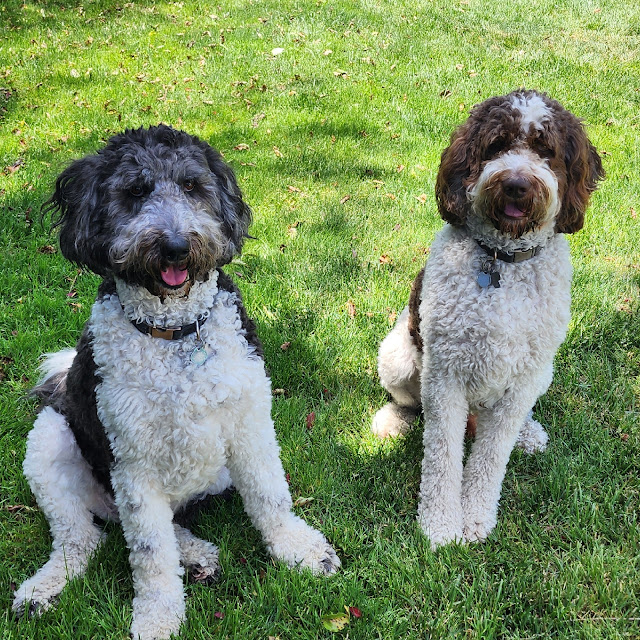
Our other great joy, especially for Shirley is our two big Golden Doodles. Cooper, the black one weighs 105 pounds and Bailey, the brown one weighs 95. Shirley and the dogs are inseparable it seems. It would be helpful if we could find a comfortable and affordable way to transport the two dogs to Sablet when we travel there. Anyone have ideas?

Cooper and Bailey in Windsor, California

We continue to make improvements to our house in Sablet including the new electric, green awning shown below. 

Our house in Sablet, France (Note our new electric awning)

We hope to see some of you in Sablet this year. If you are looking for a wonderful place to call home for a sojourn in Provence, we invite you to consider our house. You can find all the information you need on our website www.sablethouse.com.

Happy New Year. We hope that this year brings peace, joy, good health and prosperity to one and all. 

Monday, April 24, 2023

A French Memorial to 5 US Airmen who Died in WWII in Plan de Dieu While Attacking Nearby German Airfields

We were invited to dine with Paul and Francoise Roumanille "chez Bruno" in Sablet on a recent Friday. As I told you in this post, Paul and Francoise and their parents before them have been making wine in Sablet since 1939. 

We got to talking during our lunch of traditional Aioli a la Morue, about what life was like for their families during WWII. Paul mentioned that there is a memorial to US airmen in Plan de Dieu, a large area planted in vineyards 11 km west of Sablet. Plan de Dieu translates to "God's Plain."

There are around 2620 acres planted in vineyards at an altitude of 100 meters within the Plan de Dieu AOC. Rather than one named village, the area includes the territories of Camaret-sur-Aigues, Jonquieres, Violes and Travaillan. A few patches of woodlands dot the expanse of vines.

Soil is mainly red clay packed with rounded cobblestones. There is not a lot of soil matter, so yields are modest, barely enough to produce one bottle of wine per plant. The wines are all red, made from the Cotes-du-Rhone's 3 leading grape varieties, Grenache, Syrah, and Mourvedre. 

The next day, Saturday, we went out to find this war memorial to US airmen. We see war memorials in almost every village in Provence dedicated to the children of the town who died serving their country in WWI or WWII. We have never seen a war memorial to US military personnel other than near where troops landed on D-Day in Normandy

Paul said the memorial was on the road to Cameret-sur-Aigues just beyond the turnoff to Cairanne. Sure enough, as we were driving on the D23 toward Camaret-sur-Aigues, we came to a small road going off to the right with a small white sign "war memorial".


War memorial to US airmen who died in Plan de Dieu
There is not a lot of information at the memorial or on the internet about the events that occurred over the Plan de Dieu that inspired locals to build this memorial.

You can see the vast plain of vineyards to the west of the war memorial
At first glance, the site is unremarkable. Set in the middle of a vast plain of vineyards, the simple stone monument is set just off the side of a one-way dirt road. 

The memorial is festooned with flowers and red, white and blue ribbons
I found that on Saturday, April 16, 2005, approximately 200 French men and women along with French and American military representatives gathered during an icy spring rainy day to dedicate the new memorial to the five P-38 Lightning pilots who died while attacking nearby airfields.

2005 was the 60th anniversary of the liberation of France. The locals thought it necessary to express their appreciation with this memorial stone to the young pilots for their dedication in the darkest hour of French history, and active participation in the liberation of France and victory over Nazi Germany. 

Three of the honored pilots went down on June 15, 1944, trying to weaken German defenses for the Allied assault of southern France that would follow the Normandy invasion. 2nd Lt. Hugh Crandall Jr. and 1st Lt. Harold V Duggleby from the 94th Fighter Squadron were both brought down by anti-aircraft fire on strafing runs against the Orange-Plan de Dieu airfield. 

At about the same time, 1st Lt. Warren E. Semple from the 49th Fighter Squadron was shot down by a German pilot while strafing the nearby Orange-Caritat airstrip. 

Several weeks later in early August, 2nd Lt. Robert D. Simpson of the 48th Fighter Squadron and 2nd Lt. A. Tracy of the 49th Fighter Squadron were downed by flack and killed on similar missions. Watching the attacking planes get shot down was shocking for those on the ground said one of the local residents who was 11 in 1944.

Listing of the names of the 5 young US airmen who died in Plan de Dieu.
Across the narrow country road from the war memorial, there is the Bergerie du Bois des Dames. The name Bois des Dames (wood of the ladies) comes from the thick oak woods and pastures that once covered part of this area. The woods belonged to religious ladies who had retired to a high valley in the hills of Gigondas, at the convent of Prebayon, hence the name Bois des Dames. 

Bergerie du Bois des Dames
I couldn't find any information about this bergerie. I do know that bergeries are enclosures that shepherds used in old times to contain and protect their sheep. In the picture below, you can see in the corner of the bergerie, the remains of a very deep well. 

Interior of the Bergerie du Bois des Dames.
In the picture below, you can see where the water came out from the well into a water trough that delivered it into a basin for the sheep. 

Trough for water to run from well into the water basin
The next time we are in Sablet, I will go to the Domaine Bois des Dames and see if anyone there can tell me why the memorial and bergerie are located on different sides of the country road. I would also like to find out the age of the bergerie structure. It looks old, so I assume it is but sometimes looks as we know can be deceiving. 

As I have told you several times. we frequently see pilots of the Patrouille de France, the French precision flying unit, practicing their stunts over this area. So sobering to think, while we get such enjoyment from seeing the Patrouille flying overhead, there was a time in the last century when the planes flying overhead were engaged in serious, deadly warfare.