Showing posts with label Pope's Palace. Show all posts

Saturday, March 23, 2024

Visit to Avignon and Tasty Lunch at Bib Gourmand Restaurant Bibendum

As faithful readers of Our House in Provence blog know, a visit to Avignon is an essential part of our time in Provence. During the first years, it was to shop for kids' clothes for our grandchildren, now that they are older and prefer to choose their clothes, we go to visit the Nespresso store, near Place de l'Horloge, to buy espresso capsules to take back to California (way cheaper). 

Avignon is 40 km southwest of Sablet, enclosed within ancient walls along the Rhone River. The largest town in the Vaucluse, Avignon is very old, full of history, art, music, and activity.

Notre des Doms Cathedral seen below is a Roman Catholic church located next to the Palais des Papes in Avignon. The Cathedral is the seat of the Archbishop of Avignon. It is a Romanesque building, constructed primarily in the second half of the 12th century. The bell tower collapsed in 1405 and was rebuilt in 1425. 


Notre Dame des Doms Cathedral 

The Pope's palace seen in the picture below is a historical palace in Avignon, one of the largest and most important Medieval Gothic buildings in Europe. One time fortress and palace, the papal residence was the seat of Western Christianity during the 14th century. Six papal conclaves were held in the Palace, leading to the election of 5 Popes and 1 Antipope.


Pope's Palace

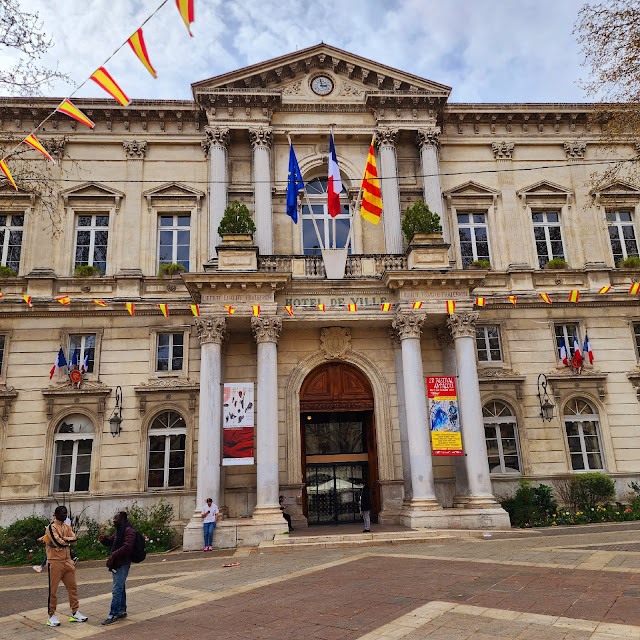
In the center or Avignon, on Place de l'Horloge, you will discover the neo-classical town hall known as the Hotel de Ville seen below. It was built in the 19th century as a replacement for an older building. The 14th century Gothic clock tower from the original structure inspired the name for the square was incorporated into the construction of the current Hotel de Ville. 


Hotel de Ville

Our visits to Avignon are always timed so we can enjoy a leisurely lunch in a nice restaurant. We frequently dine at La Fourchette which I told you about here

We learned early on, that with the exception of cafes that are mostly frequented by tourists, it is not a good idea to drop into a restaurant in France without reservations. You will probably find they are "complet" (full) even if they have empty tables. You might get lucky if you show up just as they open their door for service.

On our most recent visit, we make reservations for lunch at Bibendum on Rue Joseph Vernet, a restaurant recently designated by Michelin as Bib Gourmand. If you don't know, Bib Gourmand restaurants are those deemed by Michelin inspectors to offer a complete meal excluding beverages at an outstanding price/quality price of 40 Euros or less. 


Bibendum Restaurant

Bibendum is set in an old cloister that includes the restaurant, a wine bar, a cocktail bar and inner courtyard with patio where we chose to dine. Mathieu Desmarest, chef of the Michelin one-star restaurant Pollen, devises the menu, while his wife Emilie oversees this venue.  

Shirley sitting in the inner courtyard of Bibendum Restaurant

The following are various dishes that we enjoyed at our lunch at Bibendum starting with a tasty amuse bouche of puree with cheese sent out by the chef to kick start our taste buds. 


Amuse Bouche


Padrons


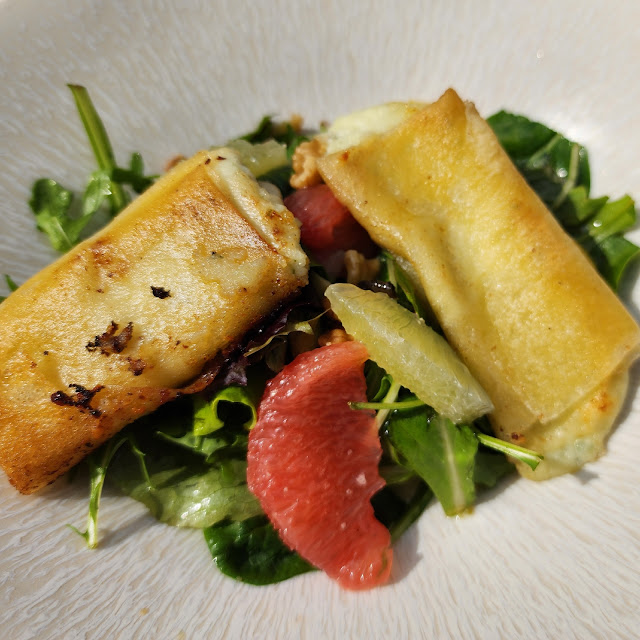
Salad with warm goat cheese


Green asparagus 


Fish fillet with beurre blanc sauce


Duck breast with side of polenta


Profiterole

We happily recommend Bibendum to friends who visit Avignon. The restaurant is open Tuesday through Saturday, 12h00 - 13h30 / 19h00 - 21h30. They offer a 3-course menu for 39 Euros. The BBD Club (bar, cocktails and tapas) is open from 18h00 - 00h30.

Bibendum
83 Rue Joseph Vernet
84000 Avignon, France
Tel: 04 90 91 78 39
website: https://www.bibendumavignon.fr

Saturday, April 2, 2022

Avignon and Delicious Lunch at Le Gout Du Jour

Avignon is 40 km southwest of Sablet, snuggled inside ancient walls along the Rhône River. The largest town in the Vaucluse, Avignon is very old, full of history, art, music and activity. I never get tired of wandering the narrow streets inside the fortified walls.

We come to Avignon to shop and meet up with cousins. Our stops always include a visit to the Nespresso Boutique, near Place de l'Horloge, to buy espresso capsules to take back to California (way cheaper). Shirley prefers to shop leisurely by herself so I go off to explore and take pictures.

Notre Dame des Doms Cathedral seen below is a Roman Catholic church located next to the Palais des Papes in Avignon. The cathedral is the seat of the Archbishop of Avignon. It is a Romanesque building, constructed primarily in the second half of the 12th century. The bell tower collapsed in 1405 and was rebuilt in 1425.

Notre Dame des Doms Cathedral

The Pope's Palace seen in the picture below is a historical palace in Avignon, one of the largest and most important Medieval Gothic buildings in Europe. One time fortress and palace, the papal residence was the seat of Western Christianity during the 14th century. Six papal conclaves were held in the Palace, leading to the elections of Benedict XII in 1334, Clement VI in 1342, Innocent VI in 1352, Urban V in 1362, Gregory XI in 1370 and Antipope Benedict XIII in 1394.

The Pope's Palace

In the center of Avignon on Place de l'Horloge you will discover the neo-classical town hall known as the Hotel de Ville seen below. It was built in the 19th century as a replacement for an older building. The 14th century Gothic clock tower from the original structure which gave the square its name was incorporated into the construction of the current Hotel de Ville.

Hotel de Ville and 14th Century Clock Tower

While Shirley shops, I choose our restaurant for lunch. We learned early on, that with the exception of cafes that are mostly frequented by tourists, it is not a good idea to drop into French restaurants without reservations. 

You will probably find they are "complet" (full) even if they have empty tables. You might get lucky if you show up just as they open their door for service. Most local restaurants with the exception of the aforementioned cafes for tourists do not turn tables like is customary in the United States.

It appears the pandemic has been hard on restaurants in Avignon like the United States. So some of the restaurants that we have enjoyed over the years are now "permanently closed". So on our visit in January, I decided we would try a new-to-us restaurant called "Le Gout De Jour" which I found in the Michelin Guide.

Shirley and I at "Le Gout Du Jour" with a glass of Mont Redon Gigondas 

Le Gout Du Jour restaurant is located just a few steps from the Hotel de Ville. The chef is a young Avignonnais (born in Avignon) by the name of Julien Chazal. He offers diners a variety of menu options including a vegetarian menu. The following photos show the dishes we enjoyed at lunch.

Pumpkin Soup

Salmon Fillet for Shirley

Venison Loin for Me

Dessert for Me

Dessert for Shirley

Espresso and Brownies to Finish the Meal

I am happy we discovered a new restaurant to recommend to friends who visit Avignon. The restaurant is opened daily for lunch and dinner except for Tuesdays and Wednesdays. As I mentioned earlier in the post, I highly recommend you make reservations and don't show up hoping to get seated without one.

Le Gout Du Jour
20 Rue Saint-Etienne
84000 Avignon
Tel: 04 32 76 32 16
Website: www.legoutdujour84.com

Friday, July 30, 2021

Walk Around Beautiful Historical Avignon

We went to Avignon so Shirley could shop so I took the opportunity to walk around and see what was new or different after our long absence.

One of the first things I noticed, this was the first time in a long time that the Opera - Theater of Avignon didn't look like there was reconstruction taking place.

Opera - Theater of Avignon

 The Opera - Theater of Avignon is located near the Pope's Palace on Place de l'Horloge. Built in 1825, it was rebuilt in 1847 after a fire. The Opera - Theater offers music, dance, theater and opera performances throughout the year.

The Pope's Palace is a historical palace in Avignon, one of the largest and most important Medieval Gothic buildings in Europe. One time fortress and palace, the papal residence was the seat of Western Christianity during the 14th century. Six papal conclaves were held in the Palace, leading to the elections of Benedict XII in 1334, Clement VI in 1342, Innocent VI in 1352, Urban V in 1362, Gregory XI in 1370 and Antipope Benedict XIII in 1394.

Pope's Palace

Next to the Opera - Theater of Avignon on Place de l'Horloge is the neo-classical town hall known as the Hotel de Ville built in the 19th century as a replacement for an older building.

Hotel de Ville

Only the 14th century clock tower remains from the original structure. The Gothic clock tower which gave the square its name was incorporated into the construction of the later Hotel de Ville.

Bell tower of Hotel de Ville

The bell tower of Basilique Saint-Pierre Church seen below is a 14th century Gothic Church in the middle of Avignon. The current church was built over a 3 year and 4 month's period and consecrated on 20 September 1359. It stands on the site of a much older church which may date back to the 7th century though the first texts mentioning the church date back to 1068.

Basilique Saint-Pierre Church

If you are looking for crepes, several good creperies are located on a shady square by Basilique Saint-Pierre Curch. If you are with kids who might not enjoy sitting through a multi-course meal, we recommend Creperie La Flourdiliz.

Creperies near Basilique Saint-Pierre Church

As our scheduled time to meet up with Shirley arrived, I headed to Place de l'Hotel and La Fourchette restaurant a few steps away. More about our meal there in a post to come.

Sunday, January 5, 2020

Avignon, City of Popes and Summer Festivals...Definitely Worth a Visit!

Avignon is 40 km southwest of Sablet, snuggled inside ancient walls along the Rhône River. The largest town in the Vaucluse, Avignon is very old, full of history, art, music and activity. I can spend hours wandering the narrow streets inside the fortified walls without getting bored.

We come to Avignon to shop for kids clothes and recently to visit the Nespresso Boutique, near Place de l'Horloge, to buy espresso capsules to take back to California, and meet up with cousins for lunch at one of the town's many restaurants. On our last visit, Shirley headed off to shop, she prefers to shop by herself, so she can do so at her leisure, and I went off to visit and take pictures.

Notre Dame des Doms Cathedral is a Roman Catholic church located next to the Palais des Papes in Avignon. The cathedral is the seat of the Archbishop of Avignon. It is a Romanesque building, constructed primarily in the second half of the 12th century. The bell tower collapsed in 1405 and was rebuilt in 1425.

From 1670 to 1672, the apse (where the alter is located) was rebuilt and extended. The building was abandoned and allowed to deteriorate during the French revolution, but it was reconsecrated in 1822 and restored by Archbishop Célestin Dupont between 1835 and 1842. The most prominent feature of the cathedral is a gilded statue of the Virgin Mary atop the bell tower which was erected in 1859

Notre Dame des Doms Cathedral and Palace of the Popes

The interior of the cathedral contains many works of art and the elaborate tombs of Pope John XXII and Benoît XII.

Interior of Notre Dame des Doms

The Popes' Palace is one of the largest medieval Gothic buildings in Europe. One time fortress and palace, the papal palace was the seat of Western Christianity during the 14th century. Six conclaves were held in the Palace and 6 French popes were elected, Benedict XII in 1334, Clement VI in 1342, Innocent VI in 1352, Urban V in 1362, Gregory XI in 1370 and anti-pope Benedict XIII in 1394.

It all began in the 13th century from a conflict between the papacy and the French crown, culminating with Philip IV of France's killing Pope Boniface VIII, and after the death of Pope Benedict XI, forcing a deadlocked conclave to elect the French Clement V, as Pope in 1305. Clement V declined to move to Rome, remaining in France, and in 1309, he moved his court to Avignon, where it remained for the next 67 years.

Palais des Papes (Pope's Palace)

The park known as Jardin des Doms sits next to Notre Dame des Doms Cathedral and can be reached via Palace Square. The park overlooks the Rhône river, the Pont d'Avignon (Avignon Bridge) and Avignon city streets. It’s a small climb but its worth it for the incredible views, manicured gardens, rock formations and sculptures.

The Monument aux Morts d'Avignon (War Memorial to Avignon) of World War 1 shown in the photograph below sits at the entrance to the walk-up to the Jardin des Doms. The monument was designed and sculpted by Louis Bottinelly from Carrara marble from Tuscany. It was completed in the fall of 1924 and inaugurated in November of that year.

War Memorial at Entrance to Jardin des Doms

View across Rhone River to Fort Saint-André in Villeneuve-lez-Avignon from Jardin des Doms

View across Rhone River to Villeneuve-lez-Avignon from Jardin des Doms

The Ramparts (defensive walls) were built by the popes in the 14th century and still encircle Avignon. They are one of the finest examples of medieval fortification in existence. The walls are surmounted by machicolated battlements flanked at intervals by 39 massive towers (see picture below) and pierced by several gateways, three of which date from the 14th century.

A Defensive Tower that is part of the historical ramparts of Avignon

View down the Rhone River to Pont Saint Bénézet, also known as the Pont d'Avignon

View of Notre Dame des Doms from the Jardin des Doms

Place du Palais (Palace Square)

The Hotel de Ville (Town Hall) is located on Place de l'Horloge, a short distance from the Pope's Palace. Construction began in 1845 and was inaugurated by the Mayor and Napoleon III in September 1856.

Hotel de Ville, Avignon

Avignon is well known for its Festival d'Avignon, the annual festival of dance, music and theater founded in 1947. There are really two festivals that take place: the more formal "Festival In", which presents plays inside the Palace of the Popes and the more Bohemian "Festival Off", known for its presentation of largely undiscovered plays and street performances.

Avignon Festival (photograph shot in July)

Avignon Street Musicians (photograph shot in July)

Saint John's Tower shown in the photograph below is the only vestige of the houses belonging to the Knights of Saint-John of Jerusalem. The other buildings were destroyed in 1898. It has 4 floors, but in the past had more. They restored the Tower and razed the houses which were massed for ages when the city fathers laid out Place Pie (Pie Square) in 1861.

St. John's Tower at Place Pie in Avignon

Saint Bénézet Bridge shown in the photograph below, better known as Pont d'Avignon, is a medieval bridge in Avignon over the Rhône River. A wooden bridge spanning the Rhône River between Villeneuve-lès-Avignon and Avignon was built between 1177 and 1185. This early bridge was destroyed forty years later during the Albigensian Crusade when Louis VIII of France laid siege to Avignon.

Beginning in 1234 the bridge was rebuilt with 22 stone arches. It was abandoned in the mid-17th century as the arches tended to collapse each time the river flooded. Four arches and the gatehouse at the Avignon end of the bridge have survived. The Chapel of Saint Nicholas sits on the second pier of the bridge. It was constructed in the second half of 12th century but has since been substantially altered.

Pont Saint Bénézet, also known as the Pont d'Avignon

When we met up for lunch, Shirley mentioned to me, "I think they increased the prices on the Nespresso capsules. It cost me a lot more this time". I asked her what they cost per capsule and I said that doesn't sound more expensive, how many did you buy? She responded "900". I said wow, that explains it, you only bought 590 last time. I guess it really goes without saying that we really like Nespresso coffee. The capsules are recyclable and that makes them perfect.

Avignon is a little confusing to navigate through and around in a car. We suggest you park at the Mercure Hotel parking lot if there is availability. From there you can easily walk around the town. If you have comments or questions about Avignon or elsewhere in Provence, please leave your comments below or send me an email at my address below.

If you are thinking about a trip to the South of France including spending time in Provence, we invite you to visit our website. Our house is available for rent by the week or more. You can reach us for further information by sending an email to chcmichel@aol.com.

Saturday, March 3, 2018

Visit to the Pope's Palace in Avignon France (not Rome Italy)

I have ignored my blog for far too long. Busy at work and projects at home, so I never seem to find quiet time to share adventures with you. So here I am. I hope to be here more frequently going forward.

As followers of "Our House in Provence" blog know, Shirley and I have been traveling to Sablet for quite a few years. During those years, we have spent a lot of time in Avignon but never felt inclined to visit the Palais des Papes (Popes' Palace). Probably has to do with the fact we steer clear of museums. Much prefer to spend our time wandering around towns and villages, walking in and out of shops and stopping periodically for a petit café or glass of rosé depending on the time of day.

Last fall, we were honored by a visit of friends from Northern California. Since several had visited Sablet previously, we wanted to take the group to some new places. One place we chose to visit was the Pope's Palace. So we loaded the group into the car and headed to Avignon. We parked in our favorite parking garage and climbed the steps and exited to a view across Place du Palais to the Cathedral.

Notre-Dame des Doms Cathedral is a Romanesque building, mainly built during the 12th century. The most prominent feature of the cathedral is the 19th century gilded statue of the Virgin which surmounts the western tower. The mausoleum of Pope John XXII (1334) is one of the most beautiful works within the cathedral. During the 14th century, this became the world’s most important church, home to seven different popes.

Notre-Dame des Doms Cathedral

The Popes' Palace is a historical palace in Avignon, one of the largest and most important Medieval Gothic buildings in Europe. One time fortress and palace, the papal residence was the seat of Western Christianity during the 14th century. Six papal conclaves were held in the Palace, leading to the elections of 6 French popes, Benedict XII in 1334, Clement VI in 1342, Innocent VI in 1352, Urban V in 1362, Gregory XI in 1370 and antipope Benedict XIII in 1394.

It all began back in the 13th century from the conflict between the papacy and the French crown, culminating with Philip IV of France's killing of Pope Boniface VIII, and after the death of Pope Benedict XI, forcing a deadlocked conclave to elect the French Clement V, as Pope in 1305. Clement V declined to move to Rome, remaining in France, and in 1309, he moved his court to the papal enclave at Avignon, where it remained for the next 67 years.

Notre-Dame des Doms Cathedral and Palais des Papes

Built in less then 20 years starting in 1335, the Popes' Palace is the amalgamation of two buildings: the old Palace of Benedict XII which sits on the rock of Doms, and the new Palace of Clement VI, the most extravagant of the Avignon popes. Not only is the final combination the largest Gothic building of the Middle Ages, it is also one of the best examples of the International Gothic architectural style.

Palais des Papes

Come along with us as we visit the Palais des Papes. Inside, you’ll walk along sloping passages, narrow stairways, through arched doorways and into over 25 rooms that are open to visitors.

The central courtyard was completed in 1347 when Clement VI added the New Palace's south and west wings. In the center, you can see the well that Clement VI created on the site that was once the former Audience Chamber of John XXII.

Central Courtyard

Benoît XII Cloister, also known as the Court of the Old Palace, is named for Pope Benedict XII. It is a serene green space enclosed by a double-arcade, the upper level of which is a blind-arcade.

Benoit XII Cloister

As I mentioned previously, the palace served for over six decades as the residence of seven popes, and then during the Western Schism as the palace of two antipopes. In later years, the complex housed the Vice-legates and served as a barracks for the French military.

Palais des Papes

Pope's Palace Corridor

The Grand Tinel was the feast room! Measuring 160 feet (48 meters) long, five seatings, each with four courses, were served here. Normally, the pope sat alone at the south end inside his papal cathedra and if a visiting dignitary were dining with him, his guest would be alongside; however, on a lower platform.

The cavernous Grand Tinel or Feast Room

The Kitchen Tower was added to the palace during the reign of Clement VI. It features an impressive cone-shaped chimney in the ceiling.

The Kitchen Tower Chimney

Not a pope, but our friend John

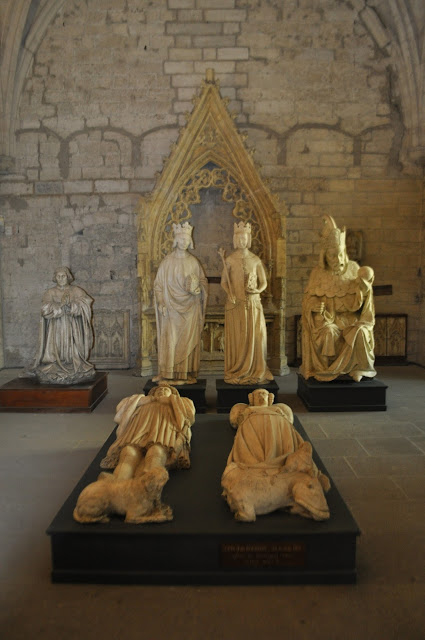
Plaster effigies of prominent figures in the Sacristy from during the papal rule in the palace

The Consistory, a meeting hall where the Pope received official dignitaries was once decorated with paintings (they were destroyed by fire in the early 15th century) and features plain stone walls and houses displays of models and architectural elements, including a scale model of the palace and a set of wooden cupboard doors.

"Passion of the Christ" sculpture inside the Consistory

An architect, Jean de Louvres, was commissioned by Clement VI to build a new tower and adjoining buildings, including a 52 m long Grand Chapel, seen below, to serve as the location for papal acts of worship.

The Grand Chapel, where the Avignon popes worshiped

Chambre des Notaires, the Notary Room seen below, houses 19th-century portraits of the nine Avignon popes painted by Henri Serrur.

Notary Room

Magna Porta

The Escalier d’Honneur, the Stairway of Honor, is a wide Italian-style processional or ceremonial stairway, restored in the 17th century, leads from the Courtyard of Honor to the Great Chapel.

Stairway of Honor

The residency of the Popes in Avignon ended on September 13, 1376, when Pope Gregory XI abandoned Avignon and moved his court to Rome (arriving on January 17, 1377). Despite this return, following Gregory's death on March 27, 1378, the breakdown in relations between the cardinals and Gregory's successor, Urban VI, gave rise to the Western Schism.

This started a second line of Avignon popes, regarded as illegitimate and known as antipopes. The second and final Avignon antipope, Benedict XIII, lost most of his support in 1398, including that of France; following five years of siege by the French, he fled to Perpignan on March 11, 1403. The schism ended in 1417 at the Council of Constance, after two popes had reigned in opposition to the papacy in Rome.

Palais des Papes Tower

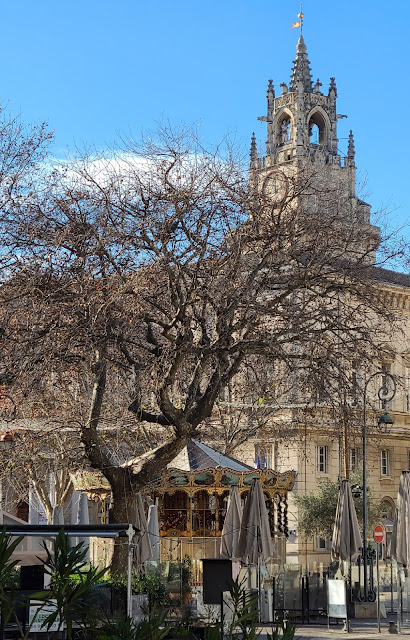
We finished our visit to the Palace and walked down to the neo-classical town hall known as the Hôtel de Ville on Place de l'Horloge. It was built in the 19th century as a replacement for an older building. Only the 14th century clock tower remains from the original structure. The Gothic clock tower seen below, which gave the square its name, was incorporated into the construction of the later Hôtel de Ville.

14th century Bell Tower of the Hôtel de Ville

If you are going to be in the area this year, and want to visit the Popes' Palace, it is probably preferable to do so first thing in the morning or in Spring or Fall as I have heard from friends that it is very hot and you will sweat profusely during your visit. Enough said.

Have a great week. Hope to hear from some of you.