Showing posts with label Sunflowers. Show all posts

Monday, March 14, 2022

Hunt for Sunflowers and Hike to the Fortress of Mornas

Last July, we went to Provence for the first time since the beginning of the Coronavirus pandemic. As I wrote in this post, shortly before our trip, about our favorite things in Provence, seasonal "floral" attractions such as red poppies, lavender, and sunflowers are high on our list. 

Since July is sunflower season, we set off one morning to look for sunflower fields around the town of Orange. We had been told there were large sunflower fields north of Orange and while we were there, we should take the time to hike up to the Fortress of Mornas.

Sunflower field near Mornas

Sure enough, we found quite a few fields as we drove toward Mornas. Sunflowers have rough, hairy stems, and what most people call the flower on a mature sunflower is a flower head of numerous small flowers crowded together. The outer flowers are sterile, and the flowers inside the circular head mature into seeds, from which oil is extracted.  

Sunflowers near Mornas

Sunflowers generally grow to between 5 and 12 feet tall and bloom from late June to end of July with harvest occurring beginning of August. A common misconception is that sunflowers track the sun. In fact mature sunflowers typically face east and do not move. The leaves and buds of young sunflowers do change their orientation from east to west during the course of the day; once mature, the movement stops.

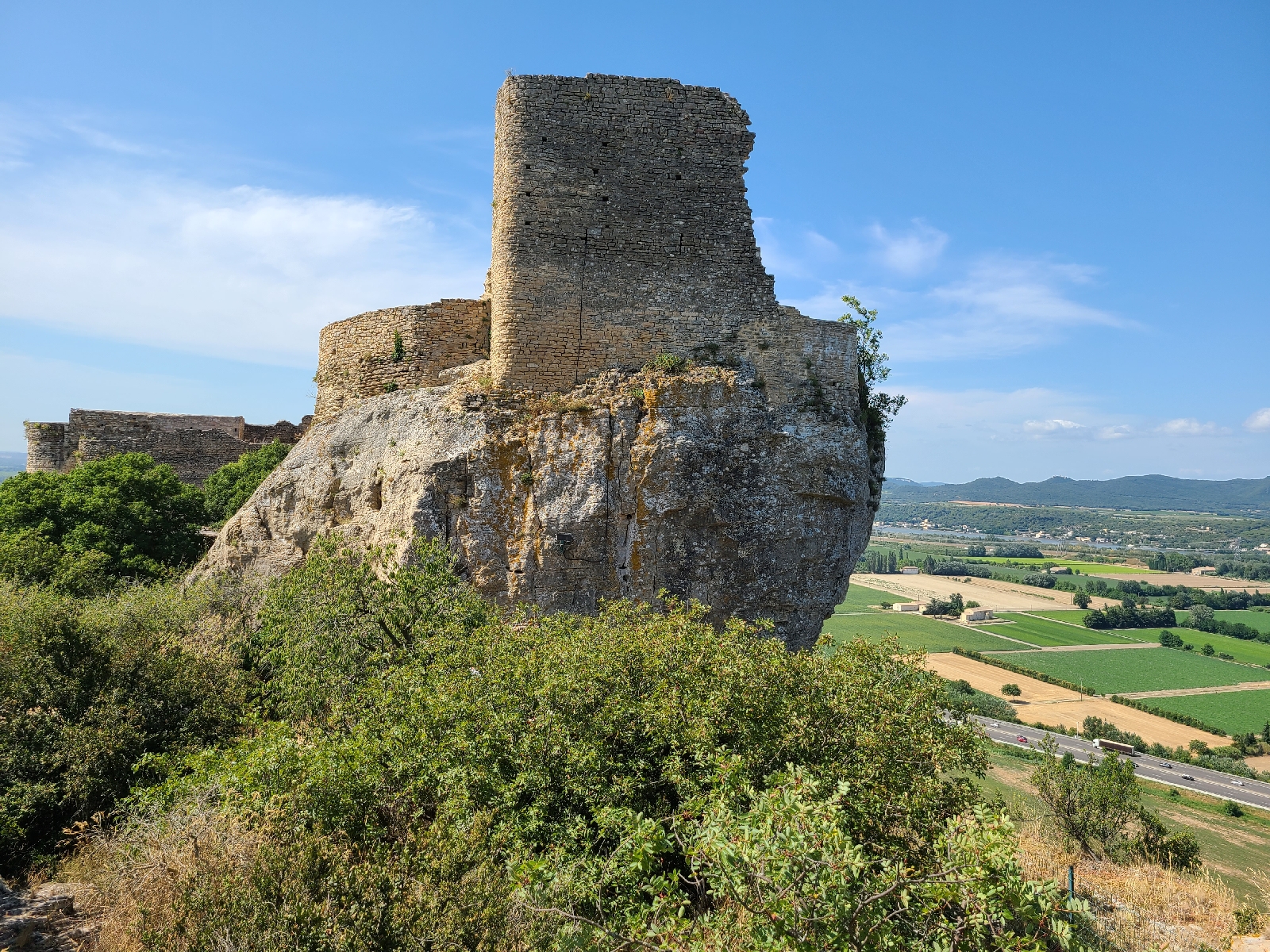
We arrived in Mornas, a medieval community that sits along the Rhone River halfway between Orange and Bollene. The village is longer than it is wide with a single street that runs end to end. At each end of the village, are magnificent, fortified stone gateways which guard the entrances to the village. Above Mornas, on top of a 450 foot cliff is the Fortress of Mornas. 

14th century Saint Nicolas gate

We had come to visit the fortress, so we headed up a very steep narrow road. About half way to the fortress, past the village cemetery, we came to Notre-Dame du Val-Romigier, a Romanesque church dating from the middle of the 12th century. It was enlarged during the Gothic era and restored several times over the years. 

Notre Dame de Val Romigier Church

After pausing our walk to stroll around the cemetery and visit the church, we continued up the very steep road to the fortress. Note, the walk up to the fortress takes about 15 minutes. The first part of the walk to the church is steep, the walk from the church to the fortress is very steep, on a wide, flat cement roadway with no shade. 

The Fortress of Mornas

The large fortress, with stone walls, towers, chateau and chapels was constructed on top of the cliffs in the 12th century by the Earl of Toulouse. 

The Fortress of Mornas

The fortress ruins are visible for a long distance to the west. If you have ever driven down the A-7 autoroute from Bollene past Mornas to the Rhone valley, you have surely observed it as you passed below. 

The Fortress of Mornas

Mornas was passed to the Avignon Popes at the beginning of the 14th century. The fortress was restored and improved with an outer wall built around the top of the hill to protect it from highway robbers that were looting and devastating the land at that time.

The Fortress of Mornas

Protestants and Catholics fought fiercely over Mornas during the wars of Religion. In 1562, after killing women, children and elderly in the church, the Protestant troops forced the Catholic brigade to throw themselves off the walls. The Protestant Huguenots met the same fate when the Catholics recaptured the fortress in 1568. 

Shirley below the Fortress of Mornas

After the French Revolution, the fortress was abandoned and fell into ruins. 

The Fortress of Mornas

Starting in 1978, the "Les Amis de la Forteresse" association has been restoring the fortress back to medieval times. 

Shirley at bottom of the path leading up to the Fortress of Mornas

If you want to do an serious climb, or look for sunflowers, then head to Mornas. You are probably curious anyway about the fortress on the hill if you ever drove past on the A-7 autoroute.  If you go there during truffle season, there is a very good restaurant that is famous for their truffle menus in Mondragon that I told you about here

Wednesday, July 28, 2021

Sunflowers in Provence.

As soon as we finished our drive around the lavender fields we started hunting for sunflowers, called tournesol in French

You may not be aware that despite the fact that you find postcards,  photos and paintings of sunflowers all over Provence, they are actually native to the Americas. Sunflower seeds were brought to Europe by Spaniards in the 16th century where sunflower oil became a widespread cooking ingredient.

Sunflowers have rough, hairy stems, and what most people call the flower on a mature sunflower is a flower head of numerous small flowers crowded together. The outer flowers are sterile and the flowers inside the circular head mature into seeds from which oil is extracted. 

Sunflowers

Sunflowers generally grow to between 5 and 12 feet tall and bloom from late June to the end of July with harvest occuring at the beginning of August. 

Sunflower field near Jonquiere

A common misconception is that sunflowers track the sun. In fact mature sunflowers typically face east and do not move. The leaves and buds of young sunflowers do change their orientation from east to west during the course of the day; once mature the movements stop.

Sunflower field near Mornas

You may not know that the Jerusalem artichoke also called sunchoke and topinambour, is a type of sunflower. It is cultivated in temperate zone for its tuber, which is used as root vegetable and delicious roasted or in soup.

Sunflower field near Chateauneuf-du-Pape

Its hard to not pull over to take pictures when you come upon a field of sunflowers. Sunflowers give off a sense of happiness, like little suns shining on a perfect summer day.

Sunflower field near Courthézon

If you are in Provence during July, make sure you stop and snap a picture or two of yourself in one of the sunflower fields you will surely pass by.

Thursday, August 31, 2017

Sunflower fields are special places of beauty in Provence, worth seeking out!

Friday, July 21, and we were on the road to find a good vantage point to watch the Tour de France near Lauris. As we drove toward the town of Orange to get on the A-7 autoroute, we came upon a huge field of sunflowers. There is nothing Shirley likes more than sunflowers, except maybe a field of purple lavender or red poppies, so we stopped for photos.

You may not be aware that despite the fact that you find postcards, photos and paintings of sunflowers all over Provence, they are actually native to the Americas. Sunflowers seeds were brought to Europe by Spaniards in the 16th century where sunflower oil became a widespread cooking ingredient.

Sunflowers, tournesol in French, have rough, hairy stems, and what most people call the flower on a mature sunflower is a flower head of numerous small flowers crowded together. The outer flowers are sterile and the flowers inside the circular head mature into seeds from which oil is extracted.

Sunflower

Sunflowers generally grow to between 5 and 12 feet tall and bloom from late June to the end of July with harvest occurring at the beginning of August.

Sunflower field near Violès

When we come upon a beautiful field of flowers (sunflowers, lavender or red poppies) that are in peak season and facing the road, it is mandatory that we stop and Shirley and whoever is traveling with us run into the field and pose for pictures.

Daughter Stephanie and Shirley

A common misconception is that sunflowers track the sun. In fact, mature sunflowers typically face east and do not move. The leaves and buds of young sunflowers do change their orientation from east to west during the course of a day; once mature the movements stop.

Sunflower field near Violès

You may not know that the Jerusalem artichoke also called sunchoke and topinambour, is a type of sunflower. It is cultivated widely across the temperate zone for its tuber, which is used as a root vegetable and delicious roasted or in soup.

More of the sunflower field near Violès

It's hard not to fall in love with a field of sunflowers: they give off a sense of happiness, like suns shining on a perfect summer day.

Sunflower field near Violès

I have read that the most beautiful sunflower fields in the world are in Tuscany. I have not seen those fields but until I do, I will continue to believe there are none more beautiful than the sunflower fields of Provence.

The family

If you are in Provence during July, make sure you stop and get a picture or two of yourself in one of the sunflower fields you will surely pass by. For me, I continue to look for a place where sunflowers and lavender grow next to each other so I can take one of those only on a postcard shots to share with you.

Saturday, August 4, 2012

Sunflowers in Provence

Shirley's three favorite things about summertime in Provence are lavender, coquelicots (poppies) and sunflowers, especially when we come upon them unexpectedly in large fields along the back roads. Shirley loves flowers and is forever on the lookout for these and other flowers, flowering shrubs and vines wherever we go in Provence.

Unfortunately due to work demands, Shirley was not able to spend time in Provence this summer. So I made a special effort to look for and take pictures of as many fields of lavender, sunflowers, and coquelicots as I could find. I was there at the perfect time when all three were in bloom. Shirley, this post is for you.


For those of you who don't know, sunflowers, known in France as tournesol, are an annual plant, native to the Americas, first domesticated in present day Mexico. Sunflowers possess a large flowering head. The sunflower is named after its huge, fiery blooms, whose shape and image is often used to depict the sun.

The sunflower has a rough, hairy stem, broad, coarsely toothed, rough leaves and circular heads of flowers. The heads consist of many individual flowers which mature into seeds, often in the hundreds, on a receptacle base. From the Americas, sunflower seeds were brought to Spain in the 16th century, where, along with sunflower oil, they became a widespread cooking ingredient.


This field of sunflowers was off the old road to Orange. I have not yet found a place where there are both sunflowers and lavender planted in such a way that you can get pictures of both. If anyone knows where I can find this in Provence, please let me know. I will put it on my list of places to go visit when we are in Provence next summer.


I have a long list of favorite things about summertime in Provence. What are your favorite things? Tell me in a comment below. Bonne journée mes amis et à bientôt. Have a great day, chat soon!

Wednesday, August 24, 2011

Beautiful Sunflowers in a Field

Bastille Day, July 14, the French Fête Nationale, was a beautiful day in the Vaucluse. We checked with Bruno the congenial proprietor of Café des Sports and my go-to-source for information about Sablet and surprising to us, no celebration was planned for our village.

So we decided it would be a perfect day to drive to the Metairie Neuve, the small family farm near Viane in the Tarn region in Southern France. On the way to the freeway, we came upon a large field of sunflowers. Now you know there is nothing that wife Shirley likes more than a field of sunflowers, except maybe a field of purple lavender or red poppies, so we had to stop and take pictures.

You may not be aware that despite the fact that you find postcards, photos and paintings of sunflowers all over Provence, they are actually native to the Americas. Sunflowers seeds were brought to Europe by Spaniards in the 16th century where sunflower oil became a widespread cooking ingredient.

Sunflowers, tournesol in French, have rough, hairy stems, and what most people call the flower on a mature sunflower is a flower head of numerous small flowers crowded together. The outer flowers are sterile and the flowers inside the circular head mature into seeds from which oil is extracted.


Sunflowers generally grow to between 5 and 12 feet tall and bloom from late June to the end of July with harvest occurring at the beginning of August.


A common misconception is that sunflowers track the sun. In fact, mature sunflowers typically face east and do not move. The leaves and buds of young sunflowers do change their orientation from east to west during the course of a day; once mature the movements stop.

Wife Shirley and niece Leslie face the morning sunshine from the east along with the sunflowers that surround them.


Most of you have probably seen one or more of the paintings of sunflowers by the Dutch painter Vincent van Gogh or other photos or paintings by lesser known artists. None of these paintings can compare to the beauty of a field of sunflowers, faces to the sun, along side the road.

You will have to come to Provence to see for yourself. Bonne journée mes amis et à très bientôt.

Sunday, March 14, 2010

Happiness

I am feeling very happy; I just bought tickets for Shirley and me for our return to Sablet on April 29.


We have never been in Sablet during the month of May so we are anxious to see what new sights and activities are in store for us.


I am most excited about seeing what will be available in the various village markets, especially the Tuesday morning market in Vaison la Romaine.


As usual, we will have guests visiting from the US. Long time staff and friends Julia, Allison, Kari and Lisi from Bistro Des Copains in Occidental, California will be coming to Sablet for the first time.

I can't wait to show them our favorite places in the Vaucluse, eat wonderful food and drink some great wine from the Cote du Rhone.

It will be too early for the sunflowers in this field on the road to Orange but I know there will be other pretty sights to see and photograph.

I can't wait!