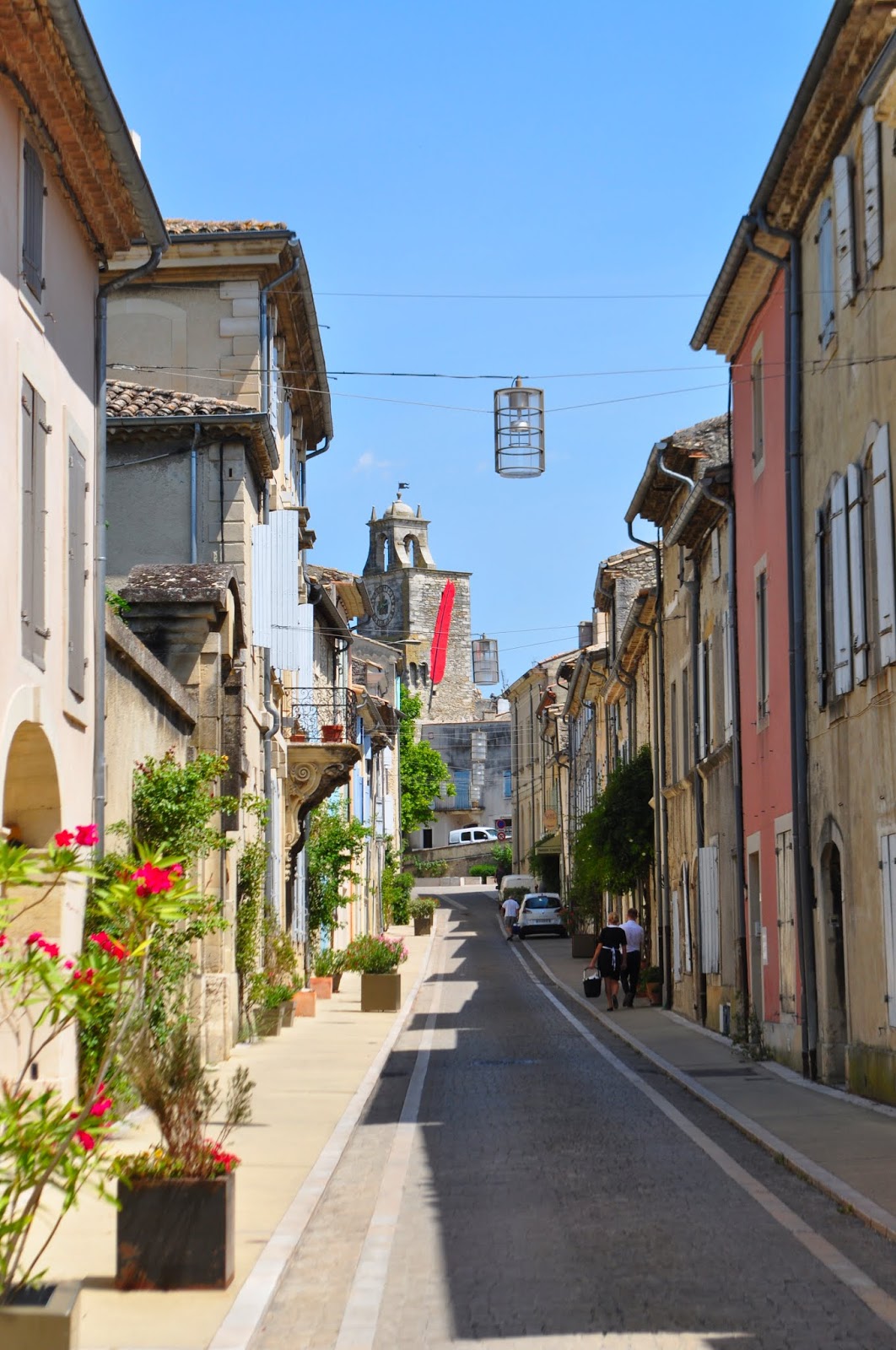
The amazing region of Provence France has so many wonderful places to explore and points of interest to check out that it is almost impossible to decide which are my favorites. After not going to Sablet because of the pandemic for more than 1 year and 1/2, I am trying to figure out how get to as many places as possible, but leaving lots of time to spend with family and friends.
If you don't know, the Romans spent hundreds of years in Provence and left many ruins for travelers to visit. Before them were the Greeks. Many years later, seven popes resided in Avignon and artists such as Vincent van Gogh and Paul Cezanne did most of their work in Provence.
Lovers of fine wine can spend their entire visit going to wineries and tasting some of the best wines produced in France. The region offers dramatic scenery at every turn. For beach lovers, the Mediterranean Sea is just a short drive. If your tastes go more to exploring cities or charming hill top villages, they are mere minutes away.
We were first attracted to Sablet because of its convenient location to most of the wonderful attractions in Provence. That and all of the wonderful friends we have made in Sablet and the surrounding area keeps us coming back.
#1. Sablet
For those of you who read my posts about Provence, it should not come as any surprise that my favorite place is our village of Sablet. For those who don't know, Sablet is a small village located at the base of the jagged Dentelles de Montmirail west of Mont Ventoux. You can find out more here.
 |
| Sablet under the Dentelles de Montmirail |
#2. Pont du Gard
Shirley says our favorite Roman ruin in the South of France is the Pont du Gard, the aqueduct bridge that crosses the Gardon River about 37 miles from our house in Sablet between the towns of Remoulins and Uzès. I can't disagree.
The Pont du Gard is part of a 50 km (31 mile) aqueduct constructed by the Romans in the middle of the 1st century to bring fresh water from the Eure spring near Uzès, to the Roman city of Nîmes where it supplied running water to fountains, baths and private homes around the city. You can find out more here.
 |
| Pont du Gard |
#3. Tuesday Morning Market in Vaison-la-Romaine.
We plan our time in Sablet around the Tuesday morning market that takes place, rain or shine throughout the year in Vaison-la-Romaine.
Vaison-la-Romaine is a quick 6 mile trip from Sablet down a winding road and then left across the Ouvèze River. The town is known for its Roman ruins, medieval town and cathedral.
The town is split into two parts by the Ouvèze River; on the left bank is the old medieval town with the Castle of the Counts of Toulouse at the highest point shown in the photograph below and on the right bank is the ancient Roman colony and modern town.
 |
| The Castle of the Counts of Toulouse above Vaison-la-Romain |
The bridge in the photograph below was built by the Romans in the 1st century AD and is the oldest surviving Roman bridge. It may even be the oldest stone bridge in existence in the world. It was built with a single arch, spanning 56 feet of large course masonry, resting directly upon the rock. It links the lower modern town and the upper medieval old town.
 |
| Roman Bridge across Ouvèze River in Vaison-la-Romaine |
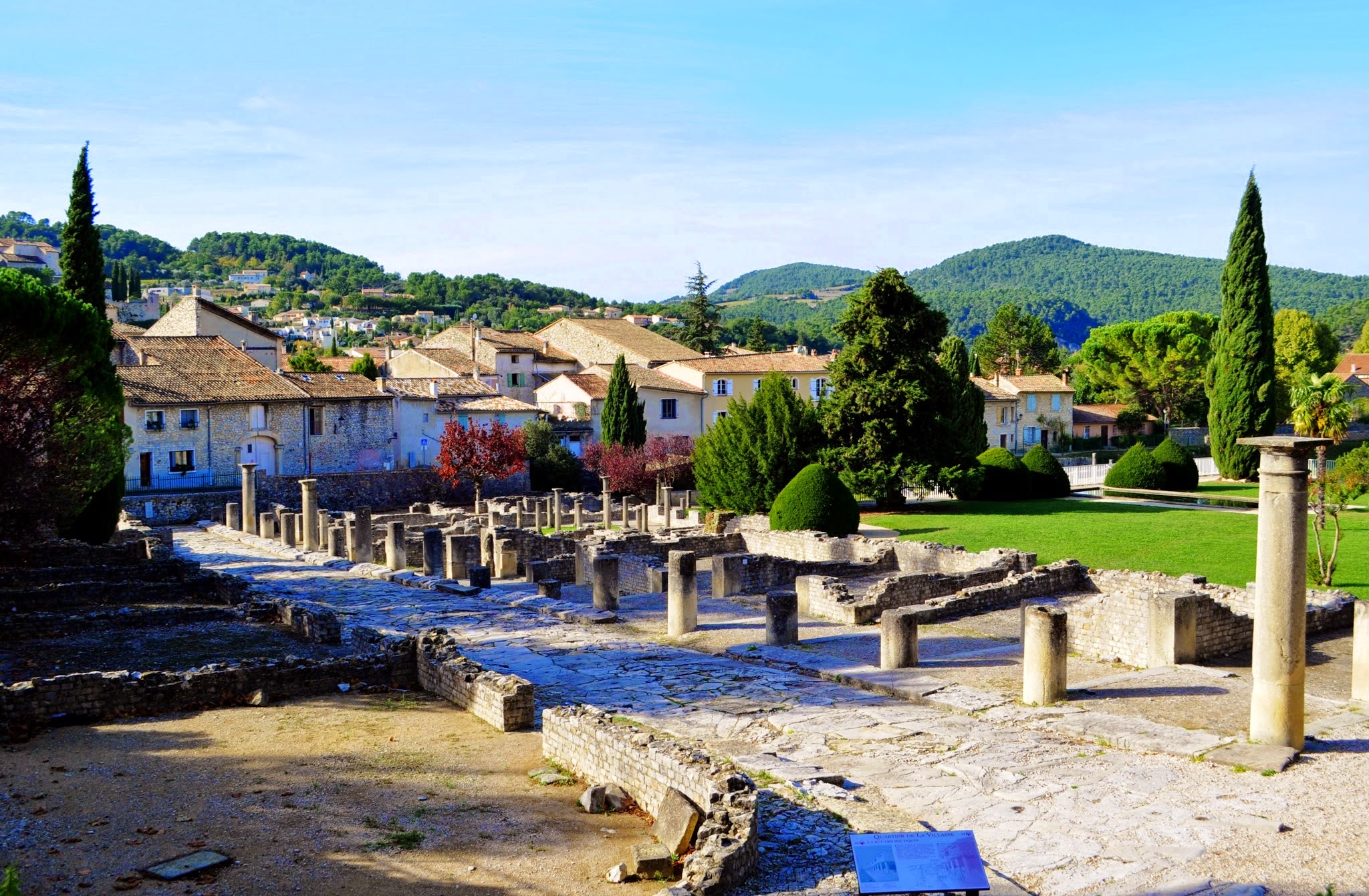
The Roman ruins lie in the valley on the right bank of the Ouvèze River in two main areas: La Villasse and Puymin. Some of the ruins of La Villasse are shown in the picture below.
 |
Roman Ruins in La Villasse in Vaison-la-Romaine
One of the best things about owning or renting a house in Provence, in my opinion, is the chance to cook some of the amazing produce, seafood, cheese and meats you find at the various outdoor markets you come across as you travel around Provence. And let me tell you, the weekly market in Vaison-la-Romaine is one of the biggest and best.
|
 |
| Tuesday Morning Market in Vaison-la-Romaine |
#4. Luberon Villages
Every time we come home to Sablet, we head toward the Luberon mountain to visit one or more of the small hill top villages in that area. Many times, Gordes is one of the villages we visit, especially if we are touring first time visitors around Provence.
Gordes is a beautiful old village about 1 hour southeast of Sablet. The small village (pop. 1773) sits on a rocky outcrop of the Vaucluse Mountains and dominates the plain and Calavon River Valley, offering a view of the Luberon mountain across the way.
 |
| Gordes |
We usually include a trip to the vibrant red-ocher colored town of Roussillon, one of five villages nestled in the Luberon hills which are classified as Plus Beaux Villages de France (Most Beautiful Villages of France). Roussillon is one of our favorite villages and just one hour from Sablet.
Roussillon sits on the southern edge of the Plateau de Vaucluse above one of the world's largest known ocher deposits where 17 shades of ocher--violet, blood red, orange, yellow, and everything in between were once mined.
 |
Roussillon
|
#5. Côtes du Rhône Wines
We like wine, there I said it. Especially red and rose wines made in the Côtes du Rhône. Did you know that there is a hierarchy for Côtes du Rhône wines? Yes, that's true! The Côtes du Rhône appellation stretches 125 miles between Vienne in the north to Avignon in the south and is separated into two regions of Rhône wines: the Northern Côtes du Rhône is the region from Vienne to Valence and the Southern Côtes du Rhône is the region from Montélimar to Avignon.
The basic level consist of 171 communes (similar to a township in the US) in the French departments of Ardèche, Bouche du Rhône, Drôme, Gard, Loire, and Vaucluse that produce wine. The average production of Côtes du Rhône wine is about 419 million bottles a year, making this one of the largest appellations in the world. Level 2 is Côtes du Rhône-Villages and includes 95 communes around the region which supposedly produce a higher quality of wine.
The third level is Côtes du Rhône-Villages (named village) which are 18 villages including Sablet who are authorized to put the village name on wine labels. The top level of the Côtes du Rhône hierarchy are Crus, a total of 17 villages who put their name on the label but do not have to mention Côtes du Rhône. These include our favorite appellations, Châteauneuf-du-Pape and Gigondas.
Sablet is located between Séguret, a village classified as a "Plus Beaux Village de France," to the north and Gigondas, a village renown for its red wine to the south. We think Gigondas is one of the prettiest of all Côtes du Rhône wine villages and one you should visit especially if you love red wines.
From the road, Gigondas (2.5 miles) seems little more than a cluster of stone houses set on a hillside with a church below the Dentelles de Montmirail Mountains overlooking vineyard covered slopes and valley below.
 |
| Gigondas |
Red wine lovers should stop in at the Caveau du Gigondas (wine cooperative) where you can taste more than 100 different Gigondas wines from 80 wineries and buy them at the same price as at the winery. Having said that our favorite producers of Gigondas wine are Domaine la Bouïssière and Domaine Notre Dame des Pallières both of which have tasting rooms.
Our other favorite Côtes du Rhône wine village is Châteauneuf-du-Pape (15 miles), a small village on the side of a hill, guarded by the ruins of an ancient chateau towering above. From the chateau you have an outstanding view in all directions, mostly of vineyards and of the Rhône River 1.9 miles to the east.
Châteauneuf-du-Pape is the most renown appellation in the southern Rhône Valley. Vineyards are located around Châteauneuf-du-Pape and in the neighboring villages of Bédarrides, Courthézon and Sorgues between Avignon and Orange and cover slightly more than 7,900 acres. The chateau was built in the 14th century for Pope John XXII, the second of the popes who resided in Avignon.
 |
| Châteauneuf-du-Pape |
Our favorite Châteauneuf-du-Pape winery is located just outside the village on the Route de Courthézon. We first became acquainted with Domaine de la Charbonnière and their wines when we tasted wines for the initial wine list for our Bistro Des Copains in Occidental, California and have been fans and friends ever since.
# 6. Mediterranean Seaside Village of Cassis
Cassis is a picturesque town a little over 1 and 1/2 hours from Sablet snuggled at the bottom of a steep bowl of land along the Mediterranean Sea between little coastal fjords with tall cliffs called calanques about 25 km east of Marseille.
Cassis is on a steep hillside with vineyards and pastel-colored houses that tumble down to a seaside port lined with more pastel-colored houses, shops and restaurants with 8,000 inhabitants. The wineries of Cassis make some of our favorite white and rose wines.
 |
| Cassis |
Cassis remains a small fishing port but the fishing boats now share the harbor with yachts and a collection of boats that tourists can book for visits to the nearby calanques. You will see traditional wooden fishing boats known as pointus tied up along the Quai des Baux. You can learn more here.
 |
| Cassis Harbor |
#7. Avignon and Aix-en-Provence
Our two favorite larger towns in Provence are Avignon and Aix-en-Provence.
Avignon is 25 miles southwest of Sablet, snuggled inside ancient walls along the Rhône River. The largest town in the Vaucluse, Avignon is very old, full of history, art, music and activity. I can spend hours wandering the narrow streets inside the fortified walls without getting bored.
Avignon is well known for its Festival d'Avignon, the annual festival of dance, music and theater founded in 1947. There are really two festivals that take place: the more formal "Festival In", which presents plays inside the Palace of the Popes and the more Bohemian "Festival Off", known for its presentation of largely undiscovered plays and street performances.
 |
| Avignon from across the Rhone River |
Notre-Dame des Doms Cathedral is a Romanesque building, mainly built during the 12th century. The most prominent feature of the cathedral is the 19th century gilded statue of the Virgin which surmounts the western tower. The mausoleum of Pope John XXII (1334) is one of the most beautiful works within the cathedral. During the 14th century, this became the world’s most important church, home to seven different popes.
 |
Notre-Dame des Doms Cathedral and Pope's Palace
|
The Popes' Palace is a historical palace in Avignon, one of the largest and most important Medieval Gothic buildings in Europe. One time fortress and palace, the papal residence was the seat of Western Christianity during the 14th century. Six papal conclaves were held in the Palace, leading to the elections of 6 French popes, Benedict XII in 1334, Clement VI in 1342, Innocent VI in 1352, Urban V in 1362, Gregory XI in 1370 and antipope Benedict XIII in 1394.
 |
| Pope's Palace |
As I said above, our other favorite town in Provence is Aix-en-Provence. The capitol of Provence in the middle ages, it is located about 1 hour and 15 minutes from our home in Sablet. Cousin Annick lives in a nearby village.
Aix-en-Provence is famous for its outdoor markets, shopping and beautiful people, and as the home of Paul Cézanne (1839-1906) who lived and did most of his work here. Unusual for Provence, there are no ancient historical sights to see.
Aix-en-Provence is often referred to as the city of a thousand fountains (a slight exaggeration). The construction of the Rotonde fountain in 1860 at the end of Cours Mirabeau was unusual for Aix-en-Provence because of its size and because it was the first to have a water basin. |
| The Rotonde fountain in Aix-en-Provence |
The Cours Mirabeau is one of the most beautiful boulevards in the South of France. Created in 1650, it is one of the most popular and lively places in Aix-en-Provence. 440 meters long (1444 feet) and 42 meters wide (138 feet), it is lined with cafés.
The Cours Mirabeau divides Aix into two parts, the Quartier Mazarin, or "new town", which extends to the south and west, and the Ville Comtale, or "old town", which lies to the north. The Cours Mirabeau is decorated by four fountains, the most impressive of which is La Rotonde.
 |
| Cours Mirabeau |
# 8. Favorite Seasonal Attractions
The favorites I have shared so far can be enjoyed all year long, no matter when you come to Provence. The ones that follow usually only happen once a year and/or for a few weeks.
For spectacular scenery, you can't find much better than red poppies called coquelicots, lavender and sunflowers in bloom. Shirley's favorites are the coquelicots, although she loves lavender and sunflowers too.
 |
| Coquelicots |
Sunflowers generally grow to between 5 and 12 feet tall and bloom from late June to the end of July with harvest occurring at the beginning of August.
 |
| Field of Sunflowers |
It's a toss up between coquelicots (red poppies) and lavender but probably no other scent or sight says Provence better than the pungent aroma of a purple field of lavender growing in mounded rows under a brilliant blue summer sky.
 |
| Lavender Field near Aurel |
One of things that we consider as we set our dates for summer visits to Sablet is the route for the annual Tour de France bike race. If they are going to be riding through Provence, especially climbing to the summit of Mount Ventoux, we try to be there.
Even though they pedal by quickly, we love to watch the peloton and the official vehicles and publicity caravan that accompany the riders as they make their way around France to our vantage point. Because of the pandemic, we can't get there this year to watch the riders climb Mount Ventoux twice in one day.
 |
| Tour de France Peloton |
The custom of the transhumance is the migration of sheep and shepherds from low pastures to higher ground. Traditionally, shepherds begin to move their flocks up into higher pastures in May or early June before the hot, sunny Provençal weather dries the grasses and water becomes scarce.
In earlier times, the flocks were herded by shepherds and their dogs, and had time to get acclimated to the change in altitude during the journey. Today, most flocks are moved by large, double-tiered, trucks. The spring transfer towards higher altitudes is celebrated every year with traditional Fête de la Transhumance in several towns and villages, of which Saint Remy's is the most famous.
The picture below is from the Fête de la Transhumance in Jonquières. Locals told me that day that they were expecting more than 2000 sheep to cross the town along with their shepherds, horses, dogs and donkeys. Word to the wise, if you go wear old shoes...for obvious reasons.
 |
| Fête de la Transhumance in Jonquières |
# 9. Other Villages
Besides the towns and villages I have mentioned earlier in this post, we also go regularly to Séguret, Grignan, Les Baux de Provence, Venasque and Nyons among other villages.
Sablet is surrounded by small wine-making villages, the closest of which is Séguret, about 1.25 miles northeast of Sablet. As you can see in the picture below, Séguret is elevated above the vineyards that separate Sablet from Séguret and wraps around the bottom of a steep hill topped by ruins of its medieval castle. This pedestrian only village is classified as a "Plus Beaux Villages de France".
 |
| Séguret |
We make regular visits to Grignan in the Drôme Provençale, an area that falls between the Rhône River and the Alps north of the Vaucluse. Grignan sits on a large rocky peak crowned by a huge castle, formerly owned by Adhémar de Monteil.
 |
| The Castle of Grignan |
The village is officially classified as one of the "Plus Beaux Villages de France". The beauty of the village and surrounding Alpilles, a small range of mountains, makes Les Baux de Provence a very popular place for visitors all year long. Shirley likes one of the pottery shops there.
 |
| Les Baux de Provence village as seen from the plateau |
Venasque (19 miles) is a small pretty village that clings to a rocky hillside overlooking vineyards, garrigue and cherry trees. It is classified as one of the "Plus Beaux Villages de France", one of seven villages with that designation in the Vaucluse region where Sablet is located.
 |
| Hilltop Village of Venasque |
Nyons sits in a natural basin on the right bank of the Eygues river, surrounded by hills and small mountains, which provides shelter from wind. The town gets an unusual amount of sunshine, earning Nyons the nickname "Little Nice" for its great climate.
 |
| Nyons with Randonne Tower at the highest point |
Frequently on Thursday mornings, we head to Nyons (17 miles) so we can wander around the bustling Provençal market that takes place in the center of town throughout the year. In 1994, Nyons became the first region in France to be awarded its own appellation or AOC, for olives and oil, similar to that of wine regions.
 |
| Market Day in Nyons |
#10. More Roman Historical Monuments
There are no shortage of Roman ruins, some amazingly well preserved like the Pont du Gard, for history buffs to explore. A couple of the other more well known are the obelisk and amphitheater in Arles, the temple and arena in Nîmes and the theater and Triumphal Arch in Orange.
Arles sits along the Rhone River about 75 miles southwest of Sablet. It is located just down stream of where the Rhone River splits into two parts (big and little) before it flows into the Mediterranean Sea. Besides Roman ruins, there is a bustling weekly market, Vincent van Gogh lived there and the town is the gateway to the Camargue, the vast Rhone River delta.
 |
| Obelisk in Arles |
Nîmes (46 miles) has a very long and rich history, dating back to the Roman Empire when the city was home to between 50-60,000 people. There are several famous monuments, such as the Nîmes Arena and the Maison Carrée and because of this, Nîmes is often referred to as the French Rome.
 |
| Nîmes Arena |
Orange is about 25 minutes from Sablet and best known to us as the exit off the A7 and A9 for home to Sablet. Orange is best known to most people for its Roman ruins, especially the Roman theater and the Triumphal Arch of Orange.
 |
| Triumphal Arch of Orange |
The Théâtre Antique d'Orange - literally translated as the Ancient Theater of Orange is a Roman Theater built in the 1st century between A.D. 10 and 25 under the reign of Augustus in the heart of the town of Orange. It is now owned by the town and is the home of the summer opera festival, the Chorégies d'Orange. It is a UNESCO World Heritage site.
 |
| Théâtre Antique d'Orange |
Well there you have it, my top 10 list of favorite places to visit and activities when we are in Provence. I could add festivals, more charming villages, towns, restaurants, activities, special shops and wonderful wineries but decided to stop at 10.
I am sure that Shirley would have included other choices in some categories such as Fontaine de Vaucluse but these are my list of favorites.
If you are thinking about a trip to the South of France including spending time in Provence, we invite you to visit our website. Our house is available for rent by the week or more. We still have weeks open in August and through the fall. You can reach me for further information by sending an email to chcmichel@aol.com.