Showing posts with label Vincent van Gogh. Show all posts

Sunday, February 12, 2023

The Original Van Gogh Experience in the Carrieres des Lumieres at Les Baux de Provence

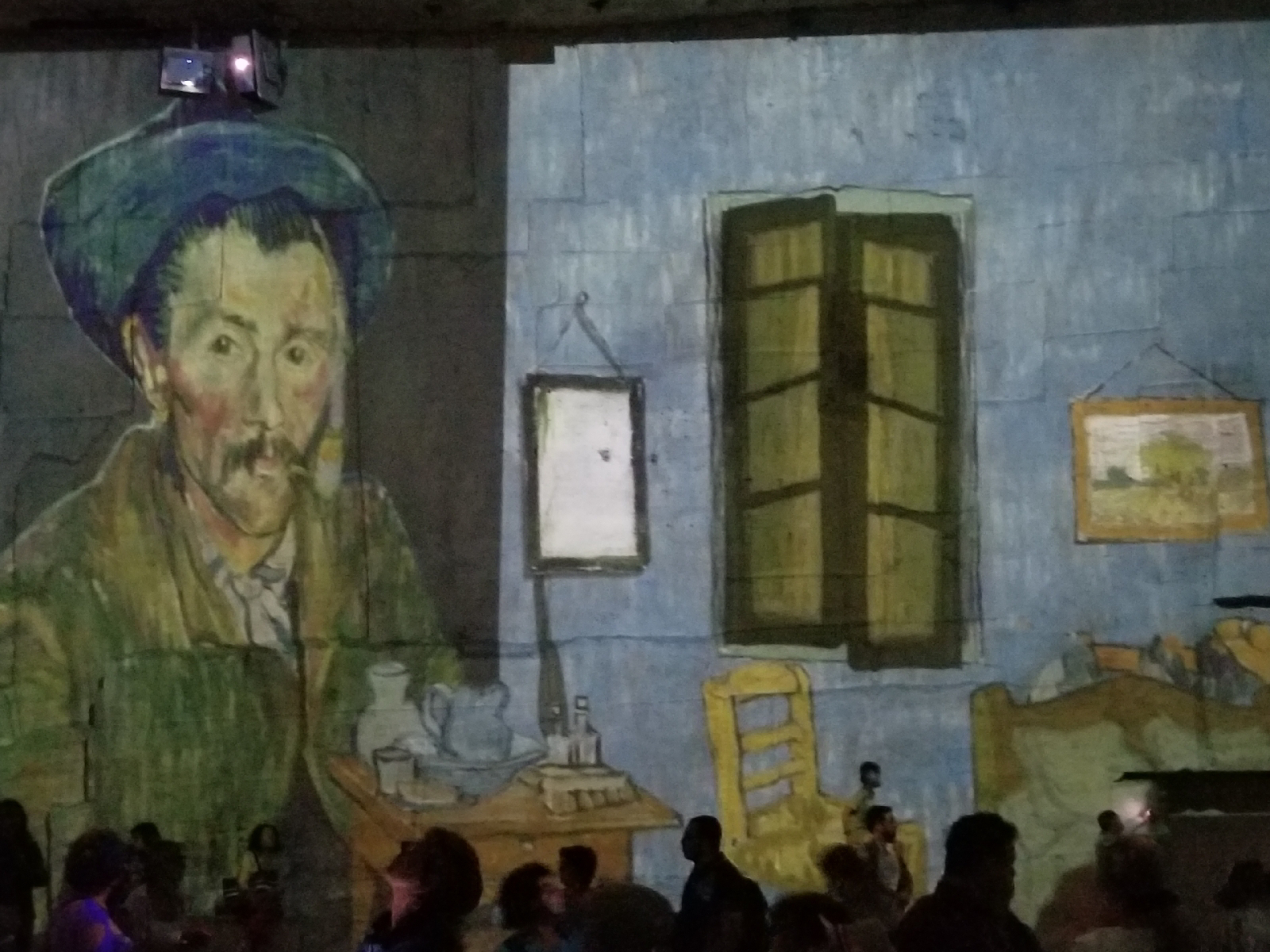
I figure that many of you have seen the immersive Van Gogh Experience in one of the many US cities that have offered this program. But how many of you know that the "Van Gogh Starry Night" art and music program was first exhibited in the Carrières des Lumieres at Les Baux de Provence in the South of France from March 1, 2019, to January 5, 2020?

Les Baux de Provence is a picturesque village about 47 miles southwest of our home in Sablet, France. The village sits in a strategic location on a rocky outcrop with ancient houses and a ruined castle perched on top of the village overlooking vineyards and olive groves to the south.

Les Baux de Provence is officially classified as a Les Plus Beaux Villages de France - one of the most beautiful villages of France. The beauty of the village and the surrounding Alpilles mountains, makes Les Baux de Provence a very popular place for tourists all year long as I told you here.

The name Les Baux refers to its site, a baou is a rocky spur. Aluminum ore bauxite was first discovered near Les Baux in 1821 and named after the village of Les Baux de Provence. Bauxite was extensively mined in the area but by the end of the 20th century, the bauxite had been completely extracted. 

Les Baux de Provence

The Carrières des Lumieres is located 800 meters from Les Baux de Provence, a 10-minute walk from the village so you can get there easily if you are parked near the village. There is limited parking near the village or the Carrières des Lumieres, so you may have to walk a little.

Arrival at Les Baux de Provence

The quarry of Les Grands Fonds, now known as the Carrières des Lumieres, was opened in 1800. The area's white limestone was easily worked and was used to build Glanum, the village of Les Baux de Provence and for the construction of the castle of Les Baux.  

As I mentioned earlier, a red mineral was discovered in 1821 in the limestone quarries. The mineral was used to extract aluminum and named bauxite after the nearby village. In 1935 after the first world war, with the emergence of new building materials such as steel and concrete, the quarry closed. 

In 2012, the village of Les Baux entrusted Culturespaces with management of the quarry. Every year since opening, Les Carrières de Lumieres has offered an immersive digital exhibition devoted to a major artist. In 2019, we had the opportunity to see "Van Gogh, Starry Night" in July and again in October.

Entrance to the Carrières de Lumieres

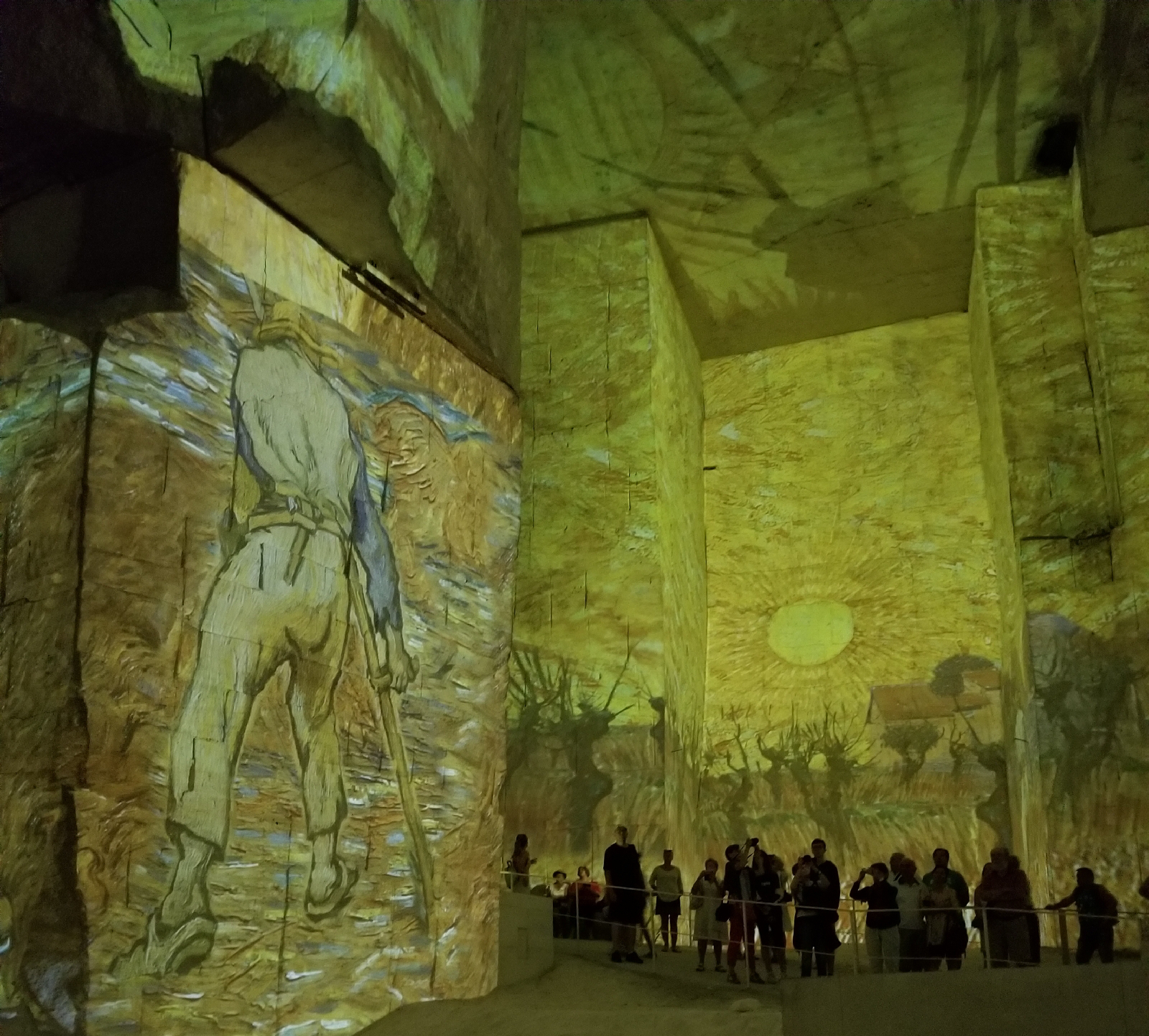
To the right of the entrance, a larger gallery leads you under the mountain, towards an enormous hall divided by huge pillars left by quarry workers to hold up the roof. The 7,000 square meters (75,000 square feet) of walls and ceilings are used as natural screens to project beautiful 14 meter-high (45 feet) images. 


There are no seats per se. Audience members walk around, viewing the changing images from different vantage points as their own shadows are eerily cast on the paintings. Some people sit on a few concrete slabs around the perimeter, some huddle together for warmth. 


The pictures which follow show some of the artwork which was displayed as the program ensued during our visit in July 2019.




In 2023, the Carrières des Lumieres will present two new immersive exhibitions: a long program, "From Vermeer to Van Gogh, the Dutch Masters", and a short program, "Mondrian, the architect of colors".

If you are planning a trip to the South of France, we would be honored if you would consider making our house in Sablet your home for your Sojourn. Please reach out to me for information about availability and rental rates. www.sablethouse.com 

Saturday, July 8, 2017

Vincent van Gogh at Saint-Paul-de-Mausole asylum near Saint-Rémy-de-Provence

Vincent van Gogh was a Dutch Post-Impressionist painter who is among the most famous and influential figures in the history of art. In just over a decade he created about 2,100 artworks, including around 860 oil paintings, many of them in the last two years of his life.

Saint-Paul-de-Mausole seen below, lies just outside of Saint-Rémy-de-Provence, about one hour southwest of Sablet. Mentioned on several occasions by Nostradamus, who was born nearby and knew it as a Franciscan convent, it was originally an Augustinian priory dating from the 12th century, and converted into an asylum in the 19th century.

A well-preserved set of Roman ruins known as les Antiques, the most beautiful of which is le Mausolee, adjoins the property, and forms part of the ancient Graeco-Roman city of Glanum. The asylum is located in an area of cornfields, vineyards and olive trees.

Saint-Paul-de-Mausole asylum

Exterior grounds near the entrance to Saint-Paul-de-Mausole asylum

Vincent Van Gogh arrived on May 8, 1889 at Saint-Paul-de-Mausole in Saint-Rémy-de-Provence after an incident in which he cut off his ear, to voluntarily commit himself to the asylum and remained there for just over a year until May 16, 1890.

He had suffered a series of severe breakdowns since December 1888 and believed he should be institutionalized for his own sake and that of others.

Statue of Vincent van Gogh by sculptor Gabriël Sterk near entrance to Saint-Paul-de-Mausole asylum

Cloister Corridor with arcades of twinned columns

The main building at Saint-Paul-de-Mausole is centered around its lovely Romanesque cloisters (pictured below) lined with rambling roses and lavishly planted with begonias and other flowers. Part of the Saint-Paul complex remains a psychiatric institution and still accepts patients (female only).

Cloister garden

Stairway lined with paintings to Van Gogh's room on upper floor

Corridor leading to Van Gogh's room

Vincent van Gogh's bedroom (pictured below) was sparsely furnished with an austere single bed, easel, wooden chair, desk, battered leather bag and a barred window looking out on to a kitchen garden and wheat fields which he painted 15 times.

Vincent van Gogh's bedroom at Saint-Paul-de-Mausole asylum

Vincent van Gogh's studio which adjoined his bedroom

Vincent van Gogh's treatment at Saint-Paul-de-Mausole was rudimentary – limited to two-hourly baths twice a week, a frugal diet and managing to stop his intake of alcohol, coffee and self-harming consumption of turpentine and paint.

Tubroom at Saint-Paul-de-Mausole asylum

Bedroom in Arles (seen below) is the title given to each of three similar paintings by Vincent van Gogh. Van Gogh's own title for this painting was simply The Bedroom. There are three authentic versions described in his letters, easily discernible from one another by the pictures on the wall to the right.

The painting depicts Van Gogh's bedroom at 2, Place Lamartine in Arles, known as the Yellow House. The door to the right opened on to the upper floor and the staircase; the door to the left was that of the guest room he held prepared for a friend; the window in the front wall looked on to Place Lamartine and its public gardens.

Bedroom in Arles

He was initially confined to the immediate asylum grounds and painted (without the bars) the world he saw from his room. After a few weeks being there, he was granted permission to work outside the asylum and ventured into the countryside to paint. He was productive and sent most of his work to his brother Theo.

As you stroll around the garden seen below, you can view more than 20 large-scale reproductions of Vincent van Gogh’s most famous paintings on the site where they were created.

View from Vincent van Gogh's window

During his time at Saint-Paul-de-Mausole, he finished over 150 drawings and 143 paintings of his surroundings over all four seasons of the year. They include some of his best known works such as Irises, Wheat Field with Cypresses, The Siesta and The Starry Night.

View over lavender field toward Saint-Paul-de-Mausole asylum

Vincent van Gogh seemed for a while to be recovering, but he suffered a relapse in early 1890 and in May 1890, moved north to Auvers sur Oise to be near his brother, Theo, and a new physician, Dr. Paul Gachet. Only two months later, on 29 July 1890, Vincent van Gogh took his own life at the age of 37.

Iris field outside Vincent van Gogh's room at Saint-Paul-de-Mausole asylum

During his lifetime Vincent van Gogh was never famous as a painter and struggled to make a living as an artist. He only sold one painting during his lifetime, "The Red Vineyard". This painting sold in Brussels for 400 Francs a few months before his death (about $1800 in 2011) to the impressionist painter and heiress Anna Boch.

Since his death, he has become one of the most famous painters in the world. Van Gogh’s paintings have captured the minds and hearts of millions of art lovers. Seven of his paintings are among the highest priced sales on record and alone sold for over 730 million current dollars.

Flower carving on wall of Cloister

There are no original works by Vincent van Gogh to be seen at Saint-Paul-de-Mausole. But you will find plenty of reproductions and, as a nice extra to the visit, you can take a self-guided walk from Saint-Paul to Saint-Rémy-de-Provence. The route is peppered with 21 illustrated panels, with short explanations in English and French comparing Vincent van Gogh's visions directly with the real landscapes that inspired him.

Sunday, February 26, 2012

Arles

The last time I went to Arles, it was on the spur of the moment early in the morning after dropping friends off at Marseille Provence Airport. As I got to Arles, the sun was coming up and the streets were empty except for a couple of the town's street cleaners I encountered while walking around.

This fall wife Shirley and I went back to Arles with friends but the experience was totally different. Saturday morning, weekly market day in Arles, was hot and the town was crowded with Arlesians shopping at the market and tourists come to visit the Roman ruins. It took me forever to find a place to park.

Arles sits along the Rhone River about 75 miles southwest of Sablet. It is located just down stream of where the Rhone River splits in two (big and little) forming the Camargue delta. A large part of the Camargue is located in the Arles commune making it the largest commune in France in terms of territory.

The town has a long history and the Roman and Romanesque monuments of Arles are listed as a UNESCO World Heritage Site. Arles is just as famous for its connection to Vincent van Gogh - he completed over 300 of his paintings and drawings during his time in Arles, including many of his most famous. It is also where he chopped off his ear.

On December 23, 1888, feeling frustrated and ill, van Gogh went to a local brothel. While there, he cut off his left ear and wrapped it in newspaper and handed it to a prostitute named Rachel, asking her to "keep this object carefully." He was checked into the Hotel Dieu, the local hospital for treatment of blood loss as well as severe depression.


The Hotel Dieu today is the Espace Van Gogh cultural center that surrounds a central garden recreated based on Van Gogh's painting of this space (Garden of Arles Hospital) and a letter to his sister containing details of the plants grown in the garden.


As I mentioned, it was market day and the big Saturday market for which Arles is well known was crowded with local shoppers and tourists, including ourselves. While walking around, we came across this duo playing music for passersby in hope they might drop coins into their open guitar case.


The Hôtel de la Lauzière was built at the beginning of the 17th century. The façade is proof of the social status of the family that lived within the walls of this home. The door is framed by stone torsos sculpted in the Mannerist style, a movement in art and architecture between the Renaissance and Baroque periods.


The Obélisque d'Arles is a 4th century Roman obelisk in the center of the Place de la République in front of the Hotel de Ville - town hall of Arles. The obelisk is made of red granite and originally located in the Arles circus; it was moved to its present location in the 17th century. The obelisk stands about 65 feet tall.


To the left of the obelisk on the Place de la République is Eglise Sainte-Anne a church built at the beginning of the 17th century.


The Hotel de Ville - town hall on Place de la République in the center of Arles was built in 1676.


The Church of St. Trophime at Place de la République, formerly a cathedral, is a major work of Romanesque architecture and the representation of the Last Judgment on its portal is considered one of the finest examples of Romanesque sculpture as are the columns in the adjacent cloister. The Church was built in the 12th and 15th century.


The streets of Arles are narrow and wind between old medieval buildings.


A pretty café that caught my eye.


Still in business today, but now named Café Van Gogh, this is the bright yellow café that Vincent van Gogh painted in The Café Terrace on the Place du Forum in Arles in September 1888.


A statue in Place du Forum of Frédéric Mistral, a popular poet who wrote in the local dialect rather than French and a champion of Provencal culture.


Wife Shirley with friends Deb and Rick relaxing at a café on Place du Forum. We had a fun time, the food was not very good.


Café tables are set for hungry shoppers. The menu is listed on the blackboard on the left.


Morning glory climbs up the wall of this bright yellow house.


Friends Deb and Rick walk up one of Arle's many narrow streets through a live archway.


As I said, when I was last in Arles, it was early morning and nothing was open yet so I was not able to go inside the Arènes - Roman amphitheater. This time we wandered all around.

The amphitheatre is said to measure 136 m (446 ft) in length and 109 m (358 ft) wide, the 120 arches date back to the 1st century BC. The amphitheatre was capable of seating over 20,000 spectators and was built to provide entertainment in the form of chariot races and bloody hand-to-hand battles. Today, it draws large crowds for bullfighting as well as plays and concerts in summer.

Most of these photographs of the interior of the amphitheater were shot by Shirley. One of the walkways that circle the amphitheater.


Part of the amphitheater.


The entrance to the amphitheater used for the bulls.


A passageway into the amphitheater.


Stairway up to an upper level of the amphitheater.


Some of the 120 arches that circle the amphitheater.


One more passageway through the amphitheater.


There are panoramic views from the top of the amphitheater. The shots which follow are some of the views that caught my eye.


Eglise Notre-Dame-de-la-Major built in 1152 as seen from the amphitheater. The allied bombings in 1944 caused significant damage and major restoration work was required.


A lady enjoying her coffee and newspaper on the rooftop terrace of her Arles home.


The Eglise Notre-Dame-de-la-Major as seen through one of the 120 arches that circle the amphitheater.


A pretty courtyard of a home near the amphitheater.


The Rhone River seen through an amphitheater window.


Not much remains of the Roman theatre which was built at the end of the 1st century BC. The theatre is said to have been able to accommodate 10,000 spectators in 33 rows of seats.


If you are a fan of Roman history or van Gogh art make sure you save time in your schedule to visit Arles. Weekly markets are held in Arles on Wednesday and Saturday so plan accordingly as parking is most difficult on those days.

Bonne journée mes amis et à bientôt.