Showing posts with label Peter Mayle. Show all posts

Saturday, January 25, 2020

Gordes, A "Most Beautiful Villages of France" and location for many scenes in the "A Good Year" Movie

Every time we come to our home in Sablet, in the Provence region of France, we head toward the Luberon mountain to visit one or more of the small hill top villages in that area. Many times, Gordes is one of the villages we visit, especially if we are touring first time visitors around Provence.

Gordes is a beautiful old village about 1 hour southeast of our home in Sablet. The small village (pop. 1773) sits on a rocky outcrop of the Vaucluse Mountains and dominates the plain and Calavon River Valley, offering a view of the Luberon mountain across the way.

Cubist painter André Lhote discovered Gordes in 1938 followed by Marc Chagall, Victor Vasarely and other artists who visited and summered in Gordes. More recently Gordes gained fame as one of the locations for a movie filmed in the region, "A Good Year" starring Russell Crowe.

If you have not seen the movie, it is based on a novel by Peter Mayle and tells the story of Max Skinner (Russell Crowe), who, when he inherits a château and vineyard in Provence from dear Uncle Henry, he just wants to sell it quickly and get back to his life being a successful London securities trader and miserable loner.

Instead, stuff intervenes to keep him hanging around and before he knows it, he's forgotten how to be lonely and falls for beautiful café owner Fanny Chenal played by Marion Cotillard. OK guys, I know its not an Oscar, great movie as film making goes, but I love the setting in the Luberon and I am a sucker for a love story.

Gordes

The original Romanesque church in Gordes was dedicated to Notre Dame. Rebuilt in 1704, it has a colorful interior and was dedicated to its patron Saint Firmin, a former Bishop of Uzès, the bell tower of which can be seen in the photograph below.

Gordes castle and St Firmin church bell tower in background

The fountain in the square by Hôtel Renaissance seen below, is where Max waits for Fanny Chenal, the character played by Marion Cotillard in a memorable scene from the "A Good Year" movie to get off work.

Fountain near Hôtel Renaissance in Center of Gordes

Some streets in the village are paved with stones called calades - small paved, sometimes stepped alleyways lined with gutters defined by two rows of stone as seen in the photograph below.

White stone house and typical Gordes' street with calades.

Hôtel Renaissance was transformed into Fanny Chenal's bistro for the movie, a location seen several times, and where Max famously tells an obnoxious American couple that "MacDonalds is in Avignon, fish and chips in Marseille. Allez".

Hôtel Renaissance in Gordes

In the picture below, Shirley stands on the steps going down from Fanny Chenal's bistro where a wonderful encounter occurs between Max and Fanny in the "A Good Year" movie.

Shirley doing her best imitation of Marion Cotillard

Around the center of the village near the castle, you will find various cafés, restaurants, art galleries and souvenir shops. Every Tuesday morning is market day. Merchants from around the area set up stalls on Place du Château and sell their wares; fresh fruits and vegetables, Provençale pottery and linens, art work and clothing.

Tourist shop in Gordes

The memorial to the children of Gordes who died in wars for France is in the main square and where Russell Crowe's character, Max Skinner circles several times in his little yellow smart car looking for the notaire, a self-employed legal specialist with public authority to draw up real estate contracts for clients, in the "A Good Year" movie.
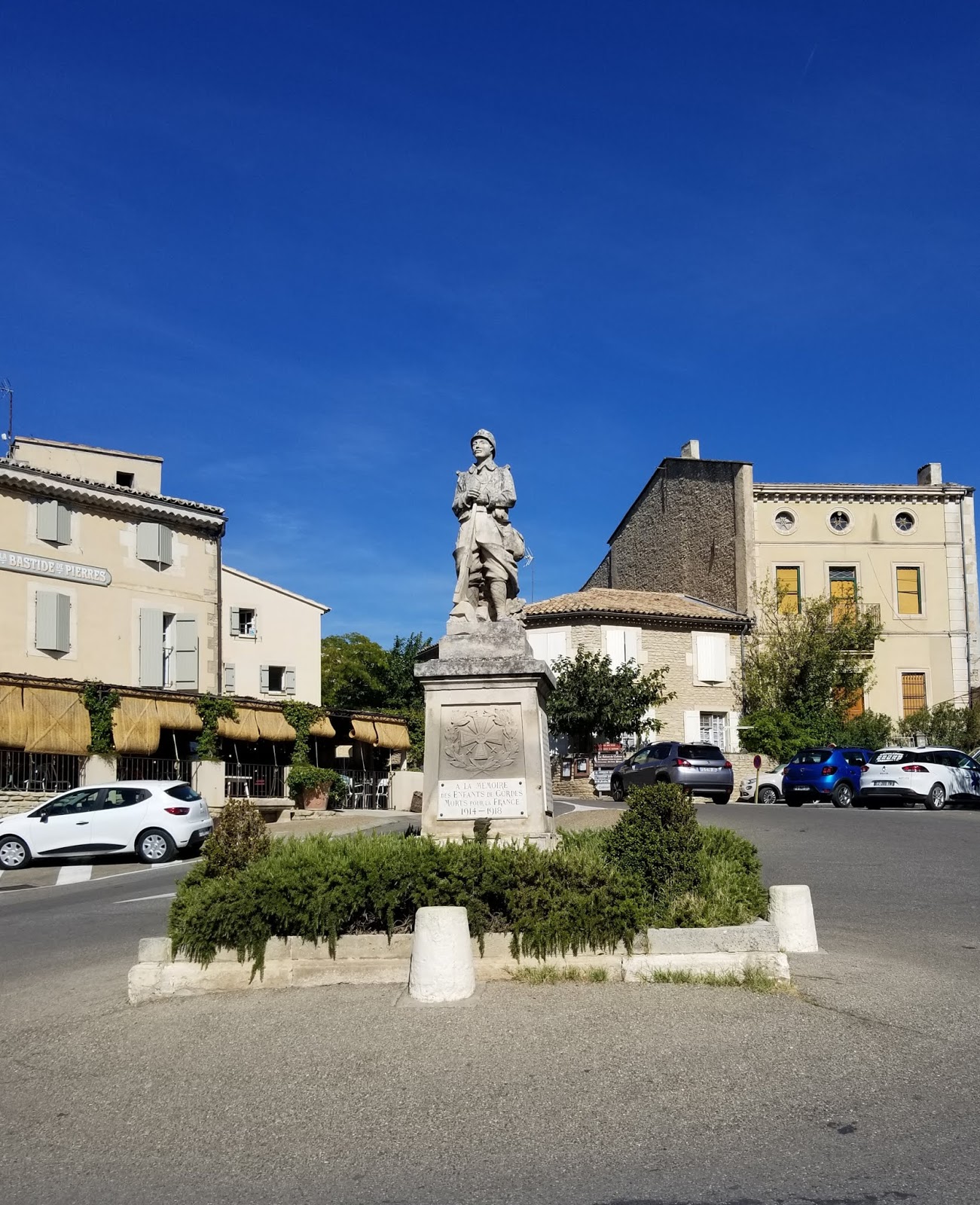
War Memorial in center of Gordes

The Chapelle des Pénitents Blancs, translated into English as the "white penitents chapel" is located near the castle. Dating from the 17th century, the chapel is an art gallery today.

White Penitents Chapel

At the top of Gordes and in the center of the village sits the castle which dominates the village. Built in 1031, reinforced in 1123, the castle was rebuilt in 1525. Today the castle is home to the Pol Mara museum, a contemporary Flemish painter who lived in Gordes, and the Gordes tourist information office. In summer there are concerts and plays in the castle's courtyard.

Gordes castle

Another view of Gordes from the Luberon Valley can be seen in the photograph below. The strategic defensive possibilities of Gordes' location are clearly evident. The village was never taken even during the brutal Wars of Religion.

During World War II, Gordes was an active resistance village and was later awarded a medal, the Croix de Guerre 1939 - 1945. On the 21st of August 1944, just 6 days after the start of Operation Dragoon, the Allied invasion of Southern France, a German patrol was attacked by members of the Gordes resistance and the day after, the village was subjected to violent reprisals and much of Gordes was destroyed.

Gordes

It is definitely worthwhile to visit Gordes. If you are lucky enough to be in Provence between late June through the middle of July, make sure you take time to visit nearby Sénanque Abbey.

It is a beautiful Cistercian abbey located in a deep valley a short distance north of Gordes and well worth a visit anytime you are in the area.

You can drive to the Abbey from Gordes on the narrow D177 road or if you are in the mood for a hike, you can walk there on the GR6 hiking trail. Don't forget, you will have a hike back up.

Along the way, you will come upon an "aerial" view of the Abbey down in the deep Senancole valley where Sénanque Abbey is located.

"Aerial" view of Sénanque Abbey

The Sénanque Abbey is an active community with a handful of elderly monks that I told you about here. The monks grow the lavender and tend to honey bees to earn income for living and upkeep of the Abbey. The Sénanque Abbey along with two other early Cistercian abbeys in Provence, Silvacane Abbey and Le Thoronet Abbey, are sometimes referred to as the "Three Sisters of Provence"

Sénanque Abbey

If you have comments or questions about Gordes, Sénanque Abbey, or elsewhere in Provence, please leave your comments below or send me an email at my address below.

If you are thinking about a trip to the South of France including spending time in Provence, we invite you to visit our website. Our house is available for rent by the week or more. You can reach us for further information by sending an email to chcmichel@aol.com.

Sunday, September 6, 2015

Vaugines, a Marcel Pagnol village and home to Peter Mayle

From Cucuron, Annick drove us a short distance west down a road through olive grove fields, vineyards, and oak forests to nearby Vaugines, a very old and isolated village situated at 1300 feet elevation on the southern side of the Luberon.

Vaugines

Vaugines is the setting for the famous French films "Jean de Florette" and "Manon des Sources", adapted from books written by Provencal author Marcel Pagnol. The film stars three of France's most prominent actors – Gérard Depardieu, Daniel Auteuil, and Yves Montand in one of his last roles before his death.

The film takes place in rural Provence, where two local farmers scheme to trick a newcomer out of his newly inherited property. The film was shot, together with Manon des Sources, over a period of seven months. At the time the most expensive French film ever made, it was a great commercial and critical success.

Entrance to Vaugines

The church on the edge of Vaugines (below), was originally dedicated to Saint-Sauveur. It was built in the 11th century. From 1350 to 1450, France was hit by the plague, wars and famine and an almost 50% decrease in the French population. As a result, Vaugines and its church were abandoned.

Saint Barthelemy Church

It wasn't until 1470 that the village and the church were restored which then became Saint-Barthélemy. Beginning in 1630 and over the next 100 years, 5 successive side chapels were added giving the church its current structure.

Saint Barthelemy Church

Vaugines is also the village where the author Peter Mayle and his wife live after moving from Lourmarin a couple of years ago.

Canal outside Vaugines

Vaugines house and street

An old wall in Vaugines

The chapel/library below in Capello Place was built in 1873. In 1988, it was renovated and converted into a library.

Chapelle/Bibliothèque (chapel/library)

We came across several sundials in the village, including a triple sundial, for summer, winter and sun time. The triple is on the chapel/library building at Place Capello high in the village.

Triple Sundial

Stone step street and covered passageway

Pretty Vaugines house

Vaugines house

The ancient fountain in the main square of Vaugines

The Mairie with the clock and bell in the iron campanile seen below was built between 1845 and 1846.

Mairie (town hall)

The magnificent old house seen below known as La Commanderie was built in the 17th century by the descendants of Georges de Bouliers.

La Commanderie

Vaugines house and street

Vaugines house

Cherry Orchard

Saint Barthelemy Church

Cemetery next to old village church

Olive tree grove near old village church

As I have been writing this post, I have been watching the movie Jean de Fleurette...again. If you have not seen this charming and exceedingly well made movie, I recommend it to you. If you are in the Southern Luberon, I recommend you visit Vaugines. You might see some sights you recognize from the movie and you might even see Peter Mayle.

Have a great week. We are on the countdown till we leave for our fall sojourn to Sablet with our friends Steve and Mary. Can't wait. A bientot.

Saturday, October 25, 2014

Ménerbes, Peter Mayle's First Village in Provence

I fell in love with France, or at least a tiny part of it, during childhood trips to the Metairie Neuve, the family farm located near Viane Pierre-Segade, a small hamlet about 15 km from Lacaune in the southeast department of Tarn in the Midi-Pyrenees region of France.

It wasn't until quite a few years later that I discovered and began a love affair with Provence and began to dream about owning a home there through the pages of Peter Mayle's charming book, "A Year In Provence" and his other books that followed.

If you don't know, "A Year in Provence," describes Provence, its culture and the people Mayle, a retired advertising executive, meets after he and his wife leave London, buy a stone farmhouse in a Luberon village, fix it up, and adopt the region as their new home.

The village where Mayle and his wife settled was Ménerbes, a small walled village perched on the top of a long ridge of the north face of the Luberon. Ménerbes is classified as one of the Plus Beaux Villages of France.

One day last spring, wife Shirley and friend Kari and I drove from Sablet to Ménerbes to visit Peter Mayle's village (I should mention that the Mayle's don't live there anymore). Here are a few pictures from our visit to Ménerbes that day.

Ménerbes

The city of Ménerbes and its citadel were the site of a major battle between Huguenots and Catholics, called the Siege de Ménerbes, which lasted from 1573 to 1578 during the French Wars of Religion. The Protestants finally agreed to negotiations, apparently because of a lack of drinking water, surrendering on December 9, 1578 to a "glorious capitulation."

Ménerbes

Narrow streets wind up and down between lovely old buildings.

Ménerbes Street

Pretty Ménerbes House

Ménerbes House

Saint-Blaise Chapel was built in 1734 by the Brotherhood of Pénitents Blanc. During the Revolution, it served as a gathering place for the Republicans and its façade was very damaged. Today, it serves as a place of worship during the winter.

Saint-Blaise Chapel

Ménerbes village street, looking southeast

Ménerbes Iron Cross and Fountain

At Place de l'Horloge at the top of Ménerbes is the Maison de la Truffe et du Vin (House of Truffles and Wine) in a beautifully restored, grand village house. There you can find out all about the truffles and wines of the region, as well as take wine appreciation courses in the summer.

Maison de la Truffe et du Vin (House of truffles and wine)

Monument honoring the bicentennial of the French Revolution in 1789

Ménerbes Town Hall

The clock tower and wrought-iron campanile at Place de l'Horloge were built in the 15th century. Through the arch, there is a magnificent view out across the plains with several villages visible.


Ménerbes town hall with its wrought-iron "campanile"

Ménerbes Town Hall

Saint-Luc Church was built in the 16th century on the foundation of Saint-Sauveur Church. It is currently undergoing renovation.

Saint-Luc Church

Iron Cross

Gated Entrance to Ménerbes Home

Looking back towards Clock Tower at Place de l'Horloge in Ménerbes

Ménerbes' ancient fortified wall and round tower

If you go to Ménerbes, you might want to stop by the Musée du Tire-Bouchon (Cork Screw Museum) at La Citadelle winery about 1 km outside Ménerbes on the road to Cavaillon. The museum displays 1000 cork screws from the 17th century to today.

I think the Mayles were attracted to Ménerbes more for the house and the surrounding area rather than the village itself. While Ménerbes and the surrounding area are very pretty, there is not much life in the village as far as we could see.

Have a great week. Chat soon.