Tuesday, July 15, 2014

Sunday Lunch in Le Beaucet

We do everything we can to help guests enjoy themselves at our home in Sablet. In addition to information about the house and advice about where to find the best bread, fish, and cheese, the best outdoor markets, and lots of other information, I also give them a list of recommended restaurants.

Initially, we assembled the list of restaurants from what we believed to be trustworthy sources. Over time, that list has evolved into a list of mostly favorite restaurants in the region. I say mostly, because we had not dined at one or two of the restaurants on the list despite several efforts to check them out.

That is until we had to choose where to eat one Sunday and discovered that one of the restaurants that we had not tried serves lunch on Sunday. So off we went to Le Beaucet to dine at Auberge du Beaucet. Le Beaucet is a small village set in the Vaucluse hills topped by the ruins of a stone castle.

Le Beaucet

We found parking near the monument honoring Saint Gens. He was born in Monteux, near Carpentras, in 1104. He was a hermit, lived in renouncement, praying, working and doing penitence. He is called upon for rain during droughts. He died on May 16, 1127 in Le Beaucet. Many miracles are attributed to his intervention, and his veneration is approved by the Catholic Church.

Monument to Saint Gens in Le Beaucet

A street runs north and south through Le Beaucet and ends at the two 14th century stone gates through the original ramparts that once defended Le Beaucet. The road on the north end of the village seen below is called "Coste Froide," because it is literally the "froid" (cold) side of the village where the Mistral hits Le Beaucet.

Le Beaucet North Gate

The steep narrow streets pass houses and ancient stone walls that merge into the cliffs and rocks behind, and enhance the appeal of the village - some troglodyte dwellings are even built into the rocks themselves. The center of the village is restricted for pedestrians only.

Looking Down the Street out the North Gate of Le Beaucet

Le Beaucet Window

We walked below the 12th century L'église de l'Assomption with clock tower and a typical Provencal campanile.

L'église de l'Assomption

Le Beaucet Door

The water for the village lavoir and fountain comes from a spring up above the village in Barnouin Valley. The water from this spring was divided between Le Beaucet and Venasque. The lavoir was rebuilt in 1896 and has a tub for washing and one for rinsing with a roof to protect the women from the sun, rain and wind. The mural was added in 1998.

Le Beaucet Lavoir

The hexagonal fountain at Castel Loup Place was built in the 19th century. Castel Loup Place is outside the southern arched gate of the village at the end of "Coste Chaude," literally meaning this is the warm, sunny side of the village.

Fountain at Castel Loup Place

Le Beaucet House Built into Rocks

Le Beaucet

Le Beaucet Stone House

Cross of the Spirit in Le Beaucet

The ruins of a castle built in the 11th and 12th centuries for the Count of Toulouse stands on a rock above Le Beaucet, that you can reach by climbing a steep flight of stairs in the rock. From the castle, there are wonderful views across the Vaucluse countryside.

Le Beaucet Castle Ruins

Le Beaucet

Throughout Provence, there are many examples of dry stone construction including homes and streets including the one seen below in Le Beaucet. The term “dry stone” refers to a practice of assembling stones without using a cement or other binder, simply a clever stacking and fitting of undressed stones.

Dry Stone Walkway in Le Beaucet

Le Beaucet Window

The striking Assomption Church in the village was built in the 12th century.

L'église de l'Assomption

Statue of Virgin Mary and Baby over Door to L'église de l'Assomption

We found our restaurant at the southern end of the village down a few steps below the main street. Auberge du Beaucet is owned by Amélie L'hôte who oversees the front of the restaurant and Clément Bazin who is chef. The young couple have owned the restaurant since 2011.

Auberge du Beaucet

We were shown into a dining room with wood beams across the ceiling, a stone tile floor and an ancient fire place. We chatted about the menu and made our selections and then turned our attention to the wine list. I was very happy to find one of our favorite rosé wines on the list from Domaine de Valdition. We were off to a good start.

Auberge du Beaucet Dining Room

Wife Shirley

Friend Kari

Our meal began with an amuse bouche from the chef. Unfortunately, I can't find my notes so I can't tell you exactly what were the ingredients in our various dishes.

Amuse Bouche

Ravioli

Fish of the Day

Beef

Cheese Plate

Mignardises

I was happy to confirm that Auberge du Beaucet deserved a spot on our list of recommended restaurants. I hope our guests will make their way to try it out, we will certainly return again in the near future.

Le Beaucet Town Hall

We exited Le Beaucet through the southern arched gate at the end of "Coste Chaude," meaning "chaude" (warm), sunny side of the village.

Castel Loup Place and the Southern Arched Gate into the Village

Auberge du Beaucet
Rue Coste Chaude
84210 Le Beaucet
Tel: 04 90 66 10 82
www.aubergedubeaucet.com

Have a great week. Chat soon!

Tuesday, July 1, 2014

Le Barroux, a Village with an Impressive Château

After a delicious lunch at Le Tourne au Verre in Cairanne that I told you about here, we headed for Le Barroux. I had recently been told that my grandfather owned a home in Le Barroux and I was on a mission to find the house.

It was exciting to think that grandfather had owned a house so close to our village and that surely my father must have come to that house. I had no idea how I was going to find the house since I didn't have an address or know anything further than he had a house there.

A friend's father told me about going to his parent's village in Sicily and not knowing anybody or where they lived, he walked into the village and loudly called out his family name and several relatives materialized from houses. I wondered if that might work for me but opted to just walk around.

Le Barroux is a small village (population 656) in the Vaucluse, southeast of Sablet, perched on a rocky outcrop on the other side of the Dentelles de Montmirail from Sablet. Le Barroux is known for its château perched like an eagle's nest right at the top of the village.

Le Barroux Château

The château was built in the 12th century as a defense against Saracen and Italian incursions, and went through major overhauls in the 16th and 17th centuries. The château was damaged during the French Revolution, repaired in 1929 using private funds, set on fire by German occupation troops in 1944 as reprisal for acts of resistance, and restored again after 1960.

Le Barroux Defensive Wall

Shirley and Kari explore Le Barroux

The Hôtel Dieu, the original hospital of Le Barroux was built in the 16th century. It is now privately owned.

Le Barroux Hôtel Dieu (hospital)

During the off-season, like when we were there, the village seems a bit sleepy, as if it's more of a place to vacation than to live. It's very pretty and not spoiled by shops selling trinkets for tourists. The narrow streets wind between lovely old buildings, with many little squares with fountains hidden away for discovery.

Le Barroux street


Sign marking the entrance to the old olive oil mill built in 1792

Inside the old olive oil mill


Le Barroux Town Hall

Le Barroux Château


Construction for the Roman style Saint-Jean-Baptiste Church began in the 14th century. The iron campanile was added in the 16th century.

Saint-Jean-Baptiste Church Belfry and Iron Campanile


Saint-Jean-Baptiste Church


Outside the village is the Benedictine Abbey named Sainte Madeleine du Barroux, founded in 1978 by a French Roman Catholic abbot named Dom Gérard Calvet. If you are interested, the monks of Sainte Madeleine du Barroux stream their chanted Office each day. You can get more details on their website.

Sainte Madeleine du Barroux Abbey

Besides the beauty of the abbey and site, this abbey is also a worthwhile stopping point for foodies. Much of the produce sold in its shop is generated by the monks who live and farm here; the logo MO-NAS-TIC indicates which items are theirs. With 900 olive trees and a mill developed in 2000, the abbey has become famous for its olive oil.

Nearby, is L'Aube Safran, which produces the most fragrant saffron as I told you here.

The Interior of Sainte Madeleine du Barroux Abbey

Well after wandering around the Le Barroux, I didn't find anyone or anyplace that would give me any leads for finding my grandfather's house. I did find out that Charles, Prince of Wales spent a week in Le Barroux back in November of 1990, convalescing after an operation.

With my father gone, and most of his cousins gone or fading memories or knowledge, I am not hopeful that I will ever discover it. But it's fun to wander around and imagine my father exploring the village years ago.

Have a great day. Chat soon.

Friday, June 6, 2014

D Day, Omaha Beach, Normandy France

Seventy years ago today, at 0630, allied infantry and armored divisions from America, Britain and Canada under the command of General Dwight D. Eisenhower landed in France along a stretch of Normandy coast divided into five sectors: Utah, Omaha, Gold, Juno and Sword Beach in the largest seaborne invasion in history. The operation began the invasion of German-occupied western Europe, leading to the restoration of France and Allied victory in World War II.

Omaha Beach, Normandy France

Hitler had placed German Field Marshal Erwin Rommel in command of German forces and of developing fortifications along the Atlantic Wall in anticipation of an Allied invasion. Rommel believed that the Normandy coast could be a possible landing point for the invasion, so he ordered the construction of extensive defensive works along that shore.

In addition to concrete gun emplacements at strategic points along the coast, he ordered wooden stakes, metal tripods, mines, and large anti-tank obstacles to be placed on the beach to delay the approach of landing craft and impede the movement of tanks. Tangles of barbed wire, booby traps, and the removal of ground cover along the shore made the approach hazardous for infantry.[

Omaha Beach, Normandy France

Allied troops landed under heavy fire from gun emplacements overlooking the beaches. Omaha Beach was assigned to the American 1st Infantry Division and 29th Infantry Division. Casualties were heaviest at Omaha Beach, the most heavily defended beach, with its high cliffs.

The Normandy landings were the largest seaborne invasion in history, with nearly 5,000 landing and assault craft, 289 escort vessels, and 277 minesweepers participating. Nearly 160,000 troops crossed the English Channel on D-Day, with 875,000 men disembarking by the end of June.

Omaha Beach, Normandy France

Allied casualties on the first day were at least 12,000, with 4,414 confirmed dead. The Germans lost 1,000 men. The Normandy American Cemetery and Memorial is a World War II cemetery and memorial in Colleville-sur-Mer, that honors American troops who died in Europe during World War II.

Normandy American Cemetery and Memorial in Colleville-sur-Mer

Like all other overseas American cemeteries in France, France has granted the United States a special, perpetual concession to the land occupied by the cemetery, free of any charge or any tax. This cemetery is managed by the American government, under Congressional acts that provide yearly financial support for maintaining them, with mostly military and civil personnel employed abroad. The U.S. flag flies over these granted soils.

Normandy American Cemetery and Memorial in Colleville-sur-Mer

The names of 1,557 Americans who lost their lives in the Normandy campaign but could not be located and/or identified are inscribed on the walls of a semicircular garden on the east side of the memorial. This part consists of a semicircular colonnade with a loggia at each end containing maps and narratives of the military operations. At the center is a 22-foot bronze statue entitled The Spirit of American Youth Rising from the Waves.

Facing west at the memorial, one sees in the foreground the reflecting pool, the mall with burial areas to either side and the circular chapel beyond. Behind the chapel are allegorical figures representing the United States and France. An orientation table overlooks the beach and depicts the landings at Normandy.

Normandy American Cemetery and Memorial in Colleville-sur-Mer

The cemetery in Colleville-sur-Mer is located on a bluff overlooking Omaha Beach and the English Channel. It covers 172 acres, and contains the remains of 9,387 American military dead, most of whom were killed during the invasion of Normandy and ensuing military operations in World War II. Included are graves of Army Air Corps crews shot down over France as early as 1942.

Normandy American Cemetery and Memorial in Colleville-sur-Mer

I visited the Normandy American Cemetery and Memorial in Colleville-sur-Mer with daughter Tricia and son-in-law Alvin on a day weather wise not unlike the day the Allied forces landed on the Normandy coast. Seeing the rows of 9,387 white tombstones, Jewish-American soldiers bear the Star of David at their grave site, rather than a cross, was one of the most moving moments of my life.

Standing there quietly and thinking about the thousands of lives that were sacrificed, was a truly humbling experience. If you are ever in the area, we made it a day trip, albeit a long one from Paris so we could see the battlefields and visit the hallowed grounds of the cemetery.

In addition to the Normandy American Cemetery and Memorial, there is a memorial to the American National Guard at the location of a former German strongpoint. Pointe du Hoc is little changed from 1944, with the terrain covered with bomb craters and most of the concrete bunkers still in place. A museum about the Utah landings is located at Sainte-Marie-du-Mont, and there is one dedicated to the activities of the American airmen at Sainte-Mère-Église. Two German military cemeteries are located nearby.

Saturday, May 10, 2014

Le Tourne au Verre Restaurant, Cairanne

We arrived in Sablet as winter's cold and rain gave way to clear skies and warm weather heralding the arrival of spring in Provence. Every time a local would say how lucky we were with the weather, I would say "we brought the weather from California."

I usually arrive with a list of villages to visit, restaurants to try, and wines to taste, this time was no exception. Le Barroux, a small village on a hilltop east of Sablet where I had learned my grandfather owned a house topped the list. We have been to the saffron farm near Le Barroux but never visited the village. This was our plan for the first Monday. But first there was déjeuner (lunch) to attend to.

View toward Cairanne over the vineyards

Cairanne is a small village in the middle of the Côtes du Rhône about 8 kms northwest of Sablet. The newer part of Cairanne which includes a few shops, the Town Hall, and school sits below the old village up on the top of the hill. Cairanne was a fortified village of the Knights Hospitallers in Medieval times.

The restaurant Le Tourne au Verre is also in the center of new Cairanne on Route de Sainte Cécile which is where we headed for lunch.

Fountain in the center of Cairanne

Le Tourne au Verre is a restaurant wine bar with a terrace for outdoor dining and a large bar where lunch is served and an adjoining dining room for dinner. We have eaten here on several previous occasions but it was several years back.

Le Tourne au Verre Restaurant

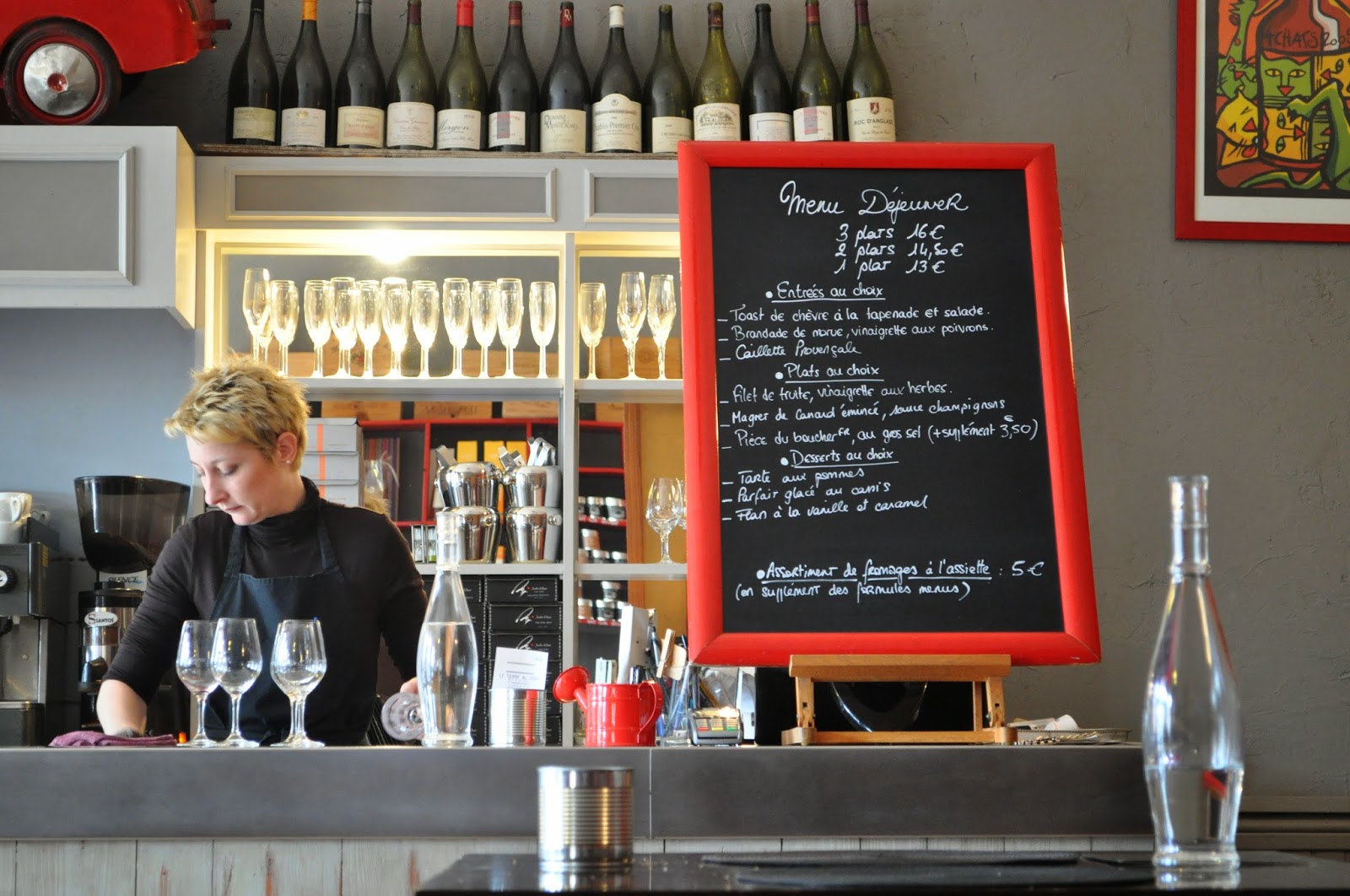
Upon entering, I noted the bar area seemed brighter and prettier than I recalled. We were seated at a small table by a pretty woman, with short blond hair. The menu changes daily and is presented on a blackboard. There are three choices for starters, main course and dessert. We chose the three course option for 16€, about 22 USD. At dinner, the three course option is 28€.

Daily blackboard menu at Le Tourne au Verre Restaurant

Dining room at Le Tourne au Verre Restaurant

The starters we chose included salt cod with salad greens and pepper vinaigrette; and

Salt cod with salad greens and pepper vinaigrette

green salad with goat cheese and tapenade on toast.

Green salad with goat cheese and tapenade on toast

For our main courses, we chose fillet of trout over rice with herb vinaigrette; and

Fillet of trout over rice with herb vinaigrette

and grilled duck breast over mashed potatoes with mushroom sauce.

Grilled duck breast over mashed potatoes with mushroom sauce

For dessert, we selected the cassis parfait; and

Cassis parfait

and apple tart.

Apple tart

Our friend Kari decided she wanted cheese which came with an assortment of greens instead of dessert.

Assortment of local cheeses with greens

All of the food was delicious, excellent ingredients, cooked perfectly, so good we returned twice, once for lunch and then for dinner, during our sojourn in Sablet. The price was a bargain and especially for ingredients and cooking this good.

The blond server was super friendly and gave Shirley and Kari samples of the locally made soaps and hand lotion they sold there. As we were leaving the restaurant after dinner our last night, I told her we were leaving the next day but we would be back in the fall.

She responded sweetly that they would not be at Le Tourne au Verre Restaurant when we came back as they had sold the restaurant and would be leaving at the end of March. She said she didn't know what they would be doing after that besides taking time off.

I hope the new owners have maintained the quality of cooking and prices but won't know till we return in the fall. If any of you who read Our House in Provence blog have eaten at Le Tourne au Verre since ownership changed, please let me know. I would love to know.

I had a problem with my computer plus I have been super busy so I have not been blogging. Hopefully, I can catch up soon. Have a great week. Chat soon.

Le Tourne au Verre
Route Sainte Cécile
84290 Cairanne
Tel: 04 90 30 72 18
www.letourneauverre.com