Monday, September 5, 2016

Vaison-la-Romaine, a Tale of Two Towns

You are probably not aware but this past July, we had the pleasure of a visit from daughter Tricia, her husband Alvin and two of our wonderful grandchildren; Avery and Caedon. We have talked and planned for this visit for a long time. We knew that we had to plan things to keep the little ones entertained. We had a visit to the castle in upper Vaison-la-Romaine on our list because we knew they would burn lots of energy getting there and they would enjoy seeing an old castle.

We go often to Vaison-la-Romaine, sometimes it seems almost every day. We go for Tuesday morning market, buy basic household supplies at Intermarché, pick up cheese at Lou Canesteou owned by Meilleur Ouvrier de France Josiane Deal, visit friends, or simply pass through on the way to Nyons and other destinations in the Drôme Provençale.

As we near Vaison-la-Romaine, we see the castle of the Counts of Toulouse sitting on a cliff above the town inviting passersbys to come and visit. Although we see the Castle all the time from the car, we have only walked through the upper town to see the Castle two times.

Belfry tower with its 18th century wrought-iron bell cage

Vaison-la-Romaine is a short (6 mile) drive from Sablet along a winding road and then across the Pont Neuf (new bridge) over the Ouvèze River; farther up the river, there is a bridge which dates from Roman times. Vaison la Romaine is divided into two parts by the Ouvèze River; on the right bank is the ancient Roman colony and modern town and on the left bank on top of a rocky spur is the old medieval town.

Medieval upper town

One day after market, with our family in tow, we decided to visit the old upper town and walk up to the castle. The entry street is lined with a few tourist shops and cafes. As you continue on up into the heart of the old town, the shops disappear and there's a sense of quiet, and of entering into the Medieval past.

Street performer in Medieval upper town

The entrance into the upper, heart of the Medieval town is through a deep, fortified gateway through the base of the belfry tower seen below. The lower part of this tower was built in the 14th century. The upper part and the ornate wrought-iron campanile were added in the 18th century.

14th century belfry tower with the 18th century wrought-iron campanile

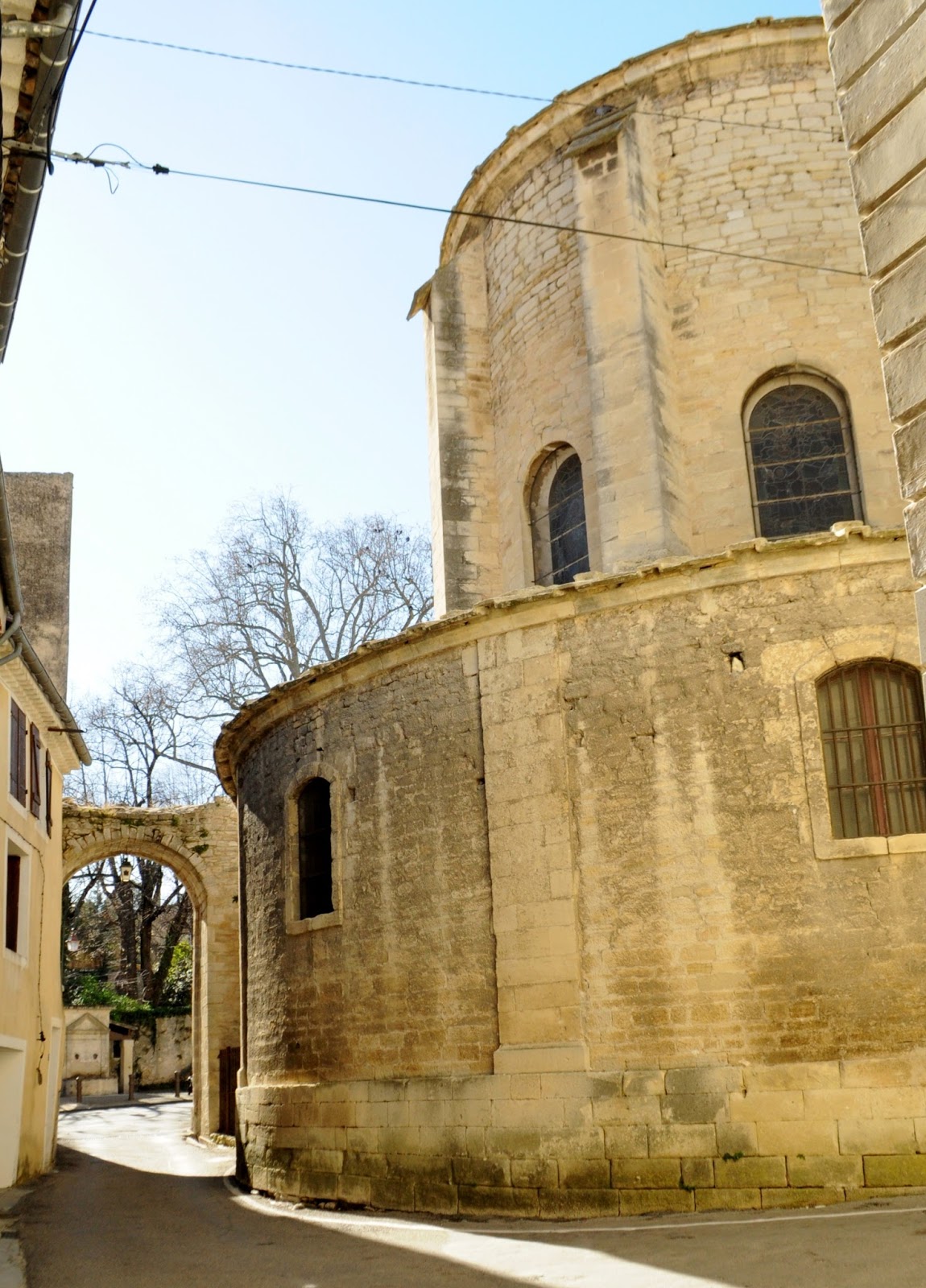
Cathédrale Sainte-Marie-de-l'Assomption de Vaison-la-Romaine

The Cathédrale Sainte-Marie-de-l'Assomption de Vaison-la-Romaine, also known as the Cathedral of the Upper Town sits on the site of a church built in the 12th century. A new church was started in 1464 and was modified over the years up into the 18th century.

Cathédrale Sainte-Marie-de-l'Assomption de Vaison-la-Romaine

Daughter Tricia pauses near an Iron Cross

Daughter Tricia hung back with me as I made my way through the village taking pictures along the way.

A tiny door in the upper Medieval town of Vaison-la-Romaine

Daughter Tricia sits on a pretty fountain in the Medieval upper town of Vaison-la-Romaine

Stone archway in garden in upper town of Vaison-la-Romaine

Stone archway over walkway through upper town

Around 1180, the men of the Count of Toulouse built a wooden tower strengthened by palissages (trellises) on the top of this hill to impose the image of the Count’s power on the citizenry. This was pulled down by order of Bishop Bérenger de Reilhane and replaced in 1195 by Raymond V, Count of Toulouse and Marquis of Provence. Later, two buildings were added. The castle has been modified along the centuries.

Castle of the Counts of Toulouse in Vaison-la-Romaine

View from the back side of the castle

The view from near the castle over the lower Roman town is worth all the energy you expended to get up there; trust me!

Lower Roman and modern town of Vaison-la-Romaine

Lower Roman and modern town of Vaison-la-Romaine

Castle of the Counts of Toulouse in Vaison-la-Romaine

Shirley stands by vaulted arch over path up to castle

Pretty house in upper town of Vaison-la-Romaine

Vaison-la-Romaine upper town

Stone flower planters in Vaison-la-Romaine upper town

Stone house in Vaison-la-Romaine upper town

Vaison-la-Romaine upper town gift shop

Me taking a momentary pause on one of the upper town fountains

In the 18th century, most of the fountains were erected. They are composed of a central column from which water springs, their top is rounded and decorated with a sculptured pine cone.

Stone laundry basin in Medieval Vaison-la-Romaine

Vaison-la-Romaine upper town

Random flower in Vaison-la-Romaine upper town

Fountain in old town

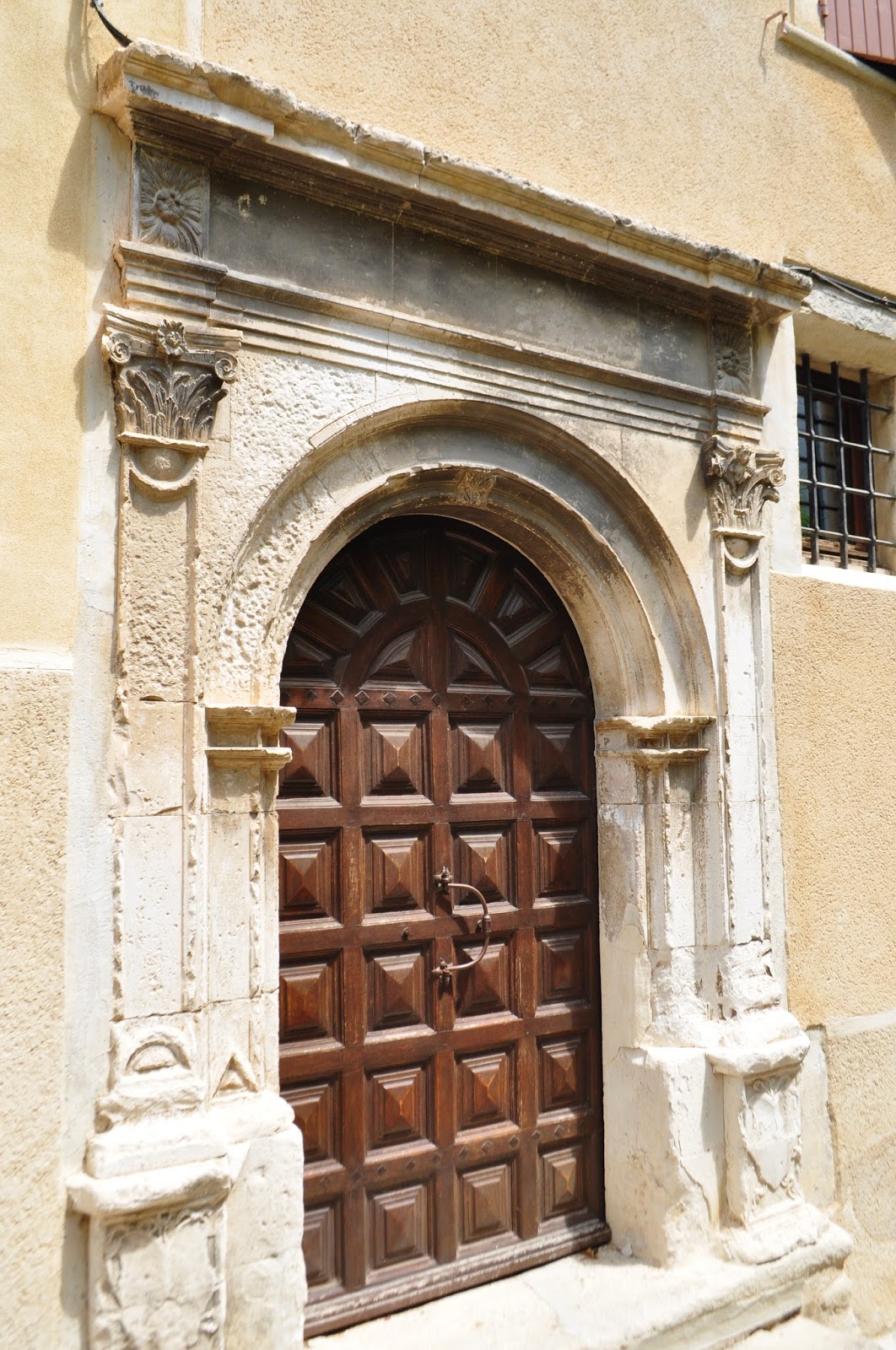
Grand old door in Vaison-la-Romaine

The bridge in the picture below was built by the Romans in the 1st century AD, with a single arch spanning 56 feet. It was built of large course masonry, resting directly upon the rock. It is a classified historic monument and links the lower town center and the upper medieval old town. Until a footbridge was built in 1858, the Roman bridge was the only link between the two sides of the river.

Vaison-La-Romain had a disastrous flood in 1992 which swept away the new bridge and several houses and killed more than 30 people. Amazingly the Roman Bridge withstood the flood and is still in use today

Roman bridge in Vaison-la-Romaine

Happy to be able to post again "Our House in Provence" blog. Thank you for your patience. I will try to keep future posts coming more regularly. A bientot.

Saturday, August 6, 2016

Truffle Season and Lunch at La Beaugravière in Mondragon

Almost without fail, we are out and about during the middle of the day so every morning I look for a new restaurant to try or a favorite dining spot to return to. So one morning last February, I was thumbing through the Michelin Guide to "Bonnes petites tables" for restaurants that had been awarded Bib Gourmands in our area looking for a restaurant.

On one page, I saw a restaurant called La Beaugravière that was located in a village called Mondragon. I recalled that the young ladies at Domaine de la Charbonnière had mentioned the restaurant to us and said "On mange très bien là-bas," we eat every well there. We had never been to this restaurant so we decided to give it a try.

Mondragon is a small village stretched out along the old National-7 highway beside the Rhône river, north of Orange. Ruins of an old castle are perched above, and some Medieval buildings and doorways remain in the narrow streets of the old town. It took us about 40 minutes to get there, longer than we expected, we hoped the trip would be worthwhile.

We finally arrived, but I wasn't sure what we were getting into when I saw the sign on the non-descript building seen below located next to the N-7 highway.

La Beaugravière Restaurant in Mondragon

We parked and walked into the dining room. It was clear from the muffled French we heard throughout the dining room that the restaurant is mostly frequented by locals, not tourists. A word we heard multiple times was "truffes" (truffles), from the server and guests. Being February, La Beaugravière was featuring truffles on menus as well as many of the dishes on the A la Carte menu.

Locals Dining

We looked over the menu options and dishes offered "A la Carte." To our disappointment, there were not a lot of options for someone like Shirley who is mostly vegetarian. She does like fish but there were none on the menu that day. The wine list was excellent and included quite a few red and white bottles from Domaine de la Charbonnière.

2012 Domaine de la Charbonniere, Chateauneuf-du-Pape

We figured out a meal for Shirley that began with a simple Butternut squash soup, one of her favorites. When the server set it down in front of her, we saw the simple soup had been gilded with a pile of thin slices of truffles. The aroma was out of this world.

Butternut Squash Soup with Truffles

I went with one of the menus and chose for starter seared foie gras with caramelized apple balls. I have had foie gras many times but the only time I truly love it is when it's served in this manner. I think eating a foie gras terrine or torchon is similar to eating a stick of butter, obviously with much more taste, not something I really like.

Seared Foie Gras with Caramelized Apple Balls

For her main course, Shirley chose atichokes barigoule, a traditional Provençal dish of artichokes braised with onions, garlic and carrots in a seasoned broth of wine and water.

Artichokes Barigoule

My main course was beef cheeks Parmentier with truffled potato puree. It was a very good choice as it was truly delicious. Parmentier is a culinary term referring to dishes garnished or made with potatoes. This dish honors Frenchman Antoine-Augustin Parmentier, an 18th-century French botanist who devoted his lifetime to promoting potato's attributes.

Beef Cheeks Parmentier with Truffled Potato Puree

Shirley was still a little hungry so we ordered a cheese plate. The selections included Roquefort (a sheep milk blue cheese), St. Marcellin (a soft cheese made from cow's milk), St. Nectaire (cheese made from cow's milk in the Auvergne), and two Reblochons (a soft washed-rind and smear-ripened cheese made in Savoy from raw cow's milk).

Cheese Plate

We chose apple tart tatin, a famous French upside-down apple tart made by covering the bottom of a shallow baking dish with butter and sugar, then apples and finally a pastry crust. While baking, the sugar and butter create a delicious caramel that becomes the topping when the tart is inverted onto a serving plate.

Apple Tart Tatin

The other dessert we chose was a chocolate fondant, a dessert that combines the elements of a flourless chocolate cake and a soufflé.

Chocolate Fondant Cake

We're usually a bit sad to see a nice meal come to an end, but in some restaurants you get a plate of mignardises to finish your meal. This parting gesture from the kitchen—usually an artful arrangement of confections like gemlike pates de fruits, something made with chocolate or tiny macaroons—is a tradition that dates back to 18th-century France. The name mignardise comes from an old French word for "precious" or "cute."

Mignardises

When I received our check after asking for "l'addition," I was dealt a surprise. I recalled that the Butternut squash soup had been quite reasonably priced on the A la Carte menu, but the addition of those truffles which we had not known was going to be done, added a lot to the bill.

I am not a person who is bothered about spending money for a good meal in a restaurant. But the price of the soup was a shock. I just said to Shirley, "I hope that was the best soup you have ever had." I have been forbidden by Shirley from sharing how much it was (she is embarrassed), but let's just say it was way more than the most expensive steak I have ordered in a steak house.

All in all, I would return again. Every dish was excellent. When I reserve the next time, I would see if there is something the chef could prepare for Shirley that was not on the menu.

The terrace at La Beaugravière

La Beaugravière Restaurant
214 Avenue du Pont Neuf (National-7)
84430 Mondragon
www.beaugraviere.com
04 90 40 82 54

Monday, May 16, 2016

Update about Our House in Provence Blog

Hello faithful readers!

I have not entered the witness protection program, become incapacitated nor am I dead if you have been wondering why I have not posted anything new on the blog for a while.

So here's the story. A few weeks ago, I turned on my computer to look at pictures to choose what I was going to write for my next post. I had new restaurants, villages and wineries to choose from.

I clicked on the picture file and instead of seeing lots of picture, all I saw were black images. As you can imagine, I had a sick feeling in my stomach. I bravely clicked on one of the pictures to see if an image would appear behind that black mask.

What opened was a message telling me that I needed to follow the instructions if I wanted to get my pictures back. The instructions were essentially I had to send them $2,000 in bit coins. I had been hacked and my pictures were being held hostage.

After speaking with our IT consultants at work, I decided the only thing I could do was have them clean my hard drive which meant the pictures I had not saved to an auxiliary drive were forever lost. So I won't be doing too much blogging until we get to France in June.

I am really down about the photos I have lost but it was really my own fault since I wasn't backing them up to a secure environment like I should have been. It is hard to replicate the good scenes which occur spontaneously when you are with family and friends.

I have been blessed the last few weeks to hear from several readers with questions about Provence or nice feedback about the enjoyment and travel help they get from reading the blog. So I can't let you down, I will be back very soon.

Until then, à bientôt mes amis.

Monday, April 11, 2016

Malaucène, a Gateway to Mont Ventoux

One of the great things about writing a blog is getting comments on the blog or emails from readers with suggestions for villages to visit or restaurants to try. That is why we headed to Malaucène one morning back in February.

Located in the Northern Vaucluse on the edge of the Drôme Provençale, Malaucène is a small typical Provençal village at 1,150 feet elevation on the north slope of Mont Ventoux. Malaucène is one of three villages where you can start an ascent to the top of Mont Ventoux.

We found parking and entered into the historic center of Malaucène through Porte Chaberlin seen below; It is also known as Porte de Roux. Both names come from important families that lived close by.

Porte Chaberlin (exterior side)

The door was built in 1363 and enlarged in 1742. Make sure you take note of the pretty virgin that sits in the nook on the interior side of the door.

Porte Chaberlin (interior side)

The Malaucène fountain seen below has a date of 1783 inscribed in the stone. While I was shooting the picture, a gentleman came out of the house and asked me if I had permission to take a picture of the fountain. I ignored him as I think he was just trying to be difficult.

Malaucène fountain

Malaucène's Medieval old town is quiet but very interesting. You'll find narrow streets, old buildings, ancient doorways, and quite a few old lavoirs and fountains.

Malaucène porte

The old Hotel de Ville seen below was built in 1741. It served as the seat of the mayor of Malaucène until 1966. Check out the magnificent door with the town's coat of arms. It was refurbished in 1995 by a local artisan.

Old Hotel de Ville (Town Hall) of Malaucène

The origin of the name “Malaucène” comes from an Occitan word, malaussena, which describes the sandstone rock of yellowish color which forms the subsoil of Malaucène.

Statue of the Virgin Mary on a Malaucène home

Fountain Picardie seen below was named after a local citizen named Picard. It was built at the end of the 15th century with a lavoir (laundry basin), now gone, and refurbished in 1770.

Fountain Picardie

Malaucène alley and arch entryway into courtyard

There is a Latin inscription, “porticus” (colonnades) on the door into Malaucène seen below which translates into an old Provençal word, “pourtègue.” This ancient local name, which later would be replaced by “soustet” or “saunarie”, indicates the presence of a salt store. The inscription at the bottom of the sign “ubi tenetur curia” (wherein is the court of justice) suggests that in the Middle Ages the court of justice was nearby.

Porte Saunarie

Malaucène Fountain and Lavoir

Malaucène House

Porte Bechon

Malaucène Mairie (town hall)

The Malaucène belfry was constructed between 1482 and 1532 to serve as a watchtower. The highest part was remodeled in 1762. The face of the clock was changed recently; the original can be seen in the Mairie.

Malaucène belfry

The ancient Porte Soubeyran was once the main entrance into Malaucène.

Porte Soubeyran

The fountain and lavoir seen below can be found near St Michel Church. It dates from 1839.

Fountain and lavoir near Saint Michel's church

In the 14th century, Malaucène housed the summer home of Pope Clément V. In 1309 the Pope built Saint Michel Church seen below. The Church has a fortified aspect and mixes Roman and Gothic styles and at the time was part of the village defensive walls.

Saint Michel Church

Porte Soubeyran and Saint Michel Church

Michael Bastow is an artist born in 1943 who lives and works in the South of France. In 2000 he bought the Saint Alexis Chapel in Malaucène seen below which over the years he has decorated with a series of frescos celebrating the seven ages of woman, work which Françoise Heretier described in an essay as Woman in all her Majesty.

St. Alexis Chapel

Inside Saint Michel Church, you will see its case organ in gilded wood (1639), its sculpted pulpit and its curious stone bench, 137 feet long, they say, the longest in France.

Interior of Saint Michel Church

Saint Michel Church

Saint Michel Church

Malaucène is only 20 kilometers from Sablet, so I am sure we will return as there was more to see than we knew. The Tour de France will be making the ascent to the top of Mont Ventoux on Bastille Day, July 14 this year. I believe this time again, the peloton will start the ascent from Bedoin. But in any case, I hear there are several nice restaurants in Malaucène we need to check out.

Have a great week. Chat soon.