Sunday, November 18, 2018

Le 6 à Table Restaurant, Caromb

As wife Shirley tells everybody, "Michel is a list person". And yes, when it comes to restaurants and most anything that is related to food or wine, I'm usually drawn to places which are on a list of "best" in the area. That is why we headed to Caromb to meet friends one evening a few months ago to dine at Le 6 à Table Restaurant, a new addition to the Bib Gourmand restaurants in the Michelin Guide.

Caromb is a small village located about 20 kms from Sablet between Mont Ventoux and the Dentelles de Montmirail. Caromb is memorable for me as the location of a restaurant called Le Four à Chaux where we and our Bistro des Copains team who were lodged in nearby Mormoiron dined the first night of a memorable trip to Provence back in January 2007.

Entrance to Caromb

There are quite a few fountains in Caromb, many from the 18th and 19th centuries. The most well known is the Fountain du Portail du Rieu, on the main road in the village in front of the Medieval entry, and popular with the many cyclists who pedal by on their way to or from Mont Ventoux.

Center of Caromb

Le 6 à Table is located in the center of Caromb across from the church. It is owned by chef Pascal Poulain and his wife Claire. The name comes from its location at 6 Place Nationale. As I mentioned at the beginning of the post, the first place we ever dined in Provence was called Le Four à Chaux. In an interesting coincidence, the restaurant where the chef first cooked was Le Four à Chaux which at the time was owned by his father.

Le 6 à Table Restaurant

We arrived with friends Robert and Barbara of Vaison-la-Romaine culinary school Cuisine de Provence and shown to our table in the dining room. After catching up, we perused the wine list and were delighted to find a wine from Corinna Faravel's Domaine Martinelle on the list. In another bit of coincidence, wine from Martinelle appeared on Bistro Des Copains' wine list from time to time.

Domaine Martinelle Beaumes De Venise

After we ordered wine, the chef sent out his amuse bouche for the evening, a little bite of Chèvre from Le Barroux with cherry tomato. An amuse bouche of some type, sometimes as simple as olives or tapenade almost always accompanies a meal in a French restaurant. The term literally means "mouth amuser" and serves to prepare guests for the meal and/or offer a preview of the chef's cooking style. I just posted on Facebook about my family's tie to Le Barroux. You might want to check it out.

Amuse Bouche of Chèvre from Le Barroux with cherry tomato

What follows are photographs of a starter and main course and the desserts.

Starter of Provence asparagus with Salmon eggs and Sabayon sauce

Shirley was happy to see a Spelt risotto accompanied the fillet of fish. Until we started spending time in Sablet, we had never encountered Spelt, an ancient grain cultivated on the plateau of Sault (1 hour from Sablet) and harvested in August. It was plentiful in the Roman era, it was only rediscovered by the general public about thirty years ago. You find it frequently on restaurant menus around Sablet. It has a sweet, nutty chewiness that we love.

Fillet of wild Barbue (species of fish in the Turbot family) with Spelt risotto

Molten chocolate cake with strawberry sorbet

Mille Feuille with strawberries and coconut ice cream

We had a wonderful time at Le 6 à Table, a convivial evening with dear friends, excellent wine and delicious and beautifully presented food. I highly recommend you plan to dine here if you happen to be spending time in or around Sablet. You won't regret it.

Le 6 à Table
6 Place Nationale
84330 Caromb
Tel: +33 4 90 62 37 91
website: http://pascal-poulain.com/

Thursday, November 15, 2018

Roussillon, the Most Colorful Village in Provence

We rarely go to Sablet without taking a day trip to Roussillon, a village in the Luberon about 35 miles southeast of Sablet. We never tire of seeing this colorful village, tinted by 17 different colors of ocher that used to be mined here; this makes Roussillon unique compared to other villages in the area.

The Luberon is a combination of 3 mountain ranges that stretch 35 miles from Cavaillon in the west to Manosque in the east and from the town of Apt south to the Durance River. Much of the area including Roussillon is protected in the Parc Naturel Régional du Luberon.

Roussillon lies in the northern part of the Luberon and is classified as one of the Plus Beaux Villages de France (one of the most beautiful villages of France). Roussillon sits above one of the world's largest ocher deposits where 17 shades of ocher--violet, blood red, orange, yellow, and everything in between were once mined.

Roussillon

The Librairie (bookstore) in La Maison Tacchella to the left and the Hotel de Ville (town hall) to the right in Town Hall Square, the main hub of activity along with the place du Pasquier on Thursday mornings when there's a weekly market and traffic gets even more congested than usual.

View of Town Hall Square

As you stroll around the village, make sure you look for the 169 year old grape vine in front of Restaurant la Treille.

169 year old grape vine

The clock and 19th century belfry with a campanile overlooking the main village square. The archway at the bottom of the belfry was the ancient entrance into the fortified area called the Castrum

Roussillon clock and belfry

Roussillon has been inhabited since Neolithic time, then later by the Romans who also left their traces. The village is also well known for being home to Samuel Beckett during Second World War.

Saint Michel Church

Colorful Roussillon House

Saint Michel Church whose origins go back to the 11th century, originally faced the castle, inside the fortified walls. The church has undergone countless renovations over time, necessitated in part by its location by the cliff.

Saint Michel Church

The ocher facades of the houses in Roussillon are beautiful - the colors vary from light yellow to dark red, accented by brightly painted shutters and doors. Many date from the 17th and 18th century.

View over village to the cemetery and ocher cliffs

Just a few minutes walk from the village is the trailhead for the Sentier des Ocres (Ocher trail). Ocher is a natural pigment in the soil which form the cliffs around Roussillon. Iron oxides color the sands into shades ranging from yellow to violet. The mineral landscape shows the effects of erosion and mining work done by man.

Two different trails, one short, one long, take you through the ocher lands on a 30-minute or 60-minute walk. You can stay as long as you like. Information signs along the way describe the geology, flora and history of the ocher deposits in the Luberon. The trails takes you past multi-colored ocher formations set against a backdrop of pine trees.

Ocher Cliff

Flowering bush spotted in Roussillon

Shirley with friends, Fred and Linda

Color abounds in Roussillon

As you can imagine, the beauty of Roussillon draws hordes of artists and visitors during tourist season. It is the most visited village in the Luberon after Gordes, a few miles to the west. Despite this, we have never had any problem finding parking close to the village.

View of bell tower from parking lot

We think it's best to visit in the morning when the first sunshine of the day strikes the village, to see the glowing colors at their most stunning. Roussillon is fairly small so it doesn't take very long to explore. So combine a visit to Roussillon with a visit to Gordes or other hill towns such as Lacoste, Menerbes or Lourmarin in the Luberon.

If you are considering a visit to France in 2019, and living the life of a local for a short period of time, we would be honored if you would consider our home. You can find everything you need to know at www.sablethouse.com. We still have availability. Please contact us for further information at chcmichel@aol.com. We look forward to hearing from you.

Sunday, July 22, 2018

Return to the film locations for "A Good Year" movie starring Rusell Crowe and Marion Cotillard

I told you in a previous post that "A Good Year" starring Russell Crowe and Marion Cotillard is my favorite American/British-made movie set in the South of France. The movie is directed by Ridley Scott who himself lives in the Luberon and is based on a Peter Mayle novel.

The movie tells the story of Max (Russell Crowe) who inherits a rundown house and vineyard in Provence from his Uncle Henry played by Albert Finney who Max visited during summers as a boy. Rather than being excited about his good fortune, Max wants to quickly sell the property and return to his life in London where he is a ruthless securities trader and loner.

Instead, things get a little complicated and he stays around and soon falls head-over-heels for a beautiful café owner named Fanny Chenal played by the very pretty, perfectly French, Marion Cotillard. I know it didn't win any Oscar awards but I love romantic stories and the movie is set in one of our favorite parts of Provence.

A few months back, our Windsor neighbors Fred and Linda paid us a visit in Sablet. Like us, they are fans of the movie, so one of our day trips was a tour of the locations where "A Good Year" was filmed during 9 weeks in the fall of 2005 in the Luberon region of Provence. In this post, I will share some of the sights we saw that day.

The first scene in Provence after Max learns Uncle Max passed away is a plane flying over Gordes on its way to the Marseille Provence airport. Gordes is a beautiful hilltop village, one of the Plus Beaux Villages de France...which means "Most beautiful villages of France", seen below.

Early scene in movie shows this view of Gordes as Max's plane passes overhead on the way to Marseille Airport

Château la Canorgue, the location used for the house and vineyard that Max inherits is really a working winery owned by Jean-Pierre Margan. The Chateau is about 1 mile outside of Bonnieux on the road to the Pont Julien. Château la Canorgue is a family-owned wine estate that thanks to the hard work and dedication of successive generations has remained in the family for more than 200 years.

In the 1970s, Jean-Pierre Margan, a pioneer in organic farming started tending the vineyard and producing wines. He passed on his passion and experience to his daughter, Nathalie, who is the 5th generation of winegrowers. If you visit the winery, you can taste their wine, including a bottle of "Le Coin Perdu" which has a very significant part in the movie.

Entrance to Château la Canorgue

The movie was filmed inside the house, and outside in the garden and vineyards. As you stand by the vineyards and look up at the house, it looks just like it did in the film warm, inviting, and "aged to a soft patina".

The house at Château la Canorgue

For the movie, Château la Canorgue's name was changed to Château la Siroque. Several scenes in the movie were filmed in front of the house, including a final scene with Max and Fanny on the terrace.

Pool at Château la Canorgue and view toward current tasting room

Back in Gordes for his appointment with the Notaire, Max circles this roundabout several times with a war memorial in the center as he tries to figure out which direction to take. The best thing about roundabouts in Provence is that many are beautifully designed or some type of art form and reflect something important about the town or village where they are located.

Roundabout in center of Gordes which Max circles several times in his little yellow car before meeting the Notaire

La Renaissance Restaurant in the heart of Gordes is the place where scenes of Fanny's bistro were filmed in the 'A Good Year' movie.

Fanny's bistro was filmed at Hotel le Renaissance in Gordes

It is hard to pass the restaurant and fountain on Place du Château in Gordes without thinking about Max and Fanny and the movie scenes shot in this location.

Fountain in front of Fanny's café where Max waited for Fanny to ask her out on a date

Uncle Henry's longtime winemaker in the movie is Francis Duflot (Didier Bourbon)and his wife is Ludivine (Isabelle Candelier) who cared for the place when Max was a boy. One night Max is invited to dinner at their home.

Château Les Eydins which was the location for Francis Duflot's home

Cucuron is where Max and Fanny have their first date, watching a black and white movie in the square by the basin under the plane trees. Max brings a bottle of "Le Coin Perdu" wine.

Place de l'Étang in Cucuron

Bonnieux is the village seen in this panoramic shot from the Chateau. There is a very similar shot in the movie.

Bonnieux as seen from Chateau la Canorgue

Cafe de France in Lacoste is where Max finds Christie to return her book and give her a letter he forged from Uncle Henry acknowledging that Christie is his child and asked Max to please share La Siroque with her.

Café de France terrace

The bus stop where Max finds Christie was shot in front of Café de France in Lacoste.

Café de France in Lacoste

We were saddened by the passing of Peter Mayle a few months back. My love of Provence truly began with reading "A Year in Provence," a 1989 best-selling memoir by Peter Mayle about his first year in Provence, and the local events and customs.

Saturday, March 3, 2018

Visit to the Pope's Palace in Avignon France (not Rome Italy)

I have ignored my blog for far too long. Busy at work and projects at home, so I never seem to find quiet time to share adventures with you. So here I am. I hope to be here more frequently going forward.

As followers of "Our House in Provence" blog know, Shirley and I have been traveling to Sablet for quite a few years. During those years, we have spent a lot of time in Avignon but never felt inclined to visit the Palais des Papes (Popes' Palace). Probably has to do with the fact we steer clear of museums. Much prefer to spend our time wandering around towns and villages, walking in and out of shops and stopping periodically for a petit café or glass of rosé depending on the time of day.

Last fall, we were honored by a visit of friends from Northern California. Since several had visited Sablet previously, we wanted to take the group to some new places. One place we chose to visit was the Pope's Palace. So we loaded the group into the car and headed to Avignon. We parked in our favorite parking garage and climbed the steps and exited to a view across Place du Palais to the Cathedral.

Notre-Dame des Doms Cathedral is a Romanesque building, mainly built during the 12th century. The most prominent feature of the cathedral is the 19th century gilded statue of the Virgin which surmounts the western tower. The mausoleum of Pope John XXII (1334) is one of the most beautiful works within the cathedral. During the 14th century, this became the world’s most important church, home to seven different popes.

Notre-Dame des Doms Cathedral

The Popes' Palace is a historical palace in Avignon, one of the largest and most important Medieval Gothic buildings in Europe. One time fortress and palace, the papal residence was the seat of Western Christianity during the 14th century. Six papal conclaves were held in the Palace, leading to the elections of 6 French popes, Benedict XII in 1334, Clement VI in 1342, Innocent VI in 1352, Urban V in 1362, Gregory XI in 1370 and antipope Benedict XIII in 1394.

It all began back in the 13th century from the conflict between the papacy and the French crown, culminating with Philip IV of France's killing of Pope Boniface VIII, and after the death of Pope Benedict XI, forcing a deadlocked conclave to elect the French Clement V, as Pope in 1305. Clement V declined to move to Rome, remaining in France, and in 1309, he moved his court to the papal enclave at Avignon, where it remained for the next 67 years.

Notre-Dame des Doms Cathedral and Palais des Papes

Built in less then 20 years starting in 1335, the Popes' Palace is the amalgamation of two buildings: the old Palace of Benedict XII which sits on the rock of Doms, and the new Palace of Clement VI, the most extravagant of the Avignon popes. Not only is the final combination the largest Gothic building of the Middle Ages, it is also one of the best examples of the International Gothic architectural style.

Palais des Papes

Come along with us as we visit the Palais des Papes. Inside, you’ll walk along sloping passages, narrow stairways, through arched doorways and into over 25 rooms that are open to visitors.

The central courtyard was completed in 1347 when Clement VI added the New Palace's south and west wings. In the center, you can see the well that Clement VI created on the site that was once the former Audience Chamber of John XXII.

Central Courtyard

Benoît XII Cloister, also known as the Court of the Old Palace, is named for Pope Benedict XII. It is a serene green space enclosed by a double-arcade, the upper level of which is a blind-arcade.

Benoit XII Cloister

As I mentioned previously, the palace served for over six decades as the residence of seven popes, and then during the Western Schism as the palace of two antipopes. In later years, the complex housed the Vice-legates and served as a barracks for the French military.

Palais des Papes

Pope's Palace Corridor

The Grand Tinel was the feast room! Measuring 160 feet (48 meters) long, five seatings, each with four courses, were served here. Normally, the pope sat alone at the south end inside his papal cathedra and if a visiting dignitary were dining with him, his guest would be alongside; however, on a lower platform.

The cavernous Grand Tinel or Feast Room

The Kitchen Tower was added to the palace during the reign of Clement VI. It features an impressive cone-shaped chimney in the ceiling.

The Kitchen Tower Chimney

Not a pope, but our friend John

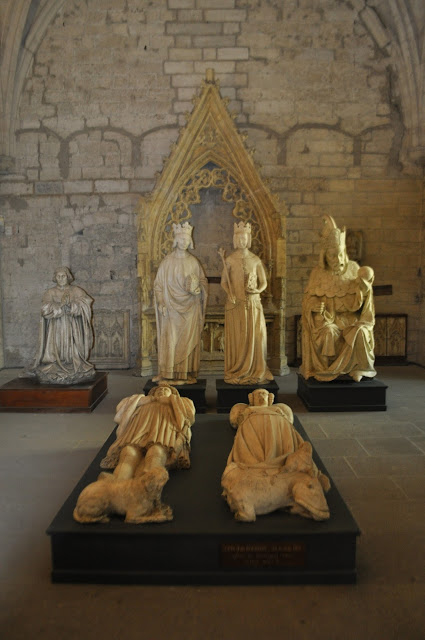
Plaster effigies of prominent figures in the Sacristy from during the papal rule in the palace

The Consistory, a meeting hall where the Pope received official dignitaries was once decorated with paintings (they were destroyed by fire in the early 15th century) and features plain stone walls and houses displays of models and architectural elements, including a scale model of the palace and a set of wooden cupboard doors.

"Passion of the Christ" sculpture inside the Consistory

An architect, Jean de Louvres, was commissioned by Clement VI to build a new tower and adjoining buildings, including a 52 m long Grand Chapel, seen below, to serve as the location for papal acts of worship.

The Grand Chapel, where the Avignon popes worshiped

Chambre des Notaires, the Notary Room seen below, houses 19th-century portraits of the nine Avignon popes painted by Henri Serrur.

Notary Room

Magna Porta

The Escalier d’Honneur, the Stairway of Honor, is a wide Italian-style processional or ceremonial stairway, restored in the 17th century, leads from the Courtyard of Honor to the Great Chapel.

Stairway of Honor

The residency of the Popes in Avignon ended on September 13, 1376, when Pope Gregory XI abandoned Avignon and moved his court to Rome (arriving on January 17, 1377). Despite this return, following Gregory's death on March 27, 1378, the breakdown in relations between the cardinals and Gregory's successor, Urban VI, gave rise to the Western Schism.

This started a second line of Avignon popes, regarded as illegitimate and known as antipopes. The second and final Avignon antipope, Benedict XIII, lost most of his support in 1398, including that of France; following five years of siege by the French, he fled to Perpignan on March 11, 1403. The schism ended in 1417 at the Council of Constance, after two popes had reigned in opposition to the papacy in Rome.

Palais des Papes Tower

We finished our visit to the Palace and walked down to the neo-classical town hall known as the Hôtel de Ville on Place de l'Horloge. It was built in the 19th century as a replacement for an older building. Only the 14th century clock tower remains from the original structure. The Gothic clock tower seen below, which gave the square its name, was incorporated into the construction of the later Hôtel de Ville.

14th century Bell Tower of the Hôtel de Ville

If you are going to be in the area this year, and want to visit the Popes' Palace, it is probably preferable to do so first thing in the morning or in Spring or Fall as I have heard from friends that it is very hot and you will sweat profusely during your visit. Enough said.

Have a great week. Hope to hear from some of you.