Monday, January 2, 2017

A trip to Marseille for an authentic Bouillabaisse

We had been talking about throwing a Provence Party in our backyard with a traditional Bouillabaisse for some time. We had even told the neighbors it would take place in August when we returned from Sablet. While we were in Provence, I wanted to go to Marseille and have a Bouillabaisse in one of the restaurants renown for the dish and see how it is presented to diners.

Despite having multiple "French Connections" to Marseille, we don't go very often (traffic is a mess and parking hard to find among other reasons). My connections include my father and family lived on Boulevard Longchamp in Marseille when he was growing up and cousins lived in Marseille with their families too at various times. Now, cousins Ginette and Josiane live there. I digress so let me get back to the topic at hand.

As the time was nearing for us to leave Sablet, we set a date to meet up with Ginette for a traditional Bouillabaisse and go shopping for our daughters. Marseille's Vieux Port is about one hour and thirty-five minutes down the A-7 from Sablet. We found parking near the Town Hall and walked around the Vieux Port from the north side to the south side to shop before we went to lunch. On the way to and from our car, we saw the sights shown in the photographs which follow.

By way of background I should mention that Marseille was founded by the Phoceans (from the Greek city of Phocaea, now Foça, in modern Turkey) in 600BC and is one of the oldest cities in Europe. The town is a far cry from the Cézanne paintings and Provençal clichés of sleepy villages, "pétanque" players and Marcel Pagnol novels.
Marseille's Notre Dame de la Garde

With around one million inhabitants, Marseille is the second largest city in France in terms of population and the largest in terms of area. The people of Marseille have varying ethnic backgrounds, with a lot of Italians and Spanish having immigrated to the area after the second world war. Currently, over one third of the population of Marseille can trace their roots back to Italy.

Marseille's Vieux Port

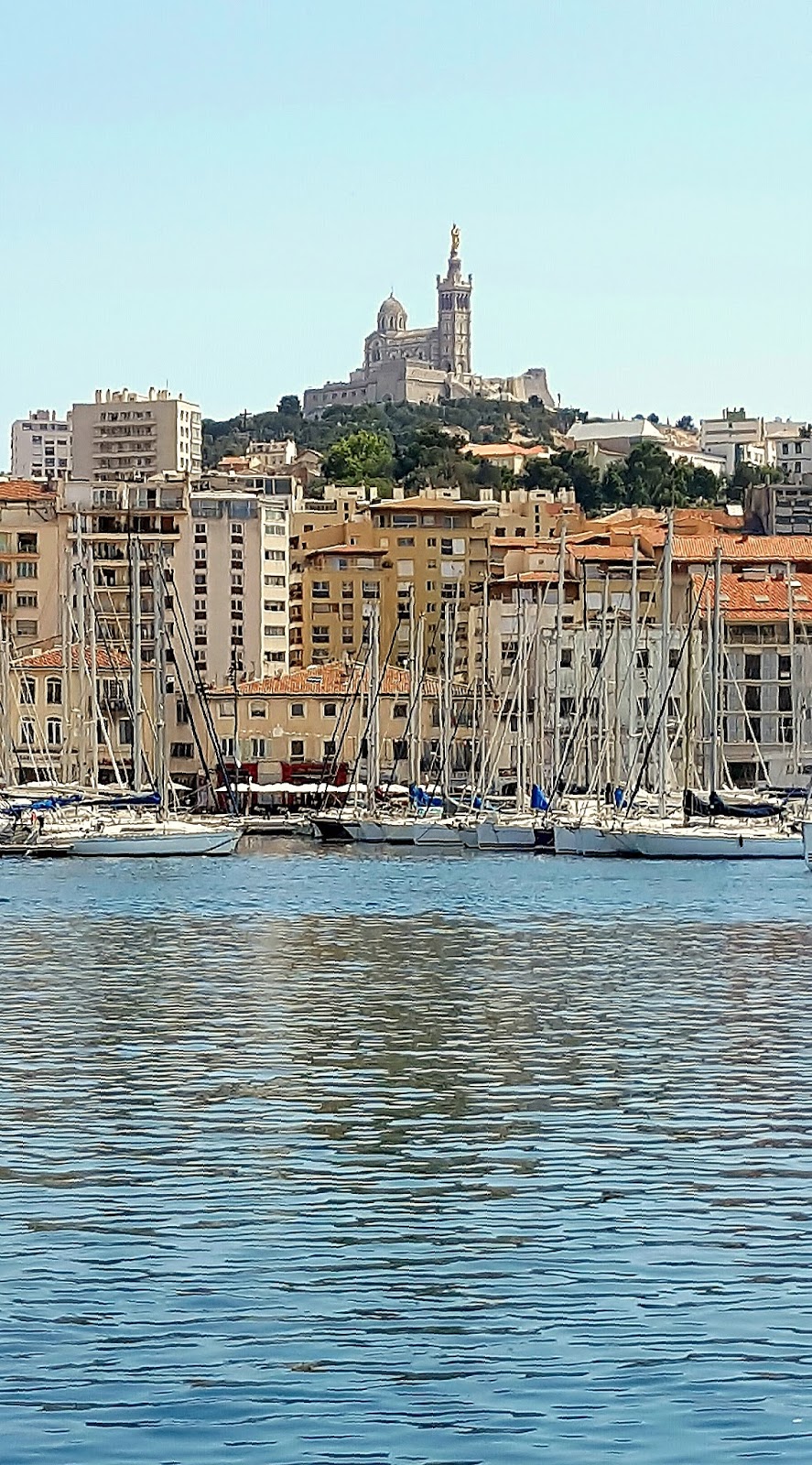
Everything in Marseille revolves around the U-shaped Vieux Port (Old Port) in the center of the city where boats have docked for 2600 years. The port is more pleasure marina that working port these days with pleasure yachts, small fishing boats, and sailboats filling more than 10,000 slips.

Marseille's Vieux Port

Around the port, fishermen mend their nets and lounge on benches reading newspapers in Greek and Arabic while cafes and restaurants serve up seafood from the nearby Mediterranean Sea.

Marseille street with nice shops

The Saint-Ferréol les Augustins Church is a Roman Catholic church located on Marseille's Vieux Port. The original building was owned by the Knights Templar. However, in 1369, it was given to a community of Augustinian hermits. By 1447, they spearheaded construction of a new church building. It was dedicated in 1542, even though the roof was not finished until 1588.

Pope Clement VII married his niece, Catherine de' Medici, to Henry II of France, in this church on October 28, 1533

Saint-Ferréol les Augustins Church

Le Panier quarter - the bread basket, seen below is one of Marseille's oldest sections. Le Panier is only a small part of what used to exist before the Germans dynamited it during World War II to flush out the Jews and Resistance fighters hiding there.

Up until the 1970s, the Le Panier quarter was the center for purification of heroin that passed through Marseille to Europe and the United States, hence the "French Connection" depicted in the 1971 movie starring Gene Hackman. Today ancient buildings line narrow back streets - kids playing, laundry flapping and people chatting in the squares.

Le Panier

Shops along the Vieux Port

The Marseille City Hall (Hôtel de Ville) seen below was built between 1653 and 1673. It was one of the few buildings on the harbor to survive the destruction of World War 2.

Marseille Town Hall

The ferris wheel seen below is located on the east end of the Vieux Port. While I am sure the view from the top of the ride over the port, the sea and the city of Marseille is nothing short of spectacular, my fear of heights will probably keep me from ever seeing those views from the ferris wheel.

Ferris wheel at Marseille's Vieux Port

After concluding our shopping, we decided to take a taxi to the restaurant in order to avoid having to deal with the Marseille traffic. Restaurant Fonfon is located in the Vallon des Auffes near the Monument aux Morts de l'Armée d'Orient off the Corniche du President-John-Fitzgerald-Kennedy.

The Monument aux Morts de l'Armée d'Orient by Antoine Sartorio seen below stands on a rocky promontory on Marseille's seafront and remembers all those Frenchmen who gave their lives during the 1914-1918 war fighting overseas particularly in the Far East.

The center of the arch has a carving of a crescent and a star. Sculptures of air force personnel and soldiers stand on one side of the arch together with a winged angel whilst on the other side is another winged angel and on a pedestal in the center of the arch is a bronze "angel of victory" her arms lifted to the skies. A stairway leading down to the sea completes the memorial.

Marseille War Memorial called "Monument aux Morts de l'Armée d'Orient"

Fonfon Restaurant which has been in business since 1952, is located in Vallon des Auffes, a small picturesque fishing port crowded with "pointus", traditional fishing boats and ringed by "cabanons", fishing sheds in Marseille's 7th arrondissement.

Vallon des Auffes

Vallon des Auffes"

Marseille is most famous for three things: the national anthem called “La Marseillaise”, the "French Connection" drug trade and bouillabaisse. Of these, the renowned fish stew of Provence is easily the most controversial and complicated. For a start, no one can even agree on the origin of the actual word, let alone the origins of the dish.

The most likely story is that it came about when local fishermen decided to boil up the fish and crustaceans they couldn't easily sell, which explains why the main contents are small rock fish and other ugly ducklings of the Mediterranean coastline, such as rascasse and anglerfish.

The prime ingredient is at least one of the three members of the rascasse family. The other commonly accepted ingredients are olive oil, onions, garlic, tomatoes, fennel, parsley and saffron. Some add a glug of Pastis, the anise-flavored aperitif.

Fonfon Restaurant

Recommended wines for bouillabaisse are Provencale rosés, and white wines from Bandol, Cassis and the Rhone. We opted for a bottle of white Clos Sainte Magdeleine, one of our favorite wineries in Cassis that I told you about here.

Clos Sainte Magdeleine

As is the custom, our server brought a platter to the table to show the fish that would be cooked for our Bouillabaisse that day. Most recipes call for bouillabaisse to include at least five types of fish. It almost always contains rascasse, a Mediterranean fish. The addition of shellfish is voluntary and is seen as snobbish by many Bouillabaisse purists.

Server presenting fish that will be cooked for the Bouillabaisse

Shirley finds the fish soup that is served for Bouillabaisse to be a little strong for her liking. So she opted for having one of Sole the server presented cooked to order for her. Whole fish is sold per 100 grams.

Tray with choices of whole fish for the day

Amuse Bouche

Bouillabaisse comes in two courses. First is the soup, accompanied by croutons, which you rub with a clove of whole garlic and spread with rouille, a bright orange mayonnaise flavored with saffron, cayenne and more garlic (rouille means, literally, "rust").

Bouillabaisse soup

The second course is the fish themselves, which are usually presented whole on a platter before they are taken back to the kitchen to be cooked and filleted for diners. The cooked fish are usually accompanied by potatoes that have been cooked in the Bouillabaisse soup.

Cooked fish for Bouillabaisse

Perfectly cooked Sole.

We chose ice cream for dessert

The Bouillabaisse was excellent. One thing I noticed was that from the last time I was there about 7 years ago, the clientele had changed from all French speakers to mostly tourists at least on this particular day. We headed back up to the Corniche and hailed a taxi to return to our car.

Vieux Port with Notre Dame de la Garde in the distance

It is very hard to find well-prepared, traditional Bouillabaisse in Provence. Forget one that is cheap. If you do find one that is cheap, don't order it. If you visit the fish mongers in the South of France, you know how expensive fresh fish is. So it stands to reason that an excellent traditional Bouillabaisse will be quite expensive. Chez Fonfon's menu currently quotes a price of 53 Euros per person.

Chez Fonfon Restaurant
140 Rue du Vallon des Auffes
13007 Marseille
Tel: 04 91 52 14 38
website: www.chez-fonfon.com

Saturday, December 31, 2016

Gordes, a Beautiful Hilltop Village in the Luberon

Gordes is a beautiful village in the Luberon region about 1 hour southeast of our home in Sablet. The obviously strategic site where Gordes sits has been occupied since prehistoric times. The stone buildings were built against the base of the cliffs and spiral up around the rock to the top where the chateau was built with a panoramic view over fields and forests and small perched villages.

The village's setting is striking and lots of tourists come to visit in the summer. Gordes is classified as one of Les Plus Beaux Villages de France, literally translated, one of the most beautiful villages of France; Gordes is one of 156 French villages with that classification. It is said to be the #1 tourist attraction in the Luberon.

Cubist painter André Lhote discovered Gordes in 1938 followed by Marc Chagall, Victor Vasarely and other modern artist who visited and summered in Gordes. More recently the village gained exposure as one of the locations for a movie filmed in the Luberon, "A Good Year" based on a novel of the same name written by Peter Mayle starring Russell Crowe.

Gordes

At the top of Gordes and in the center sits the chateau which dominates the town. Built in 1031, reinforced in 1123, the castle was rebuilt in 1525. Today the castle is home to the Pol Mara museum, a contemporary Flemish painter who lived in Gordes, and the tourist information office. In summer there are concerts and plays in the castle's courtyard.

Chateau

The Chapelle des Pénitents Blancs, translated as the "white penitents chapel" is located near the castle. Dating from the 17th century, the chapel is an art gallery today.

White Penitents Chapel

The fountain in the square by Hôtel Renaissance seen below, is where Max waits for Fanny Chenal, the character played by Marion Cotillard in "A Good Year" movie to get off work. Hôtel Renaissance was transformed into Fanny Chenal's bistro for the movie, and where Max famously tells an obnoxious American couple that "MacDonalds is in Avignon, fish and chips in Marseille. Allez".

Fountain in center of Gordes

A stone tower in Gordes next to Hôtel Renaissance

The memorial to the children of Gordes who died in wars for France is in the main square and where Russell Crowe's character, Max Skinner circles several times in his little yellow smart car looking for the notaire, a self-employed legal specialist with public authority to draw up contracts for clients, in the "A Good Year" movie.

War Memorial in center of Gordes

Every Tuesday morning is market day. Merchants from around the area set up stalls on Place du Château and sell their wares: fresh fruits and vegetables, Provençale pottery and linens, art work and clothing.

Place du Château and the fountain where Max waited for Fanny

Chateau

The original Romanesque church in Gordes was dedicated to Notre Dame. Rebuilt in 1704, it has a colorful interior and was dedicated to its patron Saint Firmin, a former Bishop of Uzès.

Façade of Saint Firmin Church

Around the center of the village near the castle, you will find various cafés, restaurants, art galleries and souvenir shops.

A Gordes tourist shop

During World War II, Gordes was an active resistance village and was later awarded a medal, the Croix de Guerre 1939 - 1945. On the 21st of August 1944, just 6 days after the start of Operation Dragoon, the Allied invasion of Southern France, a German patrol was attacked by members of the Gordes resistance and the day after, the village was subjected to violent reprisals and much of Gordes was destroyed.

Another view of the Chateau

Gordes boulangerie

It's enjoyable to wander around the maze of stone-paved-narrow streets which crisscross Gordes.

Gordes defensive tower

Gordes shop

While there are several Michelin starred and recommended restaurants in the area, we have not discovered any excellent places to eat right in Gordes itself.

Gordes street cafes

As in many villages in the Vaucluse, agriculture is important. Historically, almond trees were the most planted in the area, and though they are still present, olive trees have largely replaced them. Thus olive oil is important to local commerce. You can also find vineyards, with the production of table grapes or wine in AOC Ventoux.

Chateau

Almost opposite the church, the Caves du Palais Saint Firmin (the Cellars of the Palais Saint Firmin) offer a glimpse into a mysterious underground world. A fortified hill village where space was limited, Gordes developed an extensive network of cellars carved into the rock for use as storage areas and artisans' workshops.

Saint Firmin Church

While strolling around the tiny streets which climb up and down between the tall houses, you will discover here and there beautiful old doorways, arcades and walls of flat stone perfectly restored, and on the other side, there is the panorama of the valley and mountains of Luberon.

The year 1826 on the stone façade of a house

Arched passageway

One of the many narrow stone streets called calades - small paved, sometimes stepped alleyways lined with gutters defined by two rows of stone.

Calades

It is definitely worthwhile to visit Gordes. If you have time, you should also visit the Bories village, a collection of 30 stone huts made of dry flat stones made without mortar and the nearby Sénanque Abbey, a 12th century Cistercian abbey, that is surrounded by lavender fields.

Tuesday, November 29, 2016

Lunch at La Mirande Restaurant beneath the shadow of the Pope's Palace

One morning in October, we headed to Avignon with friends Steve and Mary for lunch at La Mirande Restaurant. Shirley and I had eaten at La Mirande before at the suggestion of fellow blogger, renown cooking instructor and friend Barbara at Cuisine de Provence, but this would be the first time for Steve and Mary.

We got to Avignon and rather than parking at our favorite garage (Hotel Mercure) close to the Popes' Palace, I decided to follow the signs for La Mirande and see if there was a garage close by. After wandering through some very narrow streets, we ended up in front of the 5 star hotel of the same name at the foot of the Palais des Papes (Popes' Palace).

It was raining and the hotel bellman took pity on me or at least I think it was pity and he let me leave our car in front of the hotel. I do not think that is a regular policy so we will park at our usual place in the Hotel Mercure garage next time.

Pope's Palace

The hotel is named after the room in the Palais des Papes, La Mirande, where the Pope’s representatives held receptions for the city’s notables and visiting high-ranking officials.

The walls of the hotel hold years of history. Originally a cardinal’s palace in the 14th century, the ruins of La Mirande were restored during the 17th century to create the Hôtel de Vervins with its baroque façade by architect Pierre Mignard, later becoming the Hôtel Pamard between the late 18th and 20th centuries.

The Stein family opened La Mirande as a hotel-restaurant in 1990 after restoring the property to recreate the atmosphere of an 18th century aristocratic residence, where period tapestries and chandeliers harmoniously co-exist with tufted armchairs and master paintings.

La Mirande Hotel

Shirley in the dining room at La Mirande

The chef offers a different 3-course "Petit Menu" every week at lunch for 39 Euros. After being seated in a beautifully furnished dining room, we all decided to begin our meal with an aperitif. Shortly after we were served our Kir Royales, the servers brought us a trio of appetizers which included black olive breadsticks, savory madeleines, and carrots tempura with a tomato tapenade dipping sauce.

Black olive breadsticks appetizer

Savory madeleines appetizer

Carrots tempura appetizer

Tomato tapenade dipping sauce for the carrots tempura

To accompany lunch we chose the 2012 Vacqueyras Le Sang des Cailloux Cuvee Azalais. It was an inspired choice as far as I was concerned and we ended up going to the domaine to taste wine and bought a case of wine to take home.

House made rolls

The chef and his kitchen team were most accommodating. The regular amuse bouche for the menu was Abalone with lime seen below.

Abalone with lime amuse bouche

For those who didn't want Abalone, he sent out eggplant ravioli with pureed spinach seen below.

Eggplant ravioli with pureed spinach amuse bouche

The starter for the "Petit Menu" that week was the Tarte fine with cèpes and pan sautéed foie gras seen below. For those who didn't want foie gras, the chef sent out the same Tarte without foie gras.

Tarte fine with cèpes and pan sautéed foie gras. Served with a reduction of veal broth

The main course for the "Petit Menu" was a white fish fillet roasted on the skin and served with baby carrots, Brussels Sprouts and spinach. This was a delicious dish.

Lieu Jaune fillet roasted on the skin with baby carrots, Brussels Sprouts and spinach

After we cleaned our plates, and they were cleared, the server brought us a "pre-dessert" of cream of corn ice cream with fromage blanc. Delicious, but this was just the "pre-dessert".

Pre-dessert of cream of corn ice cream with fromage blanc

The dessert for the week's "Petit Menu" was cream of banana with caramel ice cream. Although not a huge fan of banana desserts, this was very tasty.

Cream of banana with caramel ice cream

And if that wasn't enough, the chef sent out a plate of assorted mignardises, pretty, bite-sized pastries and sweets the restaurant served with coffee at the end of the meal. A very nice way to end a most enjoyable meal.

Assorted mignardises

As we were finishing up, chef de cuisine Florent Pietravalle stopped by our table to make sure we had enjoyed our lunch. You won't be surprised to know that we told him "yes, very much." If I recall correctly, my friend Steve said something to the effect that "La Mirande Restaurant might just be his new favorite restaurant in the Northern Vaucluse."

La Mirande Hotel (The restaurant is inside the hotel)
4 Place de l'Amirande
84000 Avignon
France
Tel: 04 90 14 20 20
website: www.la-mirande.fr

Saturday, November 26, 2016

Tis the season for Santons

You know I love santons, the hand-made clay figurines that depict the colorful people, traditional trades, activities and costumes of Provence. In Provence, they are set out at Christmas in a Provençal crèche (nativity scene). Up to now, as I told you here and here, the santons we own are on display all year long as decorations at our homes in Windsor, California and Sablet, France.

I have been talking to Shirley about buying santons for an authentic Provençal nativity scene for our home in Windsor, California. So when we are in Provence, I have been checking out every santonnier atelier (workshop) we pass and look at every display of santons we come across in local shops and I have been consulting an expert.

My expert is my own cousin Annick who lives near Aix-en-Provence. While she is not a santonnier (santon-maker), she knows a lot about how santons are made, their history, and who are the best santonniers in Provence. She and her daughter set up a beautiful Provençal crèche in their home every year. She says she owns at least 400 santons.

I have learned that the Provençal crèche have been around for centuries, but the importance of santons (the word comes from santoùn, which means in provençal "little saint") began immediately after the French Revolution in 1789. Churches at that time were forcibly closed or converted into other uses such as storehouses. Large nativity scenes were prohibited too, and so intimate nativity scenes in private homes assumed a key role in keeping alive religion and tradition.

Last summer, Shirley and I agreed that we would buy santons for a Provençal crèche when we returned to Sablet in October. So one Friday, we arranged with cousin Annick to rendezvous at one of the santonniers she likes at her workshop called Oustau d'Antan in a little village called Jonquerettes, about 15 miles east of Avignon.

Oustau d'Antan

Santons can range in size from 2cm to 15cm and come in two types: santons d'argile (figures made entirely of clay) and the slightly less common doll-like santons habillés (figures wearing cloth costumes, with hand-made accessories: baskets, fishing rods, etc).

The new collection for 2016 by Oustau d'Antan

Come November and December, the santon-makers present their new collections at santon fairs throughout Provence. It is the event of the year for all lovers of santons who come to add to their own collections, purchase gifts, or simply admire the santonniers handiwork and their colorful figurines.

Shirley, cousin Annick and I at the santonnier

The traditional crèche is composed of a cowshed, Mary, Joseph, baby Jesus (who is placed between his parents on December 24, at midnight), the donkey, and the ox who are warming Jesus with their breath, some shepherds with their sheep, then, at the epiphany, the 3 wise men. I should mention that when my French cousins saw my nativity scene on Thanksgiving Day, they immediately told me that it was too soon to have baby Jesus in the manger or the 3 wise men nearby.

The addition of figures representing country life and craftsmen drawn from a Provencal village of two centuries ago derived from the idea of Provencal inhabitants on their way to the Nativity. Some bear presents: the miller with his sack of flour, the poor old woman with nothing more than a bundle of sticks for the fire, a farmer's wife with a rabbit and a basket of fresh eggs. Others simply arrive: the mayor, the bandit, the street musician, even the parish priest.

Santons and accessories on sale at Oustau d'Antan

As the santonnier explained, when she makes a new figure, she works with a fine-pointed instrument, painstakingly modeling the face and clothing. When the clay piece finally meets her standards, which could take hours, she uses it to create a plaster mold. That original mold, in turn, will used to make figures which line the shelves of the workshop. To make the figures, she places a glob of clay between the two halves of a mold, squeezes them together and -- voila -- a wise man.

The wise man will spend about 12 hours in the workshop's kiln and then she will paint them. Then, the santons come alive as the vibrant colors are applied: Mary's red dress, the basket-maker's blue shirt, the orange tile rooftops of the villagers' homes.

The santonier of Oustau d'Antan showing us a special piece

The patron saint of santonniers is Saint Francis of Assisi, who first began staging nativity scenes with live models in Italy in 1223. Soon afterwards, Christmas crèche with model figures began appearing in churches.

Award winning collections by Oustau d'Antan

We were told that many of the artisans santonniers base their figures on the characters in a famous Christmas play written by Antoine Maurel -- the brigand, for example, who kidnapped the blind man's son; Roustido, who arrives late because he's hard of hearing; Pimpara, the knife grinder, who can always be counted on for a story.

Santons and accessories on sale at Oustau d'Antan

For parents and children, santons offer a chance to create their own Christmas world at home. Each year they add to their collection, choosing their favorite characters from among those offered for sale, buying houses, trees or windmills to provide a village setting.

Santons and accessories on sale at Oustau d'Antan

When we got to Oustau d'Antan, Annick was already there. She had with her a beautiful cowshed and a windmill (see below) she had handmade and painted for us as a gift to help us start our Christmas crèche.

The santons we already have are larger so-called "santons habillés" (figures wearing cloth costumes) which don't normally appear in nativity scenes. So we chose the more typical size of 7 cm or about 3 inches tall for the figures in our crèche.

The Holy Family in Annick's cowshed with the three wise men and shepherd with his flock of sheep

Village characters on their way to the Nativity

Village characters on their way to the Nativity with their gifts

More villagers with Annick's windmill

Most of these figures were bought at Oustau d'Antan. We added a few we found at a shop in the center of Vaison-la-Romaine which carries a nice collection of santons made by various santonniers from Provence. We will follow the tradition of adding a few new santons to our collection every year.

As you probably know, we have 5 curious and energetic grandchildren who range in age from 2 years to 10 years. So to protect our precious santons and cowshed and windmill, we set up our Christmas crèche on top of our fireplace mantle. This is not ideal so in the future when they all are a little older, we will set up in a more traditional place.

If you are around Windsor, please feel free to stop by and take a look at these beautiful handmade and painted figures from Provence. Happy Holidays everyone. Its the season for Santons.

Oustau d'Antan
Santonier-Crechiste
220 Impasse des Alpilles
84450 Jonquerettes
France
Tel: 06 11 65 71 83
website: www.santons-oustau-dantan.fr
Email: oustau.dantan@hotmail.fr