Showing posts with label Alpes de Haute Provence. Show all posts

Saturday, February 24, 2024

Our Visit to the Breathtaking Valensole Plateau Lavender Fields

Every year, thousands of tourists' travel to the sun-drenched South of France region of Provence. One of its biggest draws, field upon field of perfect rows of sweet-scented, violet-colored lavender. 

There are four main regions where lavender is grown in Provence. They are the Plateau de Valensole, the Luberon Valley, Pays de Sault, and the Drome Provençale. We have visited all of these areas several times except for the Plateau de Valensole. 

Last summer, with friends from Washington DC in tow, we loaded into our car in Sablet and headed out for the 122 km drive to the famous Valensole plateau to tour the lavender fields in the Alpes-de-Haute-Provence.  

The lavender fields on the Valensole plateau are the most photographed in Provence. This plateau, at 500 meters elevation is dedicated to the cultivation of cereals, olive trees and lavender. The plateau extends over 800 square km and offers a breathtaking panorama of the Provencal countryside. 


Lavender Field in Valensole

Lavender attracts thousands of tourists and bees, hoping to time their visit for the peak of the flowering cycle. The precise timing of flowering changes annually, depending on the weather. Typically, some fields are in full bloom by late June, and the harvest is mostly complete by mid-August.


Lavender Field in Valensole

There are many varieties of lavender. Although we typically associate lavender with purple flowers, the varietals include many colors, from deep blue to white. The plants love the dry, sandy, rocky soil that is typical of southern France.


Lavender Field in Valensole

Lavender has been cultivated at least all the way back to biblical times. Lavender is referenced in the bible as a holy herb nard. The Greeks and Romans used lavender for personal hygiene and medicinal purposes. The Romans used lavender flowers to scent bath water. The flowers and essential oils have been used throughout the ensuing centuries for everything from repelling insects to treating burns to sleep therapy. 


Lavender Field in Valensole

Two main lavender varieties are grown in Provence. The “real” lavender is a small, tufted plant with a single floral spike. Each plant is unique. The plants grow naturally at elevations between 600 and 1,400 meters, but cultivation is generally above 800m. Each plant is unique.


Lavender Field in Valensole

Lavandin is a hybrid, the result of a cross between lavender and a wild varietal, lavender aspic. It’s a hardy plant, less susceptible to disease, and it grows at lower altitudes (200 – 1,000m above sea level) than fine lavender. Since lavandin is a clone, the plants have identical biological footprints, propagated by cuttings. A single lavandin stem has three blue-purple flower spikes.


Lavender Field in Valensole

Be forewarned, lavender season brings traffic congestion. Bus tours and cars clog typically quiet roads while their passengers walk into the lavender fields to snap selfies and photos of each other in the fields. 


Lavender Field in Valensole

Much of the lavender grown in Provence is distilled for essential oil and fragrant water. The plants are also dried for scented objects. Tourist shops in Provence carry lots of lavender products, soap, perfume, honey, tea, ice cream and scented packages. Be aware, some of the products sold in stores are mass-produced outside of France and hardly artisanal.


Lavender Field in Valensole

Because of the size of the lavender fields, the lavender harvest is usually not done by hand. A tractor passes through the field, cutting the lavender and leaving small bundles in its wake. The cuttings then dry in the sun for 2-3 days before being gathered into giant bundles similar to large hay bales. 

At the distillery, the bales are dropped into cauldrons with water where the steam passes over the flowers creating the essential oil and lavender water. To produce one liter of essential oil requires 200 kg (440 lbs) of lavender flowers. 


Shirley and I on our 50th Wedding Anniversary in a Valensole Lavender Fields

Walking through lavender fields in Provence on your wedding anniversary is about as romantic a setting as you can find in my opinion. 

Just before we left California for our trip to Sablet, Shirley played her one and only pickleball game and fell and broke her wrist in 4 places. We were grateful the doctor was able to put her wrist in a cast. We were hoping it would fully heal that way but unfortunately, she had to undergo surgery a few months later.

After touring around the Valensole plateau for a few hours, we drove into the town of Valensole, to find a place to eat and drink. 

Valensole

You can find lots of guides online that identify where the prettiest shots of lavender can be found on the Valensole plateau. However, because harvest occurs at different times and growers replant fields as they age, it is not always possible to find all of the recommended locations. Yes, it was a long drive from Sablet, but worth the effort in our opinion. 

If you are still searching for a house to make your home during your sojourn in Provence this year or in future years, please don't hesitate to visit our website at www.sablethouse.com You can also email me at chcmichel@aol.com  

Saturday, April 13, 2013

Simiane-la-Rotonde, a Charming, Fortified Village along the Lavender Trail

We have explored many of the towns and villages in the Vaucluse, the French department where Sablet is located, but we have never made it to the famous Saturday morning market in the town of Apt in the Southeastern corner of the Vaucluse.

Since I was meeting cousins Ginette, Pascale, and Yoan in Apt to see the purple lavender fields (lavender routes) and explore the villages between Apt and Banon, I got to Apt early to check out the market (I will tell you about that part of my day in a future post).

Our first stop on the lavender route was Simiane-la-Rotonde, a small, seemingly quiet village (population 584), on a hill (2132 feet elevation) overlooking a plateau with lavender fields. Simiane-la-Rotonde is located at the Southwestern end of the Alpes de Haute Provence department, close to the border of the Vaucluse.

Simiane-la-Rotonde

The village dates to the 11th century when a prieuré (monastery) was established in Simiane-la-Rotonde by the Saint-André Abbey in Villeneuve-lès-Avignon that I told you about here.

Simiane-la-Rotonde street

The name of the village comes from the Simiane-Agoult family who were powerful rulers in Haute Provence and from Rotonde, a large conical structure at the top of the village.

Narrow walkway in Simiane-la-Rotonde

As you wander around the village, you will come upon the "Maison des Poupées" (Doll's House), a 17th century house with more than 1000 exhibits, dating from 1920 to the present day.

La Maison des Poupées (Doll's House)

We strolled down narrow stone-paved streets lined with tall stone houses that date from the 17th and 18th centuries.

The cousins pause for pictures along one of the stone-paved streets

Simiane-la-Rotonde is one of the main areas for production of lavender. In 1979, Alain Cassan, a farmer who is also the current mayor of the village founded the "Société Coopérative Agricole des Plantes à Parfum de Provence" (Agricultural Cooperative Society of Aromatic Plants of Provence), the largest in France.

Local distilleries transform the cut plants into essence which the Cooperative collects and stores. Its 330 members produce 424 tons of essential oils, which accounts for 34% of total French production of fine lavender, used to make perfume, pharmaceuticals and aromatherapy, and for 40% of total French production of lavendin, used for washing powders, detergents, and cosmetics.

Archway through a stone wall

The Rotonde was built at the end of the 12th century to strengthen the defense of the castle. It was saved in 1841 by Prosper Mérimée, who had it declared a historic monument. It is 62 feet tall, the massive exterior hides a ceremonial room with a twelve-ribbed cupola, beautiful stonework, and columns decorated with stylised leaves of water plants, and sculpted human masks.

The Rotonde

Before lavender, glass-making flourished and the village became prosperous and wealthy families built houses along the paved narrow flower-decorated streets. Mullioned windows, carved stone lintels, and diamond-shaped decorations on the wooden doors are proof that aristocratic and wealthy bourgeois lived here between the 16th and 18th centuries.

Simiane-la-Rotonde street

Besides production of lavender, there is limited commerce in the village except for one goat cheese maker, a bakery, a small food store, a bookstore, a rose nursery and pottery studio.

Simiane-la-Rotonde street

Every August, an international early music festival, “Les Riches Heures Musicales de la Rotonde” takes place in the Rotonde. The Festival specialises in instrumental and vocal early music, performed by famous artists and Provençal musicians.

17th - 18th century Pellissier-les-Granges House

As we walked along the stone-paved streets past the stone houses, all of which are creamed-colored, I thought about the other people who have walked these same streets during the past three-hundred years; what were their clothes like, where did they live, how did they light and heat their homes and what did they do for a living?

Pottery studio

Although there is a 16th century, covered market hall, I can't find anything to indicate that there is a weekly market in Simiane-la-Rotonde so I assume that villages go shop at the weekly markets in Apt, Banon, or Forcalquier.
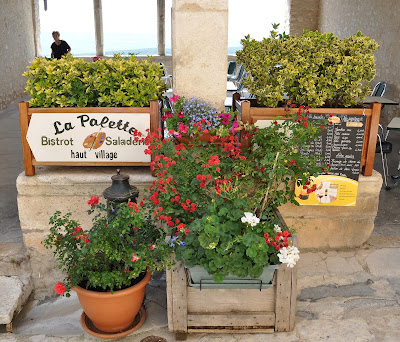
Pretty flowers in front of the 16th century covered market hall

If you go to Simiane-la-Rotonde, make sure you check out the great views over the countryside from the top of the village near the Rotonde and from the covered market hall.

A view over the lower village and lavender fields from the covered market hall

Have a great week. Bonne journée mes amis et à bientôt.