Showing posts with label Cookbook. Show all posts

Saturday, November 30, 2019

Domaine Tempier, Legendary Wine Estate and Foodie Heaven

I have wanted to visit Domaine Tempier, ever since the first time I read about the Bandol winery owned by the Peyraud family, in books authored by Richard Olney, Alice Waters and Kermit Lynch. Kermit Lynch the renown wine importer, was introduced to the Peyrauds by Richard Olney and has been importing the wines of Domaine Tempier since 1976.

For those who don't know, Alice Waters is executive chef, author of multiple cookbooks, and proprietor of Chez Panisse, a gastronomic temple in Berkeley California for more than 40 year and arguably one of the most famous restaurants in the United States; she is a long time friend of Lulu Peyraud and family.

She was also introduced to the Peyraud family by Richard Olney, a neighbor and friend of the Peyrauds. Richard Olney wrote many wonderful cookbooks including "Simple French Food", "Provence, the Beautiful Cookbook: Authentic Recipes from the Regions of Provence" and "Lulu's Provençal Table" to name a few.

Wines from Bandol including those of Domaine Tempier and Domaine de Terrebrune were on the wine list at Bistro Des Copains, the French country bistro, now closed, I co-owned with friends in Occidental, California. We got these wines from wine importer Kermit Lynch who makes his home in the Bandol region half the year.

As I told you in my last post, we decided to go visit the hilltop village of Le Castellet and taste some Bandol wines including I hoped, the wines of Domaine Tempier. After a Provençal lunch and leisurely walk around Le Castellet, we headed to Domaine Tempier.

We found Domaine Tempier, nearby right below the village, at the foot of Le Castellet. Much to my dismay, while Domaine Tempier is open for tastings, it is closed on Saturdays and Sundays, so we were not able to fulfill my dream of tasting their legendary wines at the estate tasting room.

Domaine Tempier in Bandol AOC

While the wines of Domaine Tempier have been praised by many, including Janis Robinson, a British wine critic, journalist and wine writer and Robert Parker, who famously once declared the Domaine Tempier Bandol Rosé, the "greatest rosé in the world", I am attracted to this Domaine just as much, by the stories of family meals served by Lulu Peyraud as described by countless food writers.

Lulu who turned 100 in 2017, was born in Marseille and her cooking is Marseillais, although she doesn't think there is a lot of difference between that and the cooking in Bandol. One of my favorite cookbooks is authored by Richard Olney and is drawn from a series of interviews intended to translate Lulu's words into written recipes, called "Lulu's Provençal Table", published in 1994.

Lulu Peyraud's Provençal Recipes

If you Google "Traditional Food of Provence, there are lots of lists from different publications which show up in the results. All of them it seems, include Bouillabaisse, Ratatouille, Aioli, Tapenade, and several others. For Thanksgiving this year, I made the Tapenade recipe in the "Lulu's Provençal Table" cookbook for one of our appetizers.

Tapenade is a Provençal name for a dish consisting of puréed or finely-chopped olives, capers, and anchovies. Its name comes from the Provençal word for capers, tapenas. It is ubiquitous in the Provence region of France, where it is frequently served as an amuse bouche in restaurants, or with aperitifs, sold in jars in grocery stores or freshly made in farmer's markets.

We love Tapenade and Lulu's recipe is so easy and quick to make, that it seems a shame to not enjoy it freshly made. We serve it with fresh bread, toasted slices of baguettes, or crackers. We served Tapenade as an amuse bouche at every dinner service at Bistro des Copains.

Ingredients

1/2 pound large Greek-style black olives, pitted. The olives I like come in jars with 9.5 oz drained.
4 anchovy fillets
3 Tablespoons capers
1 garlic clove
Small pinch of cayenne
1 teaspoon savory leaves, finely chopped. I can't ever find fresh savory, so I substitute fresh thyme
4 Tablespoons olive oil

Ingredients for Lulu Peyraud's Tapenade Recipe

Directions

In a food processor, reduce the olives, anchovies, capers, garlic, cayenne, herbs, and olive oil to a coarse purée. Process only until the mixture is homogenous.

Tapenade Ingredients in Food Processor

Here is what the Tapenade should look like when it is out of the food processor.

Lulu Peyraud's Tapenade

I know you will find this recipe super easy. It is something you can whip out very quickly if guests drop in unexpectedly. I hope you will enjoy the Tapenade as much as we do. We hope to go back to the Bandol region when we return to Sablet in the spring and this time we will go on a weekday so we can taste at Domaine Tempier.

If you are thinking about a trip to the South of France including spending time in Provence, we invite you to visit our website at www.sablethouse.com. Our house is available for rent by the week or more. You can reach us for further information at chcmichel@aol.com.

Sunday, March 22, 2015

Cheez-it-ish crackers, a wonderful tasty addition to your nibbles at apéritif

Many of you are aware that we closed Bistro Des Copains, the French country bistro we co-owned in Occidental, CA in January. We miss our staff and many friends who dined there on a nightly basis. However, with the Bistro closed, I now have some time and freedom to try new recipes, entertain friends, or dine at the many wonderful restaurants we have in Sonoma County.

One of our favorite times to entertain is to invite friends for nibbles and drinks at the end of the day for one of our favorite French traditions called apéritif. For the uninformed, apéritif is both a beverage and a social occasion, and a wonderful part of daily life in France. It is a national custom where time is set aside at the end of the day to share a drink and maybe a bite or two with family, friends, and colleagues, all the while engaged in conversation.

An apéritif by definition (it's a French word derived from the Latin verb aperire, which means “to open.”) is a prelude to dinner, so the "bites" of food that accompany drinks should be tantalizers to the taste buds, preparing them for the meal to come. Generally, the accompaniments are bite-sized finger foods that can be eaten with your hands.

Traditional apéritif drinks can be roughly divided into three groups. The wine group includes still and sparkling wines, fortified wines and wine based mixtures. A second group consists of herb and spiced-based alcohols, Pastis and Compari, for example, that are usually diluted with water. The third is fruit based and may or may not contain alcohol.

Salty foods are popular - olives, nuts, cornichons and radishes with butter and salt. Spreads made from olives, eggplants, pâté or salt cod and served on toasts or in puff pastry are common. We have also been served saucisson (dry sausages), apero-sized goat cheese marinated in herb-infused olive oil, and tiny clams, known as tellines which are eaten one by one - finger licking good.

I like to try new recipes every time I cook. One night last week, I tried 4 new recipes; grated carrot salad, cheez-it-ish crackers, and spaghetti with creamy Walnut-Gorgonzola sauce which are shown in the next two pictures. I also made a lentil salad that I have made before and socca, a chick pea flour pancake from Provence (and neighboring Liguria, where it’s called farinata).

Cheez-it-ish crackers, grated carrot salad and lentil salad

We have tried quite a few grated carrot recipes, a popular dish in French bistros and cafés. The recipe this night came from "Around my French Table" by Dorie Greenspan and is our personal favorite so far. I envisioned the socca from the same book as a future offering at an apéritif with friends. Unfortunately, it didn't turn out the way I expected.

The recipe for the Salsa di Noci e Gorgonzola or Spaghetti with Walnut-Gorgonzola Sauce was a new one for me from Biba Caggiano, an award winning cookbook author and restaurateur from Sacramento, California. The dish was delicious, but very rich.

Spaghetti with creamy Walnut-Gorgonzola Sauce

The Cheez-it-ish crackers from "Around my French Table" authored by Dorie Greenspan were an unexpected hit with Shirley and I. They are super tasty and remained crunchy until they were gone after three days stored in plastic bag. Future guests can look forward to enjoying these with us.

Cheez-it-ish crackers

I have had Dorie Greenspan's book "Around my French Table" since it was released in 2010. Unfortunately for us, I had not really opened it till this past week. What a mistake! The grated carrot salad and the cheez-it-ish crackers recipes were easy and wonderful. Below, I share the recipe and I strongly encourage you to try it for yourselves. They will be wonderful at your next aperitif.

"Around my French Table" cookbook

Cheez-it-ish Crackers
Makes about 50 crackers

Ingredients

8 tablespoons (1 stick) cold unsalted butter, cut into 16 pieces
1/4 pound Gruyère, Comté, or Emmenthal, grated (about 1 cup)
1/2 teaspoon salt
1/8 teaspoon freshly ground white pepper
Pinch of cayenne pepper
1 cup plus 2 tablespoons all-purpose flour

Directions

1. Put the butter, cheese, salt, white pepper, and cayenne pepper in a food processor and pulse until the butter is broken up into uneven bits and the mixture forms small curds.

2. Add the flour and pulse until the dough forms moist curds again - these will be larger. The cookbook author says that there are times, though, when you pulse and pulse and never gets curds - in that case, just process for a minute or so, so that everything is as moist as possible.

3. Turn the dough out onto a work surface and knead it gently until it comes together. Divide the dough in half, pat each half into a disk, and wrap the disks in plastic. Chill for at least an hour, or for up to 3 days.

4. Center a rack in the oven and preheat the oven to 350 degrees F. Line a baking sheet with a silicone baking mat or parchment paper.

5. Working with 1 disk at a time, roll the dough out between sheets of plastic wrap or wax paper to a scant 1/4 inch thick. Using a small cookie cutter, one with a diameter of about 11/4 inches - cut the dough into crackers.

6. Gather the scraps together, so you can combine them with the scraps from the second disk, chill, and roll them out to make more crackers. Place the rounds on the baking sheet, leaving a scant inch between the rounds.

7. Bake for 14 to 17 minutes or until the crackers are lightly golden and firm to the touch; transfer the crackers to a rack to cool. Repeat with the second disk of dough (and scraps), making certain that your baking sheet is cool. You can serve these a little warm or you can wait until they reach room temperature.

I hope you will invite your friends to join you for aperitif, it is such a civilized way to transition from your work day to personal time. The Cheez-it-ish crackers will be perfect to nibble on and enjoy with a glass of sparkling wine or white wine.

Saturday, September 21, 2013

Return to Sablet and a wonderful Zucchini Beignet recipe

We are on the way to Sablet. We are spending the weekend in Lausanne (I will share highlights in a future post) where my late father Daniel was born in 1920. We will also be attending my little cousin Audrey's wedding a short distance away in Gland Switzerland on Sunday. The weather is divine so this should be a fun weekend.

We can't wait to get to Sablet and see our friends Steve and Mary from Michigan, our friends in Sablet and nearby villages and the cousins who won't be at the wedding tomorrow. Tuesday morning, we will be at the market in Vaison-la-Romaine.

There is so much we want to do during our visit. Eating favorite Provencal foods, either at our favorite restos or cooking at home and drinking wonderful wines are high on the list. We buy fresh produce at the weekly markets but when we need something, I happily run to Vival and get it.

Vival Epicerie

Our favorite people and friends in Sablet include Alain and Mimi Fabre, the proprietors of Vival. I treat their well-stocked mini-market like my personal pantry. They have everything we need and just 5 minute walk from the house. Prior to when the Fabre bought the store, there was very little on the shelves and made me wonder if that was how stores were during the War or in third-world countries.

Alain and Mimi Fabre

As I said, I love to make and serve food from Provence. One of my favorite cookbooks is "Made in Marseille" by Daniel Young. Many of the recipes come from restaurants in Marseille.


This summer, Shirley planted several zucchini plants and they have produced prodigious numbers of zucchini. It seems that if you don't check daily or miss one hiding behind some leaves, that they grow as big as your arm in a day or so. If you have zucchini in your garden, you know what I am talking about.

I have been trying all kinds of recipes with zucchini and we have given what we can't use away to the neighbors. My favorite new zucchini recipes are; Clafoutis Provençal from Barbara over at Cuisine de Provence and this recipe for zucchini fritters from the "Made in Marseille" cookbook by Daniel Young.

Zucchini Beignets (fritters) with tomato sauce

Beignets de Courgettes
Makes 4 servings (About 12 Fritters)

Ingredients

2 pounds zucchini
1/2 cup all-purpose flour
1/2 teaspoon baking powder
1 onion, finely diced
2 tablespoons chopped parsley
2 eggs
Salt and pepper
Frying oil

Directions

1. Peel the zucchini, cut into 1 inch chunks, place in a pot of boiling salted water, and cook for 15 minutes; drain and let cool. Wrap the zucchini in a clean dish towel and squeeze out all the juices (It will be like a faucet; you may have to scrape zucchini off of the dish towel).

2. Dice the onion (I sauté the diced onion in 2 tablespoons olive oil in a skillet over medium heat until cooked).

3. Combine the flour and baking powder in a bowl. Add the zucchini, onion, parsley, and eggs. Season lightly with salt and pepper and mix well.

4. Heat a good 1/2 inch of the frying oil in a sauce pan over moderately high heat. Working in batches, scoop up a heaping tablespoonful of the mixture, drop into the sauce pan, flatten it just slightly with a spatula, and fry until golden about 2 minutes on each side.

5. They are delicious plain, even better accompanied by a simple tomato sauce.

It is very easy to double the recipe if you want more for a bigger party. The recipe may seem complicated but it's not! It makes for a nice change to side vegetables. Since zucchini is available year around, you can serve it for holiday parties.

Have a great weekend. Chat soon.

Tuesday, July 16, 2013

White Bean "Brandade", a Wonderful Dish to Accompany l'Apero

Shirley and I were strolling down Ocean Avenue in Santa Monica California a while time back looking in store windows and reading menus posted in front of restaurants and keeping an eye on people, some with dogs, enjoying the picture perfect day in Southern California.

We skipped dessert at lunch and decided that now would be a good time for a coffee and dessert break with a potty stop thrown in for good measure. We climbed the steps of a pretty beach front hotel to a porch filled with tables and chairs that ran the length of the hotel along Ocean Avenue.

After being seated and we ordered desserts, Shirley went off to find a bathroom. I called friends Steve and Mary in Michigan while I waited for Shirley to return. After a few minutes, our conversation turned to Sablet, Steve and Mary love Sablet as much as we do, and then to food. Mary said she had bought some new cookbooks including "Mediterranean Harvest" by Martha Rose Shulman.

"Mediterranean Harvest" by Martha Rose Shulman

Mary mentioned several recipes her son tried, he is a personal chef, which she thought were wonderful including one for "White Bean Brandade." A little later our walk took us to a Barnes and Noble bookstore and we went in and a short time afterwards came out with my own copy of the "Mediterranean Harvest."

I know that many of you love aperitifs and the tradition of l'apero. Some of you have written posts about your favorite aperitif and snacks for l'apero and my post about aperitifs here is one of my most widely viewed posts in terms of page views.

So in the spirit of adding to the enjoyment of l'apero, I offer you this tasty and very easy recipe from Martha Rose Shulman for White Bean "Brandade."

White Bean "Brandade"
Makes about 3 cups

"Brandade," a creamy purée of salt cod, is a signature dish of Provence. This version -- without the fish -- is considered a "poor man's brandade." In Marseille, the dish is often garnished with pressed dried tuna roe (poutargue, or bottarga). I sprinkle rosemary over mine.

Ingredients

2 garlic cloves
Salt
4 tablespoons extra virgin olive oil
2 cans (15 1/2 ounces each) white beans (cannellini or navy), drained and rinsed
1/4 cup milk (more as needed)
2 tablespoons fresh lemon juice
Freshly ground white pepper
1 tablespoon chopped fresh rosemary
Crostini or crudités

Directions

1. In a mortar and pestle, purée the garlic with 1/2 teaspoon salt and 1 tablespoon olive oil.

2. Purée the white beans with the mashed garlic in a food processor fitted with steel blade or blender. With the machine running, add the remaining 3 tablespoons olive oil, the milk, and lemon juice. Add pepper to taste and adjust the salt. The consistency should be like hummus. If the purée is too stiff, thin out with more milk. Taste and adjust seasoning.

3. Transfer to a serving bowl or platter. Sprinkle with the herbs. Serve warm or room temperature, with crostini or crudités.

Advance Preparation: The brandade will keep for about 5 days in the refrigerator. It will become thicker with time. Thin out as desired with milk.

Ingredients for White Bean "Brandade"

White Bean "Brandade"

Here is a picture of the White Bean "Brandade" on the table ready for the arrival of our guests for l'apero.

Ready for Aperitif

I hope you will try this recipe the next time you invite friends for l'apero. As I said, the dish is very easy and tasty. I have tried a number of other recipes from the "Mediterranean Harvest" cookbook including a wonderful recipe for tomato gazpacho. I like the book so much, that I bought a second copy for the cookbook library at our house in Sablet. Thanks Mary for the recommendation.

In the words of Chef Jacques Pepin, one of my favorite television chefs and cookbook authors, I wish you happy cooking. Bonne journée mes amis et à bientôt.

Sunday, May 5, 2013

A delicious and easy Lemon Goat Cheesecake (Gâteau au Fromage de Chèvre et Citron)

Yesterday was a warm sunny day in Northern California, a perfect day for an al fresco lunch on the backyard patio with friends. We served vegetable salads (roast baby beets and walnuts, baby leeks and herb vinaigrette, and a raw artichoke and arugula salad with lemon vinaigrette) as a first course followed by a creamy fennel risotto for the main course.

For dessert, I made a lemon goat cheesecake from a cookbook, "Paris to Provence" that I just added to my collection of cookbooks I told you about here. This newly published cookbook by Ethel Brennan and Sara Remington includes recipes and stories from their summer childhoods as they traveled with their respective families from Paris to Provence.

We chose the menu for seasonality and because we wanted to serve food that we would serve guests at our table in Sablet. Bien sur (of course), the perfect beverage for our menu was rosé wine so to add fun to our meal, we did a blind tasting of three 2012 rosés from Provence. In case you are interested, my favorite was the Mas de Gourgonnier, Les Baux de Provence Rosé.

I normally don't buy cookbooks written by first time authors who are non-chefs unless they are connected to a cooking school. Despite my normal hesitation, I bought this terrific book because I liked the dishes, stories and photography in the book and the foreword is written by Georgeanne Brennan a food columnist and author of several cookbooks I like alot, plus she is mother of a co-author of this book.


The meal was fabulous if I say so myself but I thought the hit was the lemon goat cheesecake. So in case you would like to make it for your next time you have guests, here is the recipe.

Lemon Goat Cheesecake (Gâteau au Fromage de Chèvre et Citron)
Serves 10

Crust

1 1/2 cups walnut halves
1/4 cup loosely packed light brown sugar
20 plain water crackers, broken into 1-inch pieces (Carr's and Jacob's are well-known UK brands)
1/2 teaspoon freshly grated nutmeg
6 tablespoons unsalted butter, melted

To make the crust, combine the walnuts, brown sugar, crackers, and nutmeg in a food processor fitted with the metal blade. Process until finely ground. Add the melted butter and continue to process until the mixture is moist and sticks to the sides of the processor bowl. Gather the mixture together and place in the center of a 9-or-10 inch springform pan. Using your fingertips, gently press the crumb mixture evenly over the bottom and two-thirds up the sides of the pan. Put in the freezer to chill for 15 minutes.


Preheat the oven to 350 Fahrenheit

Filling

15 ounces soft goat cheese
16 ounces mascarpone
3 tablespoons finely grated lemon zest
4 large eggs, lightly beaten
1 1/3 cups granulated sugar
1/2 teaspoon salt

To make the filling, first rinse out the food processor bowl, then again fit it with the metal blade. Place the goat cheese, mascarpone, lemon zest, eggs, sugar, and salt in the bowl, and process until smooth and creamy.


Remove the springform pan with the crust from the freezer, place in the center of a baking sheet, and pour the filling into the crust. Bake until the top springs back when lightly pressed with a fingertip, about 1 hour. Remove from the oven and let cool to room temperature or transfer to the refrigerator to cool for at least 1 hour and up to overnight. When completely cool, release the sides of the springform pan and transfer the cheesecake to a serving plate. Serve chilled or at room temperature, cut into slices.


It was wonderfully light with a subtle lemon taste. It was not heavy at all. I also liked that you don't have to bake it in a water bath like you do for many cheesecake recipes. I bet you couldn't tell it was made with goatcheese. This will be made often so don't be surprised if you have this Chez Michel sometime in the future.

In the words of Jacques Pepin, I wish you happy cooking. Bonne journée mes amis et à bientôt.

Saturday, January 19, 2013

Aperitif, a Wonderful French Custom

One of my favorite French traditions is the aperitif. For the uninformed, aperitif is both a beverage and a social occasion, and a wonderful part of daily life in France. It is a national custom where time is set aside at the end of the day to share a drink and maybe a bite or two with family, friends, and colleagues, all the while engaged in conversation.

At home, seated around the kitchen table or in the living room, outdoors on terraces or balconies, family and friends come together to share an aperitif and conversation before dinner. At cafés, bars and restaurants, the same ritual takes place. In twos or threes, and in groups, people meet for an aperitif and conversation. It is a ritual where family, friends, and colleagues make the transition from the work day to the personal.

The French understand that to be invited to one's home or to invite someone to your house for an aperitif, is an invitation for thirty minutes to one hour or a little more for conversation, drinks, and some nibbles, generally salty. After the accepted interval has gone by, guests excuse themselves. An invitation to aperitif does not imply that a meal will follow or that one should anticipate enough hors d'oeuvres to make a meal.

In a restaurant, where you are going to have a meal, the aperitif or apéro for short, may be taken at the table. Whether the table is covered with starched white linen or sheet of paper, the first thing the server will say is: "Désirez-vous un apéritif?" (Do you want an aperitif?). When it arrives, it will likely be accompanied by a small plate of olives, nuts, or tapenade or something special prepared by the chef.

The traditional aperitif drinks can be roughly divided into three groups. The wine group includes still and sparkling wines, fortified wines and wine based mixtures. A second group consists of herb and spiced-based alcohols, pastis and Compari, for example, that are usually diluted with water. The third is fruit based and may or may not contain alcohol.

An aperitif by definition (It's a French word derived from the Latin verb aperire, which means “to open.”) is a prelude to dinner, so the "bites" of food that accompany drinks should be tantalizers to the taste buds, preparing them for the meal to come. Generally, the accompaniments are bite-sized finger foods that can be eaten with your hands.

Salty foods are popular - olives, nuts, cornichons and radishes with butter and salt. Spreads made from olives, eggplants, pâté or salt cod and served on toasts or in puff pastry are common. We have also been served saucisson (dry sausages), apero-sized goat cheese marinated in herb-infused olive oil, and tiny clams, known as tellines which are eaten one by one - finger licking good.

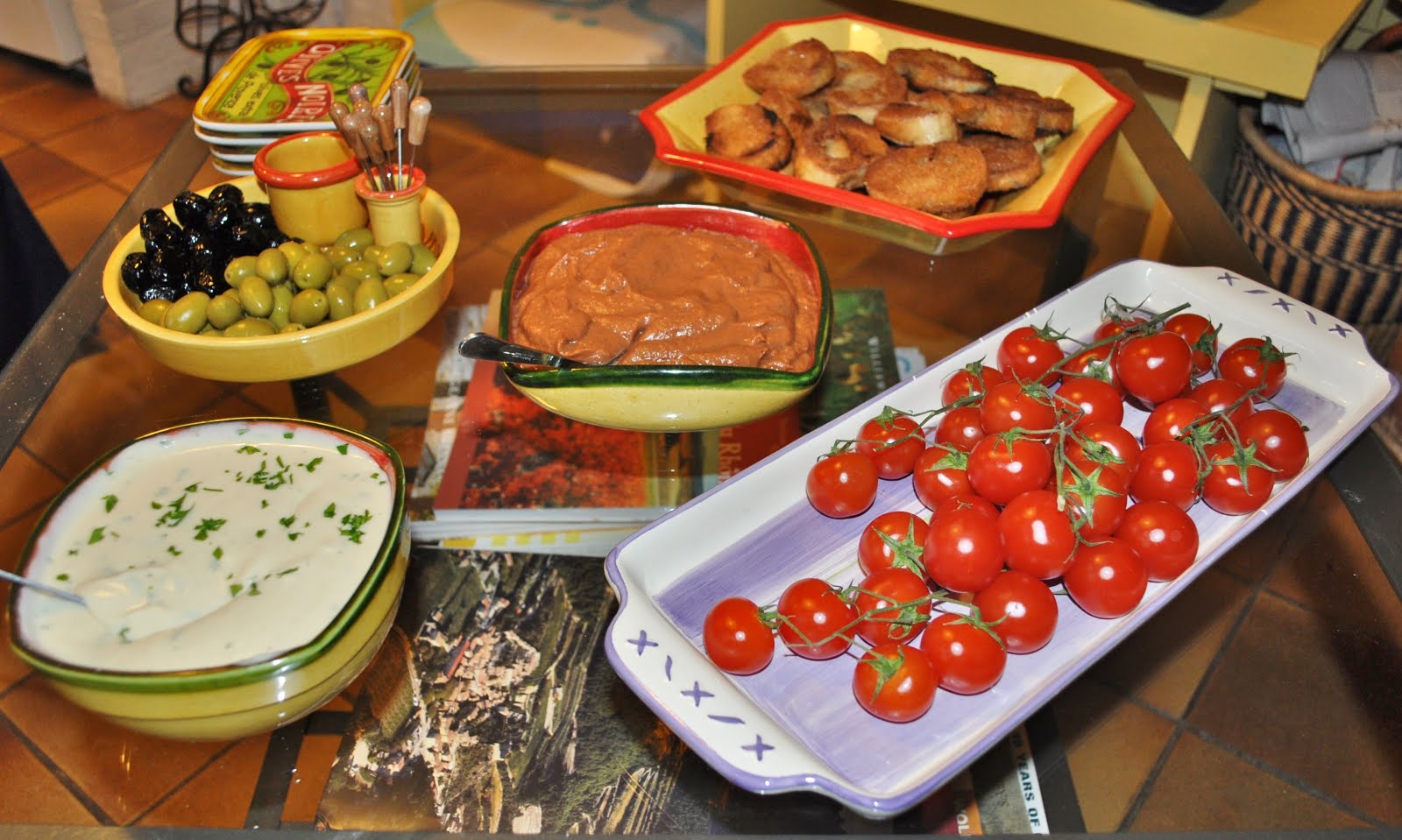
Here are pictures of "bites" we served with drinks for friends who came for aperitif at our house in Provence and in Northern California. The first is Sablet, when the weather was chilly and we set up in our cozy seating area in front of the fireplace. We served clusters of cherry tomatoes, two kinds of olives, eggplant caviar (I have shared this recipe before here), and white bean brandade with slices of toasted baguettes.


This gathering was also in Sablet but out on the kitchen terrace on a beautiful warm evening in Provence. We served eggplant caviar with slices of toasted baguettes, radishes with Camargue sea salt, two kinds of olives, saucisson, and goat cheese-stuffed cherry tomatoes. We also offered rosé wine from Tavel, white wine from Cassis, pastis and on this occasion, although not typically offered, vodka for one of our guests who we knew likes a cocktail for aperitif.


This gathering was in Northern California where we set up on a counter in the kitchen because everyone hangs out there when they are at the house. We served a mixture of marinated olives, radishes, cornichons, bibeleskaes (a fromage blanc recipe from Alsace we got from L'Auberge Chez Francois, a favorite restaurant outside Washington DC), and eggplant tapenade with a variety of crackers.


As I told you here, my 2013 cooking challenge is to try 52 new recipes out of different cookbooks. So although we love the eggplant caviar recipe we got from our friend Bruce in Villedieu, I decided to make an eggplant tapenade from "The Bistros, Brasseries and Wine Bars of Paris" cookbook by Daniel Young.

This recipe comes from Juveniles, a wine bar in Paris 1st arrondisement where they serve this tasty tapenade as their house dip. This is very good to serve with toasted baguette slices or crackers with aperitif.


Eggplant Tapenade
Makes 2 Cups

Ingredients

1 large eggplant about 1 pound
Extra virgin olive oil
Salt
1/2 cup oil-packed, sun-dried tomatoes, coarsely chopped
1/2 cup coarsely chopped pitted black olives
2 teaspoons drained capers
1/2 teaspoon piment d'Espelette, ancho powder or other medium-hot chili powder, optional
Freshly ground black pepper

Finishing

1. Pre-heat oven to 375F (190C). Split the eggplant in two vertically. Brush both halves with the olive oil and score the eggplant with a sharp knife. Place on a baking sheet and roast in oven until golden in color and soft, 40 to 50 minutes.

2. Scoop out the roasted eggplant into a food processor, add the sun-dried tomatoes, black olives, capers, 1/3 cup olive oil, piment d'Espelette, and a few grinds of black pepper. Puree to a paste, about 30 seconds. Taste the puree and correct for seasoning.


In the words of one of my favorite television chefs Jacques Pepin, "I wish you happy cooking." Bonne journée mes amis et à bientôt.

Sunday, January 6, 2013

My New Year's Cooking Challenge

Happy New Years!

If you are a regular reader of Our House in Provence blog, you know that I am a "foodie". I love to eat, cook, read and talk about food and restaurants. I guess that's how we ended up as co-owners of a small French bistro in Northern California called Bistro Des Copains.

I used to subscribe to almost every cooking magazine there is but I don't do that anymore except for "Saveur" and "Cook's Illustrated". In my opinion, in an effort to compete with all of the cooking shows and channels that populate daily TV, the magazines have been redesigned and content dummed down to keep their readers.

While I don't read food magazines like I used to, I love cookbooks and continue to get new ones about foods I like to eat and cook. In the dining room adjacent to our Northern California kitchen, I have two tall bookcases full of cookbooks. At last count, I had over 250 of them.


My family loves when I cook but I don't have time except for weekends and then cook only if Shirley is not working at the hospital. Although I have all these cookbooks, you probably aren't surprised that I usually do the same salads and cook the same pastas, risotto, and fish over and over.

A few weeks ago on a Saturday before Christmas, we were eating lunch and we started talking about my cookbook library and that I had requested, as usual, cookbooks for Christmas. Shirley suggested that my New Year's resolution should be to cook a new recipe out of a different cookbook every week. So 52 new recipes from 52 cookbooks during 2013.

Because I like a challenge and want to try new recipes, I have accepted Shirley's challenge as one of my New Year's resolutions. So in between my posts about our lives in Provence, I will share some of the recipes that we think are particularly good and think you should try.

For my first week, I chose recipes from "Patina Cookbook" by chef Joachim Splichal. Patina was a fabulous restaurant in Los Angeles on Melrose Avenue where I had the chance to dine a few times before it relocated to downtown Los Angeles. In addition to Patina, chef Splichal opened Pinot Blanc, a restaurant we really liked in nearby Napa Valley.


My Patina menu consisted of a first course "Salad of Corn" with sauteed potato, frisée and corn with a balsamic vinaigrette.


For our main course, I made the "Sea Bass" with creamy lentils and garlic infusion with baby carrots and pearl onions. As you can see, I substituted salmon for sea bass which I could not find. This was the best lentil dish I have ever tasted. Although it's time consuming, I will definitely make this dish again and again.


The piece de resistance though was the "Chocolate Croissant Pudding" with Wild Turkey Sauce, the best bread pudding according to Stephanie, a bread pudding aficionado, she has ever had. Served warm, it was almost like a chocolate fondant cake, all warm and gooey bittersweet chocolate inside.


Chocolate Croissant Pudding
with Wild Turkey sauce
Serves 6

Wild Turkey Sauce

1 cup milk
1/2 vanilla bean, halved lengthwise and seeds scraped out
4 large egg yolks
1/4 cup granulated sugar
1 tablespoon Wild Turkey whiskey

In a small sauce pan, combine the milk with the vanilla bean and seeds and bring just to a boil. Remove from heat and allow to infuse for 5 minutes, then strain out the vanilla pod. Whisk the egg yolks together with the sugar until the mixture is pale and thickened. Pour about a quarter of the hot milk into the egg mixture and mix until well combined, then return the yolk mixture to the pot with the rest of the milk and, over medium-low heat, stir until thickened. Do not allow the mixture to boil. Strain it through a strainer into a clean pan and add the Wild Turkey. Cool the sauce and refrigerate, covered, until chilled.

Croissants

4 croissants, cut in half horizontally

Preheat the oven to 450 degrees F(230 C). On a baking sheet, toast the croissant halves until golden, about 6 minutes, watching carefully as they burn easily. Remove from the oven and, when cool, cut the croissants up into 1/2 inch pieces and set aside. Reduce the oven to 350 degrees F (175 C).

Custard

2 cups heavy cream
1/4 vanilla bean, halved lengthwise and seeds scraped out
5 large egg yolks
1/4 cup plus 2 tablespoons granulated sugar

In a medium saucepan, heat the cream and the vanilla bean together over medium-high heat. Bring the cream to just below boiling point, then remove from the heat and allow to infuse for 5 minutes. Strain out the vanilla pod. In a medium mixing bowl, whisk the egg yolks and sugar together until the mixture is pale and thickened. Gradually whisk the warm cream into the egg yolks and then return the mixture to a clean saucepan. Over medium-low heat, bring the mixture up to just below boil, stirring all the time until thickened, and immediately remove it from the heat.

Finishing

The reserved toasted croissant pieces
8 ounces bittersweet baking chocolate, cut into 1/2 inch chunks. True confession, I used 10 ounces bittersweet baking chocolate chips.
1 tablespoon confectioners' sugar

Arrange an equal amount of toasted croissant pieces in each of six-eight ounce ramekins or ovenproof bowls (I used 10 ounce ramekins). Distribute the chocolate chunks evenly among the ramekins. Spoon the warm custard over the mixture, pressing down with a fork to be sure all the pieces of croissant are soaked in the custard, and cover each ramekin tightly with aluminum foil.

Place the ramekins in a roasting pan and pour in enough very hot water to come halfway up their sides. Bake in the hot oven for 15-20 minutes, or until just set, then pierce the foil with a toothpick to release the steam and let stand for 5 minutes before removing the rest of the foil. (Note: At this stage you could cool and refrigerate the pudding for several hours or overnight. Warm them through in a 400 degree F (205 C) oven for 4 to 5 minutes before serving.)

When you are ready to serve, dust the top of each warm pudding with a little powdered sugar and serve the the chilled sauce in a sauce boat on the side.


In the words of Jacques Pepin, I wish you happy cooking. Bonne journée mes amis et à bientôt.