Showing posts with label Fort Saint-André. Show all posts

Sunday, August 27, 2017

A visit to Avignon and the Jardin des Doms during the Festival of Avignon

Avignon is 40 km southwest of Sablet, snuggled inside ancient walls along the Rhône River. The largest town in the Vaucluse, Avignon is very old, full of history, art, music and activity. You could spend hours wandering the narrow streets inside the fortified walls without getting bored

The historic center of Avignon radiates from Place de l'Horloge. Here, you will find the City Hall built between 1845 and 1851 on top of a former cardinal's palace. The old fortified tower of the cardinal's palace was retained and transformed into a belfry in the 15th century with clock and bellstriker. Next to it, the municipal theater, also from the 19th century, houses the Avignon opera and, at the top of the square, the "Belle Époque" style carrousel seen below.

"Belle Epoque" Carrousel

When we go to Avignon, we try to park at the Hotel Mercure garage because the stairs exit close to the Popes' Palace. Right next to the stairway, is the Hôtel des Monnaies (mint), the earliest private Baroque monument in Avignon. It sits opposite the main entrance to the Popes' Palace. It was built in 1619 by the Vice-Legate Jean-François de Bagni, and is dedicated to Paul V, the then reigning Pope. In 1860, it became the Conservatoire National de Musique. It was used as such up to 2007.

Hôtel des Monnaies

Notre-Dame des Doms Cathedral is a Romanesque building, mainly built during the 12th century. The most prominent feature of the cathedral is the 19th century gilded statue of the Virgin which surmounts the western tower. The mausoleum of Pope John XXII (1334) is one of the most beautiful works within the cathedral. During the 14th century this became the world’s most important church, home to seven different popes.

Notre-Dame des Doms Cathedral

Next to the Opera-Theatre on Place de l'Horloge (translated as "Clock Place") is the neo-classical town hall known as the Hôtel de Ville. As I told you earlier, only the 14th century clock tower remains from the original structure. The Gothic clock tower seen below, which gave the square its name, was incorporated later into the construction of the Hôtel de Ville.

14th century Bell Tower of the Hôtel de Ville is in the background

Street performers in front of the Popes' Palace

We had come to Avignon that morning primarily so Shirley and Stephanie could hit the stores. Since I didn't think the grandkids would enjoy that very much, Earl and I with kids in tow, headed for the Jardin des Doms.

A gentle five-minute stroll up a small hill from the cathedral, the Jardin des Doms offers a welcome refuge from Avignon's heat and bustle on a summer's day as well as panoramic views of the historical city, the Rhône River, Saint Bénézet Bridge, Villeneuve-lez-Avignon, Mont Ventoux and the surrounding countryside. It was fully landscaped as a public park in the 19th century.

View from Jardin des Doms to Villeneuve-lez-Avignon

The seven acre park is beautifully landscaped with shrubs and trees, statues of local notables and built around a pond which is home to ducks and geese. There are lots of benches, a picnic area and children's playgrounds.

Granddaughter Madison pulls Jilian in a pony cart, in the Jardin des Doms

Grandson Dylan in front of bust of Paul Sain, a French Painter born in Avignon

Fort Saint-André is a medieval fortress across the Rhône River from the Jardin des Doms that I told you about here in Villeneuve-lès-Avignon, dating from the first half of the 14th century.

Fort Saint André across the Rhône River in Villeneuve-lez-Avignon

Many of you know the French children's song, "Sur le pont d'Avignon" (On the bridge of Avignon), which describes folk dancing. The bridge of the song is the Saint Bénézet Bridge over the Rhône River that we visited here.

The bridge was constructed between 1177 and 1185 with 22 arches and was 980 yards long. It was destroyed by Louis VIII of France during the siege of Avignon in 1226. It was rebuilt beginning in 1234. The bridge was only 16 feet wide, including the parapets at the sides. The arches were liable to collapse when the river flooded.

The bridge fell into disrepair during the 17th century. By 1644 the bridge was missing four arches and finally a catastrophic flood in 1669 swept away much of the structure. Since then, the surviving arches have successively collapsed or been demolished and only four arches remain.

View of Saint Bénézet Bridge from the Jardin des Doms

Madison and Dylan enjoy a teeter-totter in the Jardin des Doms

Rocher des Doms

In 1309 Avignon, still part of the Kingdom of Arles, was chosen by Pope Clement V as his residence at the time of the Council of Vienne and, from March 9, 1309 until January 13, 1377, Avignon rather than Rome was the seat of the Papacy. In all seven popes resided in Avignon.

The Campane Tower seen below is part of the Pope's Palace and served as a storeroom for arms and precious objects and housing for the night watchman and some members of the Pope's close entourage.

Palace of the Pope's Campane Tower

As we leave the Jardin des Doms to return to Place de l'Horloge, we retrace our steps down a little zigzag ramp and cross over in front of Notre Dame des Doms Cathedral.

Side view of Notre Dame des Doms Cathedral with the Campane Tower behind

Granddaughter Madison with the backdrop of Notre Dame des Doms Cathedral

Statue of Christ on the cross in front of Notre-Dame des Doms Cathedral

A side view of a statue of Christ on the cross in front of Notre Dame des Doms Cathedral

Avignon is well known for its Festival d'Avignon, the annual festival of theater and performing arts founded in 1947. There are really two festivals that take place: the more formal "Festival In", which presents plays inside the Palace of the Popes and the more Bohemian "Festival Off", known for its presentation of largely undiscovered plays and street performances.

Street performers

The 2017 Avignon Festival took place from July 6 to 26. Over 40 different plays are performed in more than twenty venues, from small, 150-seat chapels to the 2000-seat legendary Honor Courtyard in the Palace of the Popes. As you walk around Avignon, you see flyers promoting one of the plays or musical acts everywhere you go.

Promoting a show

We didn't realize that groups go around to the various squares where there are restaurants including Place du Cloître St Pierre where we were having lunch at Crêperie La Flourdiliz, promoting their upcoming programs.

We were happily surprised that one of the groups that came by to promote their show was Quatuor Leonis with our friend Guillaume Antonini. It would have been fun to attend their show, but it didn't start until 22h30 and that was way too late for our group.

Quatuor Leonis promoting their show

A theater group promoting their show

Street performer

Since we were with the grandkids, we dined at Crêperie La Flourdiliz, a Brettone crêperie near the Pope's Palace rather than one of the places we go regularly since we didn't think the grandkids would enjoy sitting through a multi-course meal. We were perfectly positioned to see the various acts come through the square and promote their shows.

The family dining at Crêperie La Flourdiliz while watching the various acts perform

Whether in Avignon with or without kids, Jardin des Doms is worthwhile to include on your visit to Avignon. Have you been to Jardin des Doms, please let me know what you think.

Saturday, March 16, 2013

Fort Saint-André, Villeneuve-lès-Avignon

One day, shortly after we signed the papers to buy our house in Sablet, we were with cousin Jean-Marc and wife Christine, who suggested we go visit elderly cousin André and wife Mauricette who live in Villeneuve-lès-Avignon. Until just recently, I didn't know we even had relatives who live near Avignon or anything about Villeneuve-lès-Avignon.

Jean-Marc suggested we get our own Notaire, preferably one who spoke English when we signed the Promesse de Vente (promise to sell). Stay with me, this is relevant to my story; The agent immobilier (real estate agent) recommended a Notaire, Maître Florence Falque in Carpentras who speaks and writes English. For any of you who are thinking about buying a house in France, and English is your first language, it's a good idea to use a Notaire who can explain and translate legal documents into English, no matter how well you speak French.

As it turns out, Jean-Marc has not had much contact with the cousins until recently. André is my father's first cousin (their father's were brothers). Jean-Marc is a renown cardiologist at the University of Montpellier and André had recently come to see him about his heart. Jean-Marc mentioned that we signed a Promesse de Vente and were using a Notaire from Carpentras. Turns out Maître Falque is a friend of Mauricette (she is originally from Carpentras) and is the Notaire that André used.

We called the cousins and asked if it was a good time for a visit? Once seated, and offered cookies and a drink, we discovered that after André heard we were buying a house in Sablet, he got on his bicycle and pedaled to Sablet and back so he could see where we were going to live. André is a long-time bike rider, has ridden up and down Mont Ventoux quite a few times, but I think it was a mighty feat to ride 90 kms (56 miles) at nearly 80 years of age.

We had a wonderful visit with the cousins, he worked for the SNCF (France's national state-owned railway company) for many years, has an amazing green thumb, you should see his garden, and both are very good painters. We are now proud owners of several of their paintings. I have since found out that she is a very good cook. We visit each time we are in Sablet but until a few months ago, we still didn't know anything about Villeneuve-lès-Avignon.

So one day I called André and asked if he would show me the special sights around town. We drive past Fort Saint-André on the way to the cousin's house. And so although there is no relation between the fort and cousin André, the Fort was our first stop on our tour of Villeneuve-lès-Avignon. The town and Fort Saint-André are located in the Gard Department at the eastern edge of Languedoc-Roussillon, on the border with Provence directly across the Rhône River from Avignon.

Fort Saint-André

King Philip IV of France, known as Phillipe le Bel (the Beautiful) commissioned the construction of Fort Saint-André in 1292 as a show of power of the Kingdom of France and to keep watch on the Holy Roman Empire on the other side of the Rhône River. At that time, Villeneuve-lès-Avignon was on the eastern border of France and Provence was part of the Empire.

Fort Saint-André Reception Building

Although the Fort was commissioned in 1292, it was not built until the 1360's by King Jean II le Bon (the Good) on Mount Andaon, a rocky hill that rises over the floodplain of the Rhône River. Prior to the 1770's, the Rhône flowed just below the rock where the Fort was built on Mount Andaon. Around 1770, the Rhône River moved its bed 900 meters away from the rock.

Saint-André Abbey Garden

Besides showing the power of the Kingdom of France, the Fort also provided protection for the Benedictine Saint-André Abbey and the small village of Saint-Andre already present on Mount Andaon.

Saint-André Abbey Garden

The walls and towers of the Fort protected a large area of more than 3 hectares (7.5 acres). The current reception area and neighboring building were used in the 18th century as the military headquarters and garrison.

View of Papal Palace in Avignon from Fort Saint-André

The fortification walls are 750 meters (2,460 feet) long and included comfort amenities such as latrines, fireplaces in the entrance fortress and sentry boxes on the wall walk.

Cousin Andre heads towards the vaulted rooms under the terrace

As I mentioned, the Fort surrounds the remains of an abbey built on Mount Andaon near the tomb of Saint Casarie in the 10th century. Very powerful in the Middle Ages, this abbey owned more than 200 monasteries and convents between Uzès and Forcalquier. After a period of decline, it was rebuilt in the 16th century according to the plans of the architect Pierre Mignard, who also designed the gardens.

The 16th-century gardens disappeared a long time ago. Redone in the 18th century, they were restored at the beginning of the 20th century when, in 1914, Gustave Fayet, patron to Paul Gauguin and an important art collector, bought the Fontfroide Abbey south-west of Narbonne and the Saint-André Abbey.

Vaulted Rooms under the Saint-André Garden Terrace

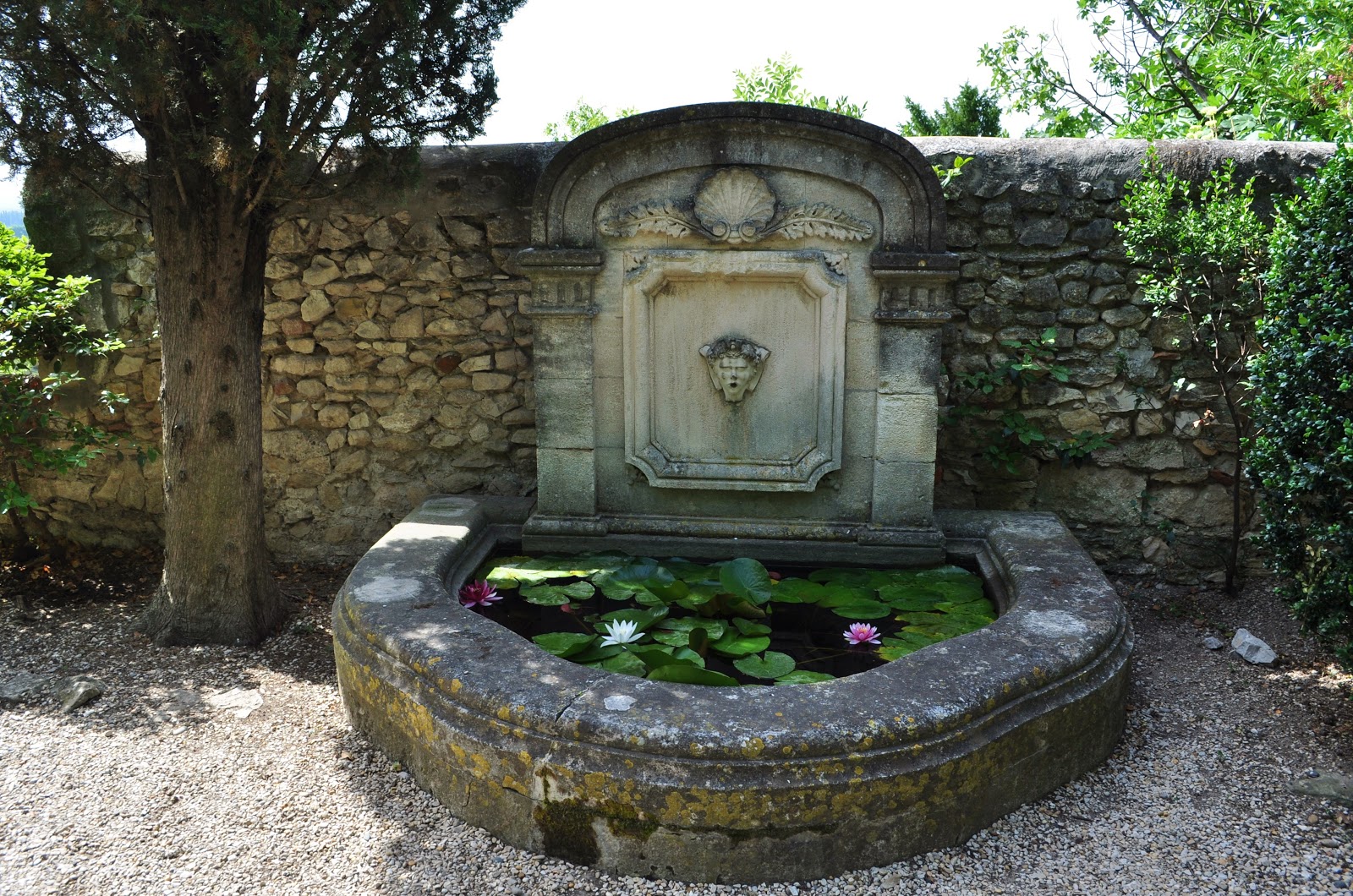
The abbey gardens are nicely maintained and contain numerous statues, fountains and other ornaments.

Vaulted passageway

The gardens provide a vast view over the surrounding countryside and Rhône valley.

View from the abbey garden with Philippe Le Bel tower in the distance


Remains of the abbey


Another vaulted passageway

The Saint Casarie Chapel was constructed during the 11th century on Mount Andaon near where St. Casarie is said to have died in a cave in 587. Casarie was married to Valens, who later became a bishop. Casarie became a hermit and lived on Mount Andaon where the monastery was founded in recognition of her sanctity.

The Saint Casarie Chapel


Cypress trees in abbey garden


Remains of the abbey

At the base of a beautiful large terrace is a pergola with stone pillars holding wisteria and roses, creating a shady corridor that is covered with flowers of all kinds.

The Pergola in the Saint-André Abbey Garden

Elsa Koeberlé who was a friend of Gustave Fayet became committed to restoring the Abbey’s garden. While remaining faithful to the old plans, she created two pools separated by beds of roses edged with santolina and oleanders. She redesigned the flowerbeds favoring Mediterranean plant varieties. The cypress tree alley, the olive trees, the arbors and pergolas, the big terrace, all help give the appearance of a Florentine garden to the place.


Cousin Andre pauses at the Saint-André Abbey garden

The Masques Tower takes its name from the Provençal "masco", meaning witch or magician, reputed to attract the wicked spells so that the rest of the battlements were protected. The Masques Tower has a single high room because of the unevenness of the site.

The Masques tower

The entrance fortress, called the Royal Château or the twin towers, was built in several stages. It ensured the defense and command of the fort and afforded an uninterrupted view of Mont Ventoux. It still has a crown of machicolations, openings through which stones, or other objects, could be dropped on attackers from the top of the curtain wall. It housed the working quarters of the châtelain, the commander of the castle, and the administrative and judicial officer.

Twin towers guard the main entrance to Fort Saint-André

After leaving Fort Saint-André, we walked down the street to Chartreuse du Val de Benediction Monastery which I will tell you about in my next post.

Bonne journée et à bientôt.