Showing posts with label Saint-Rémy-de-Provence. Show all posts

Saturday, July 8, 2017

Vincent van Gogh at Saint-Paul-de-Mausole asylum near Saint-Rémy-de-Provence

Vincent van Gogh was a Dutch Post-Impressionist painter who is among the most famous and influential figures in the history of art. In just over a decade he created about 2,100 artworks, including around 860 oil paintings, many of them in the last two years of his life.

Saint-Paul-de-Mausole seen below, lies just outside of Saint-Rémy-de-Provence, about one hour southwest of Sablet. Mentioned on several occasions by Nostradamus, who was born nearby and knew it as a Franciscan convent, it was originally an Augustinian priory dating from the 12th century, and converted into an asylum in the 19th century.

A well-preserved set of Roman ruins known as les Antiques, the most beautiful of which is le Mausolee, adjoins the property, and forms part of the ancient Graeco-Roman city of Glanum. The asylum is located in an area of cornfields, vineyards and olive trees.

Saint-Paul-de-Mausole asylum

Exterior grounds near the entrance to Saint-Paul-de-Mausole asylum

Vincent Van Gogh arrived on May 8, 1889 at Saint-Paul-de-Mausole in Saint-Rémy-de-Provence after an incident in which he cut off his ear, to voluntarily commit himself to the asylum and remained there for just over a year until May 16, 1890.

He had suffered a series of severe breakdowns since December 1888 and believed he should be institutionalized for his own sake and that of others.

Statue of Vincent van Gogh by sculptor Gabriël Sterk near entrance to Saint-Paul-de-Mausole asylum

Cloister Corridor with arcades of twinned columns

The main building at Saint-Paul-de-Mausole is centered around its lovely Romanesque cloisters (pictured below) lined with rambling roses and lavishly planted with begonias and other flowers. Part of the Saint-Paul complex remains a psychiatric institution and still accepts patients (female only).

Cloister garden

Stairway lined with paintings to Van Gogh's room on upper floor

Corridor leading to Van Gogh's room

Vincent van Gogh's bedroom (pictured below) was sparsely furnished with an austere single bed, easel, wooden chair, desk, battered leather bag and a barred window looking out on to a kitchen garden and wheat fields which he painted 15 times.

Vincent van Gogh's bedroom at Saint-Paul-de-Mausole asylum

Vincent van Gogh's studio which adjoined his bedroom

Vincent van Gogh's treatment at Saint-Paul-de-Mausole was rudimentary – limited to two-hourly baths twice a week, a frugal diet and managing to stop his intake of alcohol, coffee and self-harming consumption of turpentine and paint.

Tubroom at Saint-Paul-de-Mausole asylum

Bedroom in Arles (seen below) is the title given to each of three similar paintings by Vincent van Gogh. Van Gogh's own title for this painting was simply The Bedroom. There are three authentic versions described in his letters, easily discernible from one another by the pictures on the wall to the right.

The painting depicts Van Gogh's bedroom at 2, Place Lamartine in Arles, known as the Yellow House. The door to the right opened on to the upper floor and the staircase; the door to the left was that of the guest room he held prepared for a friend; the window in the front wall looked on to Place Lamartine and its public gardens.

Bedroom in Arles

He was initially confined to the immediate asylum grounds and painted (without the bars) the world he saw from his room. After a few weeks being there, he was granted permission to work outside the asylum and ventured into the countryside to paint. He was productive and sent most of his work to his brother Theo.

As you stroll around the garden seen below, you can view more than 20 large-scale reproductions of Vincent van Gogh’s most famous paintings on the site where they were created.

View from Vincent van Gogh's window

During his time at Saint-Paul-de-Mausole, he finished over 150 drawings and 143 paintings of his surroundings over all four seasons of the year. They include some of his best known works such as Irises, Wheat Field with Cypresses, The Siesta and The Starry Night.

View over lavender field toward Saint-Paul-de-Mausole asylum

Vincent van Gogh seemed for a while to be recovering, but he suffered a relapse in early 1890 and in May 1890, moved north to Auvers sur Oise to be near his brother, Theo, and a new physician, Dr. Paul Gachet. Only two months later, on 29 July 1890, Vincent van Gogh took his own life at the age of 37.

Iris field outside Vincent van Gogh's room at Saint-Paul-de-Mausole asylum

During his lifetime Vincent van Gogh was never famous as a painter and struggled to make a living as an artist. He only sold one painting during his lifetime, "The Red Vineyard". This painting sold in Brussels for 400 Francs a few months before his death (about $1800 in 2011) to the impressionist painter and heiress Anna Boch.

Since his death, he has become one of the most famous painters in the world. Van Gogh’s paintings have captured the minds and hearts of millions of art lovers. Seven of his paintings are among the highest priced sales on record and alone sold for over 730 million current dollars.

Flower carving on wall of Cloister

There are no original works by Vincent van Gogh to be seen at Saint-Paul-de-Mausole. But you will find plenty of reproductions and, as a nice extra to the visit, you can take a self-guided walk from Saint-Paul to Saint-Rémy-de-Provence. The route is peppered with 21 illustrated panels, with short explanations in English and French comparing Vincent van Gogh's visions directly with the real landscapes that inspired him.

Sunday, July 20, 2014

Market Day in Saint-Rémy-de-Provence

The best things about blogs are meeting wonderful people you would never meet otherwise, in person or by email. I have heard from readers who have told me they planned their entire trips to Provence from my blog and from others saying the pictures reminded them of places they visited in the past.

Most recently, I heard from cousin Mauricette who told me my last post reminded her of summer vacations in Le Beaucet. She said that I included a picture of their vacation house, completely by accident, and the picture of the fountain brought back memories of fetching water for the household.

As I've told you, we don't spend a lot of time in Sablet. Being there for only a few weeks, we like to explore different locales, some of which I discover on other blogs. If we are going to a town or village, we try to go on market day as that is the best day, in our opinion, to visit towns and villages in Provence.

On our list of places to visit this trip, were Saint-Remy-de-Provence and Les-Beaux-de-Provence. Since Wednesday is market day in Saint-Remy, that was the day we decided to go. We would spend the morning in Saint-Remy, enjoy a leisurely lunch, bien sur, then afterwards go to nearby Les-Beaux-de-Provence.

Saint-Remy-de-Provence is set 13 miles due south of Avignon and 17 miles north-east of Arles in the Alpilles, craggy limestone hills carpeted with vineyards, orchards, market gardens and olive groves. The area is quite different from the countryside around Sablet.

It was founded by Celts in around 6 BC, became Greek two centuries later, then fell to the Romans who constructed a large city, Glanum. Saint-Rémy (the name came from a bishop said to have performed a miracle there) continued to flourish in the Middle Ages, when the walls and ramparts were built.
The most obvious remains of the 14th-century walls are the old portes (gates), still in use today as entry ways into the center of old Saint-Rémy. The old center is circled by a ring-road of boulevards, small enough that you can walk around the circumference in 20-30 minutes.

Saint-Rémy-de-Provence

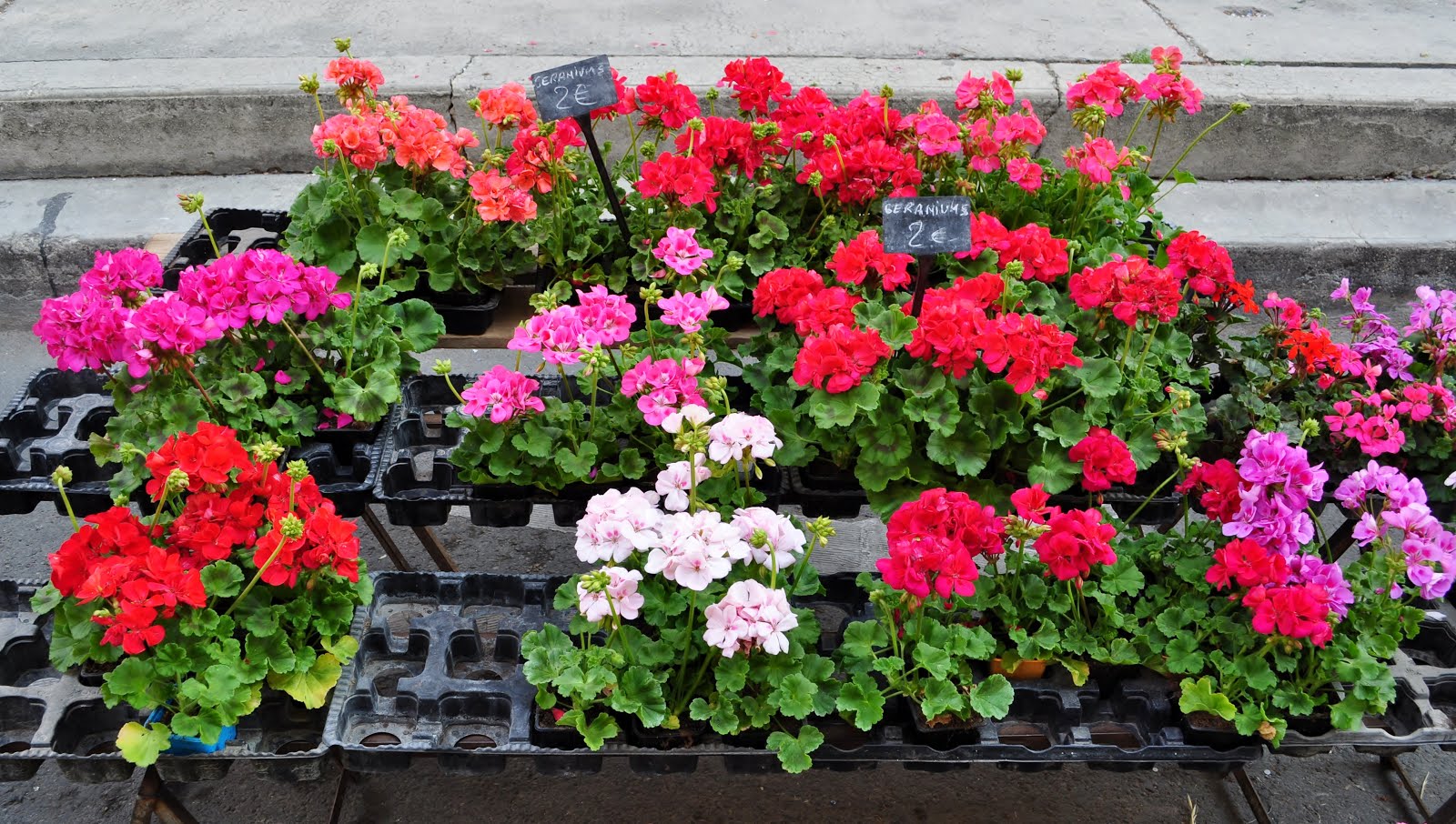
As I said it was Wednesday and market day in Saint-Remy. The stalls spill from the Rue de la République just on the edge of Saint Rémy down into the winding alleys and shady squares of the old town. They offer traditional and more unusual crafts as well as clothes, shoes and a huge range of fresh local produce, fish, meat, cheese and flowers.

Mimosa

Asparagus

Brightly Colored Market Baskets

Different Colors and Flavors of Vinegar

That Wednesday was also the start of Carnaval in Saint-Remy with the parade of Marmitons through the market.

Parade des Marmitons

Parade des Marmitons

Parade des Marmitons

Bell Tower of the Town Hall

Dried Fruits, Nuts and Fresh Garlic

Olives of Every Variety

French Flag Blowing in Front of Town Hall

Gothic Bell Tower of Collégiale Saint-Martin

Faded Blue Shutters in Saint-Rémy

Renoncules (top) and Primaveres (bottom) For Sale at Market

The beauty of the countryside and the quality of light has inspired artists, writers and painters. Without a doubt, the most famous was Vincent Van Gogh. After cutting off his ear, the artist voluntarily committed himself for treatment at Saint Paul de Mausole, a beautiful 11th century monastery converted into a psychiatric clinic, just outside Saint-Remy.

Shop Selling Local Specialties of Saint-Rémy

He arrived from Arles on May 8, 1889 and remained there just over a year until May 16, 1890. During this time, he completed over 150 drawings and 143 paintings of his surroundings over all four seasons of the year. They include some of his best known works such as Irises, Wheat Field with Cypresses, The Siesta and The Starry Night.

Saint-Remy Statue

Michael de Nostredame, or Nostradamus, was born in Saint-Rémy in 1503 in a house, tucked away down a narrow side-street. There is a plaque, but with its bricked up windows and modest façade, it's not terribly impressive. A more fitting tribute to the scholar and astrologer is the pretty fountain seen below topped by his bust on Saint-Rémy's main street, Rue Carnot.

Nostradamus Fountain

Shop Selling Souvenirs

Window Mural in Saint-Rémy

Located in the historic center of Saint-Remy at Place Favier, the Alpilles Museum is housed in the Hotel Mistral de Mondragon, a former Renaissance mansion. It has been listed as a Historical Monument since 1862, the building is built around a beautiful courtyard. Created in 1919 by Peter Brown, the museum was completely renovated between 2002 and early 2005.

Alpilles Museum

Near the Alpilles Museum at the back of Place Favier, an antiques dealer has installed her shop. She has set up mannequins in front of her store and dressed them in traditional Provencal costumes. Her shop is framed by old houses and a tower.

Antiques Dealer at Place Favier

In the 15th century, Agnès Hugolen de Fos, a daughter of Saint-Rémy nobility, married a member of the renown Provencal family de Sade, and built a house on this site, which was substantially restored after 1945. The Hôtel de Sade belongs to the French Monuments Nationaux authority.

Hôtel de Sade

Saint-Remy Arched Gate

The Collégiale Saint-Martin, pictured below, is a Catholic Church built on the site of a medieval church which collapsed in 1818 and was reconstructed three years later. The style is mostly neo-classical, though it's topped, by a Gothic bell tower. Its pride and joy is an organ which was restored in 1983 by Pascal Quoirin and is pressed into service each year for the Festival Organa, a series of free Saturday evening concerts by some of the finest organists in the world.

Collégiale Saint-Martin

Saint-Remy Street

Memorial to the Children of Saint-Remy who died in War for France 

Looking Down the Street to the Bell Tower of the Town Hall

Step into Huile du Monde and La Maison de la Truffe seen below where you can sample the best olive oil and vinegar in the area and see a good display of truffles.

Arched Entry Gate to Huile du Monde - La Maison de la Truffe

The Saint-Paul gate seen below is the entrance from the south into Saint-Rémy, onto Rue de la Commune leading to the main square called Place Pelissier where the town hall is located.

Saint-Paul gate into old Saint-Rémy

Saint-Remy Fountain

The city of Glanum built by the Romans a little south of Saint-Rémy is on the road, which today links Saint-Rémy and Les Baux de Provence. Having been covered for centuries by alluvial mud which slid down the hill, Glanum is uncommonly well-preserved and is one of the most important ancient sites in Provence.

Excavation work on Glanum only began in 1921 (so van Gogh would not have known of it) and it is believed that much more remains to be discovered.

The mausoleum seen below dates from 30-20 BCE. Particularly well preserved, it is famous for its unusual structure, unique in Roman architecture: from a rectangular pedestal with four magnificently carved faces rises a triumphal arch, on top of which stands a small round temple housing the effigies of two members of the Gallo-Roman family of the Julii, to whom this monument is dedicated.

The Antiques of Glanum Mausoleum

The Triumphal Arch seen below dates from about 20 CE, it has lost the pediment which once crowned the arch. It is decorated with beautiful reliefs illustrating Caesar’s conquest of the Gauls, with fruit and foliage, symbolising plenty, carved under the arch.

The Antiques of Glanum Arch

The market in Saint-Rémy runs on Wednesdays from around 7am to 1pm. Be sure to arrive very early or be prepared to park well away from the center of town. After we finished our stroll through the market and walked up and down the warren of streets and squares, we headed to lunch. I will tell you about a great place to have lunch nearby in my next post.

Have a great week. Chat soon.

Sunday, January 13, 2013

Saint-Rémy-de-Provence and Le Bistrot du Paradou

Blogs are a wonderful way to make friends with people that you wouldn't otherwise ever meet as all of you who have blogs well know. The best is when you get a chance to meet one of your cyber friends or a reader of your blog in person.

I have had the chance to do this several times including a day last year when we met up with Sherry Long and her husband in Saint-Rémy-de-Provence. Sherry is the author of Dog Trots Globe: To Paris and Provence, which tells the story of Chula, a Sheltie who shares her dog's eye view of France.

If you have not read the book, you should, as it is absolutely charming. You will follow Chula as she sniffs her way around boulangeries, lavender fields, and big outdoor markets of Provence. In Paris, she trots across the Seine, stands on her hind legs in awe of the Eiffel Tower, and attends opening night at a gallery.

As I was saying, last year Sherry and I got to emailing back and forth and discovered that she and her husband live in Northern California and also have a home in Saint-Rémy-de-Provence and we agreed that we would meet for lunch as we were going to be in Provence at the same time. Unfortunately, Chula was not going to be there.

On the appointed day, we headed off to Saint-Rémy, which is about 60 kms south of Sablet, at the foot of the Alpilles Mountains. The birthplace of Nostradamus in 1503, Saint-Rémy is most associated with Vincent Van Gogh, who after cutting off his ear in 1888, committed himself to an asylum there, during which time he painted olive trees, irises and the nearby Alpilles on more than 150 paintings.

We have not spent any time in Saint-Rémy since we were there with some of our Bistro Des Copains employees on a market day in January when an icy cold Mistral was blowing, making it impossible for us to stay outdoors and we retreated to one of the few cafés open that day. Since it was again market day, we went early so we could walk around Saint-Rémy before meeting Sherry and her husband.

The Vielle Ville (old town) is encircled by a ring of plane tree-shaded boulevards. The most visible remains of Saint-Rémy's 14th-century defensive wall are the portes like this Portail Saint-Paul still in use today as the southern entrance into the center of town.


Here are a couple of pictures of what we saw as walked around Saint-Rémy, As I said, it was Wednesday, market day in Saint-Rémy so we walked through the market stalls to see what was offered for sale including this pretty display.


Flowers


A display of items for sale to tourists.


An old stone arch entryway.


The old town is full of narrow streets with restaurants, cafés, tourists shops, trendy boutiques and art galleries.


Sherry had made reservations for lunch at Le Bistrot du Paradou, a favorite foodie destination for many years but a place we had not been. So I was most excited about finally going there.

Le Bistrot du Paradou is located about 12 kms southwest of Saint-Rémy in the tiny village of Paradou.


The restaurant is located in a traditional building, shaded by ancient plane trees. Although Mireille and Jean-Louis Pons who ran this lively bistrot for many years are no longer a presence there, the kitchen is still overseen by longtime chef Vincent.


A pretty mural next to the entrance to Le Bistrot du Paradou.


The dining room is country bistro in style: stone walls, wood-beams on the ceiling, zinc-topped tables, a large bar and black and white photos of celebrities on the walls.


The restaurant offers only a daily set menu that cost €42 at lunch when we were there, higher in the evening, and includes starter, main course, cheese, choice of desserts, wine and coffee.

The menu varies by the season and by the day of the week with choices including tête de veau, lamb, spit roast Bresse chicken, cassoulet and aioli. They don't advertise it but the kitchen usually has options available for diners who have food allergies or dietary preferences.


Wine is included with your meal and a bottle of Mont-Redon Côtes du Rhône was set on our table and a second one later when we had finished the last delicious drop.


Dishes are served family style. The starter that day was a frisée salad with croutons, lardons and hard boiled eggs with a tasty vinaigrette.


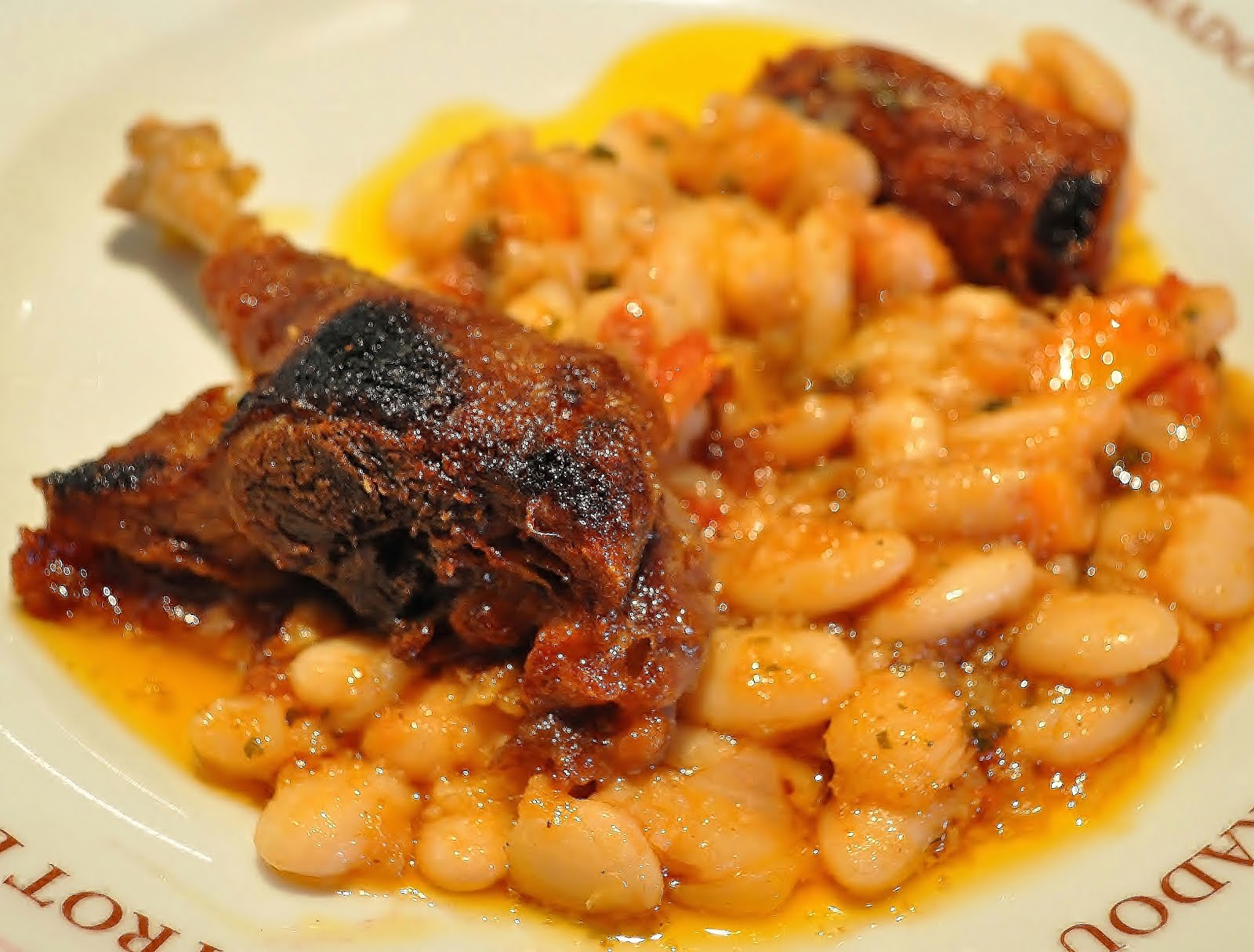
Being Wednesday, the main course offering was cassoulet. A big cassole, a conical earthenware container, glazed inside, the traditional vessel used for making cassoulet, filled to the brim with cassoulet was set in the middle of our table. The aroma which came out of that steaming dish made your mouth water.


We helped ourselves to plates of white beans, duck confit, meat and sausages in a rich tomato sauce. We all spooned second and third portions of this delicious dish on our plates.


Shirley is mostly vegetarian and the kitchen was happy to accommodate her with this tasty plate of Provençal vegetables.


When we exhausted our ability to eat anymore cassoulet, our table was cleared and a wicker platter of cheese was brought to the table for us to serve ourselves as many as we wanted to try.


Dessert choices included this chocolate mousse; and


ice cream. We finished with espressos.


As we headed back to Sablet, we passed this field with sheep. It reminds me that we must be in Provence when a Fête de la Transhumance takes place in Saint-Rémy on Pentecote Monday (50 days after Easter).

By the end of May, when there is little rainfall, the grass can no longer feed the sheep and water becomes scarce, these sheep and thousands more begin their journey towards the high mountain pastures. Today carried by truck, this trip, done by foot in the past, involved more than 10 days of walking.

At the Saint-Rémy Fête de la Transhumance, more than 3000 sheep from the Alpilles as well as goats and donkeys, accompanied by their shepherds in traditional costume along with their sheep dogs, parade twice around the boulevards that ring the old town center.


It was wonderful to meet Sherry and her husband and get the chance to try Le Bistrot du Paradou. We still have not really explored Saint-Rémy so we will return and dine at Le Bistrot du Paradou.

While it's not inexpensive to dine there, I think it's relatively good value given the quality, multiple courses, good wine and friendly service that comes with your meal. Reservations are definitely recommended, especially in high season. You may wish to check to see what will be served that day.

Le Bistrot du Paradou
57 Avenue de la Vallée des Baux
13520 Paradou
Tel: 04 90 54 32 70
No website