Aix-en-Provence is famous for its outdoor markets, shopping and beautiful people, and as the home of Paul Cézanne (1839-1906) who lived and did most of his work here. Unusual for Provence, there are no ancient historical sights to see.
Aix-en-Provence has long been a university town: Louis II of Anjou granted a royal charter for a university way back in 1409. The 40,000 students studying at the many teaching and research institutions today give the town a youthful energy.
Aix-en-Provence is often referred to as the city of a thousand fountains (a slight exaggeration). The construction of the Rotunda fountain in 1860 at the end of Cours Mirabeau was unusual for Aix-en-Provence because of its size and because it was the first to have a water basin.
Three statues: Justice, Agriculture and Fine Arts adorn the fountain and recall the main activities of the town. The fountain is at the former Porte Royale, for centuries the main entrance to the town.
 |
| Rotunda fountain |
Even though it was early in March, it was a beautiful day and the town was full of people including these street musicians seen below.
 |
| Street musicians |
The Cours Mirabeau is one of the most beautiful boulevards in the South of France. Created in 1650, it is one of the most popular and lively places in Aix-en-Provence. 440 meters long (1444 feet) and 42 meters wide (138 feet), it is lined with cafés, one of the most famous being Les Deux Garçons.
The plane-tree shaded Cours Mirabeau divides Aix into two parts, the Quartier Mazarin, or "new town", which extends to the south and west, and the Ville Comtale, or "old town", which lies to the north. The Cours Mirabeau is decorated by four fountains, the most impressive of which is La Rotonde, a large fountain that functions as a roundabout at one end of the street.
 |
| Cours Mirabeau |
 |
| Street musician |
As I said, Cours Mirabeau is lined on one side with banks and on the other with bookstores and cafés with tables that spill out onto the sidewalk, one of which is Les Deux Garçons, (I told you about eating therehere) the most famous brasserie in Aix. Built in 1792, it has been frequented by the likes of Paul Cézanne, Émile Zola and Ernest Hemingway.
 |
| Les Deux Garcons |
At the top of Cours Mirabeau is a 19th century fountain seen below which depicts the "Good King" René holding the Muscat grapes that he introduced to Provence in the 15th century.
 |
| "Good King" René |
Le Millefeuille Restaurant is where we headed for lunch. The restaurant is run by two veterans of l'Oustau de Baumanière, the well regarded restaurant with two Michelin stars in Les Baux de Provence.
 |
| Le Millefeuille Restaurant |
The fountain at Place des Prêcheurs (Preacher's Square) seen below was built in 1748, destroyed in 1793, and rebuilt in 1833, thanks to American philanthropy.
 |
| Aix-en-Provence fountain at Place des Prêcheurs (Preacher's Square) |
In front of the Palace of Justice is Place des Prêcheurs (Preacher's Square). Created in the 15th century by King René, it was the center of life in Aix-en-Provence until the construction of Cours Mirabeau. This area is undergoing a major renovation that will bring together Places Verdun, Prêcheurs and Madeleine.
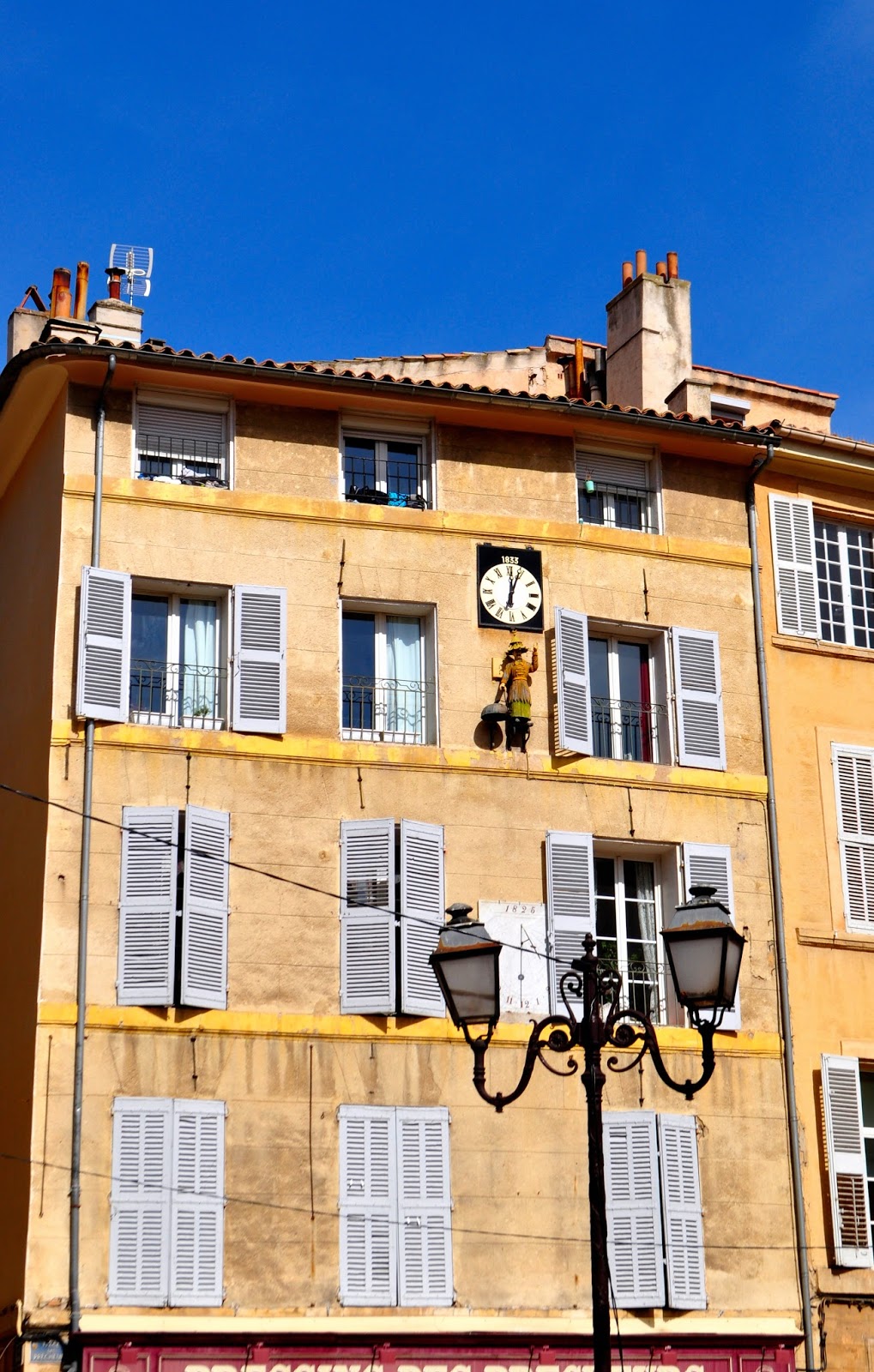 |
| Mechanical clock from 1833 at Place des Prêcheurs (Preacher's Square) |
 |
| One of the many pedestrian streets in the historic center of Aix-en-Provence |
The former prison of Aix-en-Provence built between 1825 and 1832 seen below was converted in 1998 to a legal center that now houses the Court of Appeal, the present Monclar Palace.
 |
| Former prison in center of historical Aix-en-Provence |
We always pay a visit to Marie-Hélène who owns La Victoire with her husband Philippe, the store where we purchased all our fabric for the table cloths, curtains and place mats we used at our Bistro Des Copains. This is not a tourist shop but a real fabric store. They have rolls and rolls of pretty Provençal fabrics, table cloths, place mats, and table runners. The store has been in business since 1918.
 |
| La Victoire (a fabric store) |
The Hôtel de Ville (town hall) seen below, a building in the classical style of the middle of the 17th century, looks onto a picturesque square (Place de l'Hôtel de Ville). At its side, rises the clock-tower erected in 1510.
 |
| Hôtel de Ville (town hall) |
 |
| Aix-en-Provence Hôtel de Ville (town hall) |
The 16th century clock tower at Place de l'Hôtel de Ville. The tower has two clock faces: a typical one and an astronomical clock from 1661 whose four wooden statues can still be seen: they symbolize the seasons, and appear in turn.
 |
| Aix-en-Provence clock tower |
Aix-en-Provence hosts open-air markets several mornings a week: there is a produce market daily at Place de Richelme, flea markets Tuesday, Thursday and Saturday at the Palace of Justice, flower markets on Tuesday, Thursday and Saturday at Place de l'Hotel de Ville as well as a book market on the first Sunday of each month.
 |
| The city's old belfry seen in the distance, straddles the street on Roman bases. |
Marseille soap or Savon de Marseille is a traditional hard soap made from vegetable oils that has been produced around Marseille, for about 600 years. The first documented soapmaker was recorded there in about 1370. They are nice to take home and make great gifts.
 |
| Shop selling the famous soap made in Marseille |
Aix-en-Provence is known for their Calissons. Calissons are a traditional candy consisting of a smooth, pale yellow, homogeneous paste of candied fruit (especially melons and oranges) and ground almonds topped with a thin layer of royal icing. Calissons have a texture not unlike that of marzipan, but with a fruitier, distinctly melon-like flavor. Calissons are often almond-shaped and are typically about two inches in length.
 |
| Calissons shop |
The Hôtel Estienne-de-Saint-Jean seen below was built in 1671. In 1932, it was converted to the Museum of Old Aix which is the town's history museum. The collections, established from donations by the museum's founder, Marie d'Estienne de Saint Jean, evoke the history and traditions of Aix in the setting of a beautiful aristocratic home.
You can see furniture, earthenware, figurines, objects from the guilds of craftsmen as well as lifelike nativity crib puppets.
 |
| Carved door entrance to Hôtel Estienne-de-Saint-Jean |
The historical town of Aix-en-Provence has more than 60 religious statuettes strategically placed at the corner of streets leading into an oratory: there are mostly Virgin statues dating from the 17th to the 19th centuries as well as a few other Patron Saints such as St Roch.
 |
| Statuette of Madonna on corner of building |
Fountain of Espéluque is located at Place of the Martyrs of the Resistance. Created for the chapter of the cloister, it was given to the residents and then moved in 1750 against a Roman wall to facilitate circulation. Dating from 1618, it is the oldest fountain of the city from that period of time. Its name came from a certain Espeluca who was apparently the owner of the spring. The water comes from an underground cave, the only source of water of the 15th century.
 |
| Fountain of Espéluque |
The memorial seen below honors the members of the resistance of Aix-en-Provence who were deported or executed during the Second World War. It also commemorates the more than 2000 Jews of which 100 were children who were deported to the Auschwitz concentration camp.
 |
| Memorial to the Martyrs of the Resistance and Jews deported to Auschwitz |
The Cathédrale St-Sauveur (Holy Savior Cathedral) seen below has an eclectic mixture of styles from the 5th century to the 17th century.
 |
| Cathédrale St-Sauveur (Holy Savior Cathedral) |
 |
| Typical side street in the historical part of Aix-en-Provence |
In Provençal dialect, “Fontêtes” means “small fountains” and indicates that water flows abundantly here. The waters of the hidden springs were collected in a common well that has since been replaced with the current fountain seen below.
 |
| Baroque fountain at Fontêtes Place |
 |
| Statuette of Madonna and Child |
The fountain seen below carries the name of a 20th century artist and sculptor by the name of Séraphin Gilly.
 |
| Fontaine Gilly |
The clocher des Augustins (Augustine bell tower) seen below stands over busy Rue Espariat; it's the only remnant from the old Augustinian convent which was built about 1292. The iron belfry was added in 1677.
 |
| Augustine bell tower |
The fountain seen below is one of four in Aix-en-Provence to have kept its water coming directly from springs. It was designed by Bessain and built in 1820. On a stone base, a circular basin is surmounted by a Roman column (a remnant of the former Count’s Palace) topped by a 12 pointed-star in brass.
 |
| Fountain at Place des Augustins |
Shirley and I had a wonderful day in Aix-en-Provence with Windsor neighbors Bob, Darlene, Ed and Gwen. As you can see from the pictures, the sun was shining and the sky had that special blue color that is so typical of Provence.
Lunch was very good at Le Millefeuille. If you are planning a visit to Aix, you would be happy you dined there. I would recommend reservations.


