Showing posts with label wine. Show all posts

Wednesday, March 20, 2024

If you are looking for an excellent place to lunch in Chateauneuf-du-Pape, go to Le Comptoir de la Mere Germaine.

Chateauneuf-du-Pape is a small medieval village located about 30 km from Sablet. The village spreads out on the hillside at the foot of ruins of an ancient chateau that I told you about here. From the chateau hill, you have an impressive view in all directions, mostly of vineyards and the Rhone River, 1.9 miles to the east. The village is best known for the wine that is produced from the vineyards that surround the village.

There are several cafes with outdoor terraces and a gastronomic restaurant with one Michelin star in the center of the village. Although this is a tourist town, there are not many tourists' shops besides those selling wine as the business of Chateauneuf-du-Pape is wine.


Pope's castle in Chateaueaneuf-du-Pape

The village streets are narrow, curving around the hillside or climbing up and down between the houses up to the chateau. The buildings are old, but everything seems to have been completely restored. 

You can get to the chateau ruins at the top of the village by walking up Rue Joseph Ducos pas the front of the Town Hall to the Church at Rue des Papes. Just to the left of the church are steps that lead up the wide stone-step streets to the chateau. 


Center of Chateauneuf-du-Pape

We were dragging on Sunday morning after our flight from San Francisco and especially the 3-hour drive from Nice where we landed, to Sablet. We hadn't done grocery shopping so eating lunch at home was not an option, so I called Le Comptoir de la Mere Germaine in Chateauneuf-du-Pape and reserved a table for 2.

Le Comptoir de la Mere Germaine is in a relatively new complex, a few steps from its sister restaurant La Mere Germaine and the center of the village. There is a lovely terrace for dining when the weather is a little warmer, in our opinion. 

We entered the restaurant at the time set for our reservation and we were offered a choice of tables inside or on the terrace. Although it was sunny day, it felt a little brisk to us, so we chose a table inside with a nice view of the terrace and entrance to the restaurant.  
 

Le Comptoir de la Mere Germaine

The dining room is large and airy with an open kitchen featuring a rotisserie. We like to sit at the counter and watch the kitchen team work their magic. Like the terrace, the dining room offers a panoramic view out to the vineyards. 

The menu is a la carte and offers a few starters, some larger dishes to be shared, single portion main courses, and a few side dishes to accompany main courses.

To start, we ordered Pissaladière du Comptoir to share. Pissaladière is a dish of flatbread with traditional toppings from Nice being caramelized onions, black olives, and anchovies. It was served cold, quite tasty but I would have preferred it to be warm.

Pissaladière du Comptoir

Shirley chose the fish plate of the day, which was filet of John Dory, served over braised cabbage. 
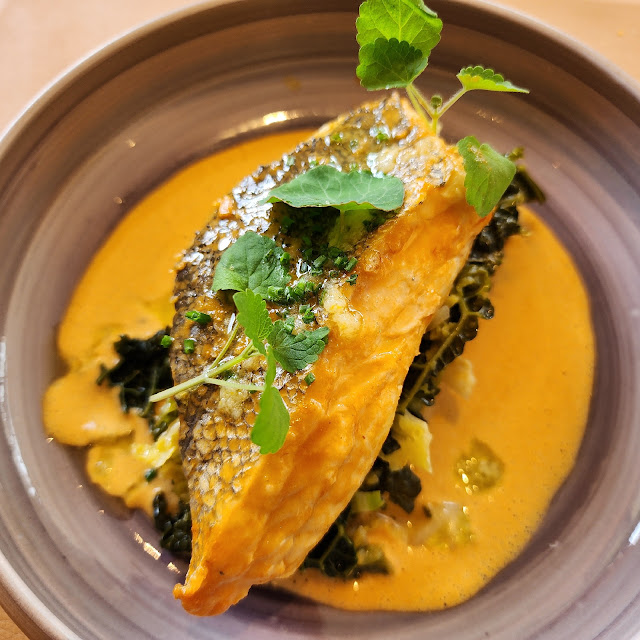
John Dory filet over cabbage

I chose the veal roasted on the rotisserie and served with a plate full of vegetables. We were both very happy with our selections. 

As you would expect from a restaurant located in Chateauneuf-du-Pape, the wine list is large with many selections of Chateauneuf-du-Pape.

Veal roasted on the rotisserie with vegetables

As we walked out, we had a great view out over the village and Chateauneuf-du-Pape vineyards towards Mont Ventoux, far in the distance. 

View from the terrace over Chateauneuf-du-Pape towards Mont Ventoux

There are few good choices for places to eat in Chateauneuf-du-Pape except Le Comptoir de la Mere Germaine et La Mere Germaine. So, because of this, we recommend highly that you make reservations, so you don't get turned away. The restaurant is open daily for lunch and dinner.

Le Comptoir de la Mere Germaine
4 Rue des Consuls
84230 Chateauneuf-du-Pape
France
www.lameregermaine.com
Tel: 01133428690060

Monday, April 24, 2023

A French Memorial to 5 US Airmen who Died in WWII in Plan de Dieu While Attacking Nearby German Airfields

We were invited to dine with Paul and Francoise Roumanille "chez Bruno" in Sablet on a recent Friday. As I told you in this post, Paul and Francoise and their parents before them have been making wine in Sablet since 1939. 

We got to talking during our lunch of traditional Aioli a la Morue, about what life was like for their families during WWII. Paul mentioned that there is a memorial to US airmen in Plan de Dieu, a large area planted in vineyards 11 km west of Sablet. Plan de Dieu translates to "God's Plain."

There are around 2620 acres planted in vineyards at an altitude of 100 meters within the Plan de Dieu AOC. Rather than one named village, the area includes the territories of Camaret-sur-Aigues, Jonquieres, Violes and Travaillan. A few patches of woodlands dot the expanse of vines.

Soil is mainly red clay packed with rounded cobblestones. There is not a lot of soil matter, so yields are modest, barely enough to produce one bottle of wine per plant. The wines are all red, made from the Cotes-du-Rhone's 3 leading grape varieties, Grenache, Syrah, and Mourvedre. 

The next day, Saturday, we went out to find this war memorial to US airmen. We see war memorials in almost every village in Provence dedicated to the children of the town who died serving their country in WWI or WWII. We have never seen a war memorial to US military personnel other than near where troops landed on D-Day in Normandy. 

Paul said the memorial was on the road to Cameret-sur-Aigues just beyond the turnoff to Cairanne. Sure enough, as we were driving on the D23 toward Camaret-sur-Aigues, we came to a small road going off to the right with a small white sign "war memorial".


War memorial to US airmen who died in Plan de Dieu
There is not a lot of information at the memorial or on the internet about the events that occurred over the Plan de Dieu that inspired locals to build this memorial.

You can see the vast plain of vineyards to the west of the war memorial
At first glance, the site is unremarkable. Set in the middle of a vast plain of vineyards, the simple stone monument is set just off the side of a one-way dirt road. 

The memorial is festooned with flowers and red, white and blue ribbons
I found that on Saturday, April 16, 2005, approximately 200 French men and women along with French and American military representatives gathered during an icy spring rainy day to dedicate the new memorial to the five P-38 Lightning pilots who died while attacking nearby airfields.

2005 was the 60th anniversary of the liberation of France. The locals thought it necessary to express their appreciation with this memorial stone to the young pilots for their dedication in the darkest hour of French history, and active participation in the liberation of France and victory over Nazi Germany. 

Three of the honored pilots went down on June 15, 1944, trying to weaken German defenses for the Allied assault of southern France that would follow the Normandy invasion. 2nd Lt. Hugh Crandall Jr. and 1st Lt. Harold V Duggleby from the 94th Fighter Squadron were both brought down by anti-aircraft fire on strafing runs against the Orange-Plan de Dieu airfield. 

At about the same time, 1st Lt. Warren E. Semple from the 49th Fighter Squadron was shot down by a German pilot while strafing the nearby Orange-Caritat airstrip. 

Several weeks later in early August, 2nd Lt. Robert D. Simpson of the 48th Fighter Squadron and 2nd Lt. A. Tracy of the 49th Fighter Squadron were downed by flack and killed on similar missions. Watching the attacking planes get shot down was shocking for those on the ground said one of the local residents who was 11 in 1944.

Listing of the names of the 5 young US airmen who died in Plan de Dieu.
Across the narrow country road from the war memorial, there is the Bergerie du Bois des Dames. The name Bois des Dames (wood of the ladies) comes from the thick oak woods and pastures that once covered part of this area. The woods belonged to religious ladies who had retired to a high valley in the hills of Gigondas, at the convent of Prebayon, hence the name Bois des Dames. 

Bergerie du Bois des Dames
I couldn't find any information about this bergerie. I do know that bergeries are enclosures that shepherds used in old times to contain and protect their sheep. In the picture below, you can see in the corner of the bergerie, the remains of a very deep well. 

Interior of the Bergerie du Bois des Dames.
In the picture below, you can see where the water came out from the well into a water trough that delivered it into a basin for the sheep. 

Trough for water to run from well into the water basin
The next time we are in Sablet, I will go to the Domaine Bois des Dames and see if anyone there can tell me why the memorial and bergerie are located on different sides of the country road. I would also like to find out the age of the bergerie structure. It looks old, so I assume it is but sometimes looks as we know can be deceiving. 

As I have told you several times. we frequently see pilots of the Patrouille de France, the French precision flying unit, practicing their stunts over this area. So sobering to think, while we get such enjoyment from seeing the Patrouille flying overhead, there was a time in the last century when the planes flying overhead were engaged in serious, deadly warfare.

Friday, April 14, 2023

Friday is Market Day in Sablet

In previous posts, I have shared the criteria that we considered as we searched for a house to buy in the South of France. Near the top of the list after Shirley's #1, "no-fixer-uppers", was our desire to own a house in a village that was active year around so we could visit whenever we wished. 

This meant we wanted a "living village" which for us meant, not tourist dependent as they essentially shut down from early November to middle of March. This eliminated a lot of villages in the Alpilles, Luberon or near the Mediterranean Sea. 

We discovered as we searched that small villages in the Cotes du Rhone and other wine making regions are open year around as wine making is a year around process. Thus, we considered these villages "living villages".

It seems that our village has only gotten better as a place to live or visit since we bought back in 2008. The village of Sablet has a population of 1381. We have a boulangerie that is open 365 days a year. We have a butcher shop; a very well stocked grocery store called an épicerie, a bar/cafe in the center of the village, a pizzeria, and a fine dining restaurant called La Table de Magali.

We have a pharmacy, a medical office, a dentist, a floral shop, two salons, a dress shop, a tourist information center where they sell local wines, and a tabac where they sell stamps, and French, English, and German newspapers and magazines. There are two churches and a bank with ATM machine. 

More recently, the village has seen their Friday morning market in the center of Sablet expand with the addition of new vendors, some of whom are shown in the pictures below. While the market is small (we recommend you go to one or more of the larger weekly markets in the area), the quality of fish, cheese and fruits and vegetables sold at the Sablet market is excellent. 


View of Sablet from Rue du Stade

Fruit and Vegetable Seller

Mobile Fromagerie

Le Poissonier

Seller of All Things Related to Honey

Something akin to a Mobile Italian Alimentari 

A Close-up Look at the Products on Offer from the Mobile Italian Alimentari 

Another Fruit and Vegetable Seller

Freshly Made Paella to Go

I have written posts about weekly markets in Vaison-la-Romaine, Nyons, Carpentras, Sainte-Cecile-les-Vignes, and Uzes, I have never written about our own smallish market that takes place every Friday morning on Place De L'Aire De La Croix, in front of Bar des Sports. 

Between the shops in the village and the Friday weekly market, you can live very well in Sablet and never venture out to shop anywhere else. Parking gets a little tight late Thursday night until after market on Friday as there is no parking on Place De L'Aire De La Croix, which normally is full of cars. 

If you are looking for a home to rent for a holiday in Provence, we still have multiple weeks available in May and June as well as a few single weeks through the end of October.  I hope to hear from you. 

Monday, February 28, 2022

Visited Wine Friends and Best Lunch Ever in Chateauneuf-du-Pape

One of the many things that drew us to Sablet was its location in the Cotes-du-Rhone wine appellation and proximity to renown villages such as Gigondas, Vacqueyras, and Chateauneuf-du-Pape. We like all the wines from this region but our favorites are the wines produced in the AOP located around the village of Chateauneuf-du-Pape. 

Chateauneuf-du-Pape is a small medieval village spread out on the hillside at the foot of ruins of an ancient chateau. From the chateau hill, you have an impressive view in all directions, mostly of vineyards and the Rhone River 1.9 miles to the east. It is best known for the wine that is produced from the vineyards surrounding the village. 

Chateauneuf-du-Pape

Our favorite Chateauneuf-du-Pape winery is located just outside the village on the Route de Courthezon. We first became acquainted with Domaine de la Charbonniere when we tasted wines for our first wine list at Bistro des Copains in Occidental, CA. We have been fans ever since. 

The domaine is owned by the Maret family, daughters Veronique and Caroline and parents Michel and Mireille. They have been making wine since 1912 when Michel Maret's grandfather bought the domaine as a gift for his wife who was the daughter of a local vigneron. Michel took over in 1978 and started bottling and selling wine, most of it out the winery door.

Veronique took over winemaking from Michel in 2012 after working alongside her father beginning in 2009. Michel, although now retired, still drives the tractor and helps her in the cellar. Veronique and Caroline are the 4th generation of Maret's to oversee the domaine. Mother Mireille continues to manage the vineyard team.


Domaine de la Charbonniere

There are several cafes with outdoor terraces and a gastronomic restaurant with one Michelin star in the center of the village. Although this is a tourist town, there are not many tourists shops besides those selling wine as the business of Chateauneuf-du-Pape is wine.

The village streets are narrow, curving around the hillside or climbing up and down between the houses up to the chateau. The buildings are old but everything seems to have been completely restored. 

You can get to the chateau ruins at the top of the village by walking up Rue Joseph Ducos past the front of the Town Hall to the Church at Rue des Papes. Just to the left of the church are steps that lead up the wide stone-step street to the chateau.


Michel in the Center of Chateauneuf-du-Pape

One morning back in January, we headed to Chateauneuf-du-Pape for a degustation (wine tasting) at Domaine de la Charbonniere. We had read reports that the 2019 vintage was outstanding throughout the Cotes du Rhone and we were eager to see our friends and taste their wines.

As our visit came to an end, they said La Mere Germaine Restaurant opened a sister restaurant in the village last summer that we should try. We are always up for new restaurants so Veronique called and made a reservation for us to have lunch at Le Comptoir de la Mere Germaine.    

Le Comptoir de la Mere Germaine

Le Comptoir de la Mere Germaine is in a new complex a few steps from the center of the village. There is a terrace with views of Chateauneuf-du-Pape. I imagine it would be a lovely place to dine when the weather is a little warmer.

The view from the terrace of Le Comptoir de la Mere Germaine

We entered at the time set for our reservation and after the obligatory checking of our Pass Sanitaires, we were offered a choice of all the tables since we were the first diners to arrive. Although, it was a beautiful day outside, it was a little brisk so we decided to sit at the comptoir in front of the rotisserie.  

La Rotisserie au Le Comptoir de la Mere Germaine

The Comptoir de la Mere Germaine has an extensive wine list including many selections from Chateauneuf-du-Pape. Since we had just come from Domaine de la Charbonniere, we chose the AOP Chateauneuf-du-Pape 2015 Cuvee Domaine Rouge.  

Domaine de la Charbonniere 

We chose the leeks in vinaigrette and chickpea hummus with little rolls to share as starters for our meal. 

Leeks in Vinaigrette

Our position at the comptoir was conducive to chatting with the cooks preparing our meals. They told us the Comptoir de la Mere Germaine opened on July 14, 2021, so quite new. 

Chickpea Hummus with little rolls with herbs and spices

I went with the farm chicken from the Luberon roasted on the rotisserie. It was accompanied by roasted potatoes. 

Rotisserie Farm Chicken from Luberon with Roasted Potatoes 

Shirley selected the filet of Bar (seabass). 

Filet of Bar (Seabass)

We were happy to see the restaurant menu included a selection of sides including a pan of seasonal vegetables.

Sauteed Pan of Vegetables

We shared a Lemon Meringue Tart to finish. 

Lemon Meringue Tart

The culinary team working in the open kitchen on the other side of the comptoir were happy to pose for a picture. 

We have not been to the La Mere Germaine since long before it was awarded a Michelin star during the pandemic. In fact, it was not very good as I recall. Also, we have not found any dining establishments in the village that we would recommend. 

So I am pleased to say the Comptoir de la Mere Germaine offers a welcoming mix of friendly, professional team, comfortable, well lit dining room and last but not least, generous portions of very good food, albeit not quite as refined as at some restaurants we frequent. 

Having said that, we will return again and again. In fact, we enjoyed our meals so much that we made a reservation before we left for the next Saturday for lunch.   

The Culinary Team

Here some different dishes we tried at the aforementioned Saturday lunch. 

We shared a vegetarian board of confit eggplant, zucchini and focaccia to start.

Vegetarian Board with Confit Eggplant, Zucchini and Focaccia

For my meal, I chose the rumsteak a la Rossini which is essentially a steak pan-fried and topped with a hot slice of fresh whole foie gras, briefly pan-fried at the last minute. I will be honest that I didn't know that "a la Rossini" means it comes with a slice of foie gras. Having said that, hey when in France...it was delicious. 

Rumsteak (Sirloin) a la Rossini 

Shirley ordered a filet of trout from l'Isle sur la Sorgue. 

Trout from l'Isle sur la Sorgue

From the list of sides on the menu, we chose a bowl of crispy, hot frites. 

Side dish of Crispy French Fries

To finish, we got the Mille-Feuille to share. This was sort of deconstructed and I didn't think it was all that special and would not order again. This was the only disappointing dish we had during our two meals there.

Mille-Feuille to share

If you are in the area to taste wines from AOP Chateauneuf-du-Pape or just looking for a good place to have lunch in wine country, I recommend that you make a reservation at Comptoir de la Mere Germaine.  There is a large public parking lot a short walk from the restaurant. You will not be sorry. 

Le Comptoir de la Mere Germaine
4 Rue des Consuls
84230 Chateauneuf-du-Pape
France
Tel: +33 4 28 69 00 60
website: www.lameregenermaine-chateauneufdupape.fr/le-comptoir/

Sunday, March 1, 2020

A fall visit to Cassis, a picturesque village along the Mediterranean Sea

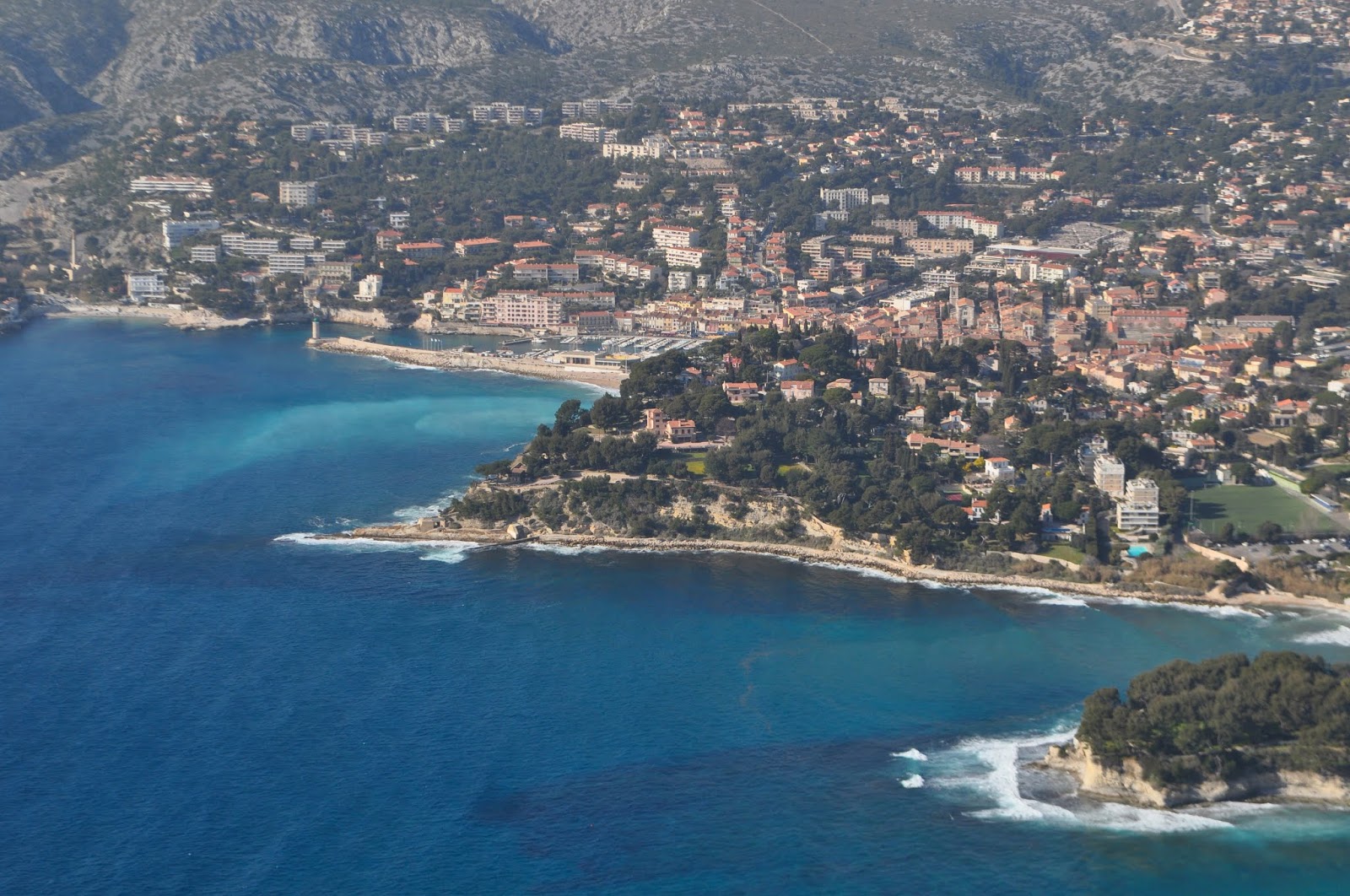
Cassis is a picturesque town a little over 1 and 1/2 hours from Sablet snuggled at the bottom of a steep bowl of land along the Mediterranean Sea between calanques (little coastal fjords with tall cliffs), about 25 km east of Marseille.

Cassis is on a steep hillside with vineyards and pastel-colored houses that tumble down to a seaside port lined with more pastel-colored houses, shops and restaurants with 8,000 inhabitants.

The area where Cassis now sits was first occupied between 500 and 600 BC by people from Liguria, a region of north-western Italy, who built a fortified habitation at the top of Baou Redon. These people lived by fishing, hunting, and farming.

If you go, I recommend you try to get to Cassis early in the morning since parking is often a challenge. From time to time, we have to park in a remote lot (Relais des Gourgettes) and hike or ride the navette (shuttle bus) to the port.

Port area where Quai des Baux and Quai Saint-Pierre meet

Cassis remains a small fishing port but the fishing boats now share the harbor with yachts and a collection of boats that tourists can book for visits to the nearby calanques. You will see traditional wooden fishing boats known as pointus tied up along the Quai des Baux.

Pointus, traditional wooden fishing boats tied up along Quai des Baux

The port is lined with tourist shops, terrace cafés and restaurants which offer a variety of food and prices. It's always great fun to watch people stroll down Quai des Baux while you soak up the sun in front of one of the cafes that line the port.

Restaurants along Quai des Baux

The fishermen sell their morning's catch quayside on tables near their boats. The selection changes daily as choice is selon arrivage (dependent on what they catch) that day.

Fisherman selling his morning catch quayside on the Quai des Baux

Over the years, many artists and writers have been attracted to Cassis. Frédéric Mistral, the Nobel Prize-winning author and defender of Provençal language and traditions, took a great fancy to Cassis, even though he was not a native of the town.

The writer famously declared, in Provençal, "Qu'a vist Paris, se noun a vist Cassis, pou dire, ‘n'ai rèn vist'." "He who has seen Paris but not Cassis can say, ‘I haven't seen anything'."

Cassis harbor

The Mediterranean coast near Cassis is known for the calanques ("fjords"), a series of white limestone rocks scored through with deep valleys that extend for almost 20 km (12.4 miles) along the Mediterranean between Cassis and Marseille.

A fun activity for Cassis visitors is a boat trip out to the calanques. There is a kiosk on Quai Saint-Pierre that sells tickets for all the charter boats that line the Cassis port for trips out to 3, 7 or 13 calanques. It takes about 45-minutes for a boat tour out and back to see 3 of the closest calanques.

Port Miou seen in the picture below is the closest calanques and easiest to reach from the center of Cassis. The Romans used Port Miou as a harbor. In fact, its name comes from the Latin portus melior: the best port. It's the deepest and most sheltered of the calanques between Cassis and Marseille.

The calanque of Port-Miou

Port Pin is the smallest and most intimate of the three calanques of Cassis. It is surrounded by Aleppo pine trees typical of this part of the Mediterranean.

The calanque of Port-Pin with its sandy beach surrounded by Pine trees

Port Pin boasts a small sand and shingle beach and the water here - emerald or turquoise depending on the light - is very clear and perfect for swimming.

A tourist boat leaving the calanque of Port-Pin

Limestone rock formation at the entrance to one of the calanques

En Vau is the most spectacular of the three calanques closest to Cassis and also the most difficult to get to. Extremely steep, it's popular with rock-climbers, there is a little shingle beach.

Entrance to En Vau calanque

Entrance to Cassis harbor

There are four public beach areas in Cassis. The Grand Mer beach is the main beach near the center of town and consists of sand and pebbles.

Cafes and houses along Quai Jean Jacques Barthélémy

Besides its stunning location and the calanques, Cassis is also famous for its wine. When you exit off the A50 auto route, the road down to Cassis is a winding road that goes past vineyards planted on steep hills between olive groves and country houses above Cassis.

The wineries of Cassis produce red, white and rosé wines but it's the white wines for which the appellation is best known. We like Cassis white and rosé wines a lot.

By the way, don't confuse the wines of Cassis with crème de cassis, a sweet black currant liqueur, a specialty of Burgundy which takes its name from black currants (cassis), not this town.


We have visited Cassis many times but never drove the route des Crêtes. So when Shirley and I went to Cassis last fall, we decided to drive to La Ciotat by way of the route des Crêtes and go back to Sablet that way.

The route des Crêtes (a generic term meaning "road across the crests"), is a 15 km (9 miles) stretch of road, that takes you between Cassis and La Ciotat, with 360 degree views over some of the most superb scenery in Provence along the way.

The route des Crêtes is closed to traffic (and hikers) on days of very strong wind and/or when fire risk is high. There are road signs as you approach it from Cassis and La Ciotat that will let you know if the road is open.

On the route des Crêtes between Cassis and La Ciotat

If you have comments or questions about Cassis, or elsewhere in Provence, please leave your comments below or send me an email at my address below.

If you are thinking about a trip to the South of France including spending time in Provence, we invite you to visit our website. Our house is available for rent by the week or more. We still have some weeks open in April, June, and August. You can reach us for further information by sending an email to chcmichel@aol.com.