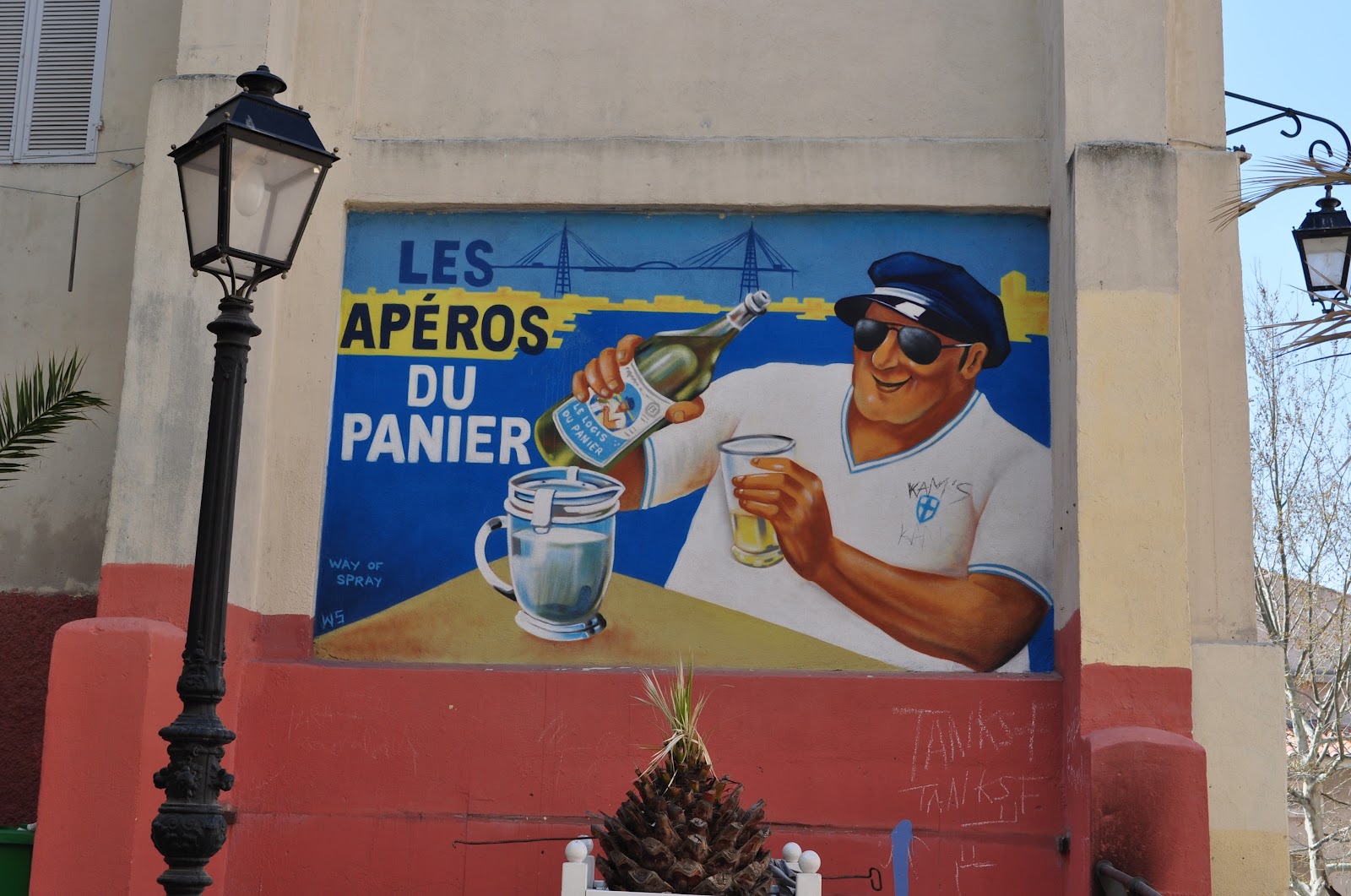
Marseille has a complex history. It was founded by the Phoceans (from the Greek city of Phocaea, now Foça, in modern Turkey) in 600 BC and is one of the oldest cities in Europe. The town is a far cry from the Cézanne paintings and Provençal clichés of sleepy villages, "pétanque" players and Marcel Pagnol novels.
Marseille is France's second largest city, after Paris, with a population of 850,636, and largest in land area. The people of Marseille have varying ethnic backgrounds, with a lot of Italians and Spanish having immigrated to the area after the second world war. Currently, over one third of the population of Marseille can trace their roots back to Italy.
My father Daniel and his family lived in an apartment on Boulevard Longchamp in Marseille when he was growing up and my cousins lived there with their families too at various times. My cousins Ginette and Josiane live there now and speak in poetic terms about Marseille's charms. Slowly after several visits with my cousins, I am growing fond of Marseille too.
So when cousin Jean Marc called a few months back to suggest we meet the next day in Marseille for lunch and a little visit, we accepted his invitation without hesitation. We set a time to meet at the Vieux Port and go to lunch at Le Grain de Sel Restaurant, a well regarded restaurant on the south side of the Vieux Port. We found a place to park in an underground parking garage and walked out and saw Saint-Victor Abbey seen below.
Saint-Victor Abbey is one of the oldest places of Christian worship in Europe. Its 5th-century crypt and catacombs occupy the site of a Hellenic burial ground, later used for Christian martyrs. Continuing a medieval tradition, every year at Candlemas, a Black Madonna from the crypt is carried in procession along Rue Sainte for a blessing from the archbishop, followed by a mass and the distribution of "navettes" and green votive candles.
 |
| Abbaye de Saint Victor (Saint Victor Abbey) |
As we strolled along the Vieux Port, we looked across and saw the Panier District. Built on the site of the ancient Greek Massalia, the Panier District, panier means basket in French, but in Marseille it is the name of the oldest area of the town. In the middle of this area is the Vieille Charité, a wonderful old monument, now hosting museums and exhibitions. It is a typically Mediterranean district with color-washed facades, the historic refuge of seafarers and generations of immigrants.
 |
| View across the Vieux Port towards the Panier District |
The Vieux Port, or Old Port, is the center of the city. It was the natural harbor of Marseille since antiquity; the Greeks landed here in 600 BC and set up a small town for trading. The town grew and in the middle ages became one of the world's largest trader of hemp baskets and ropes as the area around the Old Port were originally cannabis, or hemp fields. Hence the name of Marseille's main street Canebière, which leads down to the old port.
 |
| Vieux Port |
Today the Old Port, just 20 feet deep, is unable to accommodate commercial marine traffic, which now sails in and out of the nearby port of Joliette. Instead it's the largest of the city's 14 marinas, with 3,500 berths for which pointus, the traditional fishing boats of the Mediterranean Sea, vie alongside yachts, a handful of tall ships and common sail and motor boats.
 |
| Vieux Port |
The Old Port is lined by restaurants and cafés. We were headed to Le Grain de Sel Restaurant, which is on a side street just a few steps from the Vieux Port.
 |
| A square lined with cafés alongside the Vieux Port |
We enjoyed our time together and lunch at Le Grain de Sel Restaurant, although to be truthful, we enjoyed our conversation more than the food. By the time we finished dessert, we had decided that we were going to walk up to Notre-Dame de la Garde Church which we had seen in the distance high above Marseille.
 |
| Jean Marc and I at Le Grain de Sel Restaurant |
 |
| One of the streets we followed up to Notre-Dame de la Garde |
Notre-Dame de la Garde church seen below stands on the summit of Marseille, its most important landmark, visible from afar. The site was an observation point in ancient times and during the Middle Ages, was the location of a pilgrimage chapel. Today, the Basilique Notre-Dame de la Garde with its gilded Madonna crowning the belfry is a beacon for the faithful.
 |
| Notre-Dame de la Garde Church |
Let me tell you that hiking up to Notre-Dame de la Garde Church is quite the ordeal. Thankfully, the sidewalks along the streets that lead up to summit where Notre-Dame de la Garde sits have steps cut into the sidewalks. 1800 steps later, we got to the top and were greeted with great views over Marseille.
 |
| View to Le Panier District and Sainte-Marie-Majeure Cathedral |
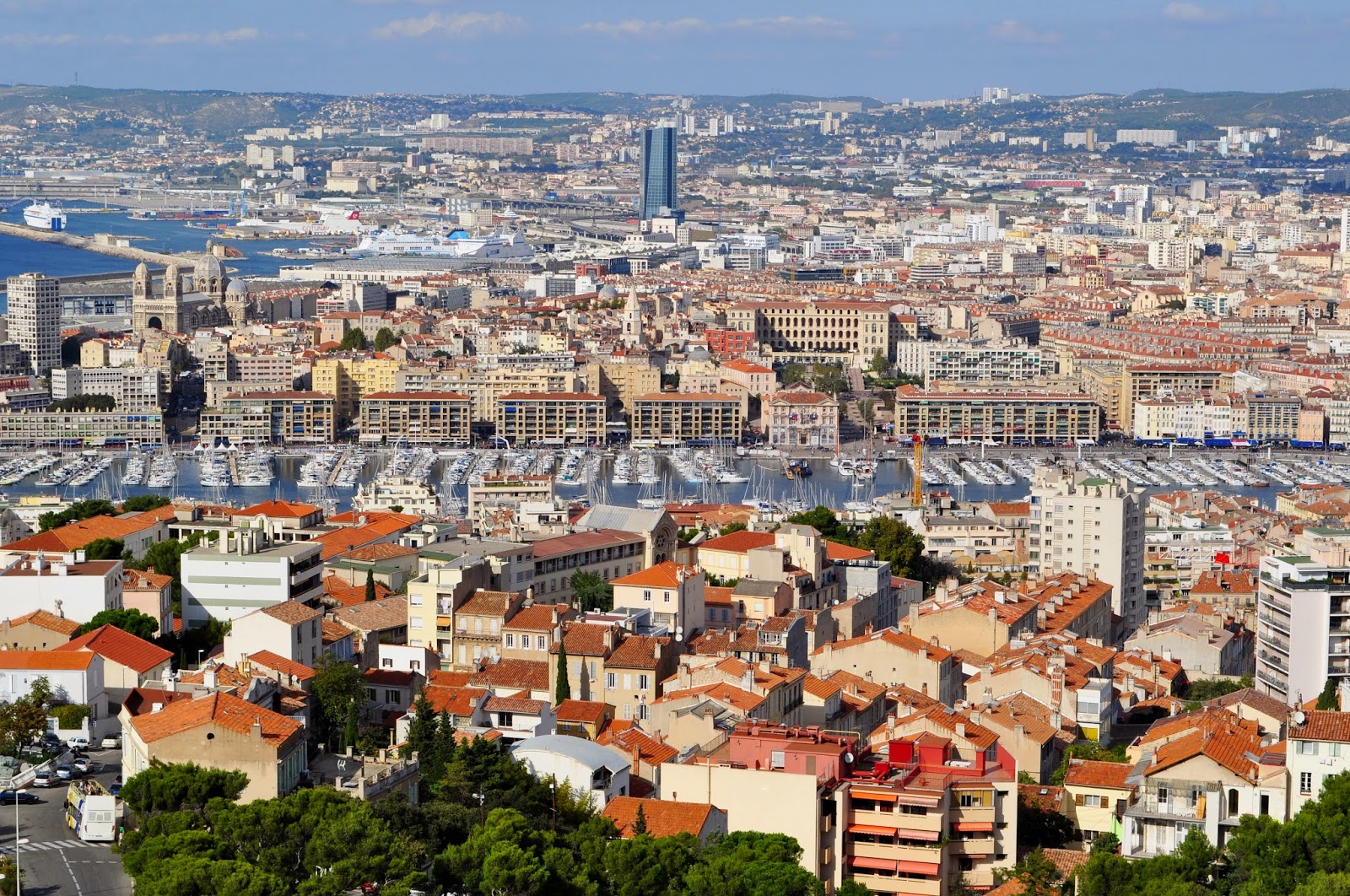 |
| View to the Vieux Port and Le Panier District |
The entry to the Vieux Port is guarded by two forts, Fort Saint-Nicolas and Fort Saint-Jean.
 |
| Fort Saint-Nicolas and Fort Saint-Jean guard the entrance to the Vieux Port |
Another view from Notre-Dame de la Garde is out toward the Château d'If located on the island of If, the smallest island in the Frioul Archipelago about a mile offshore in the Bay of Marseille. The Château was built between 1524 and 1531 on the orders of King Francis I as a defense against attacks from the sea.
The isolated location and dangerous offshore currents made Château d'If an ideal escape-proof prison, much like the island of Alcatraz in San Francisco Bay in more modern times. Its use as a dumping ground for political and religious detainees soon made it one of the most feared and notorious jails in France. Over 3,500 Huguenots (French Protestants) were sent to If.
Alexandre Dumas brought fame to the prison in his 1844 novel, the Count of Monte Cristo. In the book, Edmond Dantès (a commoner who later purchases the noble title of Count) and his mentor, Abbé Faria, are both imprisoned at Château d'If. After fourteen years, Dantès escapes from the castle, becoming the first person ever to do so and survive. In reality, no one is known to have done this.
 |
| View out toward Château d'If |
Basilique Notre-Dame de la Garde is an ornate Neo-Byzantine church situated at the highest natural point in Marseille, a 532 foot (162 meters) limestone outcrop on the south side of the Old Port. Designed by Henri-Jacques Espérandieu, the church was built between 1853 and 1864 on the site of a 1214 chapel.
It is topped by a 33-foot-high (10 meters) statue of the Madonna and child made of copper gilded with gold leaf who keeps a watchful eye over the fishermen headed out to sea. There is a walkway which encircles the entire building and provides a 360-degree panorama overlooking Marseille, the hills behind and the islands offshore.
 |
| Belfry, bell tower and statue of the Virgin with child |
Notre-Dame de la Garde is considered by the Marseille population as its guardian and protectress of the city, hence its nickname of "the Good Mother".
 |
| View of the south side of Notre-Dame de la Garde Church |
 |
| View of the north side of Notre-Dame de la Garde Church |
 |
| Statue depicting the passion of Christ in front of Notre-Dame de la Garde |
 |
| Belfry, bell tower and statue of the Virgin with child and stairs |
 |
| Statue depicting Christ on the cross in front of Notre-Dame de la Garde |
Back down to the level, I can say it is a lot easier coming down than going up.

Built in the 17th century, Fort Saint-Nicolas served not only to guard the port, but also to ensure that there were no uprisings against the king. Many of the guns pointed toward the town, rather than out to sea.
Restored in the 19th century, Fort Saint-Nicolas is a fun place to walk, with lovely views of the Vieux Port and the Mediterranean beyond the harbor.
 |
| Fort Saint-Nicolas |
I love the santons of Provence, more so than Shirley, or we would have more of them in our home. I immediately recognized the name "Marcel Carbonel" as we happened upon this shop, as one of the best known craftsman of Santons. Bright, colorful and carved by hand, the little baked clay figurines are the work of a real artisan. The selection is exhaustive with over 600 figurines in six different sizes.
 |
| Marcel Carbonel Santons Shop |
We got our car from the parking garage and headed to the other side of the Vieux Port to drop cousin Jean Marc off at his car and take a couple more pictures on our way out of town.
 |
| View from the Panier side of the Vieux-Port towards Notre-Dame de la Garde |
The Cathedral of Sainte-Marie-Majeure or La Major, founded in the 4th century, enlarged in the 11th century and completely rebuilt in the second half of the 19th century by the architects Léon Vaudoyer and Henri-Jacques Espérandieu.
The present day cathedral is a gigantic edifice in Romano-Byzantine style. A Romanesque transept, choir and altar survive from the older medieval cathedral, spared from complete destruction only as a result of public protests at the time.
 |
| Sainte-Marie-Majeure Cathedral |
I must say that Marseille continues to grow on me and I see why my cousins love living there so much. Don't be surprised if you see us exploring more of this town on future trips to Provence. Have a great week. Chat soon.