Showing posts with label Marseille. Show all posts

Monday, January 2, 2017

A trip to Marseille for an authentic Bouillabaisse

We had been talking about throwing a Provence Party in our backyard with a traditional Bouillabaisse for some time. We had even told the neighbors it would take place in August when we returned from Sablet. While we were in Provence, I wanted to go to Marseille and have a Bouillabaisse in one of the restaurants renown for the dish and see how it is presented to diners.

Despite having multiple "French Connections" to Marseille, we don't go very often (traffic is a mess and parking hard to find among other reasons). My connections include my father and family lived on Boulevard Longchamp in Marseille when he was growing up and cousins lived in Marseille with their families too at various times. Now, cousins Ginette and Josiane live there. I digress so let me get back to the topic at hand.

As the time was nearing for us to leave Sablet, we set a date to meet up with Ginette for a traditional Bouillabaisse and go shopping for our daughters. Marseille's Vieux Port is about one hour and thirty-five minutes down the A-7 from Sablet. We found parking near the Town Hall and walked around the Vieux Port from the north side to the south side to shop before we went to lunch. On the way to and from our car, we saw the sights shown in the photographs which follow.

By way of background I should mention that Marseille was founded by the Phoceans (from the Greek city of Phocaea, now Foça, in modern Turkey) in 600BC and is one of the oldest cities in Europe. The town is a far cry from the Cézanne paintings and Provençal clichés of sleepy villages, "pétanque" players and Marcel Pagnol novels.
Marseille's Notre Dame de la Garde

With around one million inhabitants, Marseille is the second largest city in France in terms of population and the largest in terms of area. The people of Marseille have varying ethnic backgrounds, with a lot of Italians and Spanish having immigrated to the area after the second world war. Currently, over one third of the population of Marseille can trace their roots back to Italy.

Marseille's Vieux Port

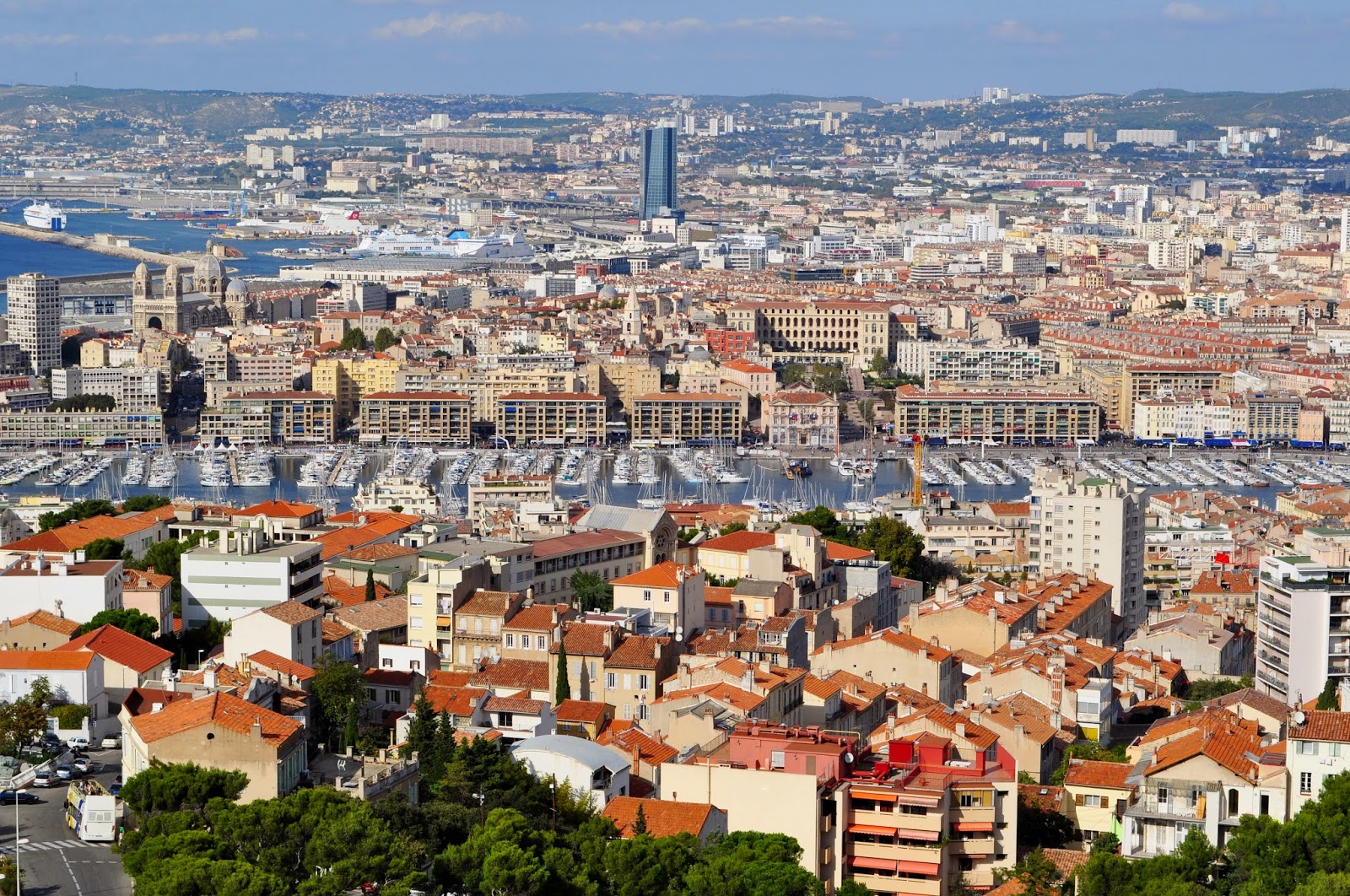
Everything in Marseille revolves around the U-shaped Vieux Port (Old Port) in the center of the city where boats have docked for 2600 years. The port is more pleasure marina that working port these days with pleasure yachts, small fishing boats, and sailboats filling more than 10,000 slips.

Marseille's Vieux Port

Around the port, fishermen mend their nets and lounge on benches reading newspapers in Greek and Arabic while cafes and restaurants serve up seafood from the nearby Mediterranean Sea.

Marseille street with nice shops

The Saint-Ferréol les Augustins Church is a Roman Catholic church located on Marseille's Vieux Port. The original building was owned by the Knights Templar. However, in 1369, it was given to a community of Augustinian hermits. By 1447, they spearheaded construction of a new church building. It was dedicated in 1542, even though the roof was not finished until 1588.

Pope Clement VII married his niece, Catherine de' Medici, to Henry II of France, in this church on October 28, 1533

Saint-Ferréol les Augustins Church

Le Panier quarter - the bread basket, seen below is one of Marseille's oldest sections. Le Panier is only a small part of what used to exist before the Germans dynamited it during World War II to flush out the Jews and Resistance fighters hiding there.

Up until the 1970s, the Le Panier quarter was the center for purification of heroin that passed through Marseille to Europe and the United States, hence the "French Connection" depicted in the 1971 movie starring Gene Hackman. Today ancient buildings line narrow back streets - kids playing, laundry flapping and people chatting in the squares.

Le Panier

Shops along the Vieux Port

The Marseille City Hall (Hôtel de Ville) seen below was built between 1653 and 1673. It was one of the few buildings on the harbor to survive the destruction of World War 2.

Marseille Town Hall

The ferris wheel seen below is located on the east end of the Vieux Port. While I am sure the view from the top of the ride over the port, the sea and the city of Marseille is nothing short of spectacular, my fear of heights will probably keep me from ever seeing those views from the ferris wheel.

Ferris wheel at Marseille's Vieux Port

After concluding our shopping, we decided to take a taxi to the restaurant in order to avoid having to deal with the Marseille traffic. Restaurant Fonfon is located in the Vallon des Auffes near the Monument aux Morts de l'Armée d'Orient off the Corniche du President-John-Fitzgerald-Kennedy.

The Monument aux Morts de l'Armée d'Orient by Antoine Sartorio seen below stands on a rocky promontory on Marseille's seafront and remembers all those Frenchmen who gave their lives during the 1914-1918 war fighting overseas particularly in the Far East.

The center of the arch has a carving of a crescent and a star. Sculptures of air force personnel and soldiers stand on one side of the arch together with a winged angel whilst on the other side is another winged angel and on a pedestal in the center of the arch is a bronze "angel of victory" her arms lifted to the skies. A stairway leading down to the sea completes the memorial.

Marseille War Memorial called "Monument aux Morts de l'Armée d'Orient"

Fonfon Restaurant which has been in business since 1952, is located in Vallon des Auffes, a small picturesque fishing port crowded with "pointus", traditional fishing boats and ringed by "cabanons", fishing sheds in Marseille's 7th arrondissement.

Vallon des Auffes

Vallon des Auffes"

Marseille is most famous for three things: the national anthem called “La Marseillaise”, the "French Connection" drug trade and bouillabaisse. Of these, the renowned fish stew of Provence is easily the most controversial and complicated. For a start, no one can even agree on the origin of the actual word, let alone the origins of the dish.

The most likely story is that it came about when local fishermen decided to boil up the fish and crustaceans they couldn't easily sell, which explains why the main contents are small rock fish and other ugly ducklings of the Mediterranean coastline, such as rascasse and anglerfish.

The prime ingredient is at least one of the three members of the rascasse family. The other commonly accepted ingredients are olive oil, onions, garlic, tomatoes, fennel, parsley and saffron. Some add a glug of Pastis, the anise-flavored aperitif.

Fonfon Restaurant

Recommended wines for bouillabaisse are Provencale rosés, and white wines from Bandol, Cassis and the Rhone. We opted for a bottle of white Clos Sainte Magdeleine, one of our favorite wineries in Cassis that I told you about here.

Clos Sainte Magdeleine

As is the custom, our server brought a platter to the table to show the fish that would be cooked for our Bouillabaisse that day. Most recipes call for bouillabaisse to include at least five types of fish. It almost always contains rascasse, a Mediterranean fish. The addition of shellfish is voluntary and is seen as snobbish by many Bouillabaisse purists.

Server presenting fish that will be cooked for the Bouillabaisse

Shirley finds the fish soup that is served for Bouillabaisse to be a little strong for her liking. So she opted for having one of Sole the server presented cooked to order for her. Whole fish is sold per 100 grams.

Tray with choices of whole fish for the day

Amuse Bouche

Bouillabaisse comes in two courses. First is the soup, accompanied by croutons, which you rub with a clove of whole garlic and spread with rouille, a bright orange mayonnaise flavored with saffron, cayenne and more garlic (rouille means, literally, "rust").

Bouillabaisse soup

The second course is the fish themselves, which are usually presented whole on a platter before they are taken back to the kitchen to be cooked and filleted for diners. The cooked fish are usually accompanied by potatoes that have been cooked in the Bouillabaisse soup.

Cooked fish for Bouillabaisse

Perfectly cooked Sole.

We chose ice cream for dessert

The Bouillabaisse was excellent. One thing I noticed was that from the last time I was there about 7 years ago, the clientele had changed from all French speakers to mostly tourists at least on this particular day. We headed back up to the Corniche and hailed a taxi to return to our car.

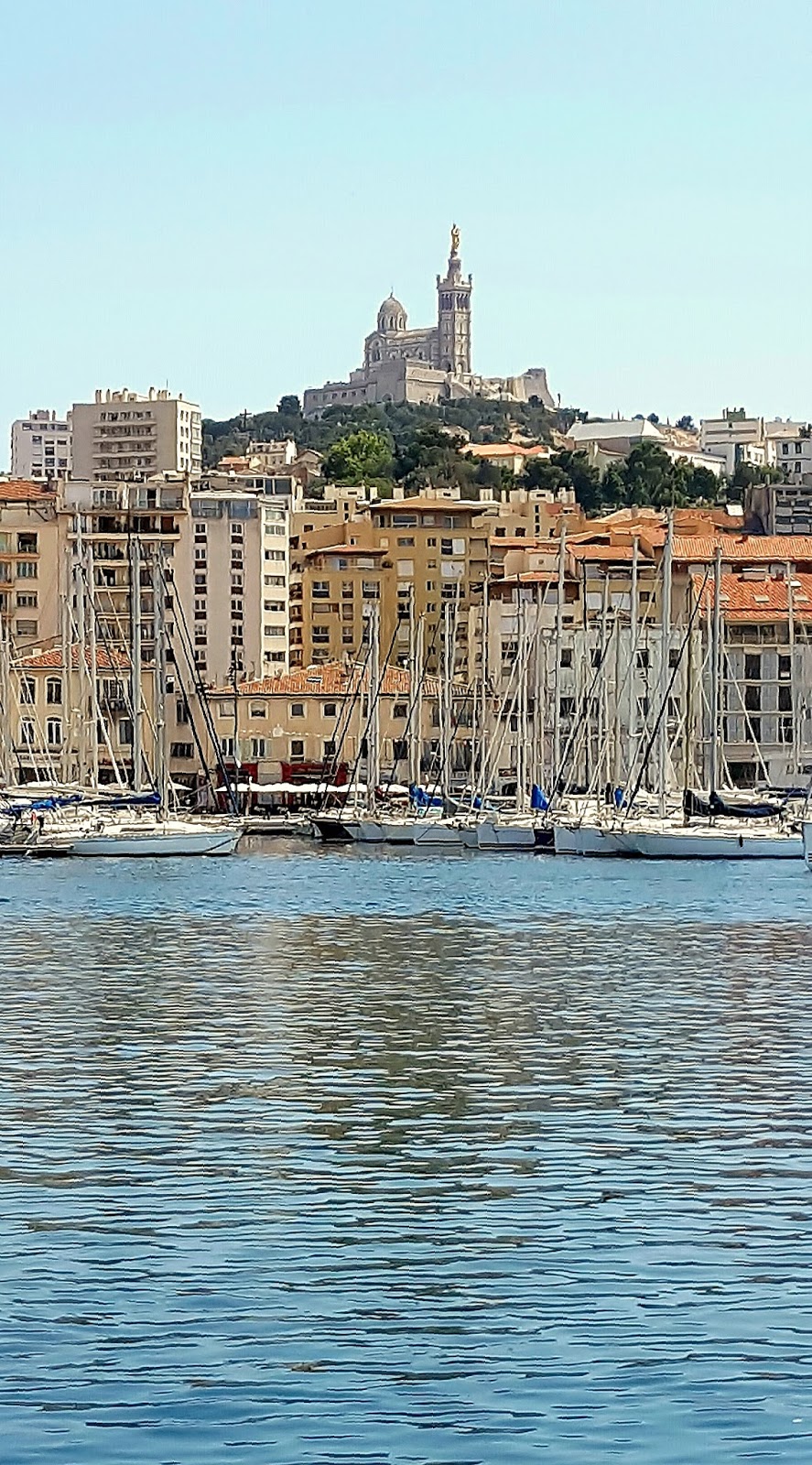
Vieux Port with Notre Dame de la Garde in the distance

It is very hard to find well-prepared, traditional Bouillabaisse in Provence. Forget one that is cheap. If you do find one that is cheap, don't order it. If you visit the fish mongers in the South of France, you know how expensive fresh fish is. So it stands to reason that an excellent traditional Bouillabaisse will be quite expensive. Chez Fonfon's menu currently quotes a price of 53 Euros per person.

Chez Fonfon Restaurant
140 Rue du Vallon des Auffes
13007 Marseille
Tel: 04 91 52 14 38
website: www.chez-fonfon.com

Sunday, March 1, 2015

Saturday in Marseille and a BIG hike up to Notre-Dame de la Garde

I've had mixed feelings about Marseille since my rental car was cambriolé, or that's what the police called it, and three suitcases were removed. I had arrived at Marseille Provence Airport a few hours earlier and a thief cleaned out my car and took my clothes, a lap top computer, and two cell phones while I enjoyed some of the best Bouillabaisse to be found in Marseille at Fonfon Restaurant in Vallon des Auffes off the Corniche du President-John-Fitzgerald-Kennedy.

Marseille has a complex history. It was founded by the Phoceans (from the Greek city of Phocaea, now Foça, in modern Turkey) in 600 BC and is one of the oldest cities in Europe. The town is a far cry from the Cézanne paintings and Provençal clichés of sleepy villages, "pétanque" players and Marcel Pagnol novels.

Marseille is France's second largest city, after Paris, with a population of 850,636, and largest in land area. The people of Marseille have varying ethnic backgrounds, with a lot of Italians and Spanish having immigrated to the area after the second world war. Currently, over one third of the population of Marseille can trace their roots back to Italy.

My father Daniel and his family lived in an apartment on Boulevard Longchamp in Marseille when he was growing up and my cousins lived there with their families too at various times. My cousins Ginette and Josiane live there now and speak in poetic terms about Marseille's charms. Slowly after several visits with my cousins, I am growing fond of Marseille too.

So when cousin Jean Marc called a few months back to suggest we meet the next day in Marseille for lunch and a little visit, we accepted his invitation without hesitation. We set a time to meet at the Vieux Port and go to lunch at Le Grain de Sel Restaurant, a well regarded restaurant on the south side of the Vieux Port. We found a place to park in an underground parking garage and walked out and saw Saint-Victor Abbey seen below.

Saint-Victor Abbey is one of the oldest places of Christian worship in Europe. Its 5th-century crypt and catacombs occupy the site of a Hellenic burial ground, later used for Christian martyrs. Continuing a medieval tradition, every year at Candlemas, a Black Madonna from the crypt is carried in procession along Rue Sainte for a blessing from the archbishop, followed by a mass and the distribution of "navettes" and green votive candles.

Abbaye de Saint Victor (Saint Victor Abbey)

As we strolled along the Vieux Port, we looked across and saw the Panier District. Built on the site of the ancient Greek Massalia, the Panier District, panier means basket in French, but in Marseille it is the name of the oldest area of the town. In the middle of this area is the Vieille Charité, a wonderful old monument, now hosting museums and exhibitions. It is a typically Mediterranean district with color-washed facades, the historic refuge of seafarers and generations of immigrants.

View across the Vieux Port towards the Panier District

The Vieux Port, or Old Port, is the center of the city. It was the natural harbor of Marseille since antiquity; the Greeks landed here in 600 BC and set up a small town for trading. The town grew and in the middle ages became one of the world's largest trader of hemp baskets and ropes as the area around the Old Port were originally cannabis, or hemp fields. Hence the name of Marseille's main street Canebière, which leads down to the old port.

Vieux Port

Today the Old Port, just 20 feet deep, is unable to accommodate commercial marine traffic, which now sails in and out of the nearby port of Joliette. Instead it's the largest of the city's 14 marinas, with 3,500 berths for which pointus, the traditional fishing boats of the Mediterranean Sea, vie alongside yachts, a handful of tall ships and common sail and motor boats.

Vieux Port

The Old Port is lined by restaurants and cafés. We were headed to Le Grain de Sel Restaurant, which is on a side street just a few steps from the Vieux Port.

A square lined with cafés alongside the Vieux Port

We enjoyed our time together and lunch at Le Grain de Sel Restaurant, although to be truthful, we enjoyed our conversation more than the food. By the time we finished dessert, we had decided that we were going to walk up to Notre-Dame de la Garde Church which we had seen in the distance high above Marseille.

Jean Marc and I at Le Grain de Sel Restaurant

One of the streets we followed up to Notre-Dame de la Garde 

Notre-Dame de la Garde church seen below stands on the summit of Marseille, its most important landmark, visible from afar. The site was an observation point in ancient times and during the Middle Ages, was the location of a pilgrimage chapel. Today, the Basilique Notre-Dame de la Garde with its gilded Madonna crowning the belfry is a beacon for the faithful.

Notre-Dame de la Garde Church

Let me tell you that hiking up to Notre-Dame de la Garde Church is quite the ordeal. Thankfully, the sidewalks along the streets that lead up to summit where Notre-Dame de la Garde sits have steps cut into the sidewalks. 1800 steps later, we got to the top and were greeted with great views over Marseille.

View to Le Panier District and Sainte-Marie-Majeure Cathedral

View to the Vieux Port and Le Panier District

The entry to the Vieux Port is guarded by two forts, Fort Saint-Nicolas and Fort Saint-Jean.

Fort Saint-Nicolas and Fort Saint-Jean guard the entrance to the Vieux Port

Another view from Notre-Dame de la Garde is out toward the Château d'If located on the island of If, the smallest island in the Frioul Archipelago about a mile offshore in the Bay of Marseille. The Château was built between 1524 and 1531 on the orders of King Francis I as a defense against attacks from the sea.

The isolated location and dangerous offshore currents made Château d'If an ideal escape-proof prison, much like the island of Alcatraz in San Francisco Bay in more modern times. Its use as a dumping ground for political and religious detainees soon made it one of the most feared and notorious jails in France. Over 3,500 Huguenots (French Protestants) were sent to If.

Alexandre Dumas brought fame to the prison in his 1844 novel, the Count of Monte Cristo. In the book, Edmond Dantès (a commoner who later purchases the noble title of Count) and his mentor, Abbé Faria, are both imprisoned at Château d'If. After fourteen years, Dantès escapes from the castle, becoming the first person ever to do so and survive. In reality, no one is known to have done this.

View out toward Château d'If

Basilique Notre-Dame de la Garde is an ornate Neo-Byzantine church situated at the highest natural point in Marseille, a 532 foot (162 meters) limestone outcrop on the south side of the Old Port. Designed by Henri-Jacques Espérandieu, the church was built between 1853 and 1864 on the site of a 1214 chapel.

It is topped by a 33-foot-high (10 meters) statue of the Madonna and child made of copper gilded with gold leaf who keeps a watchful eye over the fishermen headed out to sea. There is a walkway which encircles the entire building and provides a 360-degree panorama overlooking Marseille, the hills behind and the islands offshore.

Belfry, bell tower and statue of the Virgin with child

Notre-Dame de la Garde is considered by the Marseille population as its guardian and protectress of the city, hence its nickname of "the Good Mother".

View of the south side of Notre-Dame de la Garde Church

View of the north side of Notre-Dame de la Garde Church

Statue depicting the passion of Christ in front of Notre-Dame de la Garde

Belfry, bell tower and statue of the Virgin with child and stairs

Statue depicting Christ on the cross in front of Notre-Dame de la Garde

Back down to the level, I can say it is a lot easier coming down than going up.


Built in the 17th century, Fort Saint-Nicolas served not only to guard the port, but also to ensure that there were no uprisings against the king. Many of the guns pointed toward the town, rather than out to sea.

Restored in the 19th century, Fort Saint-Nicolas is a fun place to walk, with lovely views of the Vieux Port and the Mediterranean beyond the harbor.

Fort Saint-Nicolas

I love the santons of Provence, more so than Shirley, or we would have more of them in our home. I immediately recognized the name "Marcel Carbonel" as we happened upon this shop, as one of the best known craftsman of Santons. Bright, colorful and carved by hand, the little baked clay figurines are the work of a real artisan. The selection is exhaustive with over 600 figurines in six different sizes.

Marcel Carbonel Santons Shop

We got our car from the parking garage and headed to the other side of the Vieux Port to drop cousin Jean Marc off at his car and take a couple more pictures on our way out of town.

View from the Panier side of the Vieux-Port towards Notre-Dame de la Garde

The Cathedral of Sainte-Marie-Majeure or La Major, founded in the 4th century, enlarged in the 11th century and completely rebuilt in the second half of the 19th century by the architects Léon Vaudoyer and Henri-Jacques Espérandieu.

The present day cathedral is a gigantic edifice in Romano-Byzantine style. A Romanesque transept, choir and altar survive from the older medieval cathedral, spared from complete destruction only as a result of public protests at the time.

Sainte-Marie-Majeure Cathedral

I must say that Marseille continues to grow on me and I see why my cousins love living there so much. Don't be surprised if you see us exploring more of this town on future trips to Provence. Have a great week. Chat soon.

Thursday, October 16, 2014

A Wonderful Visit to Marseille and Lunch at La Boîte à Sardine

We have flown in and out of the Marseille Provence Airport and shopped at the nearby IKEA quite a few times. However, we have only visited Marseille twice despite its proximity to Sablet and I have two cousins that live there and as I told you here, my father lived there when he was young.

I have felt we were missing out by not going to Marseille so I had been looking at articles about Marseille, especially those that talked about the best places to eat there. Last spring, there was an article in Saveur Magazine entitled "City by the Sea" by Alexander Lobrano that got my taste buds going for a visit to Marseille.

So when we got to Sablet last spring, one of the first things I did was call cousin Ginette who lives in Marseille and cousin Annick who lives near Aix-en-Provence but knows and loves Marseille to set up a date to visit Marseille.

Marseille was founded by the Phoceans (from the Greek city of Phocaea, now Foça, in modern Turkey) in 600BC and is one of the oldest cities in Europe. The town is a far cry from the Cézanne paintings and Provençal clichés of sleepy villages, "pétanque" players and Marcel Pagnol novels.

With around one million inhabitants, Marseille is the second largest city in France in terms of population and the largest in terms of area. The people of Marseille have varying ethnic backgrounds, with a lot of Italians and Spanish having immigrated to the area after the second world war. Currently, over one third of the population of Marseille can trace their roots back to Italy.

We decided to visit sites that we had not visited on our previous visit when we toured the Le Panier District of Marseille and climbed up to Notre Dame de la Garde Cathedral. L’Opéra de Marseille, known today as the Opéra Municipal, is the opera company located in Marseille. In 1685, the city was the second in France after Bordeaux to have an opera house which was erected on a tennis court.

The present day opera house, the Opéra Municipal de Marseille, dates from its opening on December 4, 1924. It seats 1,800. It features a classic urn-shaped auditorium, three rings of boxes, two balconies and a gallery.

Municipal Opera House

Toussaint Blaize founded this Herboristerie (translates "herbalism") for the practice of herbal medicine in 1815. This boutique has been run by six generations of the Blaize family at this location since then. It is one of the oldest shops in Marseille.

Blaize Herboristerie

This marvelous statue of a giraffe and its baby is right on La Canebière, the main street of Marseille. It commemorates the arrival in the city in 1826 of a giraffe given as a gift to King Charles X by Egypt's Mohammed Ali.

Statue of a giraffe and its baby on La Canebière

Saint Vincent de Paul Church in Marseille is also called the L'Église des Réformés. It is located at the north end of la Canebière, Marseille's most famous street.

Saint Vincent de Paul Church

The monument aux Mobilisés was built on La Canébière in 1894 in memory of the Marseille soldiers who died during the 1870 war.

Monument des Mobiles (1894) War Memorial on La Canébière

I always try to choose an excellent place to eat when we go visit a new town or village. About the same time his article about Marseille appeared in Saveur Magazine, Alexander Lobrano wrote a piece for his blog where he said about La Boîte à Sardine that "There’s simply no better place in this port town to get a really good reasonably priced feed of just-out-of-the-water seafood." That was high praise for me, so we reserved there for lunch.

La Boîte à Sardine Restaurant

Sardine cans from around the world

A menu board at La Boîte à Sardine Restaurant

Another menu board at La Boîte à Sardine

A starter of deep fried artichokes

Since this day was about being with family and eating fresh seafood, I didn't take a lot of pictures or write too many notes. Please forgive me.

Shirley and I with the cousins at La Boîte à Sardine

Our friend Kari was with us for the visit to Marseille and she ordered fish and chips. We were all quite shocked to see the "fish" was whole deep fried fish, not pieces like we get in the USA. It reminded me of the scene in the movie "A Good Year" where Max who is played by Russell Crowe tells some rude American diners "MacDonalds is in Avignon, fish and chips in Marseille. Allez."

Fish and Chips

Shirley and I shared a whole roasted fish. It was fresh out of the water and perfectly cooked and served with fried polenta and ratatouille.

Whole fish with fried polenta and ratatouille

We are trying to set a date for a return during this visit to Sablet. Stay tuned, I will let you know in a future post if we were able to make it happen or not.

Shirley and I with cousin Annick

A café in Marseille

The Savonnerie Marseillaise de la Licorne has been making soap for more than 100 years in this location. The soap is made from a combination of oil and soda and then boiled before honey, lemon, lavender and other ingredients are added which give the soap great aroma. We bought several and they smell great.

Savonnerie Marseillaise de la Licorne

Apartments and shops near a Marseille water park

Bright colored café

Marseille street

Marseille street

Lots of colorful graffiti in Marseille

A square in Marseille

Fort Saint-Jean is a fortification in Marseille, built in 1660 by Louis XIV at the entrance to the Old Port. Since 2013 it is linked by two bridges to the Le Panier district and to the first French national museum to be located outside Paris; called Musée des Civilisations de l'Europe et de la Méditerranée.

Fort Saint-Jean overlooks the Old Port

The Four des Navettes is the oldest bakery in Marseilles, located on the Voie Sacrée (sacred way) leading to the Saint Victor Abbey. It belongs to Master Baker Jean-Claude Imbert and his son Nicolas.

The secret of the Four des Navette recipe has been jealously guarded for more than 200 years. Three different families have owned it since it first opened in 1781 and have kept the know-how to themselves, handing it down from one generation to the next.

The vaulted oven, built at the end of the 18th century is still in use today and helps to provide the quality of the navettes - which is all it’s used for.

Four des Navettes

The octave of Candlemas begins on February 2, at 5am, with the procession of the Black Virgin. The procession starts on the Quai des Belges and proceeds to Saint Victor's Abbey. In front of the Abbey, the Archbishop, in the presence of the Mayor, gives the blessing of the city, the sea, the Abbey's green candles, and the Candlemas' Solemn Mass is celebrated.

At 8am, the Archbishop comes to the Four des Navettes to bless the oven and the navettes! Tradition says that you keep a navette which has been blessed by the Archbishop along with a green candle until the next Candlemas to bring happiness to your family. A year later, you burn the candle and eat the navette, because they keep for a whole year!

In case you don't know, navettes are a cylindrical sweet-pastry from Marseilles with a "fleur d'oranger" flavor. It's baked without yeast in the shape of a boat (navette), an oval 7-8 cm long with the ends tapered in sharply,

Inside Four des Navettes

Saint Victor Abbey was built in the 5th century on the burial place of Saint Victor, a Roman martyr who had died two centuries previously. The abbey was destroyed several times over the years, until being fortified by Pope Urban V in the 14th century.

Abbaye de Saint Victor (Saint Victor Abbey)

The Monument aux morts de l'Armée d'Orient by Antoine Sartorio stands on a rocky promontory on Marseille's seafront and remembers all those Frenchmen who gave their lives during the 1914-1918 war fighting overseas particularly in the Far East.

The center of the arch has a carving of a crescent and a star. Sculptures of air force personnel and soldiers stand on one side of the arch together with a winged angel whilst on the other side is another winged angel and on a pedestal in the center of the arch is a bronze "angel of victory" her arms lifted to the skies. A stairway leading down to the sea completes the memorial.

As I told you here, this monument is near the Vallon des Auffes and a very good restaurant for bouillabaisse called Fonfon.

Monument aux Morts de l'Armée d'Orient et des Terres Lointaines

If you go to Marseille and love fresh, perfectly cooked seafood, don't hesitate to go to La Boîte à Sardine. Don't take my word for it, listen to Alexander Lobrano.

La Boîte à Sardine Restaurant
2 Boulevard de la Libération
13001 Marseille
Website: www.laboiteasardine.com
Tel: 04 91 50 95 95