Showing posts with label Russell Crowe. Show all posts

Saturday, January 25, 2020

Gordes, A "Most Beautiful Villages of France" and location for many scenes in the "A Good Year" Movie

Every time we come to our home in Sablet, in the Provence region of France, we head toward the Luberon mountain to visit one or more of the small hill top villages in that area. Many times, Gordes is one of the villages we visit, especially if we are touring first time visitors around Provence.

Gordes is a beautiful old village about 1 hour southeast of our home in Sablet. The small village (pop. 1773) sits on a rocky outcrop of the Vaucluse Mountains and dominates the plain and Calavon River Valley, offering a view of the Luberon mountain across the way.

Cubist painter André Lhote discovered Gordes in 1938 followed by Marc Chagall, Victor Vasarely and other artists who visited and summered in Gordes. More recently Gordes gained fame as one of the locations for a movie filmed in the region, "A Good Year" starring Russell Crowe.

If you have not seen the movie, it is based on a novel by Peter Mayle and tells the story of Max Skinner (Russell Crowe), who, when he inherits a château and vineyard in Provence from dear Uncle Henry, he just wants to sell it quickly and get back to his life being a successful London securities trader and miserable loner.

Instead, stuff intervenes to keep him hanging around and before he knows it, he's forgotten how to be lonely and falls for beautiful café owner Fanny Chenal played by Marion Cotillard. OK guys, I know its not an Oscar, great movie as film making goes, but I love the setting in the Luberon and I am a sucker for a love story.

Gordes

The original Romanesque church in Gordes was dedicated to Notre Dame. Rebuilt in 1704, it has a colorful interior and was dedicated to its patron Saint Firmin, a former Bishop of Uzès, the bell tower of which can be seen in the photograph below.

Gordes castle and St Firmin church bell tower in background

The fountain in the square by Hôtel Renaissance seen below, is where Max waits for Fanny Chenal, the character played by Marion Cotillard in a memorable scene from the "A Good Year" movie to get off work.

Fountain near Hôtel Renaissance in Center of Gordes

Some streets in the village are paved with stones called calades - small paved, sometimes stepped alleyways lined with gutters defined by two rows of stone as seen in the photograph below.

White stone house and typical Gordes' street with calades.

Hôtel Renaissance was transformed into Fanny Chenal's bistro for the movie, a location seen several times, and where Max famously tells an obnoxious American couple that "MacDonalds is in Avignon, fish and chips in Marseille. Allez".

Hôtel Renaissance in Gordes

In the picture below, Shirley stands on the steps going down from Fanny Chenal's bistro where a wonderful encounter occurs between Max and Fanny in the "A Good Year" movie.

Shirley doing her best imitation of Marion Cotillard

Around the center of the village near the castle, you will find various cafés, restaurants, art galleries and souvenir shops. Every Tuesday morning is market day. Merchants from around the area set up stalls on Place du Château and sell their wares; fresh fruits and vegetables, Provençale pottery and linens, art work and clothing.

Tourist shop in Gordes

The memorial to the children of Gordes who died in wars for France is in the main square and where Russell Crowe's character, Max Skinner circles several times in his little yellow smart car looking for the notaire, a self-employed legal specialist with public authority to draw up real estate contracts for clients, in the "A Good Year" movie.
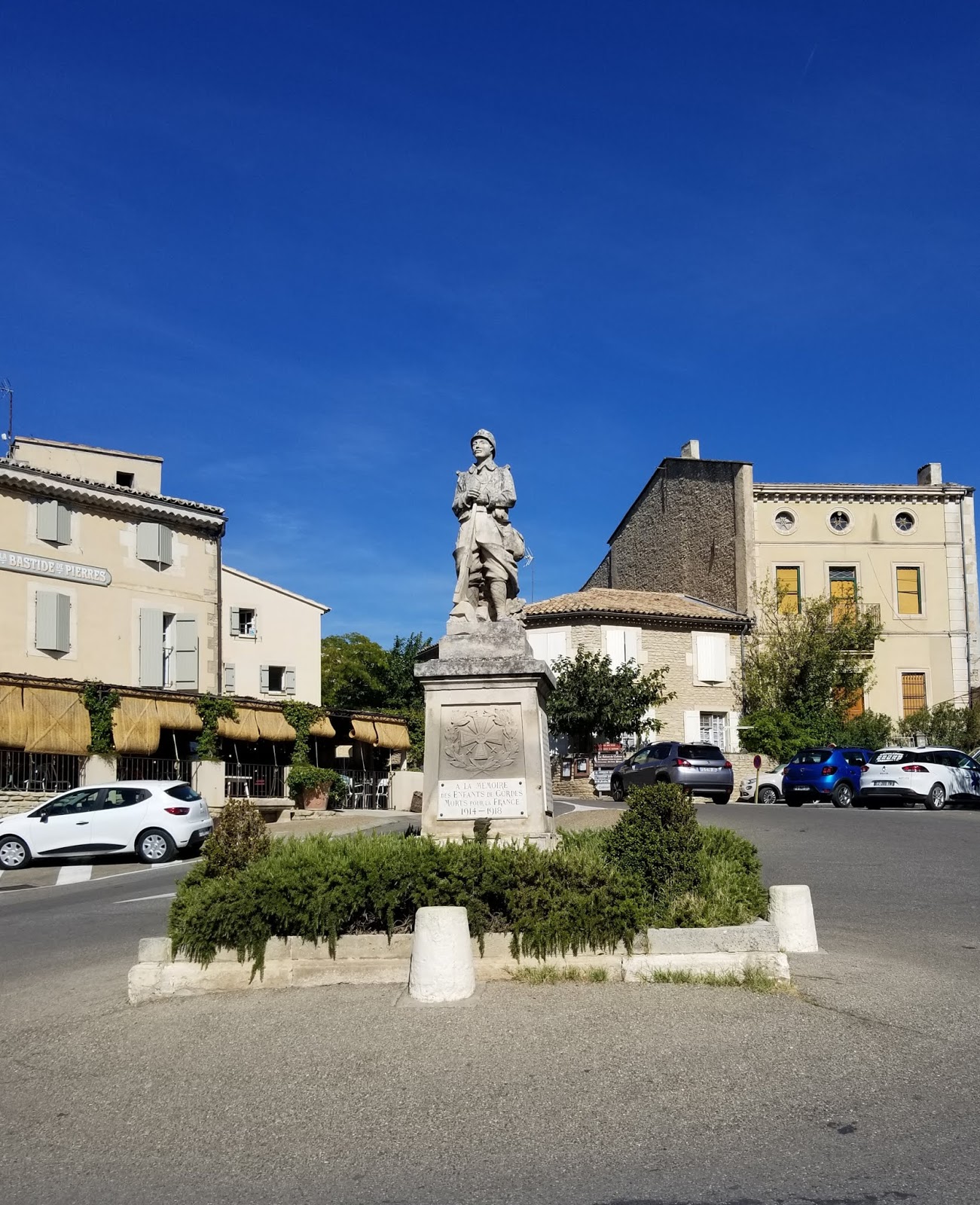
War Memorial in center of Gordes

The Chapelle des Pénitents Blancs, translated into English as the "white penitents chapel" is located near the castle. Dating from the 17th century, the chapel is an art gallery today.

White Penitents Chapel

At the top of Gordes and in the center of the village sits the castle which dominates the village. Built in 1031, reinforced in 1123, the castle was rebuilt in 1525. Today the castle is home to the Pol Mara museum, a contemporary Flemish painter who lived in Gordes, and the Gordes tourist information office. In summer there are concerts and plays in the castle's courtyard.

Gordes castle

Another view of Gordes from the Luberon Valley can be seen in the photograph below. The strategic defensive possibilities of Gordes' location are clearly evident. The village was never taken even during the brutal Wars of Religion.

During World War II, Gordes was an active resistance village and was later awarded a medal, the Croix de Guerre 1939 - 1945. On the 21st of August 1944, just 6 days after the start of Operation Dragoon, the Allied invasion of Southern France, a German patrol was attacked by members of the Gordes resistance and the day after, the village was subjected to violent reprisals and much of Gordes was destroyed.

Gordes

It is definitely worthwhile to visit Gordes. If you are lucky enough to be in Provence between late June through the middle of July, make sure you take time to visit nearby Sénanque Abbey.

It is a beautiful Cistercian abbey located in a deep valley a short distance north of Gordes and well worth a visit anytime you are in the area.

You can drive to the Abbey from Gordes on the narrow D177 road or if you are in the mood for a hike, you can walk there on the GR6 hiking trail. Don't forget, you will have a hike back up.

Along the way, you will come upon an "aerial" view of the Abbey down in the deep Senancole valley where Sénanque Abbey is located.

"Aerial" view of Sénanque Abbey

The Sénanque Abbey is an active community with a handful of elderly monks that I told you about here. The monks grow the lavender and tend to honey bees to earn income for living and upkeep of the Abbey. The Sénanque Abbey along with two other early Cistercian abbeys in Provence, Silvacane Abbey and Le Thoronet Abbey, are sometimes referred to as the "Three Sisters of Provence"

Sénanque Abbey

If you have comments or questions about Gordes, Sénanque Abbey, or elsewhere in Provence, please leave your comments below or send me an email at my address below.

If you are thinking about a trip to the South of France including spending time in Provence, we invite you to visit our website. Our house is available for rent by the week or more. You can reach us for further information by sending an email to chcmichel@aol.com.

Sunday, July 22, 2018

Return to the film locations for "A Good Year" movie starring Rusell Crowe and Marion Cotillard

I told you in a previous post that "A Good Year" starring Russell Crowe and Marion Cotillard is my favorite American/British-made movie set in the South of France. The movie is directed by Ridley Scott who himself lives in the Luberon and is based on a Peter Mayle novel.

The movie tells the story of Max (Russell Crowe) who inherits a rundown house and vineyard in Provence from his Uncle Henry played by Albert Finney who Max visited during summers as a boy. Rather than being excited about his good fortune, Max wants to quickly sell the property and return to his life in London where he is a ruthless securities trader and loner.

Instead, things get a little complicated and he stays around and soon falls head-over-heels for a beautiful café owner named Fanny Chenal played by the very pretty, perfectly French, Marion Cotillard. I know it didn't win any Oscar awards but I love romantic stories and the movie is set in one of our favorite parts of Provence.

A few months back, our Windsor neighbors Fred and Linda paid us a visit in Sablet. Like us, they are fans of the movie, so one of our day trips was a tour of the locations where "A Good Year" was filmed during 9 weeks in the fall of 2005 in the Luberon region of Provence. In this post, I will share some of the sights we saw that day.

The first scene in Provence after Max learns Uncle Max passed away is a plane flying over Gordes on its way to the Marseille Provence airport. Gordes is a beautiful hilltop village, one of the Plus Beaux Villages de France...which means "Most beautiful villages of France", seen below.

Early scene in movie shows this view of Gordes as Max's plane passes overhead on the way to Marseille Airport

Château la Canorgue, the location used for the house and vineyard that Max inherits is really a working winery owned by Jean-Pierre Margan. The Chateau is about 1 mile outside of Bonnieux on the road to the Pont Julien. Château la Canorgue is a family-owned wine estate that thanks to the hard work and dedication of successive generations has remained in the family for more than 200 years.

In the 1970s, Jean-Pierre Margan, a pioneer in organic farming started tending the vineyard and producing wines. He passed on his passion and experience to his daughter, Nathalie, who is the 5th generation of winegrowers. If you visit the winery, you can taste their wine, including a bottle of "Le Coin Perdu" which has a very significant part in the movie.

Entrance to Château la Canorgue

The movie was filmed inside the house, and outside in the garden and vineyards. As you stand by the vineyards and look up at the house, it looks just like it did in the film warm, inviting, and "aged to a soft patina".

The house at Château la Canorgue

For the movie, Château la Canorgue's name was changed to Château la Siroque. Several scenes in the movie were filmed in front of the house, including a final scene with Max and Fanny on the terrace.

Pool at Château la Canorgue and view toward current tasting room

Back in Gordes for his appointment with the Notaire, Max circles this roundabout several times with a war memorial in the center as he tries to figure out which direction to take. The best thing about roundabouts in Provence is that many are beautifully designed or some type of art form and reflect something important about the town or village where they are located.

Roundabout in center of Gordes which Max circles several times in his little yellow car before meeting the Notaire

La Renaissance Restaurant in the heart of Gordes is the place where scenes of Fanny's bistro were filmed in the 'A Good Year' movie.

Fanny's bistro was filmed at Hotel le Renaissance in Gordes

It is hard to pass the restaurant and fountain on Place du Château in Gordes without thinking about Max and Fanny and the movie scenes shot in this location.

Fountain in front of Fanny's café where Max waited for Fanny to ask her out on a date

Uncle Henry's longtime winemaker in the movie is Francis Duflot (Didier Bourbon)and his wife is Ludivine (Isabelle Candelier) who cared for the place when Max was a boy. One night Max is invited to dinner at their home.

Château Les Eydins which was the location for Francis Duflot's home

Cucuron is where Max and Fanny have their first date, watching a black and white movie in the square by the basin under the plane trees. Max brings a bottle of "Le Coin Perdu" wine.

Place de l'Étang in Cucuron

Bonnieux is the village seen in this panoramic shot from the Chateau. There is a very similar shot in the movie.

Bonnieux as seen from Chateau la Canorgue

Cafe de France in Lacoste is where Max finds Christie to return her book and give her a letter he forged from Uncle Henry acknowledging that Christie is his child and asked Max to please share La Siroque with her.

Café de France terrace

The bus stop where Max finds Christie was shot in front of Café de France in Lacoste.

Café de France in Lacoste

We were saddened by the passing of Peter Mayle a few months back. My love of Provence truly began with reading "A Year in Provence," a 1989 best-selling memoir by Peter Mayle about his first year in Provence, and the local events and customs.

Monday, March 3, 2014

Gordes, One of the Most Beautiful Villages of France

Every time we are in Provence, we head toward the Luberon mountains to visit one or more of the small hill top villages in the area. Many times, Gordes is one of the villages we visit, especially if we are touring first time visitors around Provence.

Gordes is a beautiful old village in the Luberon region about 1 hour southeast of our home in Sablet. The obviously strategic site where Gordes sits has been occupied since prehistoric times. The stone buildings were built against the base of the cliffs and spiral up around the rock to the top where the chateau was built with a panoramic view over fields and forests and small perched villages.

The village's setting is striking and lots of tourists come to visit in the summer. Gordes is classified as one of Les Plus Beaux Villages de France, literally translated, one of the most beautiful villages of France; Gordes is one of 156 French villages with that classification. It is said to be the #1 tourist attraction in the Luberon.

Cubist painter André Lhote discovered Gordes in 1938 followed by Marc Chagall, Victor Vasarely and other modern artist who visited and summered in Gordes. More recently the village gained exposure as one of the locations for a movie filmed in the Luberon, "A Good Year" based on a novel of the same name written by Peter Mayle starring Russell Crowe.

Gordes

At the top of Gordes and in the center sits the chateau which dominates the town. Built in 1031, reinforced in 1123, the castle was rebuilt in 1525. Today the castle is home to the Pol Mara museum, a contemporary Flemish painter who lived in Gordes, and the tourist information office. In summer there are concerts and plays in the castle's courtyard.

Chateau

Chapelle des Pénitents Blancs is located near the castle. Dating from the 17th century, the white chapel is an art gallery today.

Chapelle des Pénitents Blancs

The main square and memorial to the children of Gordes who died in wars for France which Russell Crowe's character, Max Skinner circles several times in his little yellow smart car looking for the notaire in "A Good Year".

War memorial in center of Gordes

Every Tuesday morning is market day. Merchants from around the area set up stalls on Place du Château and sell their wares: fresh fruits and vegetables, Provençale pottery and linens, art work and clothing.

Shops near chateau with St Firmin church bell tower in background

Gordes shops

The fountain in the square by Hôtel la Renaissance where Max waits for Fanny Chenal, the character played by Marion Cotillard to get off work. Hôtel la Renaissance is Fanny Chenal's bistro in the movie, and where Max famously tells an obnoxious American couple that "MacDonalds is in Avignon, fish and chips in Marseille. Allez".

Fountain in center of Gordes

Pigeon drinking from fountain

Around the center of the village near the castle, you will find various cafés, restaurants, art galleries and souvenir shops.

Shops and cafés near chateau

Typical Gordes street

The original Romanesque church in Gordes was dedicated to Notre Dame. Rebuilt in 1704, it was then dedicated to its patron, St Firmin, a former Bishop of Uzès.

Interior of St Firmin Church

The walls of Gordes were built later than the heart of the town – they were needed in the 16th century to protect the inhabitants from the bands of marauders roaming about Luberon during the Hundred-Years War.

Caves below Gordes

One of the many narrow stone streets called calades - small paved, sometimes stepped alleyways lined with gutters defined by two rows of stone.

Stone street

Stone steps

Gordes shops

Every town and village in Provence has a Fête Votive, which is a festival specific to that town, rather than a National holiday. In early October, Gordes holds its Fête Votive which includes a boules tournament seen below, concerts and meals.

Boules tournament

During World War II, Gordes was an active resistance village and was later awarded a medal, the Croix de Guerre 1939 - 1945. On the 21st of August 1944, just 6 days after the start of Operation Dragoon, the Allied invasion of Southern France, a German patrol was attacked by members of the Gordes resistance and the day after, the village was subjected to violent reprisals and much of Gordes was destroyed.

Gordes

It is definitely worthwhile to visit Gordes. If you have time, you should also visit the Bories village, a collection of 30 stone huts made of dry flat stones made without mortar and the nearby Sénanque Abbey, a 12th century Cistercian abbey, that is surrounded by lavender fields.