Monday, July 8, 2013

Venasque, a Most Beautiful Village in France

One of our favorite day trips from Sablet is exploring the hill-top villages of the Luberon, especially Gordes and Roussillon. To get there, we take the D4, a scenic route that traverses Carpentras and then becomes a narrow winding road flanked by cherry orchards until it passes below the village of Venasque.

A few weeks back, Greg, Jennifer and baby Julia came to visit from Lake Como and we departed for the Luberon but when we got to Venasque, we turned off the road and went up the hill since we had not been there for a long time. The temperature was cool but the sun was shining and sky blue, ideal for a walk around the village.

Venasque

It was the beginning of cherry season and the trees along the road were loaded with ripening fruit. The area is particularly beautiful when the cherry trees are covered with white and pink blossoms.

Cherry trees loaded with ripe fruit

Venasque is a small picturesque village that sits on top of a steep hill. It is classified as one of the Plus Beaux Villages de France (translated as most beautiful villages of France), one of seven villages with that designation in the Vaucluse region where we live.

The view to Venasque over the village cemetery

Venasque is one of the oldest villages of the Comtat Venaissin often referred to simply as the Comtat. Comtat means county in its original sense, or land belonging to a count and Venassin refers to Venasque, a former bishop seat which gave its name to the Comtat.

Arched doorway through the defensive walls

Venasque's location on top of the hill provided a natural defense against attacks from enemies. Nevertheless, in Roman times, a defensive wall with towers was built around the village. The arched doorways were restored at the beginning of the 20th century.

Tower and an arched doorway through the defensive walls

The thick walls of the ramparts which survive connect three Saracen towers and two arched doors "portes."

Close up view of the defensive Saracen towers

Supposedly the stones in the defensive wall that no longer exist were removed as if the wall was a sort of rock quarry and used to build the school and houses in the village.

Arched doorway through the defensive walls into the center of Venasque

Venasque is small and compact with a few shops, restaurants and hotels. It can be easily visited in a few hours.

Venasque street

There are lots of flowers and plants which decorate the stone houses and shops which line the streets of Venasque.

Venasque door

Venasque house

Water fountain

Venasque house;

As you wander the winding streets in Venasque you come upon the House with the Blue Shutters.

La Maison aux Volets Bleus

Flowers on a Venasque house

Venasque street

As you can see, Venasque is a small village, there are only 1,156 people who reside in the village. The people who live in Venasque are called Venasquais.

Venasque house

Venasque street

Arched passageway

Water was piped to houses throughout the village between 1959 and 1965. Prior to this time, villagers got their water from the various fountains throughout the village.

Venasque fountain at Place de la Poste

Venasque B and B

Venasque fountain at Place de la Planette

The Notre Dame church in Venasque dates from the end of the 12th century. The side chapels date from the 17th and 18th century, the bell tower from the 17th century.

Notre Dame Church in Venasque

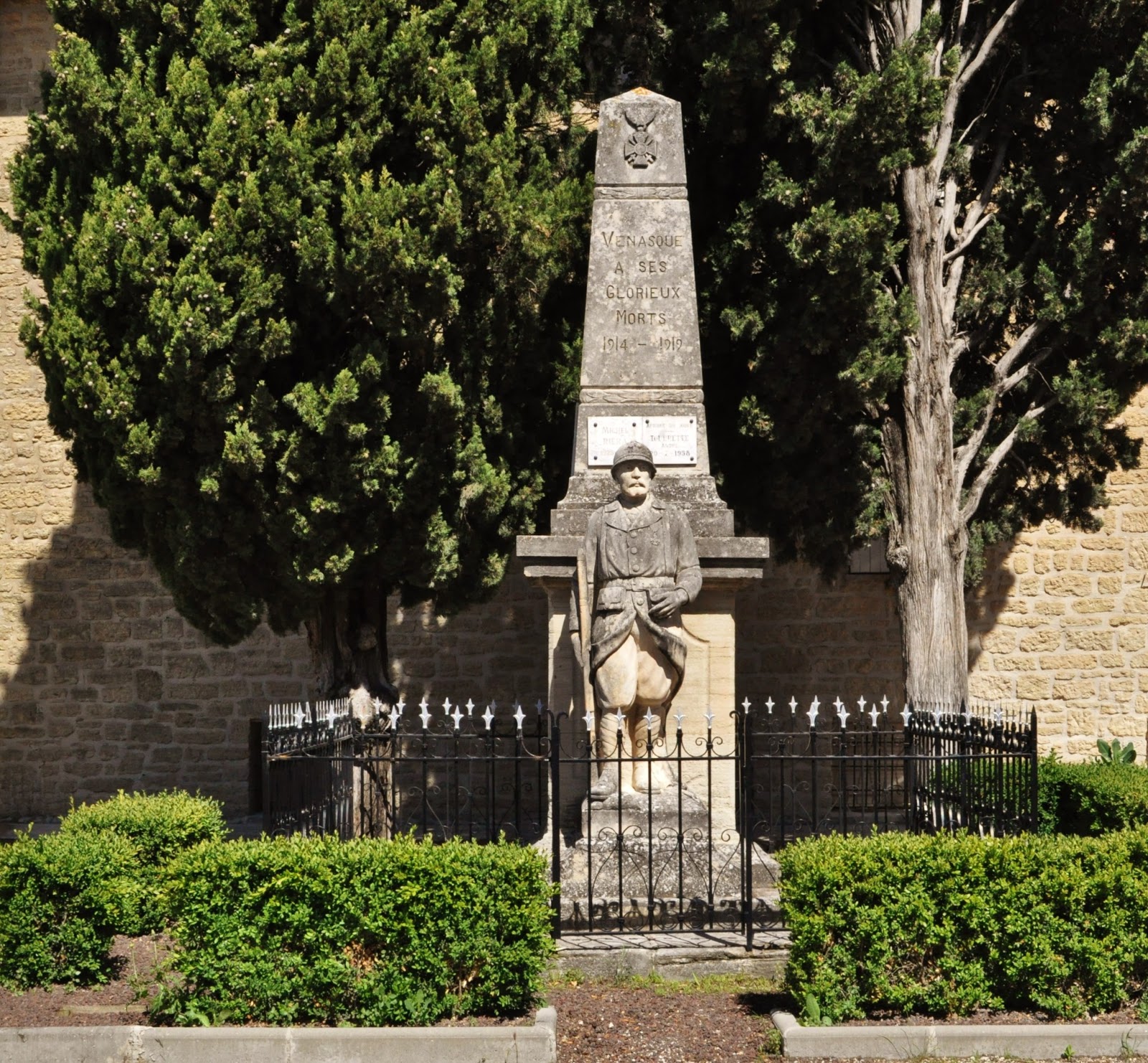
War Memorial near Notre Dame Church

Side door entrance to Notre Dame Church

Pretty house near Notre Dame Church

The fountain in the center of Venasque at Place de la Fontaine

The Venasquais are known for the cherries and table grapes (Muscat de Venasque) they grow.

View from Venasque

If you find yourself in Venasque and looking for a place to eat, you might try Les Remparts which I told you about here.

Bonne journée mes amis et à bientôt.

Monday, July 1, 2013

Oh, I Meet the Nicest People Through Blogging and a Wonderful Provencal Style Lunch in the Backyard!

It has been 3 1/2 years since I started telling you about the places we discover during our sojourns in Provence. During that time, I've had the chance to meet some of you who read this blog as well as some of the bloggers I follow. I think the first person I met through this blog was Kathy from Camano Island, Washington who came to dine at our Bistro des Copains in Occidental, CA and then later rented our Sablet house.

Since then, we have met more of you at the Bistro, several of you at the Tuesday morning market and at Le Festival Café in Vaison-la-Romaine, a couple who were riding bikes through Sablet and a group shopping at a brocante market there, and at a lunch near Saint-Rémy-de-Provence. This blogging has resulted in friendships with some amazing people including Barbara who teaches aspiring cooks at Cuisine de Provence.

This past week, I met Liza from Provence in Ann Arbor and her mother who were on their way to visit family in Northern California but detoured to dine at our Bistro Des Copains. Liza somehow finds time to write about food and Provence between her day job teaching Spanish and French to high school students. I'm sure kids like language classes at Liza's high school more than we liked them at mine; sorry Mrs. Butler.

Recently we met Aidan from Conjugating Irregular Verbs near the cousin's house in Clapiers France. The lead up to meeting our new friend began when I stumbled upon her charming blog a few years ago. Much more recently Aidan was interviewed on Blog Expat about living in the South of France where she said among other things that she wished there was more peanut butter in France.

Having just been to Costco and seen big jars of Skippy peanut butter, I sent an email to Aidan to tell her we would be happy to bring her peanut butter if she would meet us when we came to visit the cousins. So on a Sunday morning a few weeks ago, we met Aidan with two big jars of creamy (her preference) peanut butter in hand.

I develop an impression of blog authors based upon their writing styles and stories they tell. So I wondered if we would recognize Aidan and if she would be like the person I imagined from her blog. I can answer yes to both; I recognized her at quite a distance and she is just like I thought; someone we really like.

Aidan and her husband P-Daddy came to the South of France from Texas by way of Ireland. Unfortunately, Aidan doesn't write as frequently as she used to but give her a break, she is a busy mom with three kids and a dog. Besides running kids around, she was on House Hunters International, the HGTV reality show and she is finishing up a novel set in the South of France.

Aidan came bearing a gift. We didn't expect anything but I shouldn't have been surprised based upon the type of person she is. I commented on a post about how I like the wines of Domaine L'Hortus and she arrived with a bottle of 2012 Domaine de l'Hortus Bergerie de l'Hortus Rosé. We decided to carry the bottle back to California and drink it at a Provencal style lunch in honor of our new friend.

Saturday, we invited the kids to come over for lunch. I cooked inside but we dined outside in true Provencal fashion despite it being one of the hottest days of the year; 103 degrees Fahrenheit (39 Celsius for my European friends). The four grand kids splashed in the big wading pool while we ate and drank Aidan's rosé.

2012 Domaine de l'Hortus Bergerie de l'Hortus Rosé

Because of the heat, I kept the menu simple:

Heirloom Tomato Salad with Cucumbers and Fresh Basil from Shirley's Garden

Vegetarian Stuffed Mushrooms

Vegetarian Stuffed Zucchini with Farro

Oven-Roasted Wild King Salmon Over a Fresh Sweet Corn and Cherry Tomato Salsa

Sliced Organic White and Yellow Nectarines Over Vanilla Ice Cream

Heirloom Tomato Salad with Cucumbers and Fresh Basil from Shirley's Garden

Vegetarian Stuffed Mushrooms

Vegetarian Stuffed Zucchini with Farro

Oven-Roasted Wild King Salmon Over a Fresh Sweet Corn and Cherry Tomato Salsa

No pictures of dessert. Lunch was delicious if I say so myself. A la vôtre Aidan. Thanks for the wine! It was delicious on a very hot day.

Shirley and I say "A la vôtre"

We look forward to meeting more of you in the coming months and years. I hope to meet some of you who regularly comment about posts including Sara and her band of characters over at Sara in Le Petit Village, Tuula at Belle Provence Travels, Camille who writes from Paris over at Croque-Camille, Diane who writes from the Charente at My Life in the Charente, Heather who has a magical way with words and pictures at Lost in Arles, Meredith who lives near cousin Annick at Talking Story in Provence, and last but not least Veronique who writes from Seattle at French Girl in Seattle.

Bonne journée mes amis et à bientôt.

Thursday, June 27, 2013

Sainte-Cécile-les-Vignes, home to vignerons and a wonderful Saturday morning market

One of the best things about Provence is shopping at weekly outdoor "marchés" in towns and villages throughout the region...or at least it is for a "foodie" like me. Why would you buy fruits, vegetables, cheese, meats or fish at one of those super markets on the outskirt of town when you can leisurely stroll through a market and pick up what you need for the next couple of days?

I say don't go to the "marché" with a list of things to buy like you are going to a super market. No, do like I do and walk through the market and buy what is fresh, in season and local, but don't buy anything the first time through. After you have surveyed what's for sale, take a second walk through the market and buy what you liked during your first walk-through.

Invariably, whenever I buy produce on my first walk through a market, I wish I had waited to buy those tomatoes, eggplants or zucchini a little ways further up the street. The only exception to buying at the "marchés" is if there is a fantastic boucherie, poissonnier or fromager in the area whose products are better than what you can find at the "marchés" or for staples like flour, sugar, and milk.

Make up your menus as you walk through the market. Don't worry if you don't have a recipe. If you are staying at our house, there are quite a few cookbooks to browse through and you can Google the fruit or vegetable and you will get lots of links to recipes. Just choose one that sounds tasty to you. That way you are trying new dishes which is part of the fun of visiting Provence.

We generally arrive and leave Sablet on Saturday. So we pick up staples from Alain and Mimi in Sablet and wait for the Tuesday market in Vaison-la-Romaine to buy fresh, perishable foods. Several guests have told us they like the Saturday morning market in nearby Sainte-Cécile-les-Vignes. Since we got to Sablet on Friday on our last sojourn, we decided to go check out this market.

Sainte-Cécile-les-Vignes is a small village located 15 kms northwest of Sablet on the border of the Vaucluse and the Department of the Drôme. As the name suggests (les "vignes" means the vines), Sainte-Cécile-les-Vignes is an agricultural village devoted to making wine. So you will not be surprised to see vineyards all around the village.

The only door through the ramparts that remains in tact, just happens to lead to the center of the village where the market takes place. As you can see below, the Clock Tower door is topped by a wrought iron campanile with bell.

Clock Tower into the center of Sainte-Cécile-les-Vignes

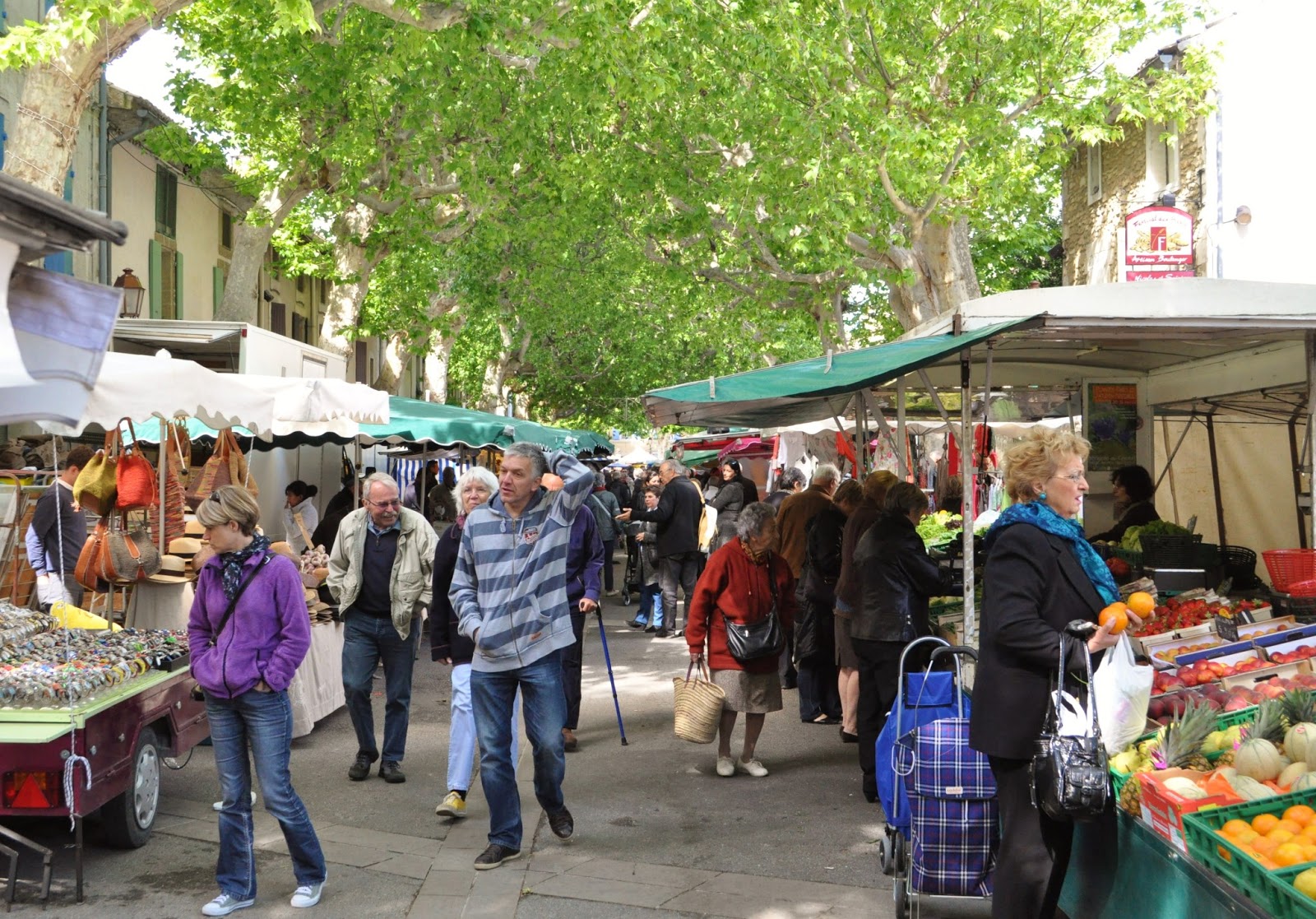
The market in Sainte-Cécile-les-Vignes takes place every Saturday morning between 8:00 AM and 1:00 PM at Le Cours du Portalet, La Place de la Mairie and La Place de la Fontaine.

The main market street in Sainte-Cécile-les-Vignes

As you can see below, you can choose from a wide variety of fresh fruit. But as I said above, it's best to choose what's locally grown in Provence if you can. Here, strawberries and cherries were locally grown but the melon and cantaloupe came from Spain. But in a few weeks, there will be loads of sweet Cavaillon melons at every market. These are locally grown. You must try one.

A wide variety of fresh fruit is available

Locally grown green and white asparagus. Did you know there is really no difference between green and white asparagus? White asparagus comes from depriving the asparagus of light. Dirt is kept mounded around the emerging stalk, depriving it of light. The plant cannot produce chlorophyll without light, thus there is no green color to the stalks.

Green and white asparagus

Lots of cut flowers. We take several bunches home to put on the table.

Cut flowers

More cut flowers

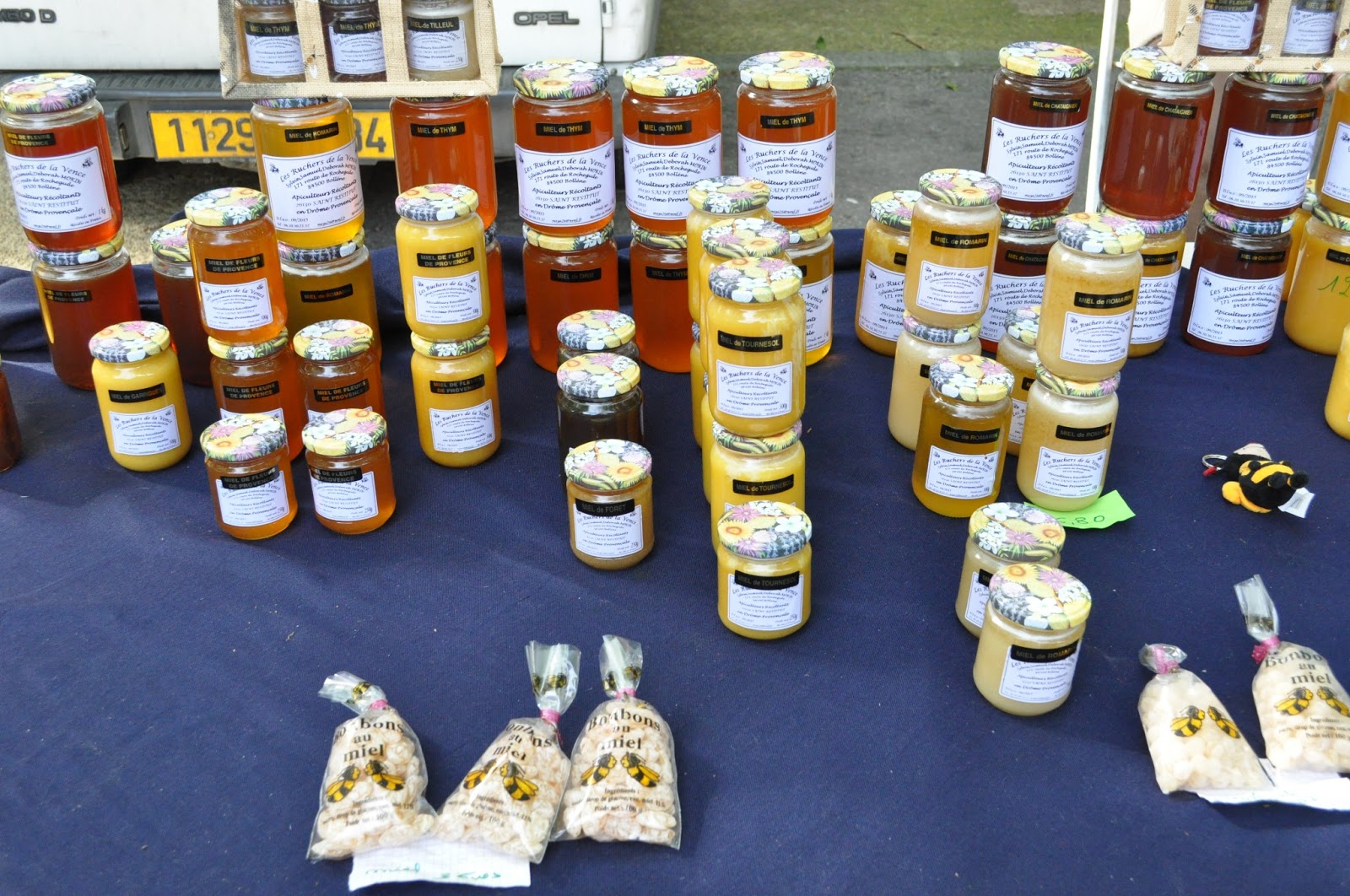
Infused with the flavors of the surrounding landscape, Provence honey is sweet and delicious. Bees generally have a range of no more than about a mile-and-a-half, so if the beekeeper places his hives near an abundant field of one plant—say lavender, rosemary, or chestnut trees—the honey will retain the distinctive flavor of its source material.

Honey

The weather was nice so the market was full of shoppers.

Another view of the main market street

An amazing variety of seafood and whole and filleted fish from the Mediterranean Sea and Atlantic Ocean.

Seafood

Whole fish

Whole fish

The parish church of Sainte-Cécile-les-Vignes seen below replaced a church that the villagers had decided was obsolete. Built between 1854 and 1860, the new church was consecrated in 1860 by the archbishop of Avignon.

The market spreads out on the square in front of the church of Sainte-Cécile-les-Vignes

In front of the Sainte Cécile Church is a statue that honors the men who died for France in WWI. This stone statue by sculptor Félix Charpentier depicts a "poilu", an informal term for French World War I infantrymen, meaning, literally, hairy one. The word carries the sense of the infantryman's typically rustic, agricultural background. Beards and bushy moustaches were often worn.

The sculpted figure below the statue represents a mother crying for her son under a willow tree.

Memorial to men who died during WWI

The Sainte Cécile parish church was built from stones brought from Saint-Restitut, a village in the Department of Drôme known for its old stones. Inside the church, you can see alters, pictures and statues saved from the old church.

The interior of the church of Sainte-Cécile-les-Vignes

The fountain below was inaugurated by Mayor Goudareau in 1881. Market vendors set up their stalls all around the fountain.

Fountain near the Town Hall

Mayor Goudareau was a busy man. He also inaugurated the Town Hall seen below in 1886.

Sainte-Cécile-les-Vignes Town Hall

There is an old winery (dates from the 18th century) in Châteauneuf-du-Pape called Château Fortia. In the early 20th century, management of the winery was taken over by Pierre Le Roy de Boiseaumarie, a decorated WWI pilot.

Baron Le Roy later co-founded the Institut National des Appellations d'Origine (INAO) and helped create the AOC system which is the basis for French wine laws. To show their appreciation, the local vignerons commissioned the bronze bust by sculptor Marcel Courbier seen below near the church.

Bronze bust dedicated to Baron Le Roy

We came across a few nice old fountains as we walked around the town.

Fountain

The streets are lined with houses, most of them picturesque, with their Provencal colors and contrasting shutters.

House with bright shutters and flowers

Unusual stone fountain

The Sainte Cécile Sainte Croix Chapel seen below sits in the heart of the village. It is the oldest religious building in Sainte-Cécile-les-Vignes with the first mention found in 1177. It is thought to be located on the site of a Roman temple. The chapel was reconstructed in 1624 and again in 1843.

Sainte Cécile Sainte Croix Chapel

The village cemetery was located next to the Sainte Cécile Sainte Croix Chapel until 1870 when it was relocated to its present location.

Sainte Cécile Sainte Croix Chapel

Notre Dame de Consolation Chapel is at the entrance to the village on the road to Cairanne. This Chapel was built on the site of an ancient chapel built in 1507. Unfortunately, that chapel was destroyed between 1560-1562 during the Wars of Religion.

The Romanesque Notre Dame de Consolation Chapel seen below was built in 1858 to replace the destroyed chapel.

Notre Dame de Consolation Chapel

If you are hungry after wandering around the market and through the village, we can recommend Campagne Vignes et Gourmandises Restaurant which we told you about here. It has been designated as a Bib Gourmand restaurant in the 2013 edition of the Michelin Guide.

Have fun at the market. Bonne journée mes amis et à bientôt.

Monday, June 17, 2013

Beaumes-de-Venise, a bustling village and producer of excellent sweet wines

We don't spend a lot of time hanging around Sablet. It's not that we don't like our village, but we are usually at one of the weekly marchés, exploring new villages, visiting family or friends, looking for fields of coquelicots, lavender and sunflowers, or doing "dégustation de vins" (wine tasting). Hey, we have only tasted at a handful of the 1,837 private wineries and 103 cooperatives in the Rhône Valley.

As we are out and about, we repeatedly traverse the villages of Violès, Vacqueyras, and Aubignan on our way to and from Sablet, but never stop to visit. Another village we drive through but have never stopped to visit is Beaumes-de-Venise. So a few weeks ago, with friends Scott and Jean-Pierre in tow, we decided to pay a visit to Beaumes-de-Venise.

Beaumes-de-Venise is a small village (2,305 inhabitants) about 12 km south of Sablet that climbs up the foot of the southern slope of the Dentelles de Montmirail. Beaumes-de-Venise is one of several wine-making villages along the 78 km "Route des Vin" that circles the Dentelles de Montmirail (a small chain of mountains I told you about here).

Beaumes-de-Venise

The word "beaumes" comes from the Provençal word bauma meaning "cave" or "grotto". There are many caves carved into the surrounding hillside which were shelter for the regions first inhabitants during the Iron Age.

Arched doorway from Raspail Avenue to Place du Marché

The Saint Nazaire Church seen below was built in 1849. There is also a Saint Nazaire Chapel, but all that remains of the latter are ruins which date from the 8th century.

Saint Nazaire Church

Close to Saint Nazaire Church, is the arched doorway seen below which leads through the ramparts into the center of the village.

Arched doorway into the center of the village

Vestiges of the 12th century feudal castle with its ramparts nicknamed “Des Barons” stand above the village in the picture seen below. This castle made Beaumes-de-Venise one of the most powerful villages in the Comtat Venaissin, in the Middle Ages.

View toward Place de la Liberté with castle ruins at top of village

A brightly colored house near the fountain at Place de la Liberté.

Fountain at Place de la Liberté

Come along with us as we walk around Beaumes-de-Venise.

The wrought-iron campanile and bell tower of Saint Nazaire Church

A pretty village house

The ramparts were probably erected in the 12th century. There are two doorways which remain; one as I said before is near Saint Nazaire Church and the second seen below is at Place du Portail Neuf.

The arched doorway and fountain at Place du Portail Neuf

We decided to follow the path up to the castle ruins at the top of the village. I would not recommend the way we went since it was not much more than a narrow footpath that wound its way through brush. When we got as high as we could go, we could see the ruins just above us but we could not get up to them. There may be a way to get there but we did not find it.

One of the views over Beaumes-de-Venise we saw as we hiked to the castle ruins

Another view over Beaumes-de-Venise with Saint Nazaire Church in the middle of the picture.

Another view over Beaumes-de-Venise

Beaumes-de-Venise is probably best known for Muscat de Beaumes de Venise, a sweet fortified wine produced by village winemakers from the small berried Muscat à Petits Grains grapes grown in vineyards surrounding the village. The color of the wine can vary from amber to rosé, and even purple.

The grapes ripen from the warmth of the sun as it reflects and radiates over the vines from the huge vertical limestone slabs of the Dentelles de Montmirail. There are just over 1200 acres currently under cultivation.

Beaumes-de-Venise is also home to two other appellations: red wines were classified in 2005 as AOC Beaumes-de-Venise and whites and rosé wines were classified in 1978 as AOC Côtes-du-Rhône-Villages Beaumes-de-Venise.

A Beaumes-de-Venise vineyard

A house built right up against the rocks

17th Century Fountain at Place du 8 Mai

Saint Nazaire Church

The Saint Roch Chapel seen below was built during the midst of the plague in 1586. Beaumes-de-Venise was spared.

Saint Roch Chapel

In addition to wine, olive oil has been produced in Beaumes-de-Venise since 1789. At the entrance to the village is La Balméenne olive oil mill which is open to the public. All of the olive oil is pressed from "Verdale de Carpentras" (or Aglandau) olives from the Vaucluse harvested by hand between the middle of November and beginning of January.

There is a cute shop on site which sells olive oil and a variety of products produced in the region including soap, honey, tapenades, jams, olives and souvenirs.

La Balméenne Olive Oil Mill

A house with pretty flowers near La Balméenne Olive Oil Mill

An olive tree near La Balméenne Olive Oil Mill

As we enter and exit Beaumes-de-Venise, we go around this striking roundabout near the Vignerons de Beaumes-de-Venise wine cooperative.

Roundabout at the entrance to Beaumes-de-Venise

So that's it! Thanks for joining us on our walk around Beaumes-de-Venise. Bonne journée mes amis et à bientôt.